




The reproduction in organisms chapter is an important topic for the NEET Exam. It includes various strategies for both asexual and sexual reproduction. The major procedures of reproduction like sexual reproduction, asexual reproduction, gamete formation, fertilization and the development of a new organism from a fertilized egg takes place in this chapter. Also, you will see how different species, ranging from simple organisms to complex organisms have a reproductive strategy and how these strategies aid in the organism's survival.
This topic has approximately 5–7% of total NEET weightage, so expect two to three questions in this section, and having answered these questions, you can predict to get a good score in relation to previous years. These questions generally test your understanding of the reproductive systems of plants and animals, as well as the phases of reproduction, including fertilization and progeny growth.Important topics tested routinely include sexual reproduction, asexual reproduction (binary fission, budding), and the life cycles of organisms (generational alternation). You need to practice NEET previous year questions and understand the concepts in order to perform well on this topic. Doing this will help you put into practice what you have learned while solidifying your understanding of how they might be tested on the exam.
Related Articles:
- Download NEET UG LAST 10 YEARS Question Paper
- Download NEET UG 2024 Question Paper PDF with solutions and answer key for code- Q, R, S and T
Here are some most important NEET Previous Year Questions of Reproduction in Organisms.
Question 1:
Given below are two statements: one is labelled as Assertion A and the other is labelled as Reason R:
Assertion A: FSH acts upon ovarian follicles in female and Leydig cells in male.
Reason R: Growing ovarian follicles secrete estrogen in female while interstitial cells secrete androgen in male human being.
In the light of the above statements, choose the correct answer from the options given below:
[NEET (UG) - 2024]
A. Both A and R are true and R is the correct explanation of A.
B. Both A and R are true but R is NOT the correct explanation of A.
C. A is true but R is false.
D. A is false but R is true.
Question 2:
Given below are two statements:
Statement I: The presence or absence of hymen is not a reliable indicator of virginity.
Statement II: The hymen is torn during the first coitus only.
In the light of the above statements, choose the correct answer from the options given below:
[NEET (UG) - 2024]
A. Both Statement I and Statement II are true.
B. Both Statement I and Statement II are false.
C. Statement I is true but Statement II is false.
D. Statement I is false but Statement II is true.
Question 3:
Which of the following is not a component of Fallopian tube?
[NEET (UG) - 2024]
A. Uterine fundus
B. Isthmus
C. Infundibulum
D. Ampulla
Question 4:
Match List I with List II:
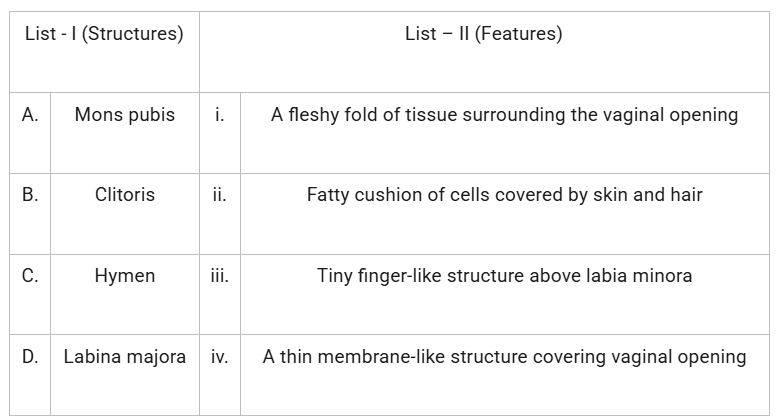
Choose the correct answer from the options given below:
[NEET (UG) - 2024]
A. (a)-(ii), (b)-(iii), (c)-(iv), (d)-(i)
B. (a)-(iv), (b)-(iii), (c)-(ii), (d)-(i)
C. (a)-(i), (b)-(iv), (c)-(iii), (d)-(ii)
D. (a)-(ii), (b)-(iii), (c)-(i), (d)-(iv)
View Solution
Question 5:
Given below are two statements: one is labelled as Assertion A and the other is labelled as Reason R:
Assertion A: Endometrium is necessary for implantation of blastocyst.
Reason R: In the absence of fertilization, the corpus luteum degenerates that causes disintegration of endometrium.
In the light of the above statements, choose the correct answer from the options given below:
[NEET (UG) - 2023]
A. Both A and R are true but R is NOT the correct explanation of A.
B. A is true but R is false.
C. A is false but R is true.
D. Both A and R are true and R is the correct explanation of A.
Question 6:
Identify the asexual reproductive structure associated with Penicillium:
[NEET (UG) - 2023]
A. Zoospores
B. Conidia
C. Gemmules
D. Buds
Question 7:
Which of the following statements are correct regarding female reproductive cycle?
A. In non-primate mammals cyclical changes during reproduction are called oestrus cycle.
B. First menstrual cycle begins at puberty and is called menopause.
C. Lack of menstruation may be indicative of pregnancy.
D. Cyclic menstruation extends between menarche and menopause.
Choose the most appropriate answer from the options given below:
[NEET (UG) - 2023]
A. A and B only
B. A, B and C only
C. A, C and D only
D. A and D only
Question 8:
Match list I with list II with respect to methods of contraception and their respective actions.
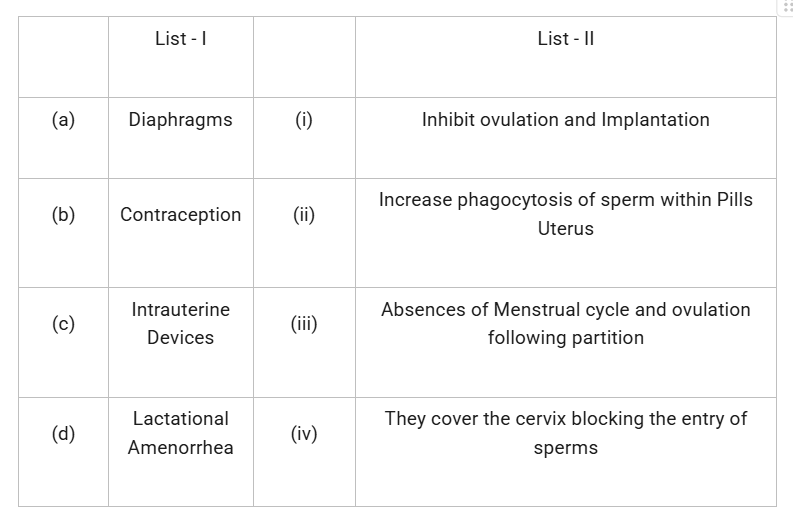
Choose the correct answer from the options given below:
NEET (UG) - 2022
A. (a) - (iv); (b) - (i); (c) - (iii); (d) - (ii)
B. (a) - (iv); (b) - (i); (c) - (ii); (d) - (iii)
C. (a) - (ii); (b) - (iv); (c) - (i); (d) - (iii)
D. (a) - (iii); (b) - (ii); (c) - (i); (d) - (iv)
Question 9:
Which of the following statements are true for spermatogenesis but do not hold true for Oogenesis?
a. It results in the formation of haploid gametes
b. Differentiation of gamete occurs after the completion of meiosis
c. Meiosis occurs continuously in a mitotically dividing stem cell population
d. It is controlled by the Luteinizing hormone (LH) and Follicle Stimulating Hormone (FSH) secreted by the anterior pituitary
e. It is initiated at puberty
Choose the most appropriate answer from the options given below:
[NEET (UG) - 2022]
A. (c) and (e) only
B. (b) and (c) only
C. (b), (d) and (e) only
D. (b), (c) and (e) only
Question 10:
Which of the following flower only once in its life-time?
[NEET (UG) - 2018]
A. Papaya
B. Bamboo species
C. Mango
D. Jackfruit
Question 11:
At which stage of life the oogenesis process is initiated?
[NEET (UG) - 2022]
A. Puberty
B. Embryonic development stage
C. Birth
D. Adult
Question 12:
Given below are two statements:
Statement I: The release of sperms into the seminiferous tubules is called spermiation.
Statement II: Spermiogenesis is the process of formation of sperms from spermatogonia.
In the light of the above statements, choose the most appropriate answer from the options given below:
[NEET (UG) - 2022]
A. Both statement I and Statement II are correct
B. Both statement I and Statement II are incorrect
C. Statement I is correct but statement II is incorrect
D. Statement I is incorrect but statement II is correct
Question 13:
Lippes loop is a type of contraceptive used as:
[NEET (UG) - 2022]
A. Cervical barrier
B. Vault Barrier
C. Non-Medicated IUD
D. Copper releasing IUD
Question 14:
Which of these is not an important component of initiation of parturition in humans?
[NEET (UG) - 2021]
A. Release of Prolactin
B. Increase in estrogen and progesterone ratio
C. Synthesis of prostaglandins
D. Release of Oxytocin
Question 15:
Which of the following secretes the hormone, relaxin, during the later phase of pregnancy?
[NEET (UG) - 2021]
A. Uterus
B. Graafian follicle
C. Corpus luteum
D. Foetus
NEET Exam Pattern
According to NTA guidelines, the NEET 2025 exam pattern has been changed. The pattern is now reverted to pre-COVID format in which there will be no choices in the questions.
There will be 180 questions in the NEET exam 2025, instead of 200. The sections are divided into equal questions, 45 questions each in Physics, Chemistry and 90 questions in Biology (45 questions each in Zoology and Botany). The time duration will be 3 hours. There are slight changes in syllabus also. You can check the latest NEET syllabus.
Subject Wise Analysis of NEET Exam
The NEET exam challenges students’ knowledge in three major subjects: Physics, Chemistry, and Biology. Here is a detailed subject-wise analysis of the NEET exam, showing the weightage of each subject.
| Subject | No. of Questions | Marks | Difficulty Level |
|---|---|---|---|
| Physics | 45 | 180 | Moderate to Difficult |
| Chemistry | 45 | 180 | Moderate |
| Biology (Botany + Zoology) | 90 (45 + 45) | 360 | Easy to Moderate |
Check: NEET Exam Analysis
This analysis is on the basis of the NEET Previous Year Questions Pattern and their level of difficulty. It can be different as per the exam every year. The NEET exam pattern is based on the latest 2025 pattern as per the NTA guidelines.
NEET Biology Paper Pattern
The NEET Biology paper is designed to test a student's knowledge of Botany and Zoology at the senior secondary level. It consists of 90 questions, equally distributed between Botany and Zoology, carrying a huge weightage in the total score.
- Total Questions: 90
- Botany: 45
- Zoology: 45
- Total Marks: 360
- Question Type: Multiple Choice Questions (MCQs)
- Marking Scheme:
- +4 marks for each correct answer
- -1 mark for each incorrect answer
- 0 marks for unanswered questions
Chapter-Wise Distribution and Weightage Analysis
There are 90 questions in the Biology section of the NEET UG 2025 exam, which are split equally between the Botany and Zoology sections. Each section comprises 45 questions which makes the Biology section a very scoring part of the NEET exam/
Botany (45 Questions):
This section covers the plant kingdom as well as the study of plants and different physiological processes. Questions from the following subjects are commonly found in this section:
- Living Organism Diversity (14%):
The classification of living organisms, specifically the kingdom of plants, and its major groups—algae, fungi, bryophytes, pteridophytes, gymnosperms, and angiosperms—as well as the traits of these groups are the primary focus of this chapter. Knowledge of plant diversity and biological classification is helpful in this section.
- Plant Structural Organization (9%):
The meristematic or permanent plant tissues, the organs' functions, the anatomy (the arrangement of stems, roots, and leaves), and a thorough analysis of plant morphology are all covered.
- Cell: The Unit of Life (9%):
Cell structure, organelle types, biomolecules, and the processes of cell division (mitosis and meiosis) are the main topics of this chapter. As we proceed through this section, it is critical to comprehend cell activity, including the production of proteins (ribosomes) and energy in cells (mitochondria).
- Plant Physiology (6%):
This chapter focuses on the physiological responses of plants, including photosynthesis, respiration, growth, and development. Understanding the mechanisms underlying plant functions, such as gas exchange and water and nutrient uptake, is essential for this section.
- Human Physiology (20%):
Even though they might seem more relevant to zoology, some aspects of human physiology, such as comparative physiology and plant-animal interactions, are found in the botany sections. There is discussion of issues related to digestion, excretion, respiration, and coordination.
Zoology Section (45 Questions):
The anatomy, physiology, behavior, and interactions between animals and their surroundings are covered in the zoology section. The chapter's main subjects are:
- Reproduction: 9%
The development of new organisms, human reproduction, asexual and sexual reproduction, and reproductive health are all covered in this chapter. Human reproductive organs, gametogenesis, and fertilization are key ideas.
- Evolution and Genetics (18%):
This chapter, which covers inheritance principles, Mendelian genetics, molecular genetics, and the evolution process, is arguably one of the most significant in all of Zoology. It calls for knowledge of genetic diversity, inheritance patterns, and natural selection.
- Biology and Human Welfare (9%):
Concerns issues related to human disease and illness, such as major diseases like malaria, tuberculosis, and AIDS. It also deals with the influence of microorganisms on human well-being, and methods of improving food production and food security.
- Biotechnology and Its Applications (4%):
This chapter gives an introduction to biotechnology principles and applications such as recombinant DNA technology, genetic engineering, and application in medicine and agriculture.
- Ecology and Environment (10%):
This discusses biodiversity, population dynamics, ecosystem principles, and environmental issues. Food chains, biogeochemical cycles, conservation strategies, and the impacts of human activity on the environment are among the subjects that will be discussed.
- Kingdom of Animals (13%).
It addresses the classification of animals into broad phyla, including chordates, mollusks, and arthropods. It also covers the diversity of the animal kingdom and their unique characteristics, morphology, and roles.
- Animal Structural Organization (9%):
This topic focuses on the anatomy and physiology of animal systems, such as the digestive, excretory, circulatory, and respiratory systems. The study of animal tissues and the comparative anatomy of various animal species are also covered.
Also read: Biology Syllabus
Detailed Topic-Wise Weightage for Biology in NEET UG 2025
Here’s the detailed topic-wise weightage for Biology in NEET UG 2025, divided into Class 11 and Class 12 subjects, along with the expected number of questions from each topic.
Class 11 Topics
| Topic | Weightage (%) | Expected Number of Questions |
|---|---|---|
| Diversity of Living Organisms | 14% | 6-7 |
| - The Living World, Biological Classification, Plant Kingdom | ||
| Structural Organisation in Plants | 9% | 4-5 |
| - Morphology of Flowering Plants, Anatomy of Flowering Plants | ||
| Cell: The Unit of Life | 9% | 4-5 |
| - Cell Structure and Function, Biomolecules, Cell Cycle and Cell Division | ||
| Plant Physiology | 6% | 3-4 |
| - Photosynthesis, Respiration, Plant Growth and Development |
Class 12 Topics
| Topic | Weightage (%) | Expected Number of Questions |
|---|---|---|
| Human Physiology | 20% | 9-10 |
| - Digestion and Absorption, Breathing and Exchange of Gases, Body Fluids and Circulation, Excretory Products, Locomotion, Neural Control, Chemical Coordination | ||
| Reproduction | 9% | 4-5 |
| - Asexual and Sexual Reproduction, Human Reproduction, Reproductive Health | ||
| Genetics and Evolution | 18% | 8-9 |
| - Principles of Inheritance, Molecular Genetics, Evolutionary Theories | ||
| Biology and Human Welfare | 9% | 4-5 |
| - Human Health, Diseases, and Food Production Enhancement | ||
| Biotechnology and Its Applications | 4% | 2 |
| - Principles and Processes of Biotechnology | ||
| Ecology and Environment | 10% | 8-10 |
| - Ecosystems, Biodiversity, Environmental Issues | ||
| Animal Kingdom | 13% | 6 |
| - Classification and Morphology of Major Animal Phyla | ||
| Structural Organisation in Animals | 9% | 4-5 |
| - Animal Tissues, Systems (Digestive, Circulatory, Respiratory, Excretory, Nervous) |
Key Insights:
- Class 11 topics mostly focus on foundational biology concepts such as plant physiology, cell structure, and diversity of organisms.
- Class 12 topics build upon these foundations with a focus on human physiology, genetics, biotechnology, and more advanced concepts such as ecology and reproduction.
Also Read: NEET Chapter Wise Weightage
NEET Previous Year Question Papers PDF with Answer Key and Solution
| Year | Question Paper PDF |
| 2024 | Download PDF |
| 2023 | Download PDF |
| 2022 | Download PDF |
| 2021 | Download PDF |
| 2020 | Download PDF |
| 2019 | Download PDF |
Frequently Asked Questions
Q1. Is reproduction in organisms important for NEET?
Answer. Absolutely! The Reproduction in Organisms topic carries a lot of importance, particularly in NEET. It is an important unit within the Biology syllabus and carries a significant amount of weight in the exam format. The all-encompassing topic shares content from both Class 11 and Class 12, covering a wide arrange of topics, including asexual and sexual reproduction in plants and animals, gametogenesis, fertilization, and the respective life cycles.
In terms of weightage, the chapter makes up around 5-7% of the total marks in NEET which can be interpreted as about 2-3 questions in the Biology section in the NEET exam. Because of this, it's very crucial to pay attention to this topic for the exam preparation.
Focus areas will include all types of reproduction (ex. binary fission and budding), reproductive systems in plants and animals, and the process of fertilization as an example. This chapter lays the basis for many of the genetics discussions that will arise later in Class 12 as well.
Q2. What is the weightage of reproduction in NEET?
Answer. In the NEET exam, Reproduction contributes around 6% of the total marks in the Biology section. This includes topics like Human Reproduction, Reproductive Health, and Plant Reproduction, covering concepts such as gametogenesis, menstrual cycle, fertilization, contraception, and sexually transmitted infections.
Q3. Are biology questions repeated in NEET?
Answer. Questions from biology in NEET would not be exactly repeated in the questions and had some of the same type or concept repeated. The exam is patterned to create questions based upon the NEET syllabus, which means questions on certain important topics (such as Human Reproduction, Genetics, Ecology, etc.) will test you on similar concepts on an annual basis in the questions each year.
While the questions may change slightly in how they are worded and change the numbers, the concepts tested are basically the same core concepts tested consistently. It is key here to conceptualize key concepts and then practice related questions from years past, so you will begin to see the pattern of the exam.
Q4. How many questions are asked from sexual reproduction in flowering plants in NEET?
Answer. In NEET, the section Sexual Reproduction in Flowering Plants usually accounts for 2-3 questions in Biology. This section tests you on concepts like:
- Structure and functions of flowers
- Pollination (types of pollination)
- Fertilization (double fertilization in angiosperms)
- Seed development and formation
- Types of seed dispersal
These concepts are frequently tested, so it is helpful to also develop an understanding of the reproductive processes of plants to answer these sub-section questions effectively.



Comments