




The CBSE 2026 Class 10 Mathematics Basic (241) Question Paper with Solutions PDF is now available for students to assess their performance and verify their answers. Held from 10:30 AM to 1:30 PM, the paper was reported to be easy to moderate, sticking closely to the NCERT curriculum.
The exam featured straightforward calculations and fundamental applications of concepts. Students who practiced Arithmetic Progressions, Statistics, and Surface Areas and Volumes from the textbook found the paper highly scoring. This solved PDF provides a clear roadmap of the marking scheme and step-by-step solutions for the 2025-26 session.
CBSE 2026 Class 10 Mathematics Basic (241) Question Paper with Solutions PDF – Memory Based
| CBSE 2026 Class 10 Mathematics Basic (241) Question Paper with Solutions PDF | Download | Check Solutions |
The HCF of \(2^2 \cdot 3^3\) and \(3^2 \cdot 2^3\) is :
A letter is selected from the letters of the word FEBRUARY. The probability that it is a vowel is :
Which of the following numbers will not end with 0 for any natural number \(n\)?
The system of linear equations \(px + qy = r\) and \(p_1x + q_1y = r_1\) has a unique solution, if :
Which of the equations among the following is/are quadratic equation(s)? \(q_1 : x^2 + x = (x+1)^2\), \(q_2 : x-1 = x^2 - 1\), \(q_3 : x = x^2\), \(q_4 : \sqrt{x} = x^2 \sqrt{x+1}\)
The discriminant of the quadratic equation \(ax^2 + x + a = 0\) is :
The distance between points (3, 0) and (0, -3) is :
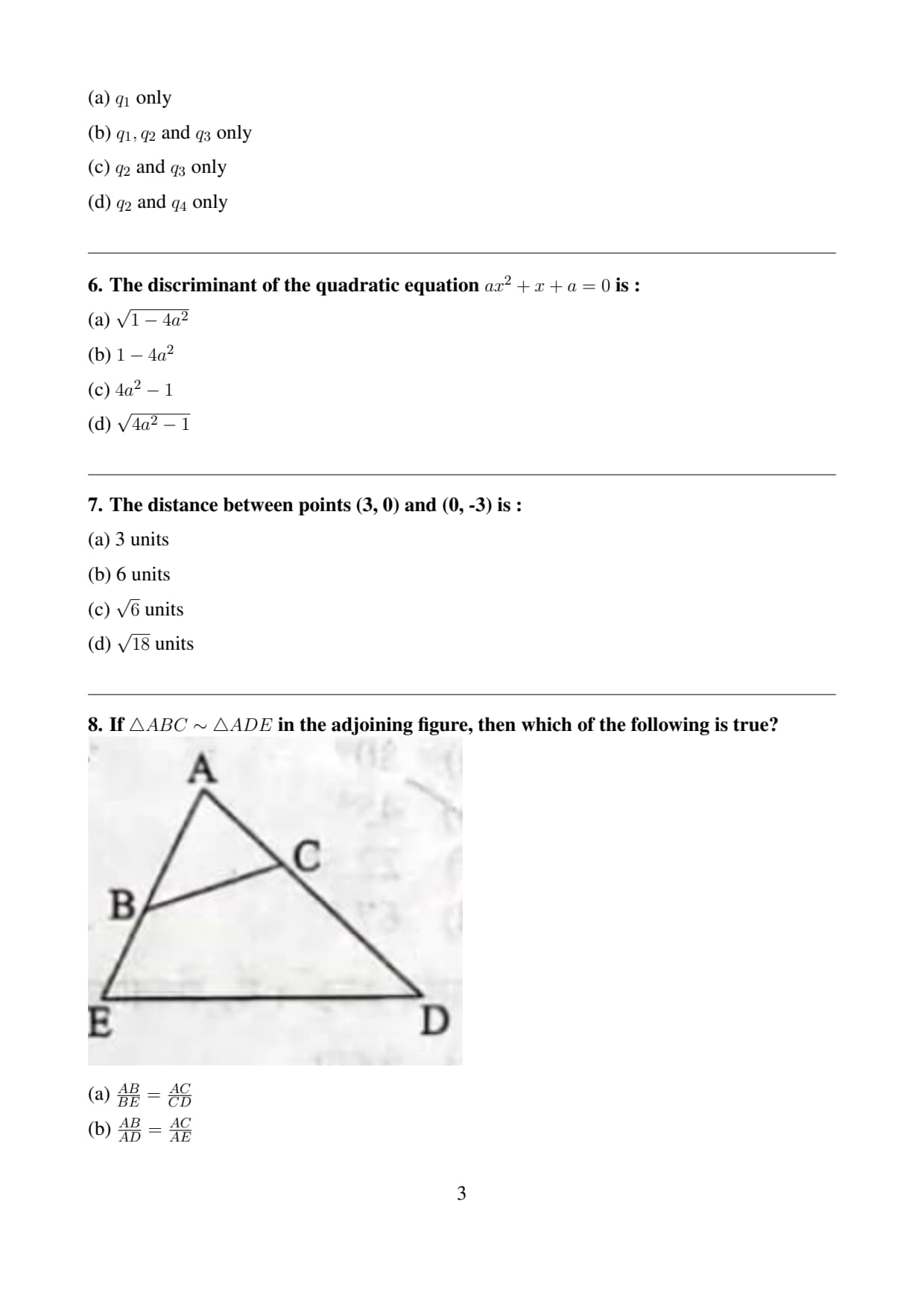
If \(\triangle ABC \sim \triangle ADE\) in the adjoining figure, then which of the following is true?

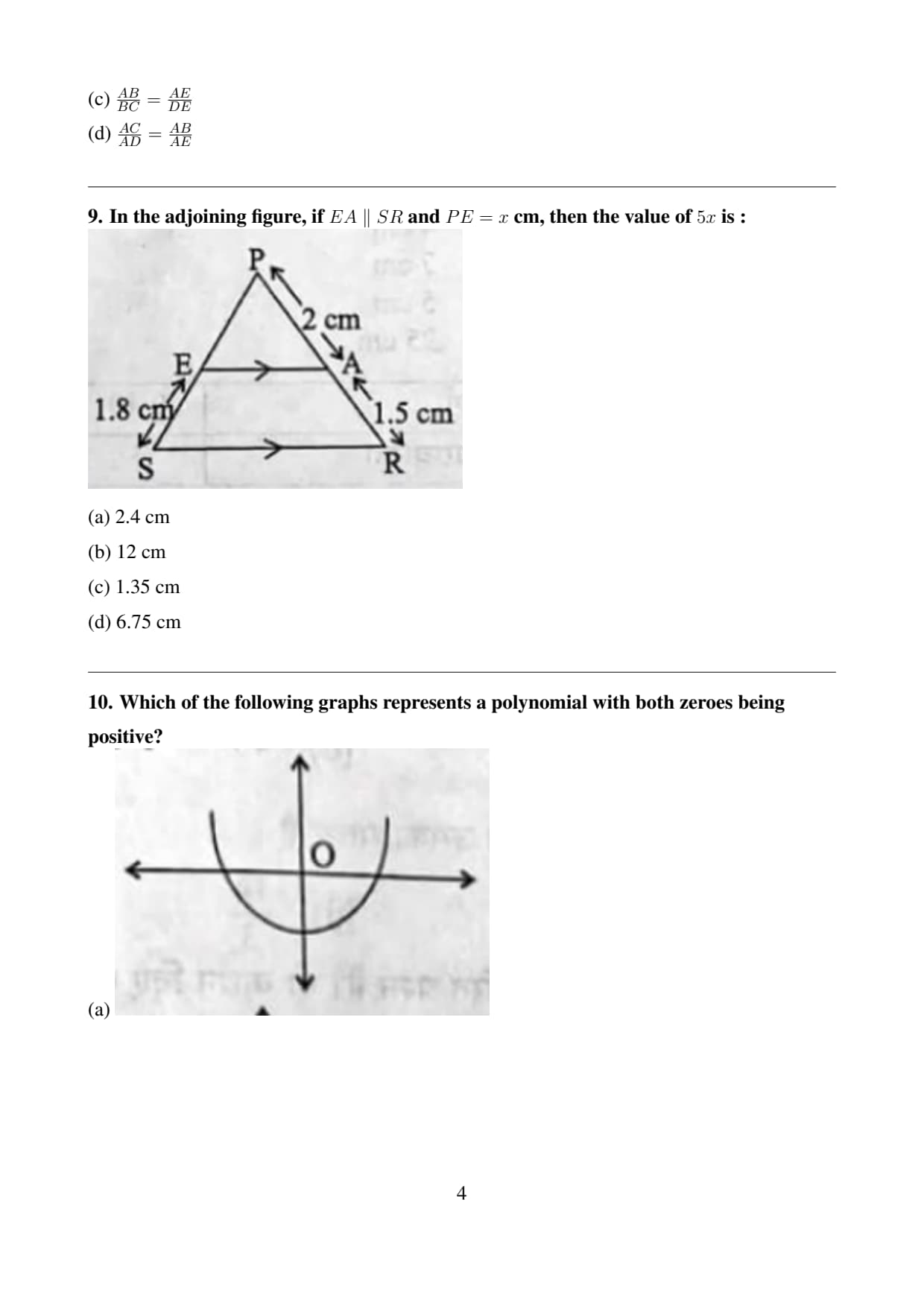
In the adjoining figure, if \(EA \parallel SR\) and \(PE = x\) cm, then the value of \(5x\) is :

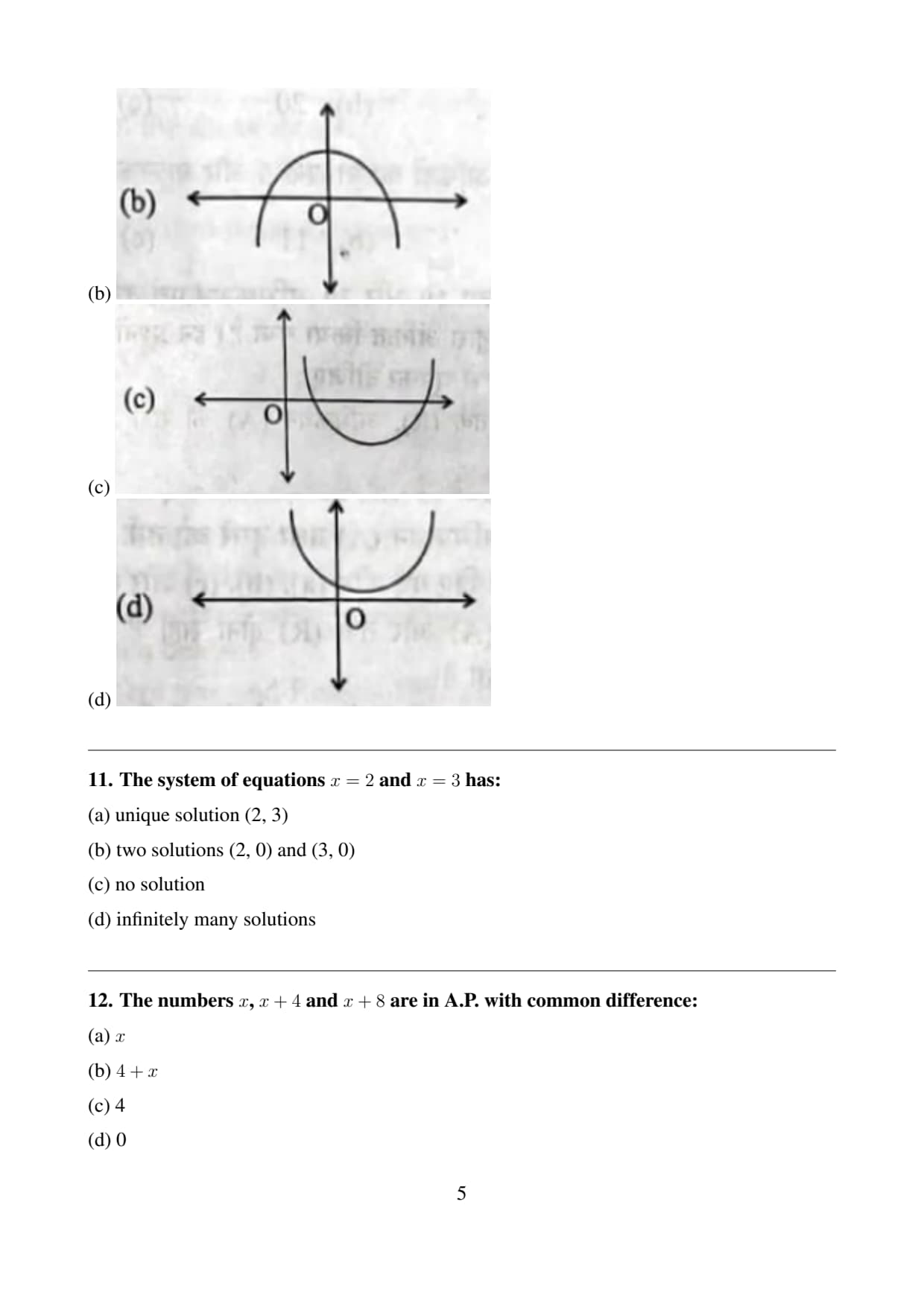
Which of the following graphs represents a polynomial with both zeroes being positive?
- (a)
![]()
- (b)
![]()
- (c)
![]()
- (d)
![]()


The system of equations \(x = 2\) and \(x = 3\) has:
The numbers \(x\), \(x+4\) and \(x+8\) are in A.P. with common difference:
Which of the following statements is not true?
If \(\sqrt{3} \sin A = \cos A\), then the measure of \(A\) is :
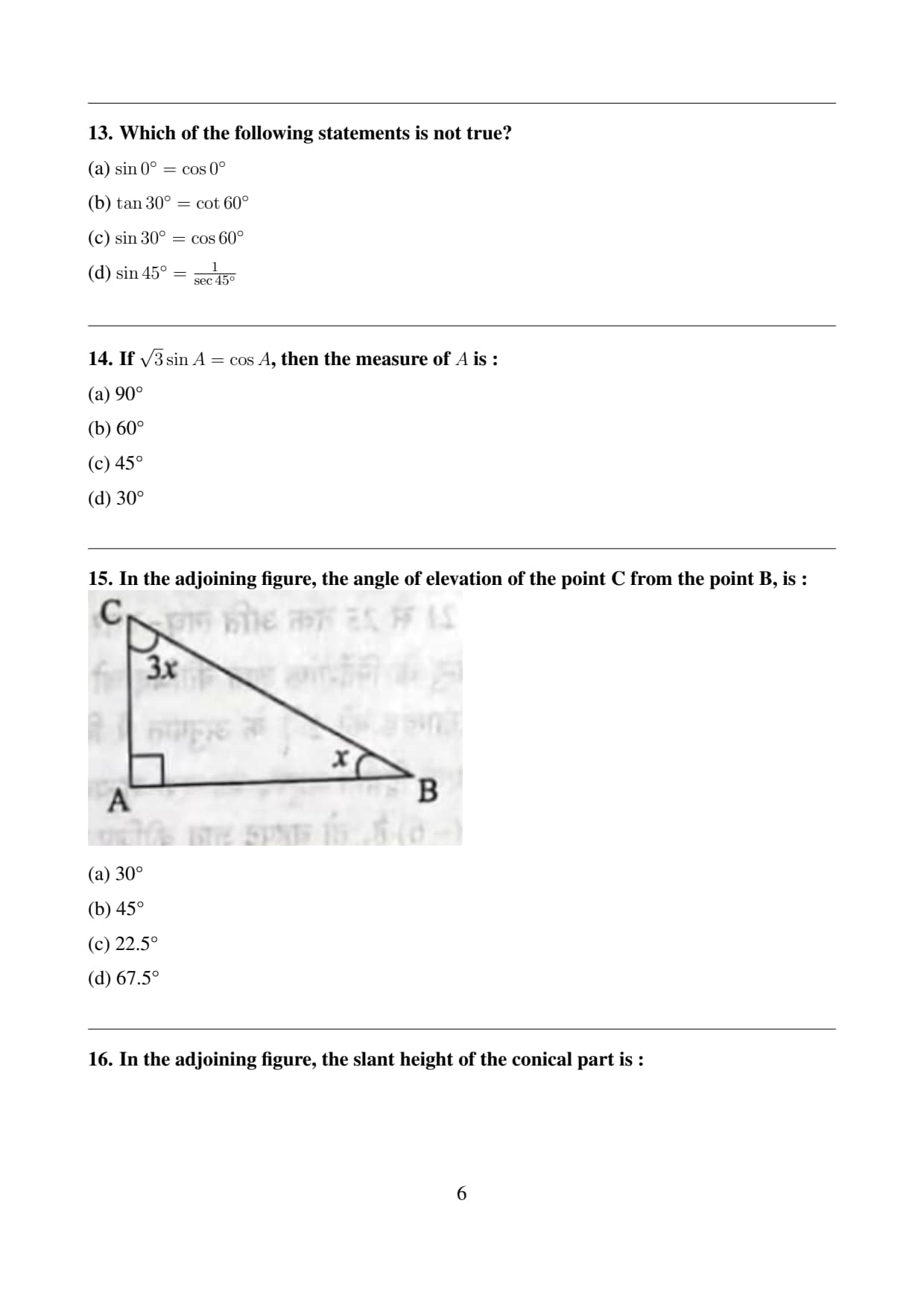
In the adjoining figure, the angle of elevation of the point C from the point B, is :

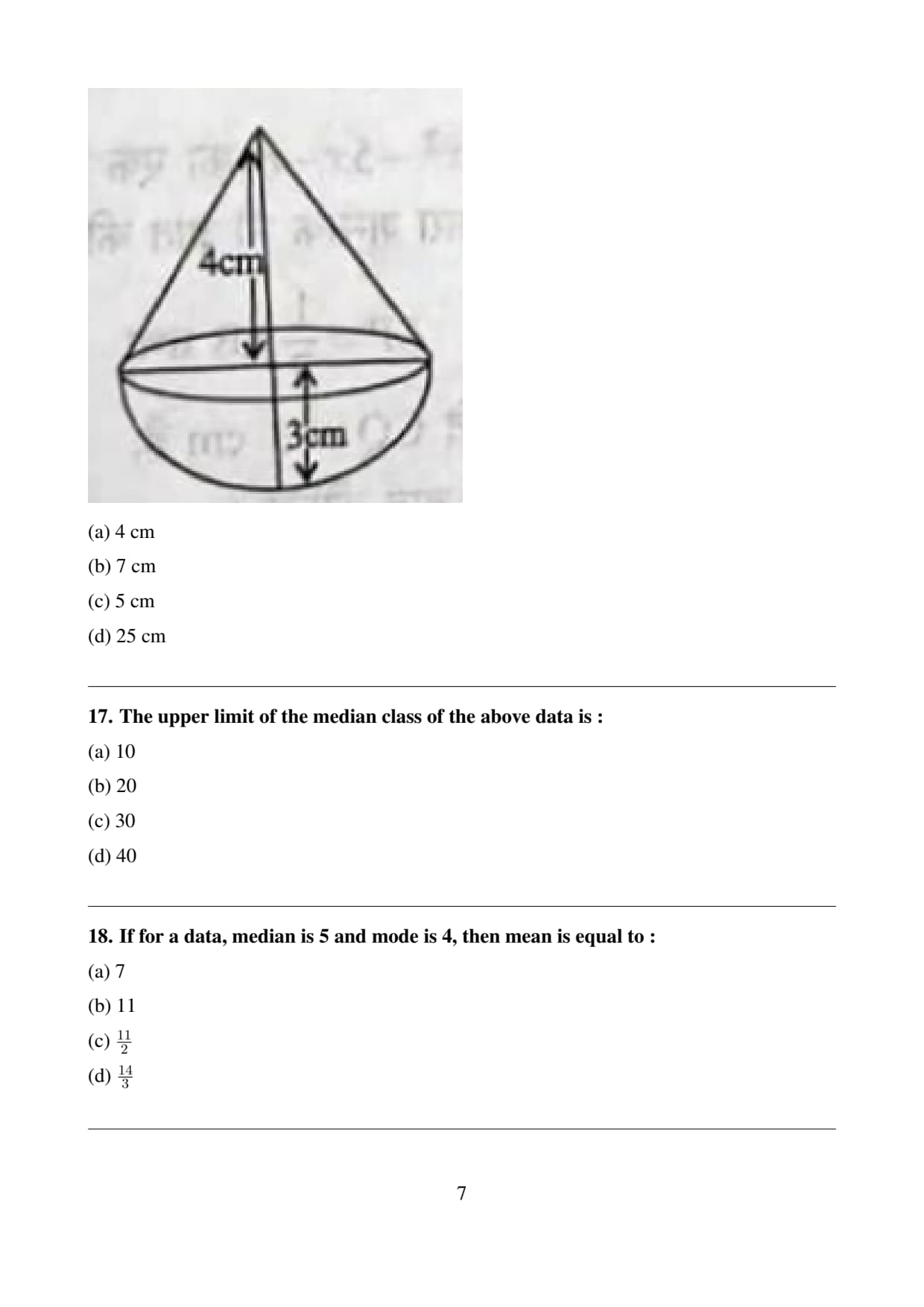
In the adjoining figure, the slant height of the conical part is :

The upper limit of the median class of the above data is :
If for a data, median is 5 and mode is 4, then mean is equal to :
Assertion (A): From a bag containing 5 red balls, 2 white balls and 3 green balls, the probability of drawing a non-white ball is \(\frac{4}{5}\).
Reason (R): For any event E, \(P(E) + P(not E) = 1\)
Assertion (A): \(7 \times 2 + 3\) is a composite number.
Reason (R): A composite number has more than two factors.
Find the coordinates of the point which divides the line segment joining the points A (-6, 10) and B (3, -8) in the ratio 2 : 7.
One zero of a quadratic polynomial is twice the other. If the sum of zeroes is (-6), find the polynomial.
If one zero of the polynomial \(x^2 - 5x - c\) is (-1), find the value of c. Also, find the other zero.
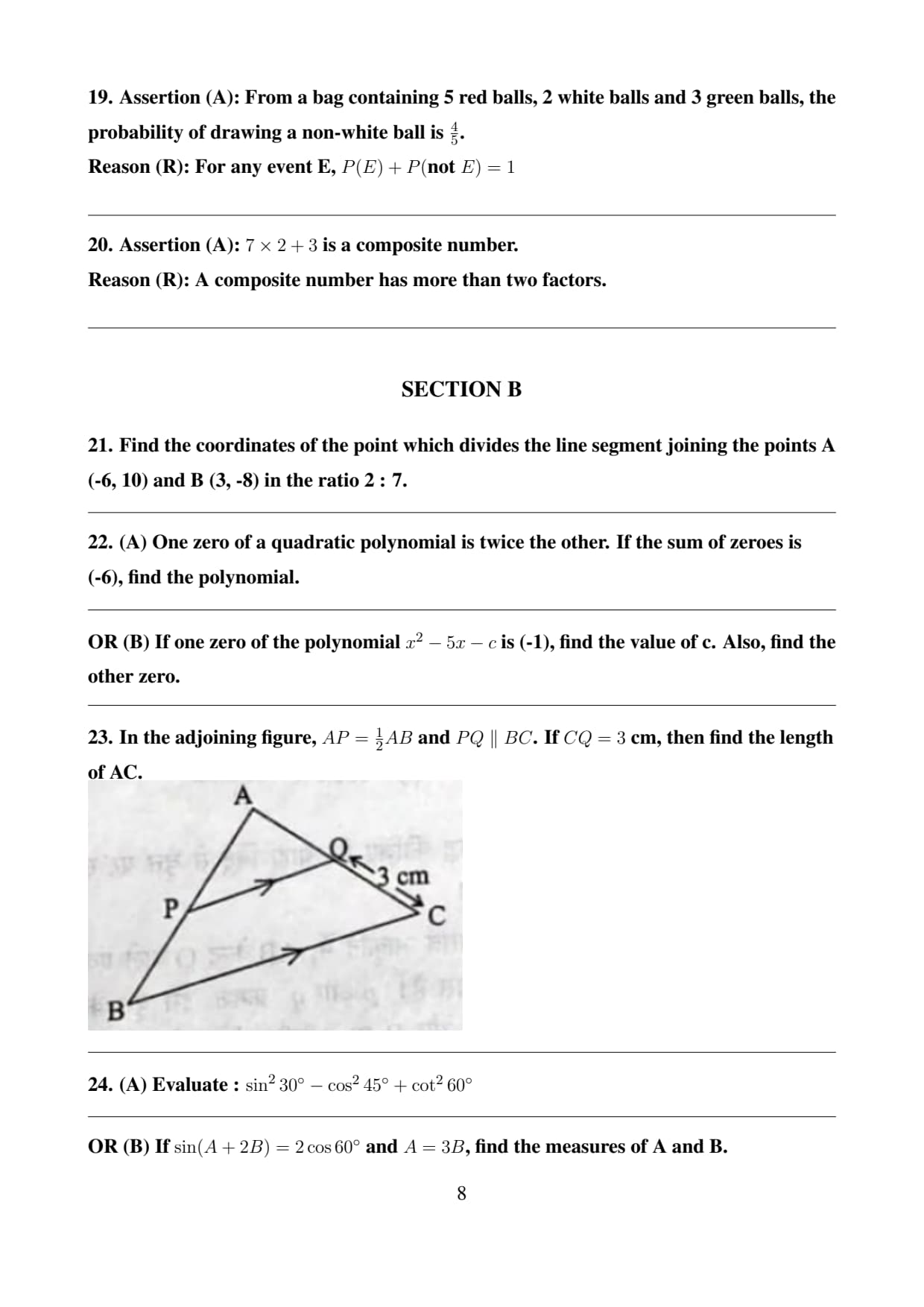
In the adjoining figure, \(AP = \frac{1}{2} AB\) and \(PQ \parallel BC\). If \(CQ = 3\) cm, then find the length of AC.

Evaluate : \(\sin^2 30^\circ - \cos^2 45^\circ + \cot^2 60^\circ\)
If \(\sin(A + 2B) = 2 \cos 60^\circ\) and \(A = 3B\), find the measures of A and B.
A box consists of 60 wall clocks, out of which 40 are good, 15 have minor defects and the remaining are broken. What is the probability that
(i) the box will be rejected?
(ii) the clock has minor defect?
Given that \(\sqrt{5}\) is an irrational number, prove that \(3 + 2\sqrt{5}\) is also an irrational number.
Solve the following system of equations graphically : \(x + 3y = 6\) and \(2x - 3y = 12\). Also, find the area of the triangle formed by the lines \(x + 3y = 6\), \(x = 0\) and \(y = 0\).
One of the supplementary angles exceeds the other by 120°. Express this as a system of linear equations and find the angles.
If the point P (x, y) is equidistant from the points (3, 6) and (-3, 4), obtain the relation between x and y. Hence, find the coordinates of point P if it lies on x-axis.
Prove that : \(\frac{\sin A - \tan A}{\sin A + \tan A} = \frac{1 - \sec A}{1 + \sec A}\)
If \(\sin x = p\), then prove that : (i) \(\cot x = \frac{\sqrt{1 - p^2}}{p}\) (ii) \(\frac{1 + \tan^2 x}{1 + \cot^2 x} = \frac{p^2}{1 - p^2}\)
Prove that the lengths of tangents drawn from an external point to a circle are equal.
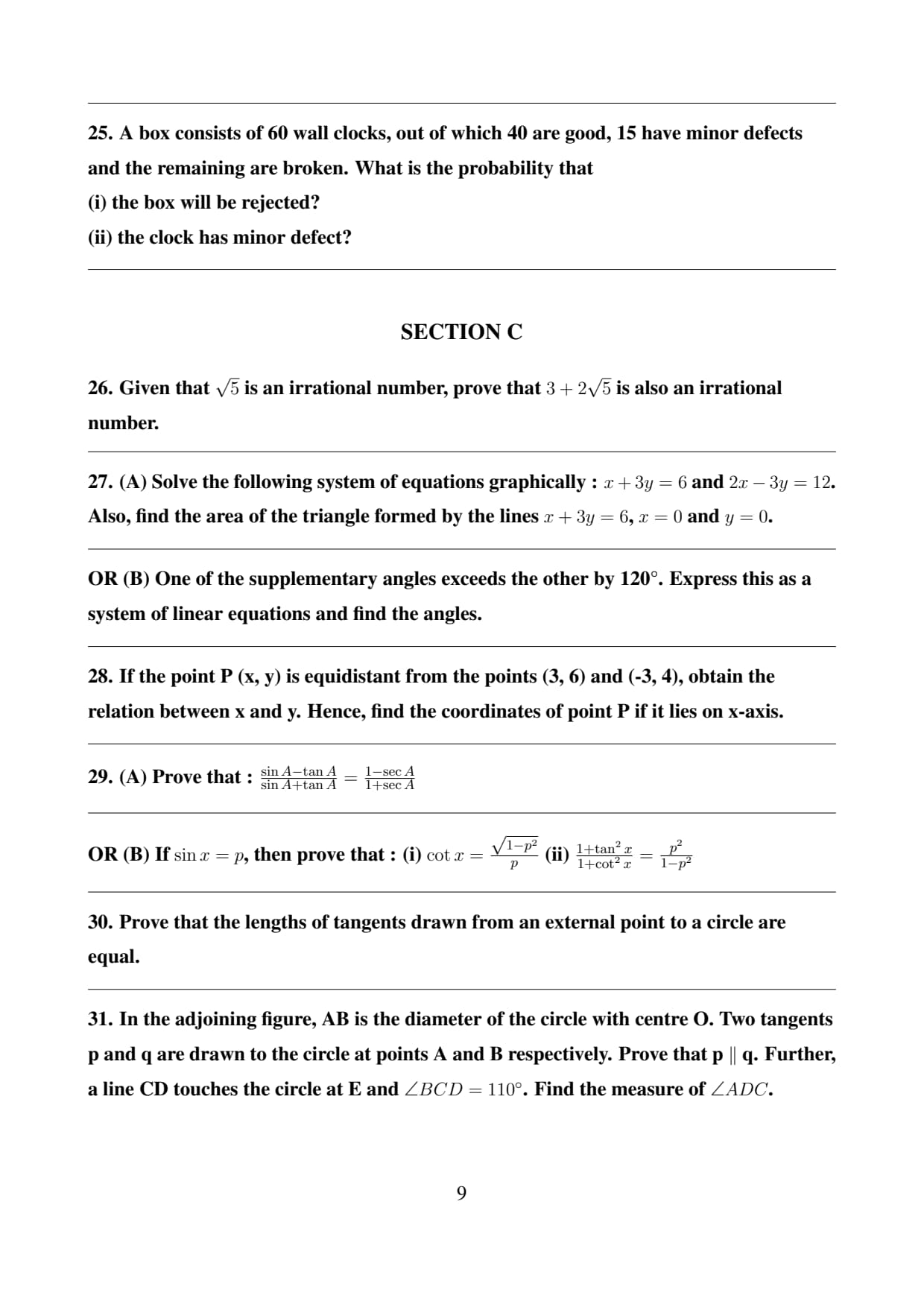
In the adjoining figure, AB is the diameter of the circle with centre O. Two tangents p and q are drawn to the circle at points A and B respectively. Prove that p \(\parallel\) q. Further, a line CD touches the circle at E and \(\angle BCD = 110^\circ\). Find the measure of \(\angle ADC\).

Express \(\frac{24}{18-x} - \frac{24}{18+x} = 1\) as a quadratic equation in standard form and find the discriminant. Also, find the roots of the equation.
The sum of squares of two positive numbers is 100. If one number exceeds the other by 2, find the numbers.
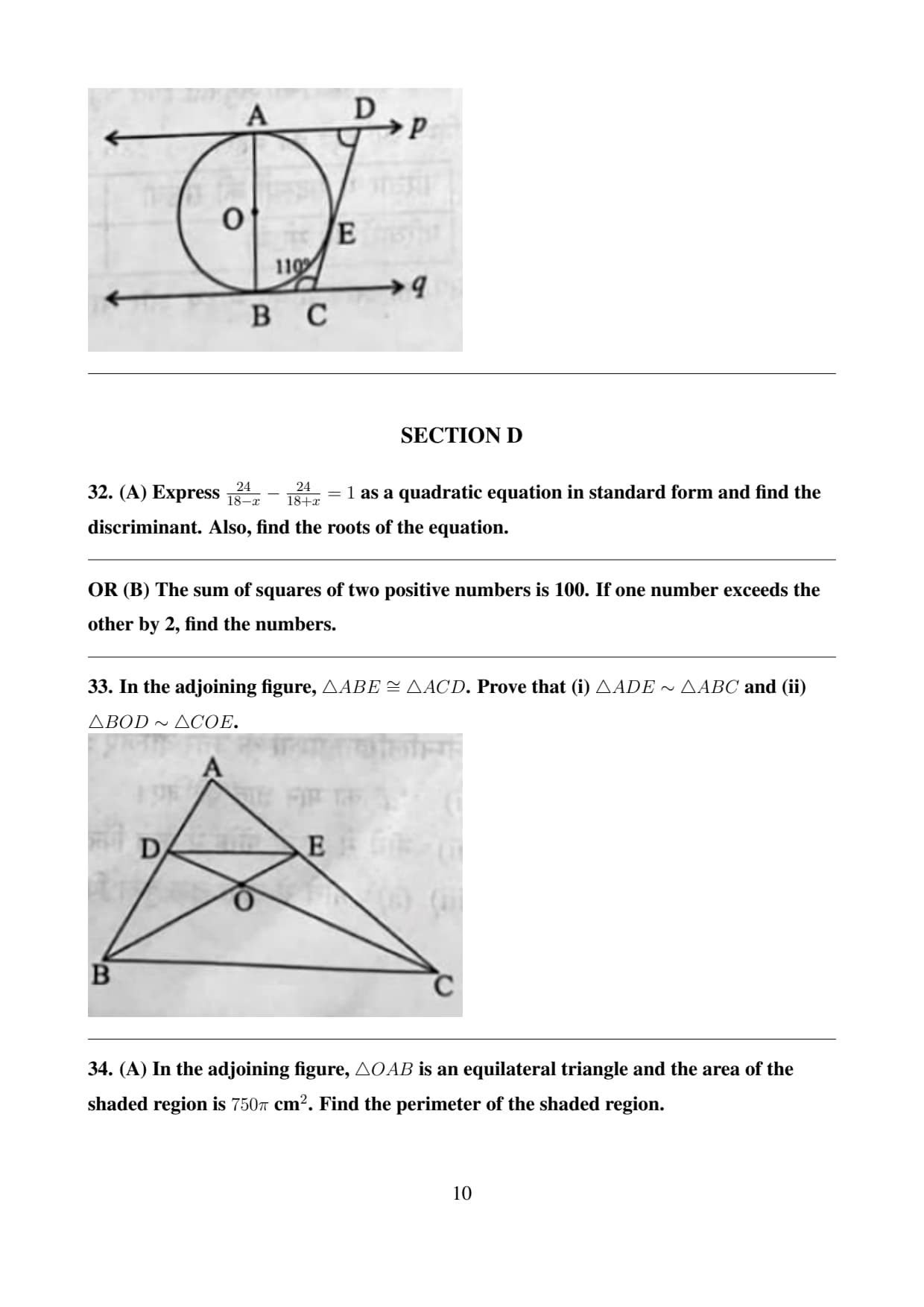
In the adjoining figure, \(\triangle ABE \cong \triangle ACD\). Prove that (i) \(\triangle ADE \sim \triangle ABC\) and (ii) \(\triangle BOD \sim \triangle COE\).

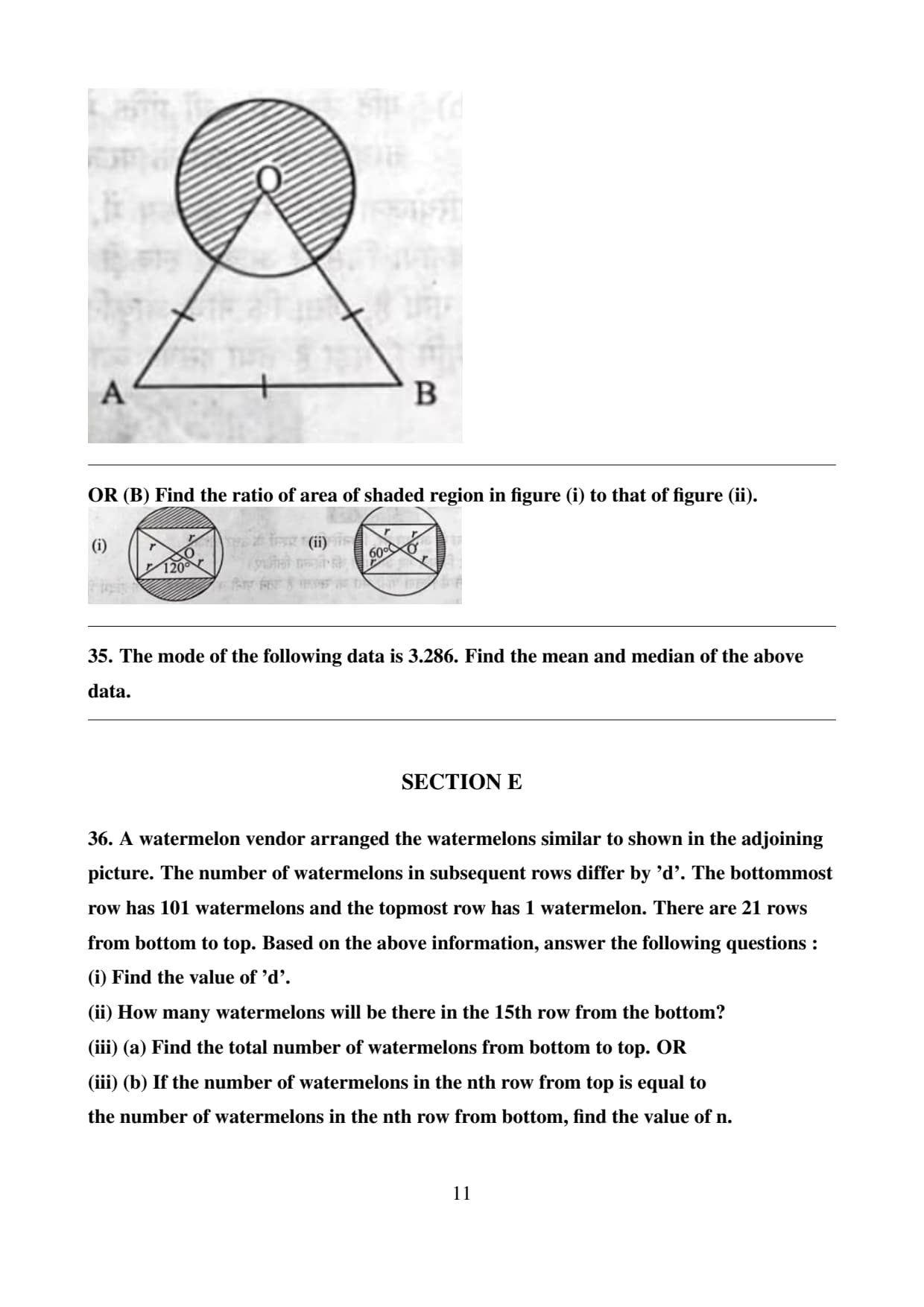
In the adjoining figure, \(\triangle OAB\) is an equilateral triangle and the area of the shaded region is \(750\pi\) cm\(^2\). Find the perimeter of the shaded region.

Find the ratio of area of shaded region in figure (i) to that of figure (ii).

The mode of the following data is 3.286. Find the mean and median of the above data.
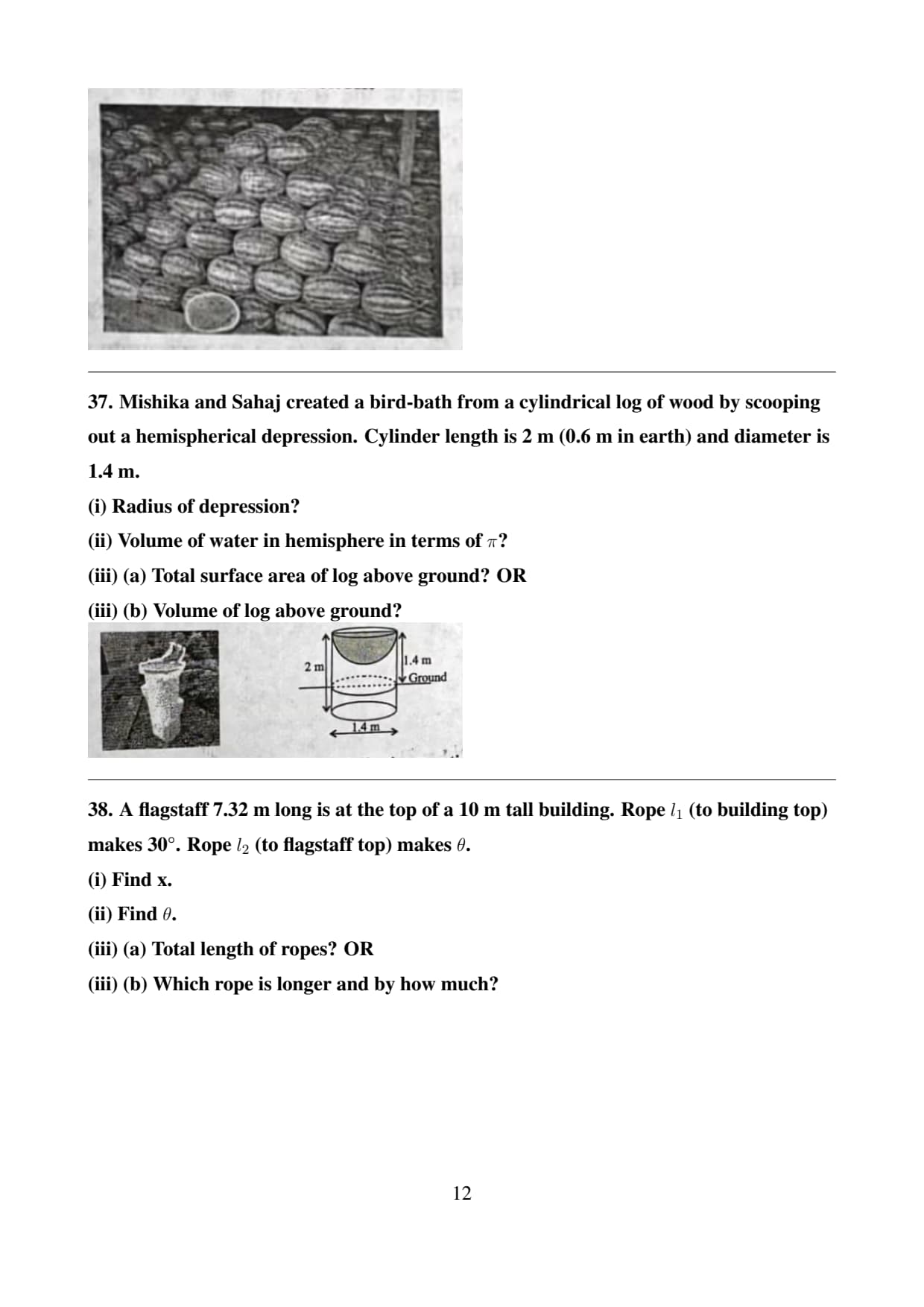
A watermelon vendor arranged the watermelons similar to shown in the adjoining picture. The number of watermelons in subsequent rows differ by 'd'. The bottommost row has 101 watermelons and the topmost row has 1 watermelon. There are 21 rows from bottom to top. Based on the above information, answer the following questions :
(i) Find the value of 'd'.
(ii) How many watermelons will be there in the 15th row from the bottom?
(iii) (a) Find the total number of watermelons from bottom to top. OR
(iii) (b) If the number of watermelons in the nth row from top is equal to
the number of watermelons in the nth row from bottom, find the value of n.

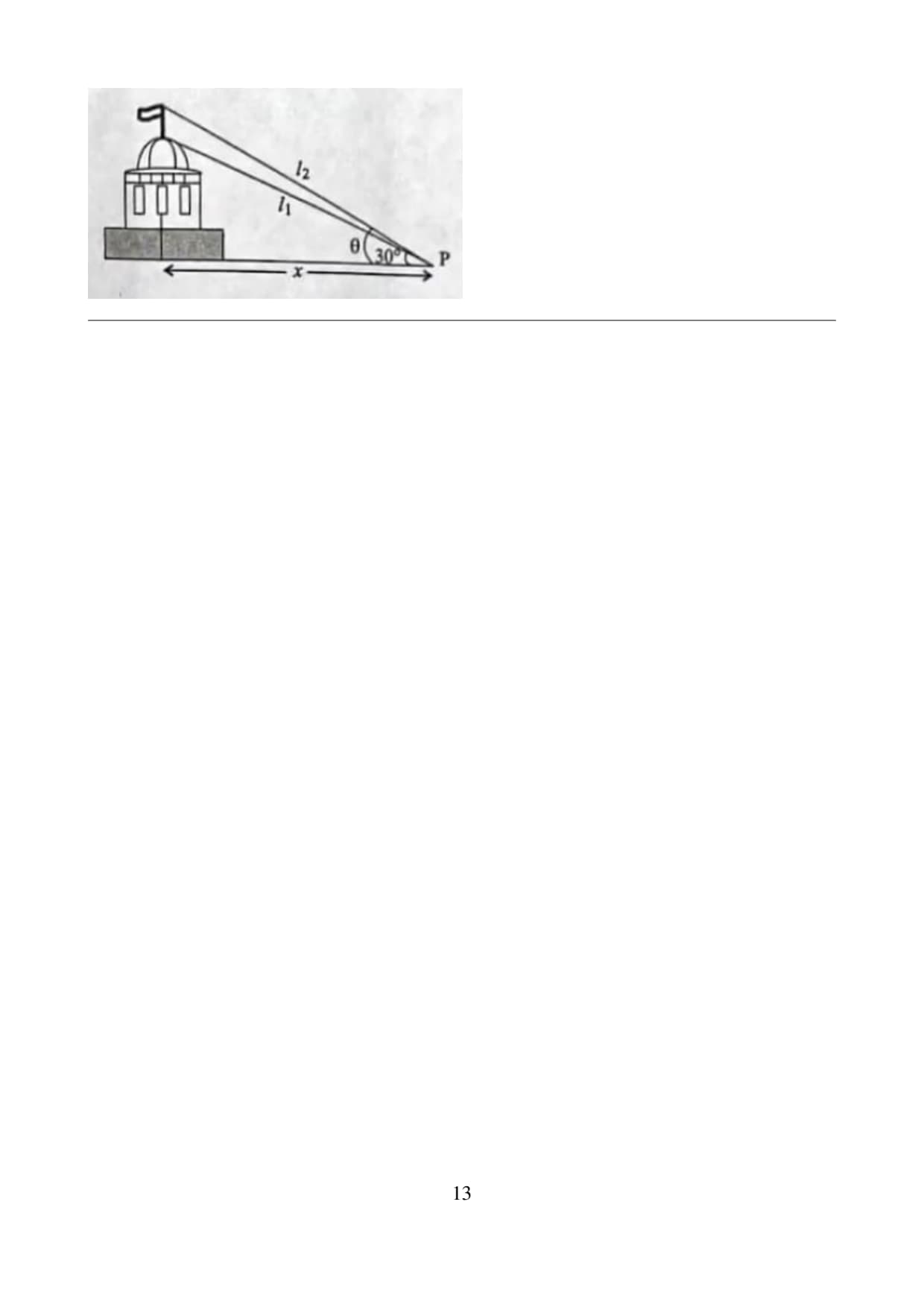
Mishika and Sahaj created a bird-bath from a cylindrical log of wood by scooping out a hemispherical depression. Cylinder length is 2 m (0.6 m in earth) and diameter is 1.4 m.
(i) Radius of depression?
(ii) Volume of water in hemisphere in terms of \(\pi\)?
(iii) (a) Total surface area of log above ground? OR
(iii) (b) Volume of log above ground?

A flagstaff 7.32 m long is at the top of a 10 m tall building. Rope \(l_1\) (to building top) makes 30°. Rope \(l_2\) (to flagstaff top) makes \(\theta\).
(i) Find x.
(ii) Find \(\theta\).
(iii) (a) Total length of ropes? OR
(iii) (b) Which rope is longer and by how much?





Comments