




The CBSE 2026 Class 10 Mathematics Standard (041) Question Paper with Solutions PDF is now available for students to evaluate their performance. Conducted from 10:30 AM to 1:30 PM, the exam was rated moderate in difficulty, featuring a balanced mix of MCQs, case-based studies, and theoretical problems.
Students who focused on NCERT fundamentals and high-weightage units like Algebra and Trigonometry found the paper manageable. This solved PDF serves as a important resource for understanding the marking scheme.
CBSE 2026 Class 10 Mathematics Standard Question Paper Set 1- 30/1/1
| CBSE 2026 Class 10 Mathematics Standard Question Paper Set 1- 30/1/1 | Download PDF | Check Solutions |
CBSE 2026 Class 10 Mathematics Standard Question Paper: Set-wise PDF Download
| Subject | Set | Question Paper | Solution PDF |
|---|---|---|---|
| Mathematics Standard | Set 1- 30/2/1 | Download PDF | Check Solutions |
| Mathematics Standard | Set 2- 30/2/2 | Download PDF | Check Solutions |
| Mathematics Standard | Set 3- 30/2/3 | Download PDF | Check Solutions |
| Mathematics Standard | Set 2- 30/4/2 | Download PDF | Check Solutions |
| Mathematics Standard | Set 3- 30/1/3 | Download PDF | Check Solutions |
| Mathematics Standard | Set 3- 30/5/3 | Download PDF | Check Solutions |
The HCF of 960 and 432 is :
The natural number 2 is :
For any natural number n, \(6^n\) ends with the digit :
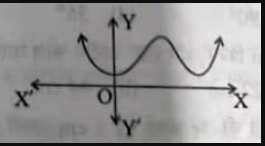
The graph of y = f(x) is given.
The number of zeroes of f(x) is :
If a pair of linear equations in two variables is represented by two coincident lines, then the pair of equations has :
The common difference of the AP : \(\sqrt{2}, 2\sqrt{2}, 3\sqrt{2}, 4\sqrt{2}, \dots\) is :
If \(\Delta ABC\) and \(\Delta DEF\) are similar such that \(2 AB = DE\) and \(BC = 8\) cm, then \(EF\) is equal to :
The mid-point of the line segment joining the points (5, -4) and (6, 4) lies on :
Given that \(\sin \theta = a/b\), then \(\cos \theta\) is equal to :
If \(\cos A = 1/2\), then the value of \(\sin^2 A + \cos^2 A\) is :
A car is moving away from the base of a 30 m high tower. The angle of elevation of the top of the tower from the car at an instant, when the car is \(10\sqrt{3}\) m away from the base of the tower, is :
If TP and TQ are two tangents to a circle with centre O from an external point T so that \(\angle POQ = 120^\circ\), then \(\angle PTQ\) is equal to :
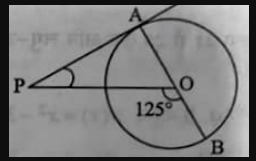
In the given figure, PA is a tangent from an external point P to a circle with centre O. If \(\angle POB = 125^\circ\), then \(\angle APO\) is equal to :
The length of the arc of the sector of a circle with radius 21 cm and of central angle 60°, is :
The hour hand of a clock is 7 cm long. The angle swept by it between 7:00 a.m. and 8:10 a.m. is :
The total surface area of a solid hemisphere of diameter ‘2d’ is :
If the mean and mode of a data are 12 and 21 respectively, then its median is :
A die is thrown once. Probability of getting a number other than 3 is :
Assertion (A) : The probability that a leap year has 53 Mondays is \(\frac{2}{7}\).
Reason (R) : The probability that a non-leap year has 53 Mondays is \(\frac{5}{7}\).
Assertion (A) : The polynomial \(p(y) = y^2 + 4y + 3\) has two zeroes.
Reason (R) : A quadratic polynomial can have at most two zeroes.
If \(\alpha, \beta\) are the zeroes of the polynomial \(p(x) = x^2 - 3x - 1\), then find the value of \(\frac{1}{\alpha} + \frac{1}{\beta}\).
In \(\triangle ABC\), \(DE \parallel BC\). If \(AD = x\), \(DB = x - 2\), \(AE = x + 2\) and \(EC = x - 1\), then find the value of \(x\).
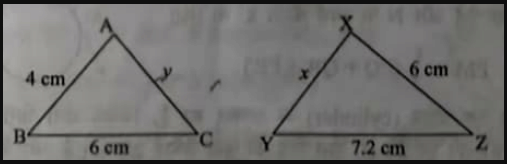
In the figure given above, \(\triangle ABC \sim \triangle XYZ\), then find the values of \(x\) and \(y\).
The coordinates of the centre of a circle are \((x - 7, 2x)\). Find the value(s) of ‘x’, if the circle passes through the point \((-9, 11)\) and has radius \(5\sqrt{2}\) units.
If \(\tan \theta = \frac{24}{7}\), then find the value of \(\sin \theta + \cos \theta\).
If \(\cot \theta = \frac{7}{8}\), then find the value of \(\frac{(1+\sin \theta)(1-\sin \theta)}{(1+\cos \theta)(1-\cos \theta)}\).
Two concentric circles are of radii 5 cm and 4 cm. Find the length of the chord of the larger circle which touches the smaller circle.
Prove that \(\sqrt{3}\) is an irrational number.
Find the ratio in which the x-axis divides the line segment joining the points \((-6, 5)\) and \((-4, -1)\). Also, find the point of intersection.
If \(x = h + a \cos \theta\), \(y = k + b \sin \theta\), then prove that : \(\left( \frac{x - h}{a} \right)^2 + \left( \frac{y - k}{b} \right)^2 = 1\)
Prove that : \(\frac{\tan A}{1 + \sec A} - \frac{\tan A}{1 - \sec A} = 2 \csc A\)
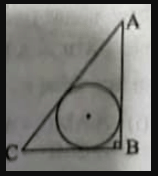
In the given figure, \(\triangle ABC\) is a right triangle in which \(\angle B = 90^\circ\), \(AB = 4\) cm and \(BC = 3\) cm. Find the radius of the circle inscribed in the triangle ABC.
Prove that : \(PM = \frac{1}{2} (PQ + QR + PR)\)

A solid is in the form of a cylinder with hemispherical ends. The total height of the solid is 20 cm and the diameter of the cylinder is 7 cm. Find the total volume of the solid. (Use \(\pi = \frac{22}{7}\))
Two dice of different colours are thrown at the same time. Write down all the possible outcomes. What is the probability that :
(i) same number appears on both the dice?
(ii) different number appears on both the dice?
Determine graphically, the coordinates of vertices of a triangle whose equations are \(2x - 3y + 6 = 0\); \(2x + 3y - 18 = 0\) and \(x = 0\). Also, find the area of this triangle.
A faster train takes one hour less than a slower train for a journey of 200 km. If the speed of the slower train is 10 km/hr less than that of the faster train, find the speeds of the two trains.
The sum of areas of two squares is 640 m\(^2\). If the difference in perimeters is 64 m, find the sides.
State and prove Basic Proportionality Theorem.
In \(\triangle ABC \sim \triangle PQR\), CM and RN are medians. Prove \(\triangle AMC \sim \triangle PNR\) and \(\triangle CMB \sim \triangle RNQ\).




Comments