




CBSE is conducting the Class 10 Elements of Business Board Exam 2026 on February 24, 2026. Class 10 Elements of Business Question Paper with Solution PDF is available here for download.
The official question paper of CBSE Class 10 Elements of Business Board Exam 2026 is provided below. Students can download the official paper in PDF format for reference.
CBSE Class 10 2026 Elements of Business Question Paper with Solution PDF - Memory Based
| CBSE Class 10 Elements of Business Question Paper 2026 | Download PDF | Check Solutions |
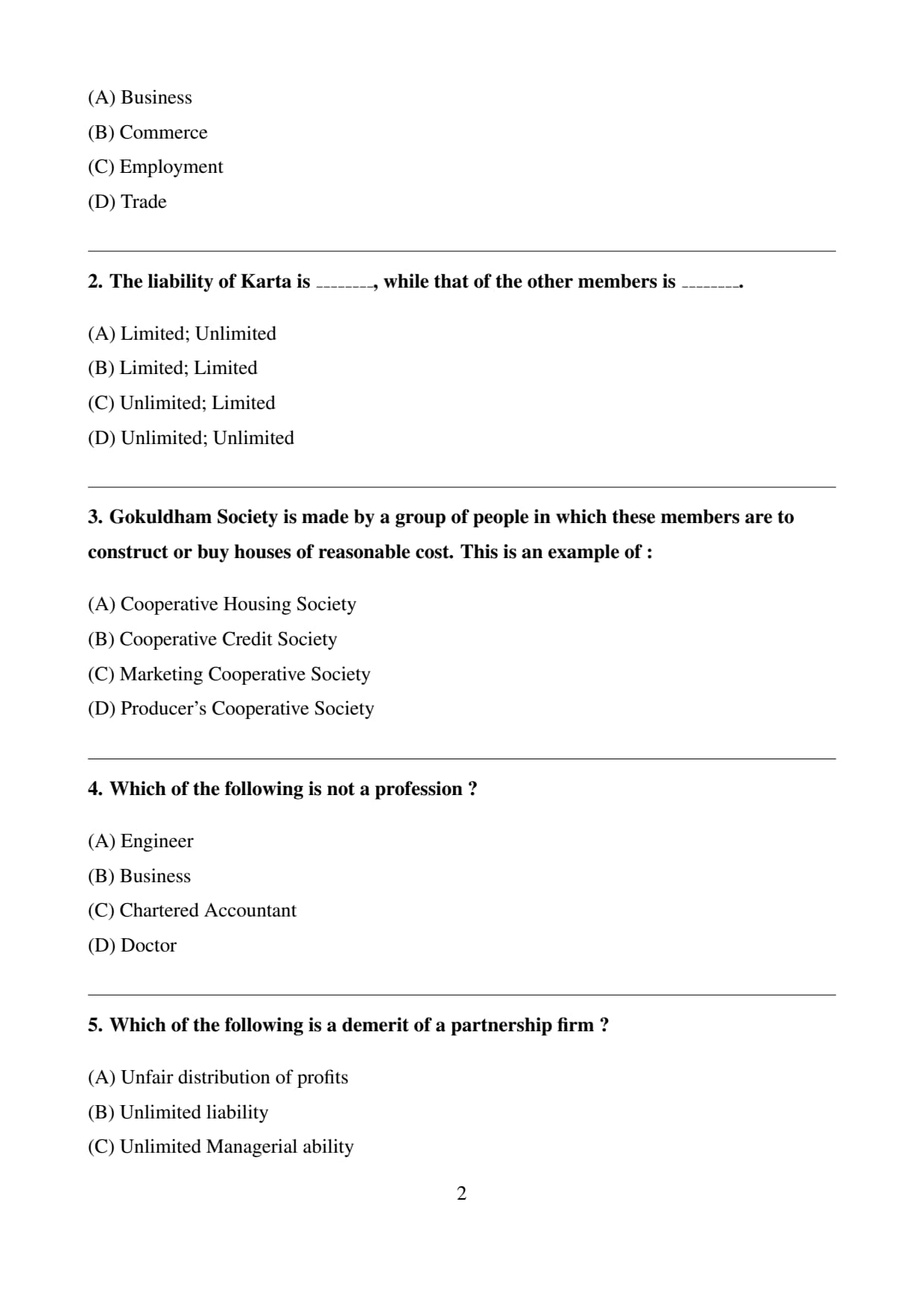
________ refers to the process of buying goods and services.
View Solution
We are asked to identify which term refers to the process of buying goods and services.
Step 1: Understand the meaning of each term.
Business: Business is a broad term that includes all economic activities (industry, commerce, trade) undertaken for profit. It includes production, purchase, sale, and exchange of goods and services.
Commerce: Commerce is a wider term that includes all activities involved in the transfer of goods from producers to consumers. It includes trade and auxiliaries to trade (transport, banking, insurance, warehousing, advertising, etc.).
Employment: Employment refers to working for others in exchange for salary or wages. It is a contract-based relationship where the employee works under the employer's direction.
Trade: Trade refers specifically to the buying and selling of goods and services. It is the actual exchange process. Trade is a subset of commerce.
Step 2: Focus on the phrase "process of buying goods and services."
The direct activity of purchasing goods and services is specifically called trade. When you buy something, you are engaging in trade.
Trade = Buying and selling
Commerce = Trade + Auxiliaries (support services)
Business = Industry + Commerce (includes production and exchange)
Step 3: Analyze each option.
(A) Business:
Business is too broad. It includes production, trade, and auxiliaries. Buying goods is part of business, but business itself is not defined as "the process of buying goods and services."
(B) Commerce:
Commerce includes trade plus supporting activities. It is broader than just buying and selling.
(C) Employment:
Employment is a contractual relationship for work, not related to buying goods and services.
(D) Trade:
✓ Correct. Trade is specifically the process of buying and selling goods and services.
Final Answer: (D) Trade Quick Tip: Remember the hierarchy: Trade = Buying and selling (core exchange activity) Commerce = Trade + Auxiliaries (transport, banking, insurance, etc.) Business = Industry (production) + Commerce (exchange) Trade is the specific term for the process of buying and selling goods and services.
The liability of Karta is _________, while that of the other members is _________.
View Solution
We are asked to identify the liability of Karta and other members in a Hindu Undivided Family (HUF) business.
Step 1: Understand what is Karta and HUF.
Hindu Undivided Family (HUF) is a legal entity consisting of family members who are lineal descendants of a common ancestor. It is governed by Hindu law.
Karta is the head or senior-most male member of the HUF who manages the family business and affairs. He has the authority to make decisions on behalf of the family.
Other members include co-parceners (usually sons, grandsons, great-grandsons) and other family members.
Step 2: Liability of Karta.
The Karta has unlimited liability in the HUF business. This means:
If the business incurs debts or losses, the Karta's personal assets can be used to pay off the debts.
His liability is not limited to his share in the HUF property.
Creditors can sue the Karta personally and recover dues from his personal estate.
Step 3: Liability of other members (co-parceners).
Other members (co-parceners) have limited liability. This means:
Their liability is limited to their share in the HUF property.
Their personal assets cannot be attached for business debts.
Only their interest in the joint family property can be used to satisfy business debts.
Step 4: Analyze each option.
(A) Limited; Unlimited:
Incorrect. This would mean Karta has limited liability (false) and other members have unlimited (false).
(B) Limited; Limited:
Incorrect. Karta does not have limited liability.
(C) Unlimited; Limited:
✓ Correct. Karta has unlimited liability; other members have limited liability.
(D) Unlimited; Unlimited:
Incorrect. Other members do not have unlimited liability.
Final Answer: (C) Unlimited; Limited Quick Tip: In a Hindu Undivided Family (HUF) business: Karta (Head) → Unlimited Liability (personal assets can be used) Other Members (Co-parceners) → Limited Liability (only to their share in HUF property) Remember: Karta bears the maximum risk and responsibility!
Gokuldham Society is made by a group of people in which these members are to construct or buy houses of reasonable cost. This is an example of :
View Solution
We are asked to identify the type of cooperative society in which members come together to construct or buy houses of reasonable cost.
Step 1: Understand the different types of cooperative societies.
Cooperative Housing Society: Formed by people who want to construct or purchase residential houses at reasonable costs. Members pool resources to acquire land, construct buildings, or buy flats. Examples: Apartment owners' societies, housing boards.
Cooperative Credit Society: Provides financial assistance (loans) to members at reasonable interest rates. Examples: Urban Cooperative Banks, credit unions.
Marketing Cooperative Society: Formed by small producers to sell their products collectively at better prices. Helps in eliminating middlemen. Examples: Amul (milk marketing), fruit and vegetable growers' societies.
Producer's Cooperative Society: Formed by small producers to pool resources for purchasing raw materials, equipment, and producing goods collectively. Examples: Weavers' cooperatives, artisans' cooperatives.
Step 2: Match the description with the correct type.
The description clearly states: "members are to construct or buy houses of reasonable cost." This directly matches the purpose of a Cooperative Housing Society.
Members pool money to acquire land
Construct buildings together
Purchase flats/houses at reasonable cost
Share common amenities
Step 3: Analyze each option.
(A) Cooperative Housing Society:
✓ Correct. This is exactly what the description says.
(B) Cooperative Credit Society:
Incorrect. Credit societies provide loans, not housing.
(C) Marketing Cooperative Society:
Incorrect. Marketing societies sell products, not housing.
(D) Producer's Cooperative Society:
Incorrect. Producer societies manufacture goods, not housing.
Final Answer: (A) Cooperative Housing Society Quick Tip: Types of Cooperative Societies: Housing → For buying/constructing houses Credit → For providing loans Marketing → For selling products collectively Producer → For producing goods collectively Consumer → For buying goods at reasonable prices Farming → For agricultural activities Gokuldham Society is a classic example of a Housing Cooperative!
Which of the following is not a profession ?
View Solution
We are asked to identify which of the given options is not a profession.
Step 1: Understand the meaning of "profession."
A profession is an occupation that requires specialized knowledge, formal education, and training. It has certain characteristics:
Specialized knowledge and skills acquired through formal education
Membership in a professional body or association
Code of conduct/ethics
Service motive (though fees are charged)
Examples: Medicine (Doctor), Law (Lawyer), Chartered Accountancy, Engineering
Step 2: Understand the meaning of "business."
Business is an economic activity involving production, purchase, sale, or exchange of goods and services with the aim of earning profit. Its characteristics:
Profit motive (primary objective)
No requirement of formal degree or membership
No mandatory code of conduct (though ethical practices are followed)
Risk and uncertainty involved
Examples: Retail shop, Manufacturing company, Trading firm
Step 3: Analyze each option.
(A) Engineer:
Engineering requires specialized education (B.E./B.Tech) and training.
Engineers may register with professional bodies (like Institution of Engineers).
Hence, engineering is a profession.
(B) Business:
Business does not require any specific degree or professional qualification.
Anyone can start a business.
There is no mandatory professional body or code of conduct.
Hence, business is not a profession; it is a separate category of economic activity.
(C) Chartered Accountant:
CA requires specialized education and passing rigorous examinations conducted by ICAI.
Membership in ICAI is mandatory.
Strict code of ethics must be followed.
Hence, Chartered Accountancy is a profession.
(D) Doctor:
Medical profession requires MBBS degree and registration with Medical Council.
Strict ethical code (Hippocratic Oath) must be followed.
Hence, Doctor is a profession.
Step 4: Classification of economic activities.
Economic activities are classified into:
Business: Production/purchase/sale of goods for profit
Profession: Specialized services requiring knowledge and skill
Employment: Working for others for salary/wages
Business is distinct from profession.
Final Answer: (B) Business Quick Tip: Remember the difference: Profession: Requires specialized knowledge, formal education, membership, code of conduct (Doctor, CA, Engineer, Lawyer) Business: Profit-oriented, no formal degree required, involves risk Employment: Working for salary under someone else Business is not a profession!
Which of the following is a demerit of a partnership firm ?
View Solution
We are asked to identify which of the given options is a demerit (disadvantage) of a partnership firm.
Step 1: Understand the meaning of a partnership firm.
A partnership is a form of business organization where two or more persons agree to share the profits and losses of a business carried on by all or any of them acting for all.
Step 2: Recall the demerits (disadvantages) of partnership.
Common demerits of partnership include:
Unlimited Liability: Each partner has unlimited liability. This means partners are personally liable for all debts and losses of the firm. Their personal assets can be used to pay business debts. This is a major disadvantage.
Lack of Continuity: Partnership suffers from instability. Death, insolvency, or retirement of a partner can dissolve the firm.
Limited Capital: Since the number of partners is limited (maximum 50 in banking, 20 in other businesses), the capital raising capacity is limited.
Lack of Public Confidence: Unlike companies, partnerships are not required to publish their accounts, so public confidence may be lower.
Possibility of Conflicts: Differences of opinion and conflicts among partners can affect business operations.
Lack of Specialization: In small partnerships, all partners may be involved in all decisions, leading to lack of specialized management.
Step 3: Analyze each option.
(A) Unfair distribution of profits:
This is not necessarily a demerit. Profit sharing is decided by the partnership deed and agreed upon by partners. If unfair, partners can renegotiate.
Not a standard demerit of partnership.
(B) Unlimited liability:
✓ Correct. This is one of the biggest demerits of partnership. Partners are personally liable for business debts, putting their personal wealth at risk.
(C) Unlimited Managerial ability:
Incorrect. This is not a demerit. In fact, partnership benefits from combined managerial abilities of all partners. "Unlimited managerial ability" is not a term used; it would be an advantage if true.
(D) Dominance of one partner:
While this can happen in practice, it is not a standard or inherent demerit of partnership. It depends on the agreement and personalities.
Unlimited liability is a more fundamental and universal demerit.
Final Answer: (B) Unlimited liability Quick Tip: Major demerits of Partnership: Unlimited Liability (biggest disadvantage) Limited Capital Lack of Continuity Possibility of Conflicts Remember: In partnership, your personal assets are at risk for business debts!
_________ is the process of exchanging information and understanding between two or more persons.
View Solution
We are asked to identify the term that refers to the process of exchanging information and understanding between two or more persons.
Step 1: Understand the meaning of each term.
Motivation: The process of inspiring or stimulating people to take action and achieve goals. It deals with needs, drives, and incentives.
Leadership: The process of influencing and guiding people to work willingly towards achieving organizational objectives. It involves directing and inspiring.
Cooperation: The process of working together willingly towards common goals. It involves mutual help and collaboration.
Communication: The process of exchanging information, ideas, thoughts, and feelings between people. It involves a sender, message, medium, receiver, and feedback. The goal is mutual understanding.
Step 2: Match the definition with the correct term.
The definition given is: "the process of exchanging information and understanding between two or more persons."
"Exchanging information" → This is the core of communication.
"Understanding" → Communication aims at creating shared understanding.
"Between two or more persons" → Communication is a two-way process involving at least two parties.
This definition exactly matches Communication.
Step 3: Analyze each option.
(A) Motivation:
Incorrect. Motivation is about inspiring action, not primarily about exchanging information.
(B) Leadership:
Incorrect. Leadership involves influencing people, which uses communication but is broader than just exchanging information.
(C) Cooperation:
Incorrect. Cooperation is working together, which may result from communication but is not the exchange process itself.
(D) Communication:
✓ Correct. This is the precise definition of communication.
Final Answer: (D) Communication Quick Tip: Communication = Exchange of information + Mutual understanding between sender and receiver. It is a two-way process involving: Sender (encodes message) Message Medium/Channel Receiver (decodes message) Feedback Remember: Without communication, no organization can function!
Online-Banking provides service to customers :
View Solution
We are asked to identify the service hours provided by online banking to customers.
Step 1: Understand what online banking is.
Online banking (also known as internet banking or e-banking) allows customers to conduct financial transactions through a bank's website or mobile application using the internet.
Step 2: Key features of online banking.
24/7 Availability: Online banking services are available 24 hours a day, 365 days a year (including weekends and holidays).
Accessibility: Customers can access their accounts from anywhere with an internet connection.
Services offered: Fund transfers, balance inquiry, bill payments, mobile recharge, account statements, loan applications, etc.
Step 3: Compare with traditional banking.
Traditional banking (branch banking) has fixed working hours (usually 10 AM to 4 PM on weekdays, limited hours on Saturdays, closed on Sundays and holidays).
Online banking overcomes this limitation by providing round-the-clock service.
Step 4: Analyze each option.
(A) 8 hours in a day:
Incorrect. This is typical for traditional branch banking, not online banking.
(B) 10 hours in a day:
Incorrect. Online banking is not limited to 10 hours.
(C) 24 hours in a day:
✓ Correct. Online banking provides 24/7 service to customers.
(D) None of these:
Incorrect because option (C) is correct.
Final Answer: (C) 24 hours in a day Quick Tip: Online Banking = 24×7 banking! Key advantages: Anytime, anywhere access No queue, no waiting Quick fund transfers Instant bill payments View statements anytime Remember: Traditional banking has fixed hours; online banking never sleeps!
The insured is expected to disclose all the important facts related to the property insured. Which principle is discussed here ?
View Solution
We are asked to identify which principle of insurance is discussed in the given statement.
Step 1: Understand the statement.
The statement says: "The insured is expected to disclose all the important facts related to the property insured." This means the person taking the insurance must reveal all material facts truthfully and completely to the insurer.
Step 2: Recall the principles of insurance.
The main principles of insurance include:
Utmost Good Faith (Uberrimae Fidei): Both parties (insurer and insured) must act in complete good faith. The insured must disclose all material facts about the subject matter of insurance. Any concealment or misrepresentation can make the contract voidable.
Insurable Interest: The insured must have a financial interest in the subject matter of insurance. Without insurable interest, the contract is invalid.
Indemnity: Insurance contracts (except life insurance) are contracts of indemnity. The insured can only recover the actual loss suffered, not more than that.
Mitigation: The insured must take reasonable steps to minimize the loss to the insured property.
Subrogation: After compensating the loss, the insurer steps into the shoes of the insured and can recover the amount from the third party responsible for the loss.
Contribution: If there are multiple insurers, they share the loss proportionately.
Causa Proxima: The nearest or proximate cause of loss is considered.
Step 3: Match the statement with the correct principle.
The statement specifically mentions "disclose all the important facts." This is the essence of the principle of Utmost Good Faith.
Under this principle:
The insured must disclose all material facts truthfully.
Facts that would influence the insurer's decision to accept the risk or fix the premium must be disclosed.
Non-disclosure or misrepresentation gives the insurer the right to cancel the policy.
Step 4: Analyze each option.
(A) Mitigation:
Incorrect. Mitigation means taking steps to reduce loss after an event occurs.
(B) Indemnity:
Incorrect. Indemnity means compensation limited to the actual loss.
(C) Insurable Interest:
Incorrect. Insurable interest means the insured must suffer financially if the insured property is lost/damaged.
(D) Utmost Good Faith:
✓ Correct. This principle requires full disclosure of all material facts.
Final Answer: (D) Utmost Good Faith Quick Tip: Utmost Good Faith (Uberrimae Fidei) = Complete honesty and disclosure of all material facts. Remember: Insured must disclose all relevant facts Insurer must clearly explain terms and conditions Any concealment or misrepresentation can void the contract This is the foundation of all insurance contracts!
Neeta saves Rs. 5,000 every month. Which type of Bank Account she should open with the Bank ?
View Solution
We are asked to identify the most suitable bank account for Neeta, who saves Rs. 5,000 every month.
Step 1: Understand the features of different types of bank accounts.
Current Account:
Meant for businessmen and enterprises who have frequent transactions.
No interest or very low interest.
Overdraft facility available.
Not suitable for regular monthly savings by individuals.
PPF Account (Public Provident Fund):
Long-term savings scheme (15 years maturity).
Fixed annual contribution (minimum Rs. 500, maximum Rs. 1.5 lakh per year).
Tax benefits under Section 80C.
Not a bank account for monthly deposits (though can be opened in banks, it has restrictions).
Recurring Deposit Account (RD):
Specifically designed for regular monthly savings.
Customer deposits a fixed amount every month for a fixed period (6 months to 10 years).
Earns interest at rates comparable to fixed deposits.
Lump sum amount (principal + interest) is paid at maturity.
Most suitable for Neeta's requirement of saving Rs. 5,000 every month.
Savings Account:
Meant for daily savings and transactions.
No fixed monthly deposit requirement.
Lower interest rate than RD.
Allows withdrawals anytime.
Not specifically designed for systematic monthly savings.
Step 2: Match Neeta's requirement with the account type.
Neeta wants to "save Rs. 5,000 every month." This implies:
Regular fixed monthly deposits
Goal is to accumulate savings over time
Likely wants to earn good interest on her savings
The Recurring Deposit Account is specifically designed for this purpose. It encourages regular savings and offers higher interest than a savings account.
Step 3: Analyze each option.
(A) Current Account:
Incorrect. Current accounts are for business transactions, not for personal monthly savings.
(B) PPF Account:
PPF allows monthly deposits, but it is a long-term investment with lock-in period and annual limits.
While she could deposit monthly in PPF, the question asks for a "Bank Account" and RD is more directly designed for this purpose.
(C) Recurring Deposit Account:
✓ Correct. RD is the ideal account for regular monthly savings.
(D) Savings Account:
Incorrect. Savings account does not mandate fixed monthly deposits and offers lower interest.
Final Answer: (C) Recurring Deposit Account Quick Tip: Recurring Deposit (RD) = Best for regular monthly savings! Fixed monthly deposit Higher interest than savings account Lump sum at maturity Available for various tenures (6 months to 10 years) Perfect for salaried persons who want to save systematically every month.
Arun mortgages his factory to Varun and gets loan from him. Varun gets it insured for fire. Which principle of insurance is applicable here?
View Solution
We are asked to identify which principle of insurance is applicable in the given scenario.
Step 1: Understand the scenario.
Arun mortgages his factory to Varun and takes a loan. Varun (the mortgagee/lender) gets the factory insured against fire.
Step 2: Recall the principle of Insurable Interest.
Insurable Interest means the insured must have a financial interest in the subject matter of insurance. In other words, the insured must suffer financially if the insured property is damaged or lost.
Key points about insurable interest:
It must exist at the time of taking the insurance policy.
In property insurance, it must also exist at the time of loss.
The interest must be lawful and capable of being valued in money.
Step 3: Apply the principle to the given case.
Arun (the owner/mortgagor) has insurable interest because he owns the factory.
Varun (the mortgagee/lender) also has insurable interest because:
He has given a loan against the factory.
If the factory is destroyed by fire, his security (collateral) is lost.
He will suffer financial loss (the loan may not be repaid).
Therefore, Varun can insure the factory to the extent of his financial interest (the loan amount).
Thus, Varun has insurable interest in the factory as a mortgagee, and the principle of insurable interest allows him to take the fire insurance policy.
Step 4: Analyze each option.
(A) Principle of Insurable Interest:
✓ Correct. Varun has insurable interest as a mortgagee/lender.
(B) Principle of Utmost Good Faith:
While utmost good faith applies to all insurance contracts, the specific issue here is about who can insure the property.
The key principle demonstrated is insurable interest.
(C) Principle of Indemnity:
Indemnity means compensation limited to actual loss. This may apply when claim is made, but the question asks which principle is applicable for Varun taking the insurance.
The primary principle here is insurable interest.
(D) None of these:
Incorrect because option (A) is correct.
Final Answer: (A) Principle of Insurable Interest Quick Tip: Insurable Interest means financial interest in the subject matter. Who has insurable interest in mortgaged property? Mortgagor (Arun): Full interest (as owner) Mortgagee (Varun): Interest to the extent of loan amount Both can insure the property separately to the extent of their interest!
Mail Order Selling is a _________ channel of distribution.
View Solution
We are asked to identify the type of distribution channel used in Mail Order Selling.
Step 1: Understand what Mail Order Selling is.
Mail Order Selling is a method of selling goods where the seller contacts the buyer through mail, catalogs, advertisements, or the internet, and the buyer places orders by mail or phone. Goods are delivered through postal services or courier. There is no personal contact between buyer and seller.
Step 2: Types of distribution channels.
Direct Channel (Zero-level channel): Producer sells directly to consumer without any intermediaries. Examples: Door-to-door selling, mail order selling, telemarketing, company-owned retail stores, e-commerce (direct from company website).
Indirect Channel: Producer sells through one or more intermediaries (wholesalers, retailers, agents). Examples: Producer → Retailer → Consumer (One-level); Producer → Wholesaler → Retailer → Consumer (Two-level).
Sole Channel: Not a standard term in distribution channels. May refer to exclusive distribution or sole selling agent, but not a channel type.
Step 3: Apply to Mail Order Selling.
In mail order selling:
The producer directly contacts the consumer through catalogs, advertisements, or mail.
There is no wholesaler or retailer involved.
The goods are sent directly from the producer to the consumer.
Therefore, mail order selling is a direct channel of distribution (zero-level channel).
Step 4: Analyze each option.
(A) Direct:
✓ Correct. Mail order selling is a direct channel as there are no intermediaries.
(B) Indirect:
Incorrect. Indirect channels involve intermediaries like wholesalers or retailers, which are absent in mail order selling.
(C) Sole:
Incorrect. "Sole" is not a standard classification of distribution channels.
(D) None of these:
Incorrect because option (A) is correct.
Final Answer: (A) Direct Quick Tip: Distribution Channels: Direct (Zero-level): Producer → Consumer (Mail order, online store, door-to-door) One-level: Producer → Retailer → Consumer Two-level: Producer → Wholesaler → Retailer → Consumer Three-level: Producer → Agent → Wholesaler → Retailer → Consumer Mail order selling eliminates intermediaries, making it a Direct channel!
Advertising influences the mind of the consumers by creating desire and taste for:
View Solution
We are asked to identify what advertising creates desire and taste for among consumers.
Step 1: Understand the purpose of advertising.
Advertising is a paid form of non-personal communication aimed at informing, persuading, and reminding consumers about products, services, or ideas. Its key objectives include:
Introducing new products to the market
Creating awareness about product features and benefits
Building brand preference
Stimulating demand
Creating desire and taste for products
Step 2: Role of advertising in creating desire.
Advertising is particularly important for new products because:
Consumers are unaware of new products
Advertising educates consumers about what the product is and how it benefits them
It creates a desire to try the new product
It builds a taste or preference for the new offering
Without advertising, new products may fail to gain market acceptance
For old or existing products, advertising reminds consumers and reinforces brand loyalty, but the primary role of creating initial desire and taste is for new products.
Step 3: Analyze each option.
(A) Old Products:
Incorrect. Old products are already known; advertising for them focuses on reminder and reinforcement, not creating new desire and taste.
(B) New Products:
✓ Correct. Advertising plays a crucial role in creating desire and taste for new products by introducing them to consumers.
(C) Same Products:
Incorrect. Same as old products; advertising maintains demand but doesn't create new desire.
(D) Different Products:
While advertising can promote different products, the specific focus of creating initial desire and taste is most associated with new products.
Final Answer: (B) New Products Quick Tip: Functions of Advertising: For New Products: Creates awareness, desire, and taste For Existing Products: Reminds consumers, reinforces brand loyalty For All Products: Informs, persuades, differentiates Remember: Advertising is essential for launching new products successfully!
Which of the following statements is true ?
View Solution
We are asked to identify the true statement(s) about consumer organizations in India.
Step 1: Understand the role of consumer organizations.
Consumer organizations (also called consumer forums or consumer protection councils) are voluntary organizations formed to protect and promote the interests of consumers. They play a vital role in the consumer movement.
Step 2: Analyze each statement.
(A) The Consumer movement in India has led to the formation of various organizations locally known as consumer forums or consumer protection councils.
This is true. The consumer movement in India led to the establishment of numerous voluntary consumer organizations across the country. They are known by various names like consumer forums, consumer protection councils, consumer guidance societies, etc.
Examples: Consumer Guidance Society of India (Mumbai), VOICE (Delhi), CERC (Ahmedabad).
(B) They guide consumers on how to file cases in consumer court.
This is true. One of the primary functions of consumer organizations is to educate and guide consumers about their rights and the procedure for filing complaints in consumer courts (District Forum, State Commission, National Commission).
(C) They do not represent individual consumers in the consumer courts.
This is false. Many consumer organizations do represent individual consumers in consumer courts. They may help in drafting complaints, providing legal advice, and even arguing cases on behalf of consumers.
Some organizations have panels of lawyers or trained volunteers who assist consumers in court proceedings.
Step 3: Evaluate option (D).
Option (D) says "Both (A) and (B)". Since both (A) and (B) are true, while (C) is false, option (D) is correct.
Final Answer: (D) Both (A) and (B) Quick Tip: Functions of Consumer Organizations: Create awareness about consumer rights Guide consumers on filing complaints Represent consumers in courts Publish magazines/newsletters Conduct product testing Lobby for stronger consumer protection laws They are the backbone of the consumer movement!
An occupation with which opportunities for advancement or promotion can be availed off in life is known as:
View Solution
We are asked to identify the term for an occupation that offers opportunities for advancement or promotion in life.
Step 1: Understand the meaning of each term.
Career: A career is an occupation or profession that a person undertakes for a significant period of their life, with opportunities for growth, advancement, promotion, and development. It implies a long-term commitment and progression along a chosen path.
Wage-employment: Wage-employment refers to working for others in exchange for wages or salary. While it may offer some promotion opportunities, it is not defined by advancement. Some wage-employment may be temporary or dead-end without growth prospects.
Self-employment: Self-employment means working for oneself rather than for an employer. It offers independence but does not guarantee structured advancement or promotion in the traditional sense. Growth in self-employment depends on business success.
Step 2: Key characteristics of a career.
A career is characterized by:
Long-term commitment to a particular field
Opportunities for advancement and promotion
Continuous learning and skill development
Progression through higher positions, responsibilities, and rewards
Planning and goal-setting for future growth
Step 3: Analyze each option.
(A) Career:
✓ Correct. A career specifically implies opportunities for advancement and promotion over time.
(B) Wage-employment:
Incorrect. While some wage-employment offers promotions, it is not inherent to the definition. Many wage-employment jobs are low-skilled with no advancement.
(C) Self-employment:
Incorrect. Self-employment offers independence and potential for business growth, but not structured promotion in the organizational sense.
(D) All of the above:
Incorrect because wage-employment and self-employment do not necessarily guarantee advancement opportunities as a defining feature.
Final Answer: (A) Career Quick Tip: Career vs Job: Career: Long-term occupation with growth, advancement, and progression Job: A specific position or task done for earning money (may or may not have growth) A career offers a path forward; a job may just be a stopgap!
Entrepreneur often is known as :
View Solution
We are asked to identify the characteristic most associated with an entrepreneur.
Step 1: Understand the meaning of an entrepreneur.
An entrepreneur is an individual who creates a new business, bearing most of the risks and enjoying most of the rewards. The entrepreneur is commonly seen as an innovator, a source of new ideas, goods, services, and business/or procedures.
Step 2: Key characteristics of an entrepreneur.
The main characteristics of an entrepreneur include:
Risk-bearing: Entrepreneurs take calculated risks. They invest time, money, and effort in ventures with uncertain outcomes.
Innovation: They introduce new products, services, or methods.
Leadership: They lead and motivate teams.
Decision-making: They make critical decisions for the business.
Profit-seeking: They aim to earn profits from their ventures.
Step 3: The risk-bearing function.
Among all characteristics, risk-bearing is considered the most fundamental and defining feature of an entrepreneur. Economists like Richard Cantillon and Frank Knight emphasized risk-taking as the core entrepreneurial function.
The level of risk:
Entrepreneurs typically take high risks because they:
Invest their own capital
Face uncertainty of market response
Risk business failure
Have no guaranteed income (unlike employees)
Step 4: Analyze each option.
(A) High risk bearing:
✓ Correct. Entrepreneurs are known for bearing high risks in pursuit of profits and innovation.
(B) Moderate risk taker:
Incorrect. While entrepreneurs take calculated risks, they are generally associated with high, not moderate, risk-bearing.
(C) Low risk bearer:
Incorrect. Low risk is associated with employees or salaried persons, not entrepreneurs.
(D) Prefers risk free business:
Incorrect. There is no such thing as a risk-free business. Entrepreneurship inherently involves risk.
Final Answer: (A) High risk bearing Quick Tip: Entrepreneur = Risk-taker! Key functions: Bears uncertainty and risk Innovates and introduces new ideas Organizes resources Makes decisions Seeks profits Remember: No risk, no reward in entrepreneurship!
Mrs. Shalini Gupta got her life insured by ‘Bajaj Life Insurance Company Ltd.’ and ‘Life Insurance Corporation of India’ for Rs. 20 lakh and Rs. 10 lakh respectively. She survived up to the end of the fixed period. What type of ‘Insurance Contract’ is indicated in Mrs. Shalini Gupta’s insurance policy?
View Solution
Type of Insurance Contract: Endowment Policy / Endowment Assurance Plan
Explanation:
Mrs. Shalini Gupta has taken two life insurance policies from different companies. The fact that she has survived up to the end of the fixed period indicates that these are endowment policies.
Endowment Policy:
An endowment policy is a type of life insurance contract where the insured amount is paid to the policyholder if he/she survives the policy term, or to the nominee in case of death during the term. It combines:
Protection (insurance cover)
Savings/investment component
Key Features of Mrs. Gupta's Policy:
Two separate policies from different companies (Bajaj Life Insurance and LIC)
Total coverage: Rs. 30 lakh (Rs. 20 lakh + Rs. 10 lakh)
She survived the fixed period (maturity period)
She will receive the maturity amount from both companies
Why this is an Endowment Contract:
Since she survived the policy term, she is entitled to receive the sum assured along with bonuses (if any)
In case of death during the policy term, her nominees would have received the death benefit
The policy provides both risk cover and savings benefit
Important Note:
This also demonstrates the principle of "Multiple Insurance" in life insurance. Unlike general insurance, a person can take multiple life insurance policies from different companies and claim the sum assured from all policies upon maturity or death claim. Quick Tip: Endowment Policy = Life Cover + Savings. It pays the sum assured on survival at maturity or on death during the term. In life insurance, you can have multiple policies from different companies.
Mr. Rajeev, a production manager is a patient of diabetes for which he takes medicines regularly. One day, on his tour to Ambala, he met with an accident and was hospitalized. Due to doctors negligence a delicate nerve of his left leg was cut rendering him crippled throughout his life. Identify the consumer right that has been violated by the doctors under the Consumer Protection Act, 1986 in the above situation.
View Solution
Consumer Right Violated: Right to Safety
Explanation:
Under the Consumer Protection Act, 1986, the following consumer rights are provided. In this case, the specific right violated is the Right to Safety.
Right to Safety:
This right protects consumers against the marketing of goods and services that are hazardous to life and property. It includes:
Right to be protected against unsafe products and services
Right to safe and quality medical services
Right to be protected from negligence of service providers
Analysis of the Situation:
Mr. Rajeev was hospitalized after an accident (he was receiving medical services)
Due to the doctor's negligence, a delicate nerve in his left leg was cut
This negligence resulted in him becoming crippled for life
The doctor's action (negligence) directly harmed the patient's safety
Why Right to Safety is Violated:
Medical services fall under the purview of "services" under the Consumer Protection Act
Doctors have a duty of care towards their patients
Negligence in medical treatment that causes harm violates the patient's right to safety
The doctor failed to provide safe medical care, resulting in permanent disability
Other Consumer Rights (for reference):
Right to be Informed
Right to Choose
Right to be Heard
Right to Seek Redressal
Right to Consumer Education
Conclusion:
The doctor's negligence causing permanent disability to Mr. Rajeev clearly violates his "Right to Safety" under the Consumer Protection Act, 1986. Mr. Rajeev can file a complaint against the doctor/hospital for medical negligence and claim compensation for the harm caused. Quick Tip: Right to Safety protects consumers against hazardous goods and services. Medical negligence is a violation of this right as it compromises patient safety.
State any two advantages of Newspaper Advertising.
View Solution
Advantages of Newspaper Advertising:
1. Wide Reach and Circulation:
Newspapers have a large readership and circulate among diverse sections of society. They reach urban, semi-urban, and rural areas, allowing advertisers to connect with a mass audience. Daily publication ensures repeated exposure to advertisements.
2. Cost-Effective and Flexible:
Compared to electronic media (TV, radio), newspaper advertising is relatively economical. Advertisers can choose the size, placement, and frequency of their ads based on their budget. They can also target specific localities through regional or local newspaper editions.
Other advantages (for reference):
Provides detailed information about products/services
Offers credibility as newspapers are trusted sources
Allows quick changes and timely announcements
Can be saved and referred to later (permanent record) Quick Tip: Newspaper advertising offers mass reach at low cost with flexibility in size and placement. It is ideal for local businesses and detailed announcements.
What is meant by Right to Safety? Explain with example.
View Solution
Right to Safety:
Right to Safety is a consumer right that protects consumers against the marketing of goods and services that are hazardous to life and property. It ensures that consumers are protected from unsafe products, defective goods, and negligent services that could cause harm or injury.
Under the Consumer Protection Act, this right includes:
Protection against unsafe products (electrical appliances, food items, medicines, etc.)
Protection against negligent services (medical, transportation, etc.)
Right to safe and quality products with proper instructions for use
Right to be protected from hazardous goods that may cause injury or damage
Example:
Mr. Sharma purchased a pressure cooker from a reputed store. While using it according to the instructions, the cooker exploded due to a manufacturing defect, causing severe burns to Mr. Sharma.
In this case, Mr. Sharma's Right to Safety was violated because:
The product (pressure cooker) was hazardous to life
The manufacturing defect made it unsafe for use
He suffered physical injury due to the defective product
Mr. Sharma can file a complaint under the Consumer Protection Act against the manufacturer and claim compensation for the injuries and losses suffered.
Another Example:
A patient undergoes surgery, but due to the doctor's negligence, a surgical instrument is left inside the patient's body, causing complications. This violates the patient's Right to Safety as medical services must be safe and free from negligence. Quick Tip: Right to Safety protects you from hazardous products and negligent services. If a product causes injury or a service harms you due to negligence, this right is violated.






Comments