




CBSE Class 10 English Question Paper 2024 PDF (Set 3 - 2/1/3) is available for download here. CBSE conducted the English exam on February 26, 2024, from 10:30 AM to 1:30 PM. The total marks for the theory paper are 80. The question paper contains 20% MCQ-based questions, 40% competency-based questions, and 40% short and long answer type questions.
Candidates can use the link below to download the CBSE Class 10 English Set 3 Question Paper with detailed solutions.
CBSE Class 10 English Question Paper 2024 (Set 3 - 2/1/3) with Answer Key
| CBSE Class 10 English Question Paper 2024 (Set 3 - 2/1/3) with Answer Key |  Download Download |
Check Solutions |
CBSE Class 10 English Question Paper 2024 (Set 3 - 2/1/3) with Solution
Section A
Reading Skills
Question 1(i):
1. Read the text given below:
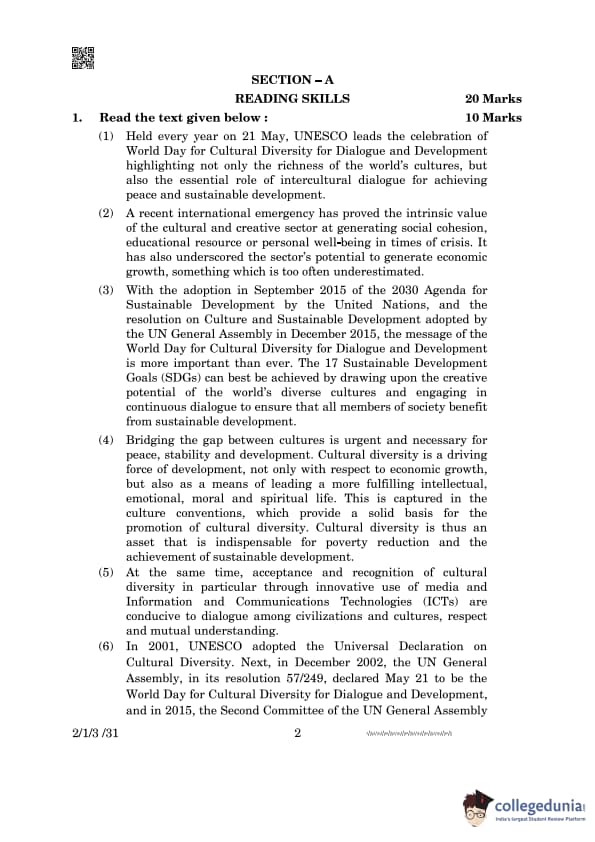
(1) Held every year on 21 May, UNESCO leads the celebration of World Day for Cultural
Diversity for Dialogue and Development highlighting not only the richness of the
world’s cultures, but also the essential role of intercultural dialogue for achieving peace
and sustainable development.
Read More
(2) A recent international emergency has proved the intrinsic value of the cultural andcreative sector at generating social cohesion, educational resource or personal
well-being in times of crisis. It has also underscored the sector’s potential to generate
economic growth, something which is too often underestimated.
(3) With the adoption in September 2015 of the 2030 Agenda for Sustainable Development
by the United Nations, and the resolution on Culture and Sustainable Development
adopted by the UN General Assembly in December 2015, the message of the World
Day for Cultural Diversity for Dialogue and Development is more important than ever.
The 17 Sustainable Development Goals (SDGs) can best be achieved by drawing upon
the creative potential of the world’s diverse cultures and engaging in continuous
dialogue to ensure that all members of society benefit from sustainable development.
(4) Bridging the gap between cultures is urgent and necessary for peace, stability and
development. Cultural diversity is a driving force of development, not only with respect
to economic growth, but also as a means of leading a more fulfilling intellectual,
emotional, moral and spiritual life. This is captured in the culture conventions, which
provide a solid basis for the promotion of cultural diversity. Cultural diversity is thus an
asset that is indispensable for poverty reduction and the achievement of sustainable
development.
(5) At the same time, acceptance and recognition of cultural diversity in particular through
innovative use of media and Information and Communications Technologies (ICTs) are
conducive to dialogue among civilizations and cultures, respect and mutual
understanding.
(6) In 2001, UNESCO adopted the Universal Declaration on Cultural Diversity. In
December 2002, the UN General Assembly, in its resolution 57/249, declared May 21 to
be the World Day for Cultural Diversity for Dialogue and Development, and in 2015,
the second committee of the UN General Assembly, unanimously adopted the resolution
on Culture and Sustainable Development, affirming culture’s contribution to the three
dimensions of sustainable development, acknowledging further the natural and cultural
diversity of the world, and recognizing that cultures and civilizations can contribute to,
and are crucial enablers of, sustainable development.
(7) The day provides us with an opportunity to deepen our understanding of the values of
cultural diversity and to achieve the goals of the UNESCO Convention on the
Protection and Promotion of the Diversity of Cultural Expressions adopted on 20
October, 2005.
Answer the following questions based on the above passage:
Based on the reading and understanding of the above passage, list 2 points to describe the purpose of UNESCO leading the celebration of World Day for Cultural Diversity for Dialogue and Development.
View Solution
Answer:
(a) To highlight the richness of the world's cultures and promote intercultural dialogue.
(b) To emphasize the role of cultural diversity in achieving peace and sustainable development.
Question 1(ii):
Select the option that corresponds to the meaning of the following sentence from para (2).
The recent international emergency has proved the intrinsic value of the cultural and creative sector at generating social cohesion, educational resource or personal well-being in times of crisis.
View Solution
Solution: The sentence explains that during the international emergency, the cultural and creative sectors demonstrated their ability to bring people together (social cohesion) and provide resources for education and well-being. Option (D) matches this meaning perfectly.
Question 1(iii):
Based on your reading of the passage, examine in about 40 words how Sustainable Development Goals can be achieved.
View Solution
Answer: Sustainable Development Goals (SDGs) can be achieved by promoting cultural diversity, encouraging creative sectors, and engaging in continuous intercultural dialogue. Recognizing the economic, intellectual, and social potential of cultures is key to achieving peace and sustainability.
Question 1(iv):
What is the tone of the writer in the given line from paragraph (4)? Rationalise your response in about 40 words.
“Cultural diversity is an asset.”
View Solution
Answer: The writer's tone is positive and appreciative. By calling cultural diversity an "asset," the writer emphasizes its importance in driving peace, stability, poverty reduction, and sustainable development. It reflects the writer's recognition of culture's crucial role.
Question 1(v):
The phrase ‘bridging the gap' in paragraph (4) refers to:
View Solution
Solution: The phrase "bridging the gap” refers to establishing connections or unity between two different ideas or cultures to bring peace and development.
Question 1(vi):
In sets a-e below, identify two sets of synonyms.
a richness and poverty
b intellectual and moral
c reduction and promotion
d essential and intrinsic
e urgent and crucial
View Solution
Solution: The words essential and intrinsic (d) are synonyms, as both refer to something fundamental or necessary. Similarly, urgent and crucial (e) are synonymous, meaning something extremely important or time-sensitive.
Question 1(vii):
Complete the sentence appropriately:
The Second Committee of UN General Assembly in 2015 adopted __________.
View Solution
Solution: In 2015, the UN General Assembly adopted the resolution on Culture and Sustainable Development, affirming culture's contribution to peace, diversity, and sustainable development.
Question 1(viii):
Complete the following sentence:
__________ is urgent and necessary for peace, stability and development.
View Solution
Solution: The phrase “Bridging the gap” refers to creating unity between cultures or ideas, which is essential for achieving peace, stability, and development in a diverse world.
2. Read the extract given below:
(1) The National Education Policy 2020 proposes the revision and revamping of all aspects
of education, including the educational structure, regulations and governance, to create a new
system which is aligned with the aspirational goals of 21st century students. According to the
policy, by 2025, at least 50% of learners through the school and higher education system shall
have exposure to skill education, for which a clear action plan with targets and timelines are
to be developed.
Read More
(2) The policy aims to overcome the social status hierarchy associated with skill educationand integration of skill education into mainstream education in all educational institutions in
a phased manner. Beginning with skill exposure at early ages in middle and secondary school,
quality skill education will be integrated smoothly into school and higher education.
(3) Every child will learn at least one skill and is exposed to several more. This would lead to
emphasizing the dignity of labour and importance of various vocations involving Indian arts
and artisanship.
(4) The development of skill capacities will go hand-in-hand with the development of ‘aca-
demic’ or other capacities. To achieve this objective, secondary schools will have to collabo-
rate with Industrial Training Institutes (ITIs), Polytechnics, Local Industry, etc. Skill labs will
also be set up and created in the schools in a Hub and Spoke model, which will allow other
schools to use the facility. Higher education institutions will offer skill education either on
their own or in partnership with industry and other institutions.
Question 2(i):
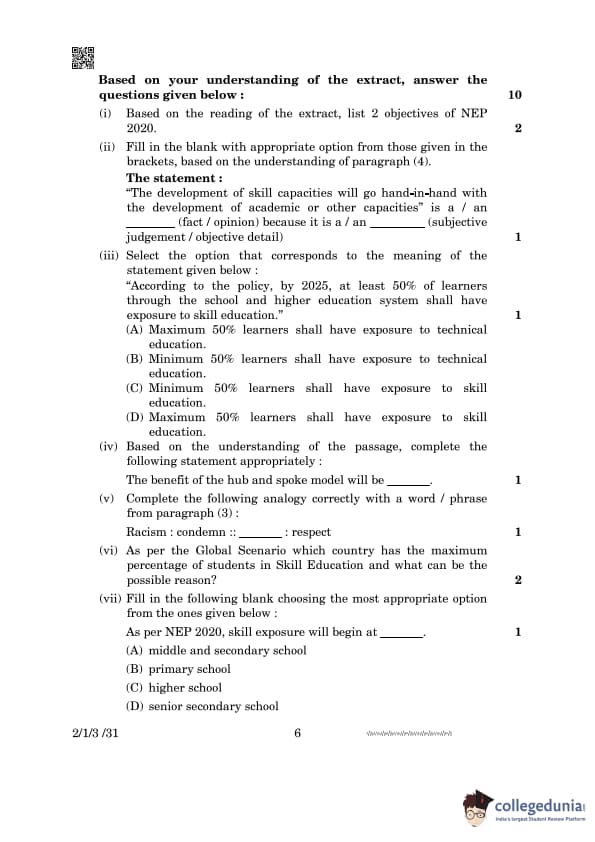
Based on the reading of the extract, list 2 objectives of NEP 2020.
View Solution
Answer: The National Education Policy (NEP) 2020 aims to reform the education system by integrating skill education into the mainstream learning process. The two key objectives are:
1. Skill Exposure by 2025: By 2025, at least 50% of learners through schools and higher education systems will have exposure to skill education. This objective focuses on equipping students with practical knowledge to meet the demands of the modern workforce.
2. Integration of Skill Education: NEP 2020 aims to remove the hierarchy associated with skill education and mainstream it across all educational institutions. Skill education will start early in middle and secondary schools and continue smoothly through higher education.
The NEP emphasizes holistic learning by combining academic and skill-based knowledge to produce a competent and skilled workforce, thus contributing to national development.
Question 2(ii):
Fill in the blank with the appropriate option from those given in the brackets, based on the understanding of paragraph (4).
The statement:
“The development of skill capacities will go hand-in-hand with the development of academic or other capacities” is a (fact / opinion) because it is a/an ________ (subjective judgement / objective detail).
View Solution
Answer: “The development of skill capacities will go hand-in-hand with the development of academic or other capacities” is an opinion because it is a subjective judgement.
Explanation:
• The statement expresses a belief or perspective rather than a verifiable fact, making it an opinion.
• A subjective judgement is specific and neutral. The policy explains the importance of balancing skill development with academic achievements to meet the aspirations of 21st-century learners.
Question 2(iii):
Select the option that corresponds to the meaning of the statement given below:
“According to the policy, by 2025, at least 50% of learners through the school and higher education system shall have exposure to skill education.”
View Solution
Answer: The statement clearly indicates that at least 50% of learners will gain exposure to skill education, which means it sets a minimum threshold. This implies that the target is a floor value, and more learners can be included in the future.
Explanation:
• The word “at least” suggests a minimum value.
• Skill education aims to equip students with essential competencies to ensure employability and productivity in the modern economy.
Thus, option (C) is the correct answer as it aligns with the stated objective of NEP 2020.
Question 2(iv):
Based on the understanding of the passage, complete the following statement appropriately:
The benefit of the hub and spoke model will be __________.
View Solution
Answer: The benefit of the hub and spoke model will be:
1. Allowing schools to share resources such as skill labs to reduce costs and improve efficiency.
2. Facilitating collaboration between schools and local industries, providing students access to practical, hands-on learning experiences.
The hub acts as a central facility for skill labs, while the spokes represent schools that utilize the hub's resources. This model enhances access to quality skill education for all learners.
Question 2(v):
Complete the following analogy correctly with a word / phrase from paragraph (3):
Racism : condemn :: __________: respect
View Solution
Solution: The analogy compares two relationships:
• Racism is condemned because it reflects a negative societal issue that must be opposed.
• In paragraph (3), the writer emphasizes the importance of “dignity of labour” and its value, stating that labour and skills deserve respect.
The analogy reflects that just as racism is condemned, dignity of labour is respected because it highlights the importance of valuing skills, hard work, and vocations.
Question 2(vi):
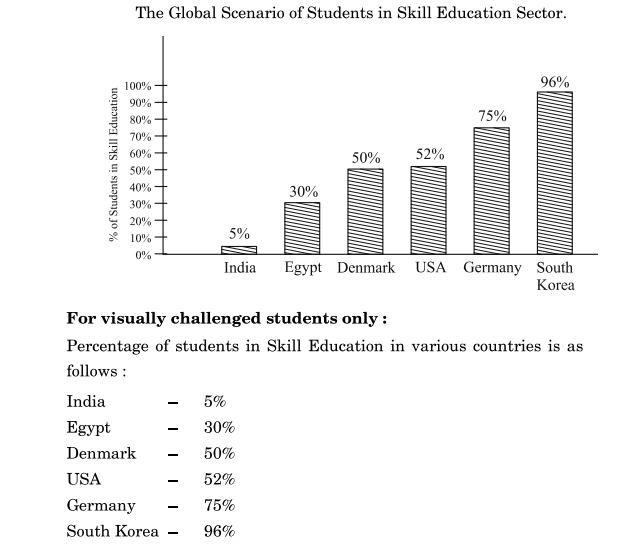
As per the Global Scenario, which country has the maximum percentage of students in Skill Education and what can be the possible reason?
View Solution
Answer: South Korea has the maximum percentage of students in Skill Education, with 96%.
Solution: South Korea's success in skill education can be attributed to the following reasons:
1. Strong Vocational Training System: South Korea has developed a robust vocational education framework aligned with industry demands. Students are equipped with practical skills that prepare them for employment.
2. Technological Advancements: Being a leader in technology and innovation, South Korea integrates skill training with technological learning.
3. Industry Collaboration: Educational institutions actively collaborate with industries to provide hands-on training and skill development opportunities.
4. Government Policies: Supportive policies promote skill education as a pathway to career success, reducing the stigma associated with vocational training.
This focus on skill-based education ensures high employability rates, addressing labor market demands efficiently.
Question 2(vii):
Fill in the following blank choosing the most appropriate option from the ones given below:
As per NEP 2020, skill exposure will begin at ______.
View Solution
Answer: According to NEP 2020, skill exposure will begin at the middle and secondary school levels. This stage is crucial because:
• It helps students develop practical skills alongside academic knowledge.
• Early exposure encourages exploration of various vocations, preparing students for future career paths.
• It reduces the social stigma associated with vocational education by integrating it into mainstream schooling.
This approach creates a balanced education system where students develop both academic and practical competencies.
Question 2(viii):
Justify the statement – ‘The NEP will create an awareness and appreciation of Indian arts and artisanship.'
View Solution
Answer: The National Education Policy (NEP) emphasizes the importance of integrating cultural and traditional values into education. It creates awareness and appreciation of Indian arts and artisanship through the following initiatives:
1. Inclusion in Curriculum: NEP 2020 promotes the integration of local art forms, crafts, and traditional knowledge into school and higher education curriculums. This ensures students understand and appreciate India's rich heritage.
2. Vocational Training: The NEP encourages skill-based education, including traditional arts and crafts. By learning artisanal skills, students can contribute to preserving Indian artisanship.
3. Promoting Dignity of Labour: NEP highlights the dignity of labour, encouraging students to value the contributions of artisans and workers.
4. Encouraging Local Talent: By collaborating with local artists and craftsmen, schools will act as a platform to promote regional art and create a sense of pride among learners.
5. Emphasis on Indian Culture: NEP encourages schools to organize workshops, exhibitions, and cultural events that focus on Indian arts, ensuring greater exposure and appreciation.
These measures aim to revive interest in India's cultural heritage and create a generation that values and respects its diverse arts and artisanship.
SECTION – B
GRAMMAR AND CREATIVE WRITING SKILLS
GRAMMAR
3. Complete ANY TEN of the following twelve tasks, as directed:
Question 3(i):
Fill in the blank by using the correct form of the word in the bracket, for the given portion of an email:
You will find in this email a brochure that _______ (present) the various tourist attractions in our city, aimed at boosting local tourism.
View Solution
Solution: The correct form of the verb is “presents” because the subject “brochure” is singular, requiring a singular verb to maintain subject-verb agreement. In present tense, verbs for singular subjects take an “-s” or “-es” ending.
Question 3(ii):
Read the given sentence. Identify the error and supply the correction in the sentence:
She don't like chocolate ice-cream.
| Error | Correction |
|---|
View Solution
Solution:
| Error | Correction |
|---|---|
| don't | doesn't |
The error lies in the use of “don’t”, which is incorrect for the singular subject “she.” The correct form is “doesn’t” because “does” is used for singular subjects in present tense.
Question 3(iii):
Read the conversation between a hostess and a customer. Complete the sentence by filling in the blank based on the conversation:
Hostess: Wonderful to see you again, sir!
Customer: Thanks, I couldn’t resist your delicious food.
The customer responded that __________.
View Solution
Solution: The customer’s response is reported in indirect speech, where pronouns and tense change. “I” becomes “he” (third person), and “your” changes to “her” to maintain consistency with the speaker's perspective.
Question 3(iv):
Read the dialogue between Raashi and Ratul regarding volunteer work:
Raashi: Have you encouraged others to volunteer?
Ratul: Absolutely, I always encourage my friends and family to consider volunteering.
Select the correct option to complete the reporting of the above dialogue:
Raashi asked Ratul __________. Ratul affirmed that he always encourages his friends and family to consider volunteering.
View Solution
Solution: In reported speech, when the direct speech is in the present perfect tense ("Have you encouraged"), it changes to the past perfect tense in reported speech. Therefore, "Have you encouraged others to volunteer?” becomes "whether he had encouraged others to volunteer.” The reporting verb "asked" also indicates that the question is being reported in an indirect manner.
Question 3(v):
Fill in the blank by choosing the correct option from the bracket, to complete the sentence:
Attached are the departmental performance reports and __________ (it / these / them) should be reviewed by each department head.
View Solution
Solution: The pronoun “these” is used to refer to plural nouns, such as “departmental performance reports” in this sentence. “It” is singular, and “them” is incorrect as it cannot act as a subject.
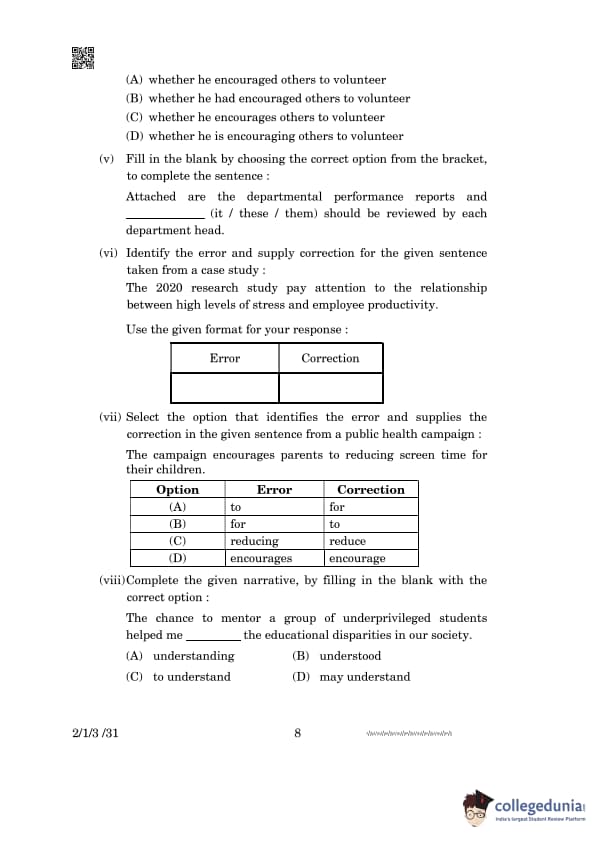
Question 3(vi):
Identify the error and supply correction for the given sentence taken from a case study:
The 2020 research study pay attention to the relationship between high levels of stress and employee productivity.
Use the given format for your response:
| Error | Correction |
|---|
View Solution
Solution:
| Error | Correction |
|---|---|
| pay | pays |
The error lies in the verb “pay”, which does not agree with the singular subject “The 2020 research study.” The correct form is "pays” to ensure subject-verb agreement.
Question 3(vii):
Select the option that identifies the error and supplies the correction in the given sentence from a public health campaign:
The campaign encourages parents to reducing screen time for their children.
View Solution
Solution: The error lies in the phrase "to reducing." The correct form is “to reduce” because the infinitive “to” must be followed by the base form of the verb, not the gerund.
Question 3(viii):
Complete the given narrative, by filling in the blank with the correct option:
The chance to mentor a group of underprivileged students helped me __________ the educational disparities in our society.
View Solution
Solution: The correct option is “to understand” because the structure of the sentence requires the base form of the verb after “helped me.” The phrase “helped me to understand” indicates the purpose or result of the mentoring opportunity.
Question 3(ix):
Report the dialogue between a vendor and his customer, by completing the sentence:
Vendor: Are you feeling alright today?
Customer: Yes, I’m doing much better than before.
The vendor asked his customer if he was feeling okay. The customer responded positively saying that __________.
View Solution
Solution: In reported speech, the present continuous tense “I’m doing” changes to the past continuous tense “he was doing.” The reporting verb "asked” introduces the question, while the response is reported using appropriate pronoun and tense changes.
Question 3(x):
Fill in the blank by choosing the correct option to complete the live feed on a school news channel:
In a miraculous turn of events, the Sunview School hockey team __________ the championship trophy.
View Solution
Solution: The verb "lifted” is in the simple past tense, which is appropriate here because the event has already been completed. Other options like “has been lifting” and “had lifted” suggest continuous or prior actions, which are incorrect in this context.
Question 3(xi):
Complete the line from a song, by filling in the blank with the correct option:
In the night, the stars _______ your dreams,
The moonlight guides your course,
The cool breeze whispers your name,
Leading you towards a new dawn.
View Solution
Solution: The verb "shine” is correct because “stars” is a plural subject, requiring a plural verb in the present tense. Options like “shines” are singular, and “shone” is the past tense, which does not fit here.
Question 3(xii):
Identify the error and supply correction for the following note in an environmental study:
The study examines the relation of carbon emissions and global warming.
Use the given format for your response:
| Error | Correction |
|---|
View Solution
Solution:
| Error | Correction |
|---|---|
| relation | relationship |
The correct word is “relationship” instead of “relation” because “relationship” better describes the connection or link between two factors like carbon emissions and global warming in an academic context.
CREATIVE WRITING SKILLS
4. Attempt ANY ONE from A and B given below:
Question 4(A):
You are Aman/Amita, living at 45-B, Bellaview Nagar. You want information about the French language course at La-France institute, Mohan Circle. Write a letter in about 120 words to the Director, Foreign Language enquiring about the details of the courses offered by the institution. In your letter include eligibility, duration of different courses, medium of instruction, examination cycle, etc.
View Solution
Solution:
45-B, Bellaview Nagar
Mohan Circle
New Delhi - 110001
March 25, 2024
The Director
La-France Institute
Mohan Circle
New Delhi - 110002
Subject: Enquiry Regarding French Language Course Details
Respected Sir/Madam,
I hope this letter finds you well. I am Amita, a resident of Bellaview Nagar, and I am interested in enrolling in the French language course at your esteemed institute. I request you to kindly provide the following details:
1. Eligibility criteria for beginner, intermediate, and advanced levels.
2. Duration and structure of each level of the course.
3. Medium of instruction (online/offline options).
4. Examination cycle, certification details, and assessment process.
5. Fee structure, installment options, and availability of weekend classes.
Kindly send me a brochure or any relevant information regarding the courses at your earliest convenience. I look forward to your prompt response and guidance.
Yours sincerely,
Amita Sharma
Contact Number: 9876543210
Email: amita.sharma@example.com
Question 4(B):
The Residents of Sunshine Society had put up a weekend carnival to raise funds for 'Apeksha,' a home for physically challenged. All items on sale were made by the residents themselves. As President of the society, Adil Kumar, write a letter in 120 words to the editor of the local daily, about this experience, appreciating the effort of the residents. Suggest how citizens must reach out to their communities, volunteer time and render help in any way they can.
View Solution
Solution:
Sunshine Society
Sector 14, Green Park
New Delhi - 110070
March 25, 2024
The Editor
The Daily Times
New Delhi - 110001
Subject: Appreciation for Residents' Efforts in Fundraising Carnival
Respected Sir/Madam,
Through the esteemed columns of your newspaper, I, Adil Kumar, President of Sunshine Society, wish to share a heartwarming and inspiring initiative undertaken by the residents of our society to support a noble cause.
Last weekend, our society organized a grand carnival to raise funds for 'Apeksha,' a home for the physically challenged. The event was a remarkable display of teamwork, generosity, and creativity. Residents contributed in every possible way—by preparing handmade crafts, delectable food, and organizing entertaining games and activities for visitors. The event witnessed enthusiastic participation from families, friends, and local citizens. We managed to collect a significant amount, all of which will directly benefit the residents of Apeksha.
The effort of our residents deserves immense appreciation as it highlights the importance of community service and social responsibility. It also reflects the power of small yet collective contributions in bringing meaningful changes to society.
I take this opportunity to encourage citizens from all walks of life to actively participate in such initiatives. By volunteering their time, skills, and resources, individuals can make a tangible difference in the lives of those in need. Whether through fundraising, organizing educational drives, or simply offering a helping hand, every act of kindness matters.
We hope our endeavor inspires others to step up and contribute to the welfare of their communities. Your esteemed publication can play a pivotal role in spreading this message and motivating readers to engage in similar activities.
Yours sincerely,
Adil Kumar
President, Sunshine Society
Contact: 9876543210
Email: adil.kumar@example.com
5. Attempt ANY ONE from A and B given below:
Question 5(A):
Teenagers have different tastes in spending their free time. The following data shows how teenagers spend their free time. Write an analytical paragraph in about 120 words analyzing how boys and girls spend their free time:
| S. No. | Hobbies | Boys (%) | Girls (%) |
|---|---|---|---|
| 1 | Reading books and comics | 12% | 25% |
| 2 | Watching movies and songs | 15% | 35% |
| 3 | Talking to their friends | 10% | 20% |
| 4 | Watching sports | 16% | 4% |
| 5 | Playing outdoor and indoor games | 40% | 20% |
View Solution
Solution: The data provided showcases how teenagers—boys and girls—spend their free time engaging in various hobbies. The differences in choices and preferences between the two genders are both striking and insightful.
Playing outdoor and indoor games is the most preferred activity for boys, with 40% of them choosing to spend their leisure time this way. This highlights boys' inclination towards physical and recreational activities that involve movement, energy, and competition. In comparison, only 20% of girls prefer this hobby, showing that physical activities are less favored among them.
On the other hand, watching movies and songs is the most popular choice among girls, with 35% participation. This is more than twice the number of boys (15%) engaging in the same activity. This suggests that girls prefer entertainment and relaxing activities more often than boys, reflecting their preference for passive forms of leisure.
Another significant observation is the interest in reading books and comics. A considerable 25% of girls enjoy reading, while only 12% of boys show interest in this hobby. This indicates that girls favor activities that are creative, intellectual, and provide knowledge or relaxation.
In contrast, boys exhibit a stronger interest in watching sports, with 16% participating in this activity compared to a mere 4% of girls. This difference highlights that boys tend to enjoy competitive and spectator-based activities more than girls.
The hobby of talking to their friends is another notable point of comparison. Here, 20% of girls choose to socialize in their free time, whereas only 10% of boys engage in this activity. This suggests that girls are more inclined toward building emotional connections and communicating during their leisure hours.
To summarize, the data clearly shows that boys prefer outdoor games and sports, which are physical and competitive in nature. On the other hand, girls are more inclined toward passive hobbies like watching movies, reading books, and socializing with their friends. These trends reflect the diverse ways teenagers spend their free time and highlight the differences in their preferences based on gender.
Question 5(B):
Read the following excerpt taken from an article that appeared in the magazine section of a local daily:
“A recent study has revealed that the prevalence of obesity among school children is on a steady rise. Consumption of food with high glycaemic index, change in sleep patterns, reduced physical activity and the increased screen time has been linked to obesity in children. This is an emerging public health problem in the country.”
Taking help from the above, write an analytical paragraph for your school magazine in about 120 words. You are Sonika/Sahil.
View Solution
Solution: The rising prevalence of childhood obesity has become a significant public health concern in our country. Modern lifestyles have led to habits that contribute to this crisis, including the consumption of food with a high glycaemic index, lack of physical activity, and prolonged screen time.
Fast food and sugary drinks have replaced healthy, home-cooked meals. These foods spike blood sugar levels, increase fat accumulation, and make children prone to obesity. Additionally, advancements in technology have led children to spend long hours on screens—playing video games, watching TV, or using mobile phones—at the cost of outdoor physical activities like sports and cycling.
Sleep deprivation further worsens the situation. Irregular sleeping habits disrupt the body’s metabolism, causing weight gain. With reduced physical activity, energy expenditure declines, leading to fat storage.
This problem poses serious health risks, such as diabetes, cardiovascular diseases, and low self-esteem among children. It is no longer an individual issue but a growing societal challenge that needs urgent attention.
Solutions must begin at home and school. Parents must ensure that children have access to nutritious food and encourage an active lifestyle. Schools should incorporate physical education programs, awareness drives, and regular fitness activities. Furthermore, society as a whole should promote campaigns to educate families about the importance of a balanced diet and physical activity.
In conclusion, combating obesity in children requires a collective effort. By adopting healthier habits and raising awareness, we can ensure a fitter and healthier generation.
Section - C
LITERATURE TEXT BOOK
6. Read the following extracts and answer the questions for ANY ONE of the given two:
Question 6(A)(i):
On the day of the inauguration, I was overwhelmed with a sense of history. In the first decade of the 20th century, a few years after the bitter Anglo-Boer war and before my own birth, the white skinned people of South Africa patched up their differences and created a system of racial domination against the dark-skinned people of their own land. The structure they created formed the basis of one of the harshest, most inhumane societies the world has ever known. Now, in the last decade of the twentieth century, and my own eighth decade as a man, that system has been overturned forever and replaced by one that recognised the rights and freedoms of all peoples, regardless of the colour of their skin.
(i) Explain the feelings of the narrator when he said; “I was overwhelmed with a sense of history."
View Solution
Solution: The narrator felt an intense emotional connection to the historical event he was witnessing. Being a part of a significant moment that symbolized the end of years of racial discrimination and apartheid in South Africa filled him with pride and humility. It was a culmination of years of struggle, sacrifice, and perseverance by millions of oppressed people. The narrator realized that this event marked not only political freedom but also the restoration of dignity, equality, and justice for people of all races. It was a celebration of victory against a system that had once divided the society so deeply. The moment represented a turning point in history, and the narrator felt honored to be alive to experience it.
Question 6(A)(ii):
The system of racial domination has been replaced by a system that:
View Solution
Solution: The system that replaced racial domination is one based on justice, equality, and freedom. It recognizes the rights and freedoms of all individuals, regardless of their race or color. Unlike the oppressive apartheid regime, which denied basic human rights to the Black population, the new system aims to ensure equal opportunities for everyone. It promotes harmony among diverse communities and strives to remove social, economic, and political inequalities that existed under apartheid. By acknowledging the rights of all people, this system lays the foundation for a more inclusive and progressive society where individuals can thrive based on merit and hard work rather than racial identity.
Question 6(A)(iii):
Comment on the kind of society apartheid had created?
View Solution
Solution: The apartheid system in South Africa created an unjust, cruel, and inhumane society. It was built on the principle of racial segregation, where the white population enjoyed privilege, while the Black population faced oppression and humiliation. Black South Africans were denied basic rights such as education, healthcare, and employment opportunities. They were forced to live in separate areas, attend separate schools, and work in degrading conditions with minimal wages. Apartheid fueled social and economic inequalities, leading to resentment and bitterness among the oppressed people. The system institutionalized racism, breaking families apart and shattering dreams for generations. It created a divided nation, where humanity and dignity were disregarded in favor of racial superiority.
Question 6(A)(iv):
Which phrase would correctly substitute ‘patched up’ in the given sentence from the extract:
“…the white skinned people of South Africa patched up their differences…”
View Solution
Solution: The phrase 'patched up' refers to temporarily resolving conflicts or disagreements. In this context, it means that the white-skinned people of South Africa managed to settle their internal issues or disputes for a short-term goal. However, this resolution was not permanent and was more of a compromise to serve their immediate interests. The phrase reflects that the unity among them was fragile and not built on genuine understanding or harmony. It highlights how historical conflicts and differences were set aside to create a dominant system of control over the dark-skinned population.
Question 6(B)(i):
I started right away at the Montessori Nursery School. I stayed there until I was six, at which time I started in the first form. In the sixth form, my teacher was Mrs. Kuperus, the headmistress. At the end of the year we were both in tears as we said a heartbreaking farewell. In the summer of 1941, Grandma fell ill and had to have an operation, so my birthday passed with little celebration.
(i) “In the summer of 1941, Grandma fell ill and had to have an operation, so my birthday passed with little celebration.”
State any one inference about Anne from the above context.
View Solution
Solution: The given context highlights Anne’s deep emotional connection with her family. Despite being a child, she understands the gravity of her grandmother’s illness, which overshadows her birthday celebration. This shows Anne’s maturity, empathy, and understanding nature. Her disappointment over her birthday not being celebrated also reveals her sensitivity and longing for family attention during significant moments.
Question 6(B)(ii):
The first education of Anne started at ______.
View Solution
Solution: Anne’s education began at the Montessori Nursery School. This is explicitly mentioned in the passage where she talks about starting her education at the Montessori Nursery School and staying there until she was six. This institution was instrumental in shaping her early learning years.
Question 6(B)(iii):
Who was Mrs. Kuperus? What kind of relationship did Anne share with her?
View Solution
Solution: Mrs. Kuperus was Anne’s teacher and the headmistress at the Montessori Nursery School. Anne shared a close and affectionate relationship with Mrs. Kuperus. Their bond was evident when they both cried at the end of the year during their farewell. This emotional farewell shows that Mrs. Kuperus was not just a teacher but also a significant figure in Anne’s early life who deeply cared for her growth and development. The tears symbolized the warmth and emotional connection between a student and a mentor, making the farewell truly heartbreaking for Anne.
Question 6(B)(iv):
Substitute the word ‘heartbreaking’ with a word similar in meaning in the following sentence:
“At the end of the year we were both in tears as we said a heartbreaking farewell.”
View Solution
Solution: The word 'heartbreaking' can be substituted with the word “sorrowful” or “emotional”.
Rewritten Sentence:
“At the end of the year we were both in tears as we said a sorrowful farewell.”
“At the end of the year we were both in tears as we said an emotional farewell.”
These words convey the same idea of intense sadness and emotional pain caused by the farewell.
7. Read the following extracts and answer the questions for ANY ONE of the given two:
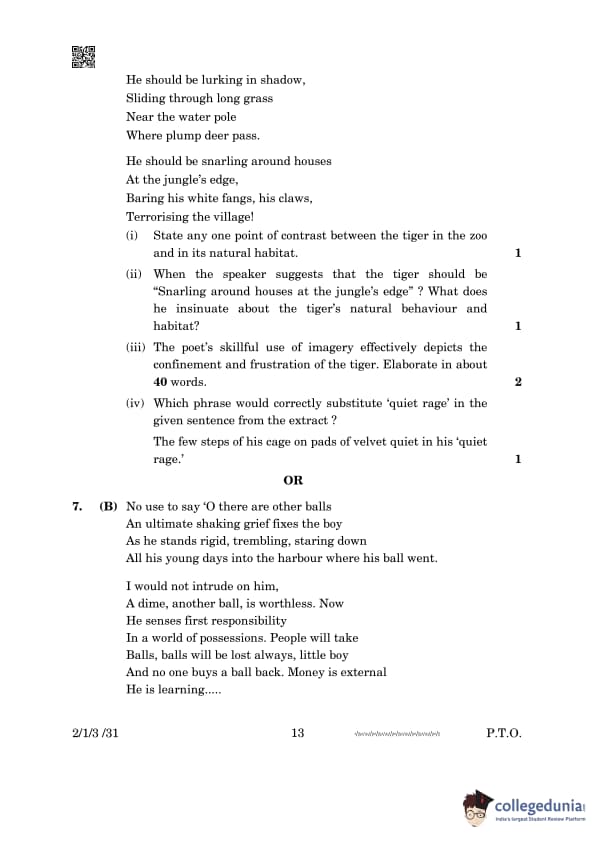
Question 7(A)(i):
He stalks in his vivid stripes
The few steps of his cage,
On pads of velvet quiet,
In his quiet rage.
He should be lurking in shadow,
Sliding through long grass
Near the water hole
Where plump deer pass.
He should be snarling around houses
At the jungle’s edge,
Baring his white fangs, his claws,
Terrorising the village!
(i) State any one point of contrast between the tiger in the zoo and in its natural habitat.
View Solution
Solution: The tiger in the zoo is confined to a cage and paces in frustration, unable to move freely or exhibit its natural instincts. In contrast, in its natural habitat, the tiger lurks in the shadows, slides through long grass, and hunts near waterholes, reflecting its freedom and power.
Question 7(A)(ii):
When the speaker suggests that the tiger should be “Snarling around houses at the jungle’s edge,” what does he insinuate about the tiger’s natural behaviour and habitat?
View Solution
Solution: The speaker insinuates that in its natural habitat, the tiger is a fierce and dominant predator. It roams freely, displaying its power and authority. By "snarling around houses,” the tiger symbolizes its wild, untamed nature, and its instinct to hunt and protect its territory.
Question 7(A)(iii):
The poet’s skillful use of imagery effectively depicts the confinement and frustration of the tiger. Elaborate in about 40 words.
View Solution
Solution: The poet uses vivid imagery to depict the tiger’s frustration in captivity. Phrases like “few steps of his cage,” “pads of velvet quiet,” and “quiet rage” highlight its suppressed instincts, anger, and helplessness in the confined space of a zoo.
Question 7(A)(iv):
Which phrase would correctly substitute ‘quiet rage’ in the given sentence from the extract:
“The few steps of his cage on pads of velvet quiet in his ‘quiet rage.’”
View Solution
Solution: The phrase "silent anger” or “muted fury” can correctly substitute 'quiet rage.' Both phrases express the tiger’s suppressed anger and frustration while being unable to act due to its confinement.
Question 7(B)(i):
No use to say ‘O there are other balls
An ultimate shaking grief fixes the boy
As he stands rigid, trembling, staring down
All his young days into the harbour where his ball went.
I would not intrude on him,
A dime, another ball, is worthless. Now
He senses first responsibility
In a world of possessions. People will take
Balls, balls will be lost always, little boy
And no one buys a ball back. Money is external
He is learning.....
(i) Which of the following best describes the speaker’s attitude towards the boy’s reaction to losing his ball?
View Solution
Solution: The speaker’s attitude is sympathetic and understanding. He does not dismiss the boy’s grief, realizing that the loss of the ball teaches the boy a deeper life lesson about responsibility, loss, and the external nature of material possessions. The speaker respects the boy’s emotional journey without interfering.
Question 7(B)(ii):
Comment on the use of metaphor in the above extract.
View Solution
Solution: The ball in the extract serves as a metaphor for the valuable things in life that may be lost forever, such as innocence or childhood. Losing the ball symbolizes a deeper understanding of responsibility and the inevitability of loss in life. The phrase "money is external" further reinforces the metaphor by emphasizing that material possessions cannot replace emotional experiences.
Question 7(B)(iii):
Explain the phrase ‘all his young days into the harbour’ with reference to the extract.
View Solution
Solution: The phrase "all his young days into the harbour” signifies the boy’s realization of loss and growing up. Watching the ball float away represents his lost innocence and childhood days, which can never be retrieved. The harbour symbolizes a vast, uncontrollable force of life, where precious moments are lost, teaching the boy about grief, responsibility, and the transience of life.
Question 7(B)(iv):
Briefly state in about 40 words the boy’s journey from ‘shaking grief’ to ‘he is learning’ in the above extract.
View Solution
Solution: The boy begins with overwhelming grief, trembling and staring at the lost ball. As he processes his loss, he learns a valuable lesson about responsibility and the nature of possessions. This emotional journey marks his growth and acceptance of life’s inevitable losses.
8. Answer ANY FOUR of the following five questions in 40-50 words each:
Question 8(i):
What mood of the poet is reflected in the poem ‘Dust of Snow’ initially? What images are used by the poet to bring about the effect? Comment.
View Solution
Solution: The initial mood of the poet in the poem ‘Dust of Snow’ is gloomy and sorrowful. The poet uses simple yet effective imagery, such as the 'dust of snow' falling from a hemlock tree and the crow, to create a contrast. The imagery symbolizes the poet’s transformation, where the snow’s touch refreshes his mind and lifts his spirits. The small incident brings a sudden positive change to the poet’s mood.
Question 8(ii):
How far would you agree that one’s positivity can bring in a spark of brightness even in adverse circumstances?
View Solution
Solution: Positivity has the power to transform even the most difficult situations into opportunities for growth and hope. A small moment of joy or optimism can act as a spark that changes one’s outlook. For instance, the poem ‘Dust of Snow’ reflects how a seemingly trivial event brightened the poet’s dark mood. Even in adversity, focusing on positive aspects can uplift one’s spirit and inspire resilience.
Question 8(iii):
What makes Custard, the dragon, look fearsome? Explain.
View Solution
Solution: Custard, the dragon from ‘The Tale of Custard the Dragon’, appears fearsome because of his sharp physical attributes and demeanor. He is described as having big sharp teeth, spikes on his back, and the ability to roar like a train. His overall appearance intimidates others, and when faced with a real threat, Custard demonstrates his courage by fearlessly fighting and defeating the pirate. Despite being ridiculed earlier, his brave actions make him a hero.
Question 8(iv):
Explain why the speaker mentions God in the poem “For Anne Gregory”.
View Solution
Solution: In the poem ‘For Anne Gregory’, the speaker mentions God to emphasize the contrast between physical beauty and inner qualities. The speaker asserts that while humans are often attracted to appearances, only God can see beyond external beauty and appreciate a person’s true character. The mention of God highlights the deeper moral lesson that inner goodness is eternal, whereas physical beauty is superficial and temporary.
Question 8(v):
What message might the Buddha’s story hold for those who are in positions of power and privilege?
View Solution
Solution: The Buddha’s story conveys a powerful message for those in positions of power and privilege. It teaches the value of compassion, humility, and the impermanence of life. The privileged must realize that power and wealth are temporary and that true happiness lies in selflessness and kindness toward others. By being mindful of their responsibilities, they can use their position to uplift the less fortunate and bring balance to society. The story serves as a reminder that attachment to material possessions and pride can lead to suffering, and only through understanding and wisdom can one attain inner peace and fulfillment.
9. Answer ANY TWO of the following three questions in 40-50 words each:
Question 9(i):
Scientists contribute to make the world a better place. Griffin is an antithesis to this statement. Justify. (Footprints Without Feet)
View Solution
Solution: Griffin, though a brilliant scientist, misuses his knowledge for evil purposes. Instead of using his discovery of invisibility for the betterment of humanity, he indulges in theft, violence, and destruction. His actions show how scientific brilliance without moral values can become a curse for society. Griffin’s choices make him an antithesis to the idea that science benefits the world.
Question 9(ii):
Why did Bholi’s teacher feel like an artist admiring her masterpiece? (Bholi)
View Solution
Solution: Bholi’s teacher felt like an artist admiring her masterpiece because she transformed Bholi from a shy, neglected girl into a confident and courageous individual. Through constant encouragement, support, and education, the teacher shaped Bholi’s personality, enabling her to stand up for herself and reject injustice, which made the teacher proud of her creation.
Question 9(iii):
What is common about the role that Dr. Urquhart and Mr. Weiherer played in Richard Ebright’s life? Describe any one commonality with evidence from the text “The Making of a Scientist.”
View Solution
Solution: Both Dr. Urquhart and Mr. Weiherer played significant roles as mentors in Richard Ebright’s life, shaping his path to becoming a successful scientist. The commonality between their roles lies in the way they guided, encouraged, and inspired him to pursue his scientific interests. Dr. Urquhart, a scientist at the University of Toronto, was instrumental in sparking Ebright’s interest in scientific research. He motivated Richard to explore the world of butterflies and their migration patterns. Dr. Urquhart’s support allowed Ebright to contribute to groundbreaking discoveries, including his research on the hormone that controls the migration of monarch butterflies. On the other hand, Mr. Weiherer, Richard’s teacher, also recognized his immense potential and pushed him to achieve greater heights. He encouraged Richard to participate in scientific competitions, giving him the confidence to excel in his research and academic pursuits. In conclusion, both Dr. Urquhart and Mr. Weiherer shared the common role of mentors who identified Ebright’s talent early and nurtured his scientific curiosity, paving the way for his success.
10. Answer ANY ONE of the following two questions in 100-120 words:
Question 10(i):
In the chapter ‘A Baker from Goa’ the narrator talks about his childhood in Goa and his fond memories. In about 120 words write a presentation draft comparing the childhood of the narrator in ‘A Baker from Goa’ to that of Nelson Mandela.
View Solution
Solution: Childhood memories remind us of the days gone by. In the chapter 'A Baker from Goa', the narrator reminisces about the simple joys of his childhood in Goa. He fondly remembers the baker’s visits, the delicious bread, and the joy it brought to families. The baker symbolized community bonding and a cherished part of his growing years.
In contrast, Nelson Mandela’s childhood, as mentioned in ‘Long Walk to Freedom', was spent in the rural countryside. Mandela had a carefree childhood playing in open fields, but his perspective changed when he realized the hardships of racial discrimination. Unlike the narrator’s light-hearted memories, Mandela’s childhood laid the foundation for his struggle against apartheid.
Both childhoods reflect contrasting realities—one of carefree joy and the other a preparation for a larger purpose in life.
Question 10(ii):
Amanda from the poem ‘Amanda’ is a teenager like Anne Frank and lives in her fantasy world whereas Anne is a chatterbox. What conversation will Anne Frank have with Amanda about different perspectives of life? Write your answer in about 120 words.
View Solution
Solution: If Anne Frank met Amanda, their conversation would reflect their contrasting outlooks on life. Amanda would describe her fantasy world as a refuge from constant nagging and societal expectations. She longs to be a mermaid, orphan, or princess, enjoying peace and freedom in her imagination.
Anne Frank, on the other hand, would gently share her perspective. Despite living in hiding during World War II, Anne remained optimistic and found joy in the little things. She valued human connection and appreciated life even during hardships. Anne would advise Amanda to embrace her real life, face challenges courageously, and seek happiness in her relationships and surroundings.
Their conversation would highlight Amanda’s escapism and Anne’s resilience in finding hope amidst adversity.
11. Answer ANY ONE of the following two questions in 100-120 words:
Question 11(i):
How did the lady in red manage to outsmart and outmaneuver the other thief, Horace Danby, by robbing the safe without leaving a single fingerprint? (A Question of Trust)
View Solution
Solution: The lady in red used her intelligence and clever manipulation to outsmart Horace Danby. Horace, a professional thief, was caught red-handed by the lady while he was breaking into a safe. Instead of panicking, the lady quickly assumed the role of the house owner. She confidently confronted Horace, making him believe she was a wealthy woman embarrassed to have forgotten her keys.
The lady’s calm demeanor and fabricated story about needing the jewels for a party convinced Horace to trust her. She avoided touching anything and made Horace open the safe, ensuring that only his fingerprints were left behind. This tactical move saved her from suspicion and successfully framed Horace for the crime. The lady’s quick thinking and manipulation highlight her resourcefulness and ability to stay composed under pressure.
Horace, blinded by trust and guilt, failed to see through her trickery. In the end, the lady in red proved herself to be the superior thief, escaping with the jewels and leaving Horace to take the blame. This incident reflects how wit and presence of mind can overpower even experienced individuals.
Question 11(ii):
Hari Singh says – “He knew it but neither his lips nor his eyes showed anything.” Anil successfully addressed the situation by not addressing it at all. Elaborate based on your reading of The Thief’s Story.
View Solution
Solution: In The Thief’s Story, Anil’s reaction to Hari Singh’s theft reveals his wisdom and understanding. Hari Singh, a young thief, stole money from Anil while he was asleep. However, he later felt guilty and returned the money. The next morning, Anil’s behavior remained unchanged—he neither confronted Hari nor showed any signs of anger or disappointment.
Anil’s decision to remain silent reflects his belief in forgiveness and second chances. Instead of rebuking Hari for his actions, he chose to trust him again, subtly encouraging him to reform. Anil’s calm and mature handling of the situation made a profound impact on Hari. By not addressing the theft, Anil acknowledged Hari’s internal struggle and gave him an opportunity to change for the better.
This incident highlights the power of trust and kindness in bringing out the best in others. Anil’s actions helped Hari realize the value of honesty and led him toward a more honest life. Anil’s approach demonstrates that sometimes, silence and trust can teach stronger lessons than anger or punishment.
Through this, the story conveys the message that empathy, understanding, and belief in someone’s potential can transform even the most dishonest individuals. Anil’s quiet response turned Hari’s life around, showing that true strength lies in patience and forgiveness.













Comments