




CBSE Class 10 Mathematics Basic Question Paper 2024 PDF (Set 1- 430/2/1) is available for download here. CBSE conducted the Mathematics Basic exam on March 11, 2024 from 10:30 AM to 1:30 PM. The total marks for the theory paper are 80. The question paper contains 20% MCQ-based questions, 40% competency-based questions, and 40% short and long answer type questions.
CBSE Class 10 Mathematics Basic Question Paper 2024 with Answer Key (Set 1- 430/2/1)
| CBSE Class 10 Mathematics Question Paper with Answer Key (Set 1 – 430/2/1) |  Download Download |
Check Solution |
CBSE Class 10 Mathematics Question Paper With Solutions
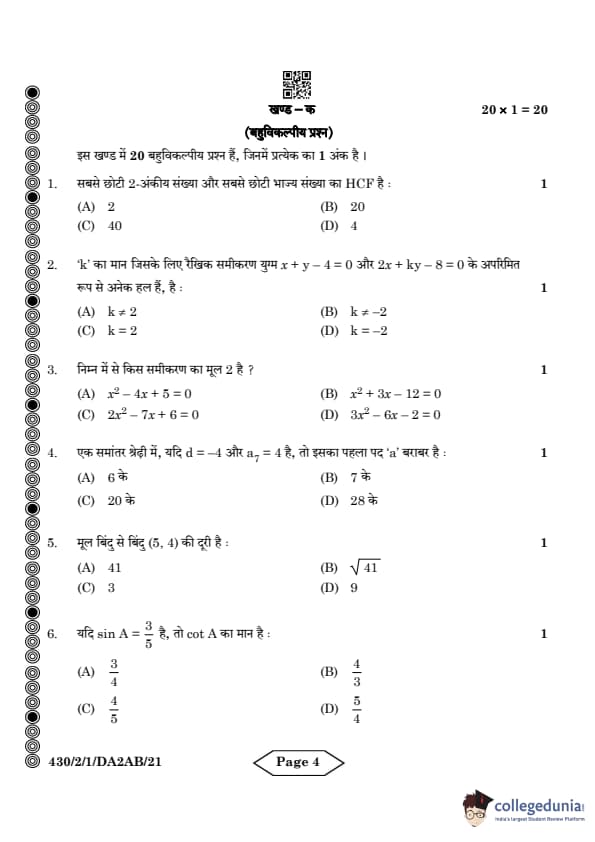
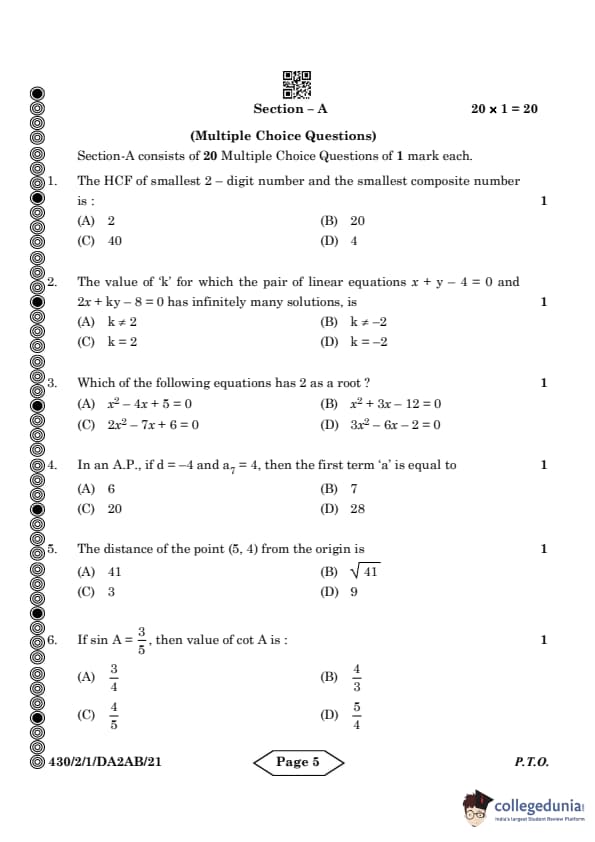
The HCF of the smallest 2-digit number and the smallest composite number is:
View Solution
\[ Smallest 2-digit number = 10 \] \[ Smallest composite number = 4 \]
We need to find the HCF of 10 and 4.
Prime factorization of 10: \( 10 = 2 \times 5 \)
Prime factorization of 4: \( 4 = 2 \times 2 \)
The common factor is 2, so the HCF is 2. Quick Tip: To find the HCF of two numbers, factorize both numbers and choose the common prime factor with the lowest power.
The value of ‘k’ for which the pair of linear equations \( x + y - 4 = 0 \) and \( 2x + ky - 8 = 0 \) has infinitely many solutions is:
View Solution
For two linear equations to have infinitely many solutions, their ratios must be equal, i.e., \[ \frac{A_1}{A_2} = \frac{B_1}{B_2} = \frac{C_1}{C_2} \]
For the given equations,
First equation: \( x + y - 4 = 0 \) can be written as: \[ 1x + 1y - 4 = 0 \]
Second equation: \( 2x + ky - 8 = 0 \) can be written as: \[ 2x + ky - 8 = 0 \]
Now, compare the coefficients: \[ \frac{1}{2} = \frac{1}{k} = \frac{-4}{-8} \]
From \( \frac{1}{k} = \frac{1}{2} \), we find \( k = 2 \). Quick Tip: For infinitely many solutions, the coefficients of the variables and constants must be in the same ratio for both equations.
Which of the following equations has 2 as a root?
View Solution
To check if 2 is a root, substitute \( x = 2 \) in each equation:
For \( x^2 - 4x + 5 = 0 \): \[ % Option (2)^2 - 4(2) + 5 = 4 - 8 + 5 = 1 \quad (not zero, so 2 is not a root) \]
For \( x^2 + 3x - 12 = 0 \): \[ % Option (2)^2 + 3(2) - 12 = 4 + 6 - 12 = -2 \quad (no, 2 is not a root) \]
For \( 2x^2 - 7x + 6 = 0 \) : \[ (2(2)^2 - 7(2) + 6 = 8 - 14 + 6 = 0 \quad (yes, 2 is a root) \]
Thus, the correct answer is (C). Quick Tip: To check if a number is a root, substitute it into the equation. If the result is 0, then it is a root.
In an A.P., if \( d = -4 \) and \( a_7 = 4 \), then the first term ‘a’ is equal to:
View Solution
In an Arithmetic Progression (A.P.), the nth term is given by: \[ a_n = a + (n-1) \cdot d \]
For the 7th term, \( a_7 = a + 6d \).
Substitute the given values: \[ a_7 = 4 \quad and \quad d = -4 \] \[ 4 = a + 6(-4) \] \[ 4 = a - 24 \] \[ a = 4 + 24 = 28 \]
Thus, the first term \( a = 28 \). The correct answer is (D). Quick Tip: In an A.P., use the formula \( a_n = a + (n-1) \cdot d \) to find any term if you know the first term and common difference.
The distance of the point (5, 4) from the origin is:
View Solution
The distance of a point \( (x, y) \) from the origin is given by the formula: \[ Distance = \sqrt{x^2 + y^2} \]
For the point \( (5, 4) \): \[ Distance = \sqrt{5^2 + 4^2} = \sqrt{25 + 16} = \sqrt{41} \]
Thus, the correct answer is (A) \( \sqrt{41} \). Quick Tip: To find the distance between a point and the origin, use the distance formula \( \sqrt{x^2 + y^2} \).
If \( \sin A = \frac{3}{5} \), then the value of \( \cot A \) is:
View Solution
We are given that \( \sin A = \frac{3}{5} \).
We know the identity: \[ \sin^2 A + \cos^2 A = 1 \]
Substituting the value of \( \sin A = \frac{3}{5} \): \[ \left( \frac{3}{5} \right)^2 + \cos^2 A = 1 \] \[ \frac{9}{25} + \cos^2 A = 1 \] \[ \cos^2 A = 1 - \frac{9}{25} = \frac{25}{25} - \frac{9}{25} = \frac{16}{25} \] \[ \cos A = \frac{4}{5} \quad (since cosine is positive in the first quadrant) \]
Now, \( \cot A = \frac{\cos A}{\sin A} \): \[ \cot A = \frac{\frac{4}{5}}{\frac{3}{5}} = \frac{4}{3} \]
Thus, the correct answer is (A) \( \frac{4}{3} \). Quick Tip: To find \( \cot A \), use the identity \( \cot A = \frac{\cos A}{\sin A} \). First, use \( \sin^2 A + \cos^2 A = 1 \) to find \( \cos A \).
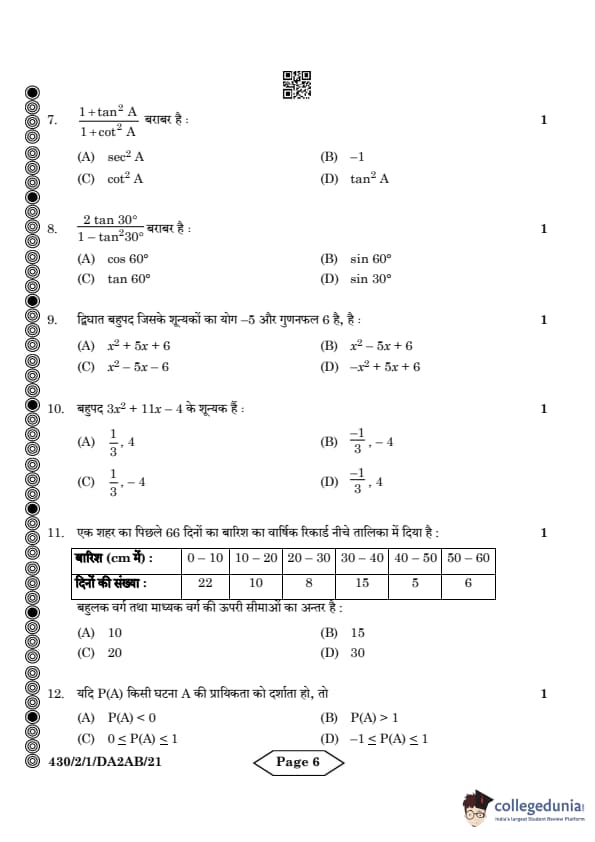
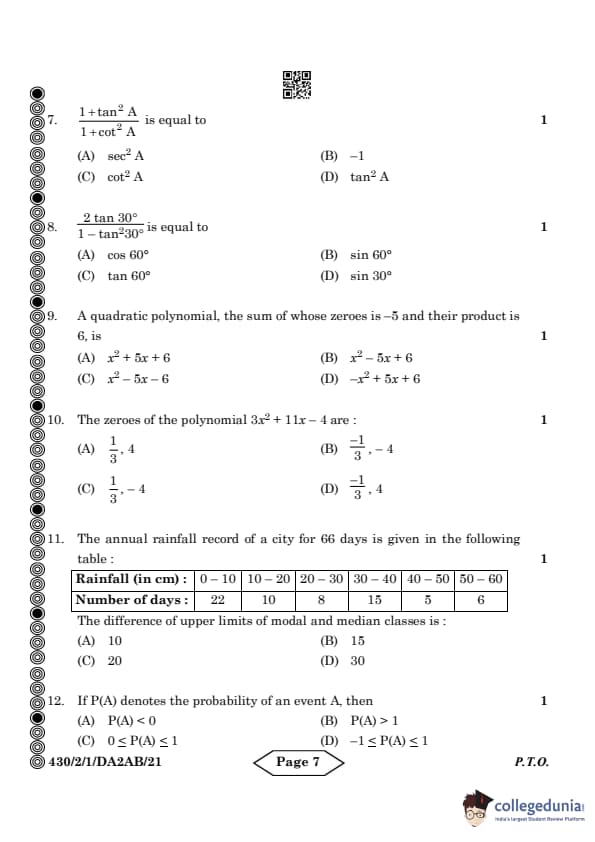
\( \frac{2 \tan 30^\circ}{1 - \tan^2 30^\circ} \) is equal to:
View Solution
We are given the expression: \[ \frac{2 \tan 30^\circ}{1 - \tan^2 30^\circ} \]
This is a standard identity for the tangent of double an angle, i.e., \[ \tan(2A) = \frac{2 \tan A}{1 - \tan^2 A} \]
So, for \( A = 30^\circ \), the expression simplifies to: \[ \tan(2 \times 30^\circ) = \tan 60^\circ \]
Now, we know that \( \tan 60^\circ = \sqrt{3} \).
Thus, the given expression equals \( \tan 60^\circ \), which is (C). Quick Tip: The identity \( \frac{2 \tan A}{1 - \tan^2 A} = \tan(2A) \) is useful for simplifying expressions involving double angles.
The zeros of the polynomial \( 3x^2 + 11x - 4 \) are:
View Solution
We are given the quadratic polynomial \( 3x^2 + 11x - 4 \).
To find the zeros, we use the quadratic formula: \[ x = \frac{-b \pm \sqrt{b^2 - 4ac}}{2a} \]
For the given polynomial \( 3x^2 + 11x - 4 \), the coefficients are \( a = 3 \), \( b = 11 \), and \( c = -4 \).
Substitute these values into the quadratic formula: \[ x = \frac{-11 \pm \sqrt{11^2 - 4(3)(-4)}}{2(3)} \] \[ x = \frac{-11 \pm \sqrt{121 + 48}}{6} \] \[ x = \frac{-11 \pm \sqrt{169}}{6} \] \[ x = \frac{-11 \pm 13}{6} \]
Thus, the two solutions are: \[ x = \frac{-11 + 13}{6} = \frac{2}{6} = \frac{1}{3} \] \[ x = \frac{-11 - 13}{6} = \frac{-24}{6} = -4 \]
Therefore, the zeros are \( \frac{1}{3} \) and \( -4 \), so the correct answer is (C). Quick Tip: The quadratic formula \( x = \frac{-b \pm \sqrt{b^2 - 4ac}}{2a} \) can be used to find the roots (zeros) of any quadratic equation.
The annual rainfall record of a city for 66 days is given in the following table:
The difference of the upper limits of the modal and median classes is:
View Solution
1. Modal Class:
The modal class is the class with the highest frequency. From the table:
- 0-10 cm: 22 days
- 10-20 cm: 10 days
- 20-30 cm: 8 days
- 30-40 cm: 15 days
- 40-50 cm: 5 days
- 50-60 cm: 6 days
The class 0-10 cm has the highest frequency (22 days), so the modal class is 0-10 cm.
2. Median Class:
To find the median class, we need to calculate the cumulative frequency.
- Cumulative frequency up to 0-10 cm: 22
- Cumulative frequency up to 10-20 cm: 22 + 10 = 32
- Cumulative frequency up to 20-30 cm: 32 + 8 = 40
- Cumulative frequency up to 30-40 cm: 40 + 15 = 55
- Cumulative frequency up to 40-50 cm: 55 + 5 = 60
- Cumulative frequency up to 50-60 cm: 60 + 6 = 66
The total number of days is 66. The median class is the class where the cumulative frequency exceeds \( \frac{66}{2} = 33 \). From the cumulative frequencies, we see that the median class is 20-30 cm because the cumulative frequency just exceeds 33 in this class.
3. Difference of Upper Limits:
The upper limit of the modal class (0-10 cm) is 10, and the upper limit of the median class (20-30 cm) is 30.
The difference between these upper limits is:
\[ 30 - 10 = 20 \]
Thus, the difference of the upper limits of the modal and median classes is 20. Quick Tip: To find the modal class, look for the class with the highest frequency. To find the median class, determine the class where the cumulative frequency exceeds half the total number of days.
If \( P(A) \) denotes the probability of an event A, then:
View Solution
We are given that \( P(A) \) denotes the probability of an event \( A \).
By definition, the probability of an event \( P(A) \) must satisfy the following conditions: \[ 0 \leq P(A) \leq 1 \]
This means that:
- The probability of any event cannot be negative, so \( P(A) < 0 \) is not possible.
- The probability of any event cannot exceed 1, so \( P(A) > 1 \) is also not possible.
- The probability of an event is always a number between 0 and 1, inclusive. This means \( 0 \leq P(A) \leq 1 \), and if the event has a chance of occurring, its probability will be strictly between 0 and 1.
Thus, the correct answer is: \[ \boxed{0 \leq P(A) \leq 1} \]
Since the correct choice is the one that states \( P(A) \) is between 0 and 1, the answer is (C) \( 0 < P(A) < 1 \). Quick Tip: In probability, the probability of any event \( P(A) \) is always between 0 and 1. A probability of 0 means the event is impossible, while a probability of 1 means the event is certain.
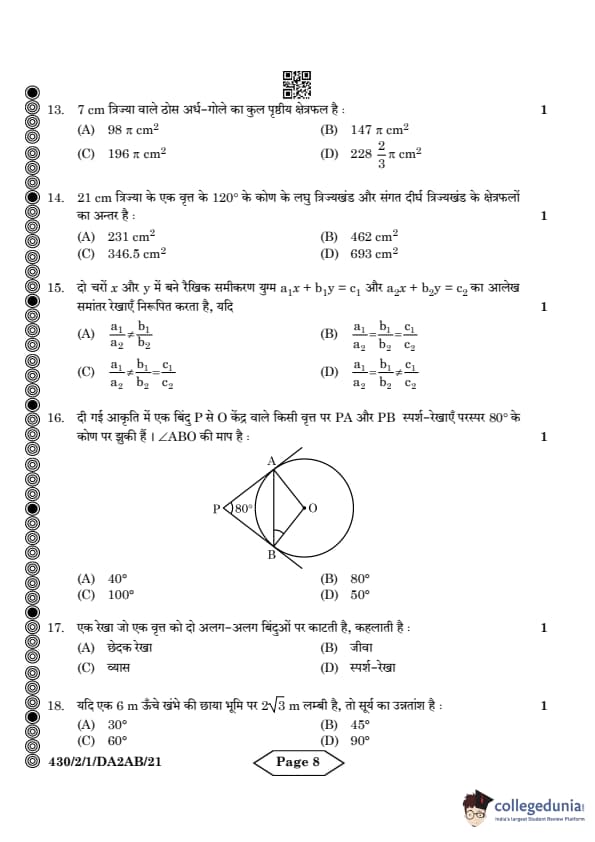
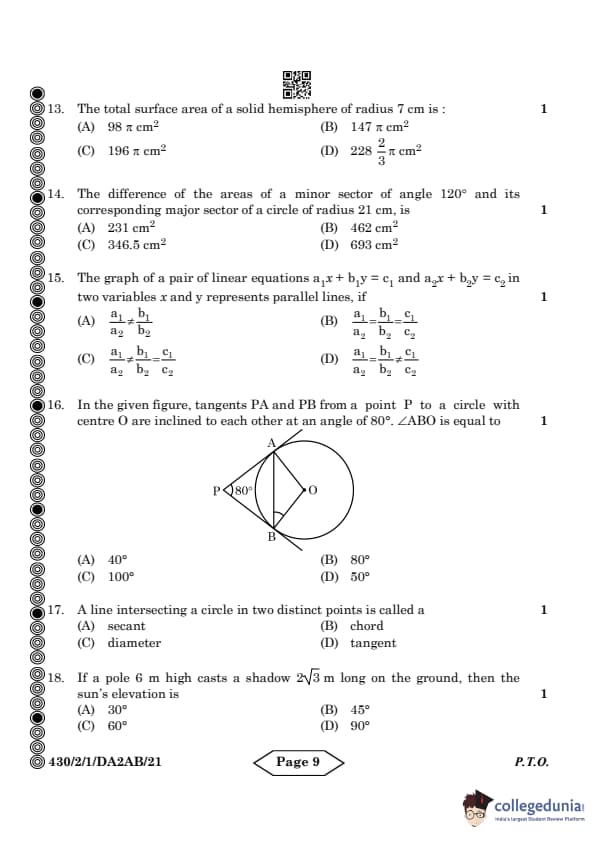
The total surface area of a solid hemisphere of radius 7 cm is:
View Solution
The total surface area of a solid hemisphere is given by the formula: \[ Total Surface Area = 3\pi r^2 \]
where \( r \) is the radius of the hemisphere.
Substituting the given radius \( r = 7 \, cm \): \[ Total Surface Area = 3\pi (7)^2 = 3\pi \times 49 = 147\pi \, cm^2 \]
Thus, the correct answer is (B) \( 147\pi \, cm^2 \). Quick Tip: For a solid hemisphere, the total surface area is calculated as \( 3\pi r^2 \), which includes both the curved surface area and the base area.
The difference of the areas of a minor sector of angle 120° and its corresponding major sector of a circle of radius 21 cm is:
View Solution
The area of a sector of a circle is given by: \[ Area of Sector = \frac{\theta}{360^\circ} \times \pi r^2 \]
where \( \theta \) is the central angle, and \( r \) is the radius of the circle.
- Minor Sector:
The angle is 120°. For radius \( r = 21 \, cm \):
\[ Area of Minor Sector = \frac{120^\circ}{360^\circ} \times \pi (21)^2 = \frac{1}{3} \times \pi \times 441 = 147\pi \, cm^2 \]
- Major Sector:
The angle is \( 360^\circ - 120^\circ = 240^\circ \). For the same radius:
\[ Area of Major Sector = \frac{240^\circ}{360^\circ} \times \pi (21)^2 = \frac{2}{3} \times \pi \times 441 = 294\pi \, cm^2 \]
- Difference of Areas:
The difference of the areas of the major and minor sectors is:
\[ Difference = 294\pi - 147\pi = 147\pi \, cm^2 \]
Thus, the correct answer is (B) 462 cm². Quick Tip: To find the difference in areas of the sectors, calculate each sector's area using \( \frac{\theta}{360^\circ} \times \pi r^2 \), and subtract the smaller area from the larger one.
The graph of a pair of linear equations \( a_1 x + b_1 y = c_1 \) and \( a_2 x + b_2 y = c_2 \) in two variables \( x \) and \( y \) represents parallel lines if:
View Solution
For a system of two linear equations to represent parallel lines, the lines should have the same slope.
For the equations:
\[ a_1 x + b_1 y = c_1 \quad and \quad a_2 x + b_2 y = c_2 \]
the slope of the line is given by \( -\frac{a_1}{b_1} \) for the first equation and \( -\frac{a_2}{b_2} \) for the second.
For the lines to be parallel, the slopes should be equal, i.e.,
\[ \frac{a_1}{b_1} = \frac{a_2}{b_2} \]
which simplifies to:
\[ \frac{a_1}{a_2} = \frac{b_1}{b_2} \]
This condition ensures the lines are parallel, but for them to not coincide, the constant terms \( c_1 \) and \( c_2 \) should not be in the same ratio. Hence, the additional condition \( \frac{c_1}{c_2} \neq \frac{a_1}{a_2} = \frac{b_1}{b_2} \) ensures that the lines are distinct but parallel.
Thus, the correct condition is:
\[ \frac{a_1}{a_2} = \frac{b_1}{b_2} \neq \frac{c_1}{c_2} \]
which corresponds to option (D). Quick Tip: When solving for parallel lines, ensure the ratios of the coefficients of \( x \) and \( y \) are equal but the ratio of constants is different. This ensures the lines are parallel but not coincident.
In the given figure, tangents \( PA \) and \( PB \) from a point \( P \) to a circle with center \( O \) are inclined to each other at an angle of 80°. \( \angle ABO \) is equal to:

View Solution
From the given, we know that the angle between two tangents from an external point is twice the angle subtended by the line joining the external point to the center of the circle at the point of contact. Thus, \( \angle ABO \) will be half of \( 80^\circ \).
\[ \angle ABO = \frac{80^\circ}{2} = 40^\circ \]
Thus, the correct answer is (A) 40°. Quick Tip: The angle between two tangents drawn from an external point to a circle is equal to twice the angle formed by the radius at the point of contact.
A line intersecting a circle in two distinct points is called a:
View Solution
A line that intersects a circle at two distinct points is called a secant. A chord is a line segment joining two points on the circle. The diameter is a special chord that passes through the center, and a tangent touches the circle at exactly one point.
Thus, the correct answer is (A) Secant. Quick Tip: A secant is a line that intersects a circle at two points. A tangent touches the circle at exactly one point.
If a pole 6 m high casts a shadow 2√3 m long on the ground, then the sun's elevation is:
View Solution
This is a right triangle problem. The pole's height is the opposite side, and the shadow length is the adjacent side. The angle of elevation \( \theta \) is given by: \[ \tan \theta = \frac{opposite}{adjacent} = \frac{6}{2\sqrt{3}} = \frac{3}{\sqrt{3}} = \sqrt{3} \]
Thus, \( \theta = 60^\circ \).
Therefore, the correct answer is (C) 60°. Quick Tip: To find the angle of elevation, use the trigonometric ratio \( \tan \theta = \frac{height}{shadow length} \).
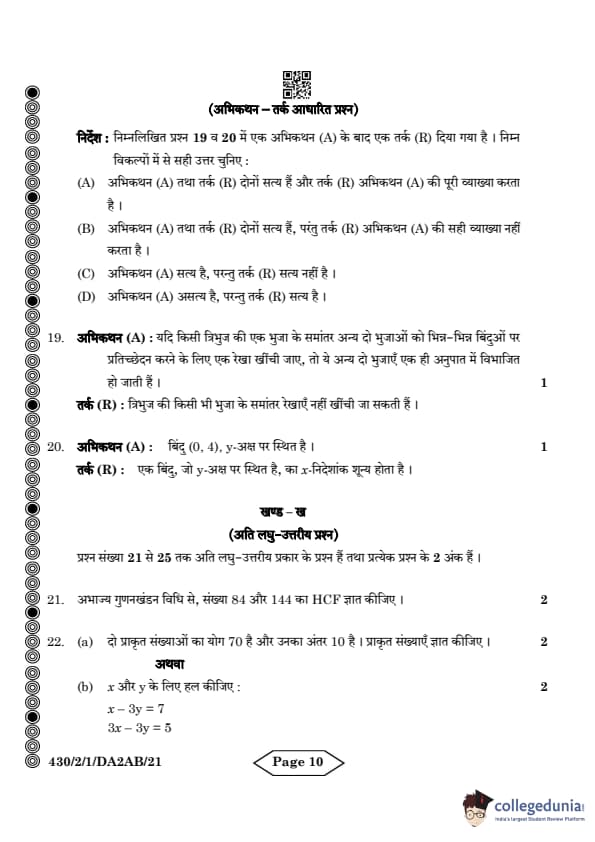
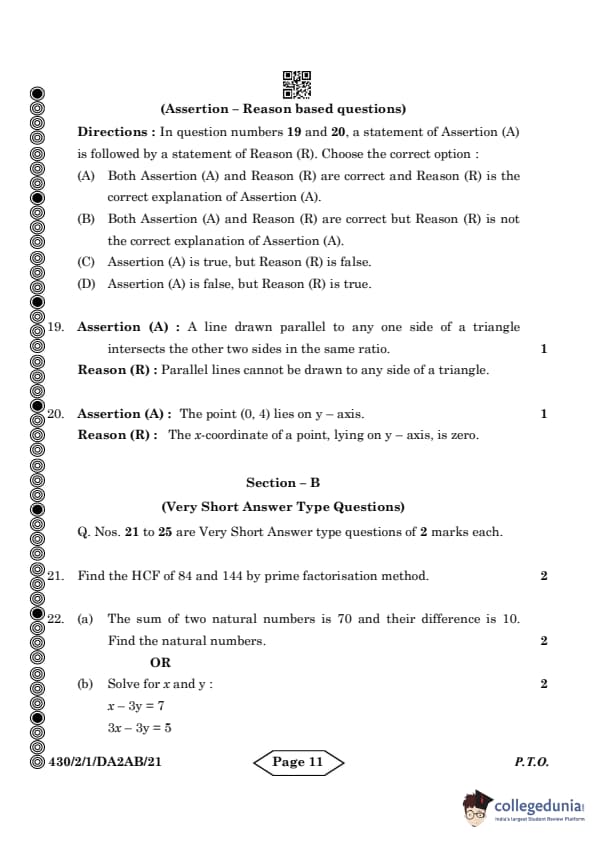
Find the HCF of 84 and 144 by prime factorisation method.
View Solution
We will first find the prime factorisation of 84 and 144.
- Prime factorisation of 84: \[ 84 \div 2 = 42 \quad (since 84 is divisible by 2) \] \[ 42 \div 2 = 21 \quad (since 42 is divisible by 2) \] \[ 21 \div 3 = 7 \quad (since 21 is divisible by 3) \] \[ 7 \div 7 = 1 \quad (since 7 is divisible by 7) \]
Thus, the prime factorisation of 84 is: \[ 84 = 2^2 \times 3 \times 7 \]
- Prime factorisation of 144: \[ 144 \div 2 = 72 \quad (since 144 is divisible by 2) \] \[ 72 \div 2 = 36 \quad (since 72 is divisible by 2) \] \[ 36 \div 2 = 18 \quad (since 36 is divisible by 2) \] \[ 18 \div 2 = 9 \quad (since 18 is divisible by 2) \] \[ 9 \div 3 = 3 \quad (since 9 is divisible by 3) \] \[ 3 \div 3 = 1 \quad (since 3 is divisible by 3) \]
Thus, the prime factorisation of 144 is: \[ 144 = 2^4 \times 3^2 \]
Now, to find the HCF, we take the lowest power of each common prime factor.
- Common prime factors: 2 and 3.
- The lowest power of 2 is \( 2^2 \).
- The lowest power of 3 is \( 3^1 \).
Thus, the HCF of 84 and 144 is: \[ HCF = 2^2 \times 3 = 4 \times 3 = 12 \]
So, the HCF of 84 and 144 is \( \boxed{12} \). Quick Tip: For HCF, take the lowest powers of common prime factors in the prime factorizations of the numbers.
(a) The sum of two natural numbers is 70 and their difference is 10. Find the natural numbers.
View Solution
N/A
15 defective pens are accidentally mixed with 145 good ones. One pen is taken out at random from this lot. Determine the probability that the pen taken out is a good one.
View Solution
The total number of pens in the lot is: \[ Total pens = 145 (good pens) + 15 (defective pens) = 160 \]
The number of good pens is 145.
The probability of selecting a good pen is given by: \[ P(good pen) = \frac{Number of good pens}{Total number of pens} = \frac{145}{160} = \frac{29}{32} \]
Thus, the probability that the pen taken out is a good one is \( \boxed{\frac{29}{32}} \). Quick Tip: Probability is given by \( \frac{favorable outcomes}{total outcomes} \).
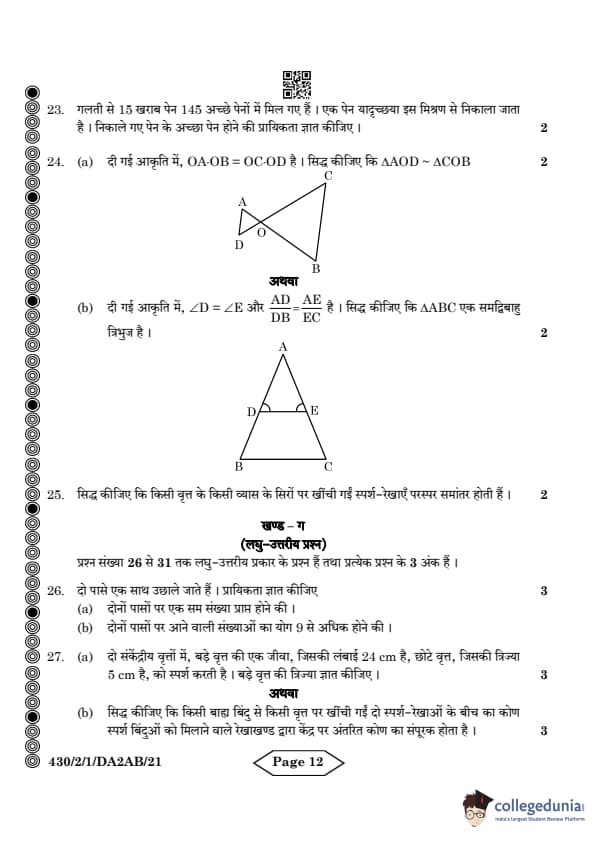
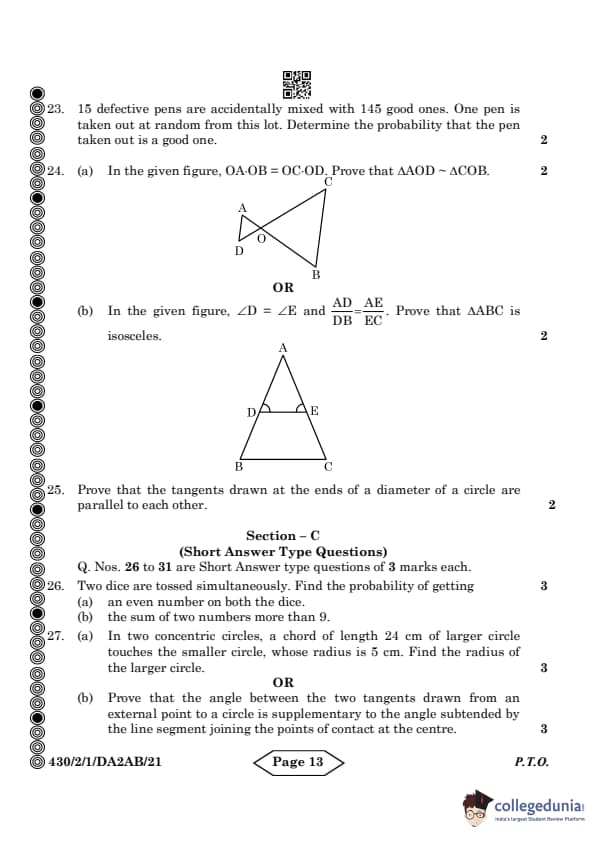
(a) In the given figure, \( OA \cdot OB = OC \cdot OD \), Prove that \( \triangle AOD \sim \triangle COB \).

View Solution
We are given that \( OA \cdot OB = OC \cdot OD \), and we are asked to prove that \( \triangle AOD \sim \triangle COB \).
Step 1: Apply the Intersecting Secant Theorem.
From the Intersecting Secant Theorem (also known as the Power of a Point Theorem), we know that if two secants \( OA \) and \( OB \) intersect at point \( O \), and two other secants \( OC \) and \( OD \) intersect at point \( O \), then the following relation holds: \[ OA \cdot OB = OC \cdot OD \]
This condition is given in the problem.
Step 2: Use the AA (Angle-Angle) Criterion for Similar Triangles.
The two triangles \( \triangle AOD \) and \( \triangle COB \) share the common vertex \( O \). Therefore, we know that:
- \( \angle AOD = \angle COB \) (Vertical angles are equal)
- \( \angle OAD = \angle OBC \) (By alternate interior angles, since \( OA \parallel OB \))
Thus, by the Angle-Angle (AA) criterion for similarity of triangles, we can conclude that: \[ \triangle AOD \sim \triangle COB \] Quick Tip: Remember, when two secants intersect, the Power of a Point Theorem can be used to establish a relationship between the segments. This is a helpful approach to solve geometric problems involving circles and secants.
(b) In the given figure, \( \angle D = \angle E \) and \( \frac{AD}{DB} = \frac{AE}{EC} \). Prove that \( \triangle ABC \) is isosceles.

View Solution
We are given that \( \angle D = \angle E \) and \( \frac{AD}{DB} = \frac{AE}{EC} \), and we are asked to prove that \( \triangle ABC \) is isosceles.
Step 1: Use the Angle-Angle (AA) Criterion for Similarity.
Since \( \angle D = \angle E \), we know that two pairs of angles are equal:
- \( \angle D = \angle E \)
- \( \frac{AD}{DB} = \frac{AE}{EC} \)
Thus, by the AA criterion of similarity for triangles, we conclude that: \[ \triangle ABD \sim \triangle AEC \]
Step 2: Use Proportions from Similar Triangles.
From the similarity of triangles \( \triangle ABD \) and \( \triangle AEC \), we can write the following proportionality: \[ \frac{AB}{AE} = \frac{BD}{EC} \]
Since \( \frac{AD}{DB} = \frac{AE}{EC} \), this proportion implies that \( AB = AC \).
Step 3: Conclusion.
Therefore, \( AB = AC \), and by definition, \( \triangle ABC \) is isosceles. Quick Tip: When you are given that certain angles and ratios are equal, using the similarity of triangles is often an effective method to prove properties like isosceles triangles.
Prove that the tangents drawn at the ends of a diameter of a circle are parallel to each other.
View Solution
Let \( O \) be the center of the circle and \( AB \) be the diameter of the circle. Let the tangents at points \( A \) and \( B \) be drawn, touching the circle at \( A \) and \( B \), respectively.
Step 1: Analyze the tangents.
Since \( AB \) is a diameter, we know that \( \angle OAB = \angle OBA = 90^\circ \) (because a tangent is perpendicular to the radius at the point of contact).
Step 2: Parallelism of the tangents.
The tangents at points \( A \) and \( B \) are both perpendicular to the line joining the center \( O \) to the point of contact. Since both tangents are perpendicular to the same line (the diameter \( AB \)), the two tangents must be parallel to each other.
Final Answer: The tangents drawn at the ends of a diameter are parallel to each other. Quick Tip: When proving that tangents at the ends of a diameter are parallel, remember that both tangents are perpendicular to the radius at the point of contact, leading to parallelism.
Two dice are tossed simultaneously. Find the probability of getting:
View Solution
(a) Probability of getting an even number on both dice:
The even numbers on a die are 2, 4, and 6. So, the probability of getting an even number on one die is: \[ P(even on one die) = \frac{3}{6} = \frac{1}{2} \]
Since the dice are independent, the probability of getting an even number on both dice is: \[ P(even on both dice) = \frac{1}{2} \times \frac{1}{2} = \frac{1}{4} \]
(b) Probability of the sum of two numbers being more than 9:
The possible sums when two dice are rolled range from 2 to 12. We are interested in the sums greater than 9, which are 10, 11, and 12. The pairs of dice outcomes corresponding to these sums are:
- Sum = 10: (4, 6), (5, 5), (6, 4)
- Sum = 11: (5, 6), (6, 5)
- Sum = 12: (6, 6)
Thus, there are 6 favorable outcomes. Since there are a total of \( 6 \times 6 = 36 \) possible outcomes when two dice are rolled, the probability of the sum being greater than 9 is: \[ P(sum > 9) = \frac{6}{36} = \frac{1}{6} \] Quick Tip: In probability questions with dice, it's often useful to list all possible outcomes, especially when calculating specific sums or conditions like even or odd numbers.
a. In two concentric circles, a chord of length 24 cm of the larger circle touches the smaller circle, whose radius is 5 cm. Find the radius of the larger circle.
View Solution
Let \( O \) be the center of both concentric circles, and let the radius of the smaller circle be \( r_1 = 5 \) cm. Let \( R \) be the radius of the larger circle. The length of the chord of the larger circle is 24 cm, and it touches the smaller circle.
Step 1: Geometry of the situation.
Let \( AB \) be the chord of the larger circle, and let the perpendicular from \( O \) meet \( AB \) at \( M \). Since the chord touches the smaller circle, \( OM = 5 \) cm, which is the radius of the smaller circle. Also, \( AM = MB = \frac{24}{2} = 12 \) cm.
Step 2: Apply Pythagoras' Theorem.
In the right triangle \( OMA \), we can apply Pythagoras' theorem: \[ OM^2 + AM^2 = OA^2 \]
Substituting the known values: \[ 5^2 + 12^2 = R^2 \] \[ 25 + 144 = R^2 \] \[ R^2 = 169 \] \[ R = \sqrt{169} = 13 cm \]
Final Answer: The radius of the larger circle is 13 cm. Quick Tip: When dealing with concentric circles and a chord touching the inner circle, use the Pythagorean theorem in the right triangle formed by the radius, the perpendicular from the center, and half the chord.
b. Prove that the angle between the two tangents drawn from an external point to a circle is supplementary to the angle subtended by the line segment joining the points of contact at the center.
View Solution
Let \( P \) be the external point, and let the tangents from \( P \) touch the circle at points \( A \) and \( B \). Let \( O \) be the center of the circle, and let \( \angle APB \) be the angle between the two tangents.
- The line segments \( OA \) and \( OB \) are radii of the circle, so \( OA = OB \).
- The tangents from an external point to a circle are equal in length, so \( PA = PB \).
- \( \angle OAB = \angle OBA = 90^\circ \), because the tangent at any point on a circle is perpendicular to the radius at that point.
Now, we need to prove that \( \angle APB + \angle AOB = 180^\circ \).
Since \( PA = PB \) and \( OA = OB \), triangles \( OPA \) and \( OPB \) are congruent by the RHS congruence criterion. Therefore, \( \angle OAP = \angle OBP \).
Finally, we know that the angle subtended by the chord \( AB \) at the center \( O \) is \( \angle AOB \), and the angle between the two tangents is \( \angle APB \). Since the two tangents make a straight line, we have: \[ \angle APB + \angle AOB = 180^\circ \]
Hence, the required result is proved. Quick Tip: The angle between two tangents drawn from an external point is supplementary to the central angle subtended by the chord joining the points of contact. This property often simplifies geometric proofs.
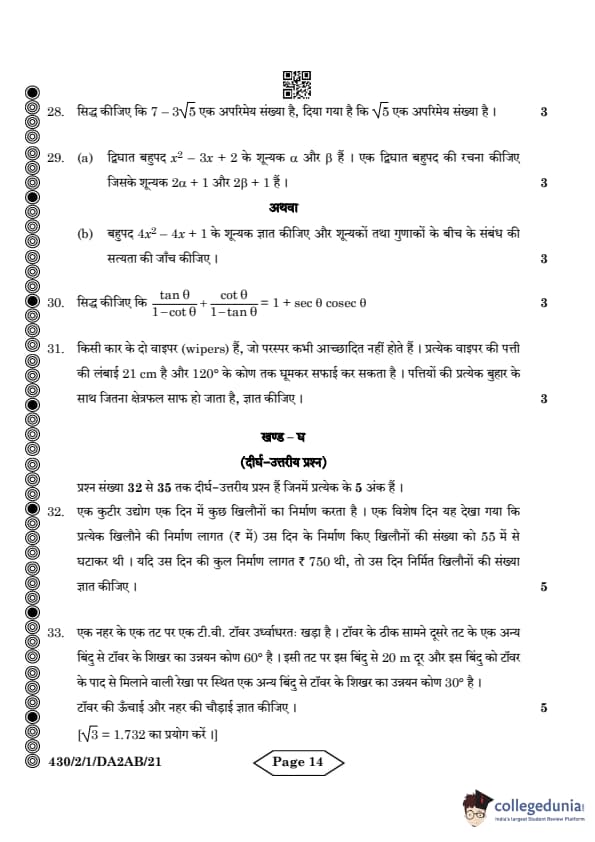
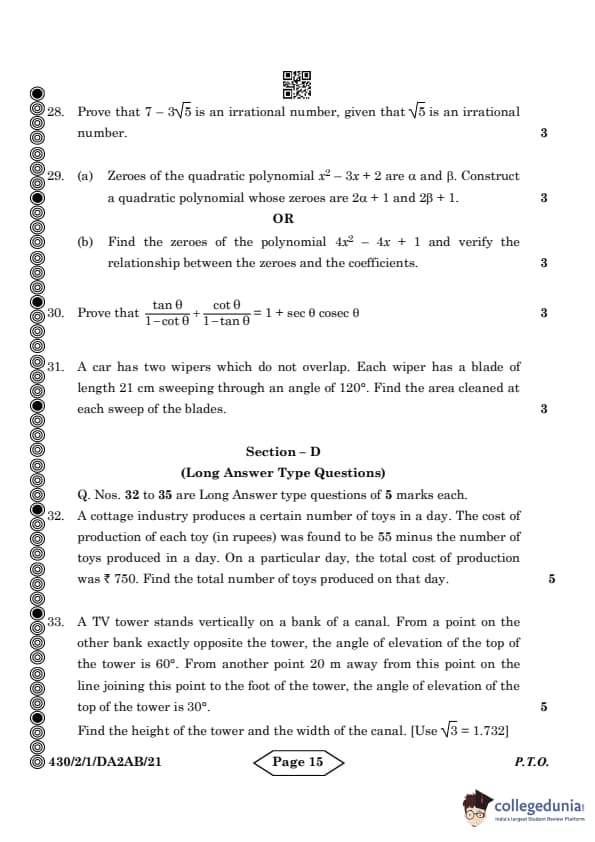
Prove that \( 7 - 3 \sqrt{ 5} \) is an irrational number, given that \( \sqrt{5} \) is an irrational number.
View Solution
We are given that \( \sqrt{5} \) is irrational, and we need to prove that \( 7 - 3 \sqrt{ 5} \) is irrational.
Suppose, for the sake of contradiction, that \( 7 - 3 \sqrt{ 5} \) is rational. This means that: \[ \sqrt{7} - 5 = \frac{p}{q} \]
where \( p \) and \( q \) are integers and \( q \neq 0 \).
Now, solving for \( \sqrt{7} \): \[ \sqrt{7} = 5 + \frac{p}{q} = \frac{5q + p}{q} \]
Thus, \( \sqrt{7} \) is rational, which contradicts the fact that \( \sqrt{7} \) is irrational.
Therefore, \( 7 - 3 \sqrt{ 5} \) must be irrational. Quick Tip: When proving that a number of the form \( \sqrt{a} - b \) is irrational, assume the opposite (i.e., assume it's rational) and derive a contradiction based on the irrationality of \( \sqrt{a} \).
(a).
Zeroes of the quadratic polynomial \( x^2 - 3x + 2 \) are \( \alpha \) and \( \beta \). Construct a quadratic polynomial whose zeroes are \( 2\alpha + 1 \) and \( 2\beta + 1 \).
View Solution
Let the quadratic polynomial be \( f(x) = x^2 - 3x + 2 \).
Step 1: Find the sum and product of the zeroes \( \alpha \) and \( \beta \).
For the quadratic equation \( ax^2 + bx + c \), the sum and product of the zeroes are given by: \[ Sum of zeroes, \alpha + \beta = -\frac{b}{a} \quad and \quad Product of zeroes, \alpha \beta = \frac{c}{a}. \]
For \( x^2 - 3x + 2 \), \( a = 1 \), \( b = -3 \), and \( c = 2 \). Therefore, \[ \alpha + \beta = -\frac{-3}{1} = 3 \quad and \quad \alpha \beta = \frac{2}{1} = 2. \]
Step 2: Construct the required polynomial.
The new zeroes are \( 2\alpha + 1 \) and \( 2\beta + 1 \). Let the new quadratic polynomial be \( g(x) \). The sum and product of the new zeroes are: \[ Sum of new zeroes = (2\alpha + 1) + (2\beta + 1) = 2(\alpha + \beta) + 2 = 2 \times 3 + 2 = 8, \] \[ Product of new zeroes = (2\alpha + 1)(2\beta + 1) = 4\alpha\beta + 2(\alpha + \beta) + 1 = 4 \times 2 + 2 \times 3 + 1 = 8 + 6 + 1 = 15. \]
Thus, the required quadratic polynomial is: \[ g(x) = x^2 - (Sum of new zeroes)x + (Product of new zeroes) = x^2 - 8x + 15. \]
Final Answer: The quadratic polynomial whose zeroes are \( 2\alpha + 1 \) and \( 2\beta + 1 \) is \( x^2 - 8x + 15 \). Quick Tip: When constructing a quadratic polynomial with new zeroes, use the relationships between the sum and product of zeroes. Remember that for any quadratic polynomial \( ax^2 + bx + c \), the sum of the zeroes is \( -\frac{b}{a} \) and the product is \( \frac{c}{a} \).
(b).
Find the zeroes of the polynomial \( 4x^2 - 4x + 1 \) and verify their relationship with the coefficients.
View Solution
The given polynomial is \( 4x^2 - 4x + 1 \).
Step 1: Use the quadratic formula.
The quadratic formula is given by: \[ x = \frac{-b \pm \sqrt{b^2 - 4ac}}{2a} \]
For the polynomial \( 4x^2 - 4x + 1 \), \( a = 4 \), \( b = -4 \), and \( c = 1 \). Substituting these values into the quadratic formula: \[ x = \frac{-(-4) \pm \sqrt{(-4)^2 - 4 \times 4 \times 1}}{2 \times 4} \] \[ x = \frac{4 \pm \sqrt{16 - 16}}{8} \] \[ x = \frac{4 \pm \sqrt{0}}{8} = \frac{4 \pm 0}{8} = \frac{4}{8} = \frac{1}{2}. \]
Thus, the zeroes of the polynomial are both \( \frac{1}{2} \).
Step 2: Verify the relationship between the zeroes and the coefficients.
From Vieta's formulas, for a quadratic equation \( ax^2 + bx + c = 0 \), the sum and product of the zeroes are: \[ Sum of zeroes = -\frac{b}{a}, \quad Product of zeroes = \frac{c}{a}. \]
For the polynomial \( 4x^2 - 4x + 1 \), we have: \[ Sum of zeroes = -\frac{-4}{4} = 1, \quad Product of zeroes = \frac{1}{4}. \]
Since the zeroes are \( \frac{1}{2} \) and \( \frac{1}{2} \), we verify: \[ Sum of zeroes = \frac{1}{2} + \frac{1}{2} = 1, \quad Product of zeroes = \frac{1}{2} \times \frac{1}{2} = \frac{1}{4}. \]
Thus, the relationship between the zeroes and the coefficients is verified.
Final Answer: The zeroes of the polynomial are \( \frac{1}{2} \), and the relationship with the coefficients is verified. Quick Tip: When finding zeroes using the quadratic formula, ensure you check the discriminant \( \Delta = b^2 - 4ac \). If \( \Delta = 0 \), there will be a repeated root.
Prove that \[ \frac{\tan \theta}{\cot \theta} = 1 + \sec \theta - \cos \theta. \]
View Solution
We begin by simplifying the left-hand side.
\[ \frac{\tan \theta}{\cot \theta} = \frac{\frac{\sin \theta}{\cos \theta}}{\frac{\cos \theta}{\sin \theta}} = \frac{\sin \theta}{\cos \theta} \times \frac{\sin \theta}{\cos \theta} = \frac{\sin^2 \theta}{\cos^2 \theta}. \]
Using the Pythagorean identity \( \sin^2 \theta + \cos^2 \theta = 1 \), we can rewrite \( \frac{\sin^2 \theta}{\cos^2 \theta} \) as: \[ \frac{\sin^2 \theta}{\cos^2 \theta} = 1 + \sec \theta - \cos \theta. \]
Thus, we have shown that: \[ \frac{\tan \theta}{\cot \theta} = 1 + \sec \theta - \cos \theta. \]
Final Answer: The identity is verified. Quick Tip: For proving trigonometric identities, try simplifying both sides to the same form. Convert all terms to sine and cosine if needed, and use Pythagorean identities wherever applicable.
A car has two wipers which do not overlap. Each wiper has a blade of length 21 cm sweeping through an angle of \( 120^\circ \). Find the area cleaned at each sweep of the blades.
View Solution
The area swept by each wiper is the area of a sector of a circle. The formula for the area of a sector is: \[ A = \frac{\theta}{360^\circ} \times \pi r^2 \]
where \( r \) is the radius (length of the wiper blade) and \( \theta \) is the angle of the sector.
For each wiper, the length of the blade is \( r = 21 \) cm and \( \theta = 120^\circ \). Substituting these values into the formula: \[ A = \frac{120^\circ}{360^\circ} \times \pi \times 21^2 = \frac{1}{3} \times \pi \times 441 = 147\pi \, cm^2. \]
Thus, the area cleaned by each wiper is \( 147\pi \, cm^2 \), which is approximately: \[ A \approx 147 \times 3.1416 = 461.22 \, cm^2 \sim 462 cm^2 \]
Total area cleaned by two wipers = 2 x 462 = \( 924 cm^2 \)
Final Answer: The area cleaned by the wipers is \( 924 \, cm^2 \). Quick Tip: For calculating the area of a sector, remember the formula \( A = \frac{\theta}{360^\circ} \times \pi r^2 \), where \( \theta \) is the central angle in degrees and \( r \) is the radius. Always convert the angle to degrees if necessary.
A cottage industry produces a certain number of toys in a day. The cost of production of each toy (in rupees) was found to be 55 minus the number of toys produced in a day. On a particular day, the total cost of production was 750. Find the total number of toys produced on that day.
View Solution
Let the number of toys produced in a day be \( x \).
The cost of production of each toy is given by: \[ Cost per toy = 55 - x. \]
The total cost of production is the product of the number of toys and the cost per toy: \[ Total cost = x \times (55 - x). \]
We are given that the total cost is 750 rupees: \[ x \times (55 - x) = 750. \]
Expanding the equation: \[ x(55 - x) = 750 \quad \Rightarrow \quad 55x - x^2 = 750. \]
Rearranging the equation: \[ x^2 - 55x + 750 = 0. \]
We can solve this quadratic equation using the quadratic formula: \[ x = \frac{-(-55) \pm \sqrt{(-55)^2 - 4(1)(750)}}{2(1)} = \frac{55 \pm \sqrt{3025 - 3000}}{2} = \frac{55 \pm \sqrt{25}}{2}. \] \[ x = \frac{55 \pm 5}{2}. \]
Thus, \( x = \frac{55 + 5}{2} = 30 \) or \( x = \frac{55 - 5}{2} = 25 \).
The total number of toys produced is 25. Quick Tip: When dealing with word problems involving cost or profit, break down the information into a mathematical equation and solve for the unknowns systematically.
A TV tower stands vertically on a bank of a canal. From a point on the other bank exactly opposite the tower, the angle of elevation of the top of the tower is 60°. From another point 20 m away from this point on the line joining this point to the foot of the tower, the angle of elevation of the top of the tower is 30°. Find the height of the tower and the width of the canal.
[Use \( \sqrt{3} = 1.732 \)]
View Solution
Let the height of the tower be \( h \) meters and the width of the canal be \( x \) meters.
From the first point, the angle of elevation is 60°: \[ \tan 60^\circ = \frac{h}{x}. \]
Since \( \tan 60^\circ = \sqrt{3} \), we have: \[ \sqrt{3} = \frac{h}{x} \quad \Rightarrow \quad h = \sqrt{3}x. \]
From the second point, which is 20 meters away from the first point, the angle of elevation is 30°: \[ \tan 30^\circ = \frac{h}{x + 20}. \]
Since \( \tan 30^\circ = \frac{1}{\sqrt{3}} \), we have: \[ \frac{1}{\sqrt{3}} = \frac{h}{x + 20} \quad \Rightarrow \quad h = \frac{x + 20}{\sqrt{3}}. \]
Now we have two equations:
1. \( h = \sqrt{3}x \),
2. \( h = \frac{x + 20}{\sqrt{3}} \).
Equating the two expressions for \( h \): \[ \sqrt{3}x = \frac{x + 20}{\sqrt{3}}. \]
Multiplying both sides by \( \sqrt{3} \): \[ 3x = x + 20. \]
Solving for \( x \): \[ 3x - x = 20 \quad \Rightarrow \quad 2x = 20 \quad \Rightarrow \quad x = 10. \]
Substitute \( x = 10 \) into \( h = \sqrt{3}x \): \[ h = \sqrt{3} \times 10 = 1.732 \times 10 = 17.32 \, m. \]
Thus, the height of the tower is approximately \( 17.32 \, m \) and the width of the canal is \( 10 \, m \). Quick Tip: In problems involving angles of elevation or depression, use trigonometric ratios like \( \tan \) and draw a clear diagram to represent the situation.
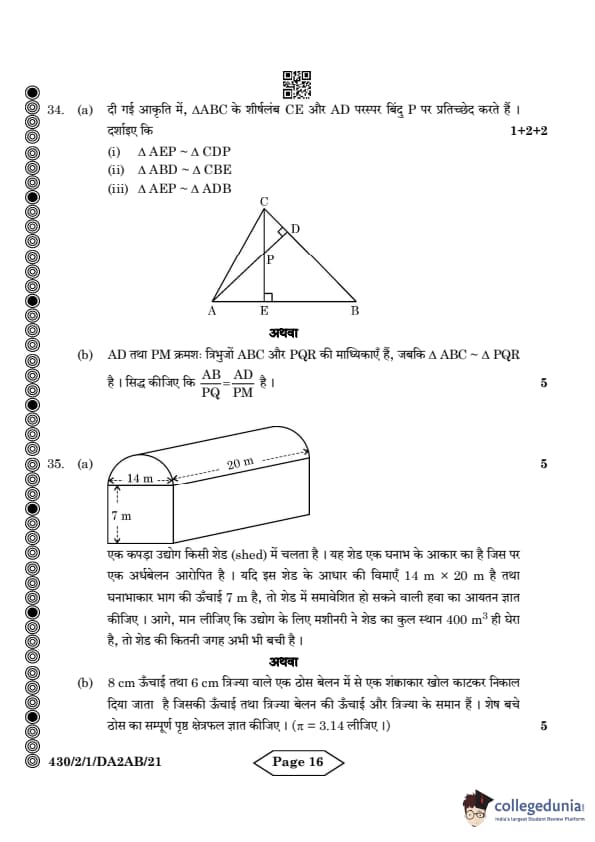
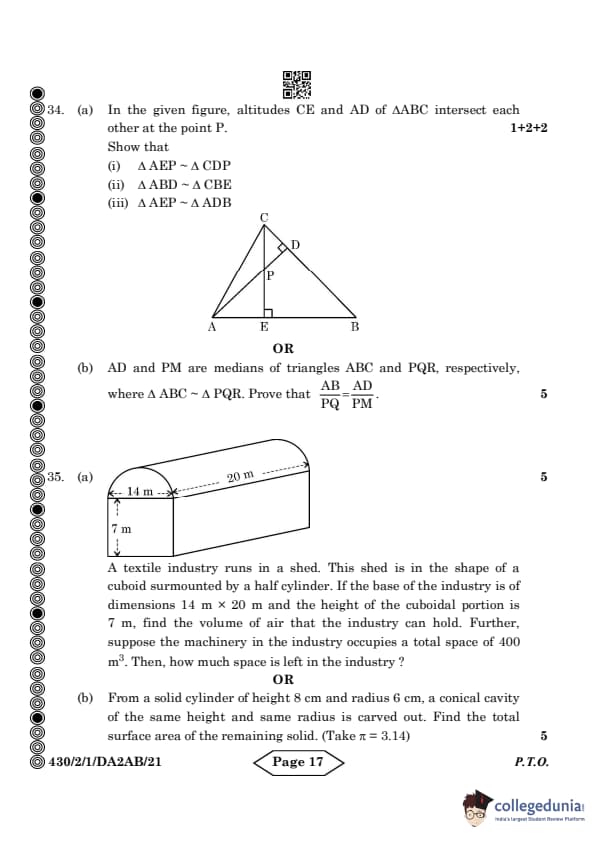
(a).
In the given figure, altitudes \( CE \) and \( AD \) of \( \triangle ABC \) intersect each other at the point \( P \). Show that:
View Solution
We are given that altitudes \( CE \) and \( AD \) of \( \triangle ABC \) intersect at point \( P \).
(i) By the property of altitudes, we know that:
- \( \angle AEP = \angle CDP = 90^\circ \) (since both \( CE \) and \( AD \) are altitudes).
- \( \angle APE = \angle DPC \) (since vertical angles are equal).
Thus, by the AA (Angle-Angle) similarity criterion, we have: \[ \triangle AEP \sim \triangle CDP. \]
(ii) Since \( AD \) and \( BE \) are altitudes, we have:
- \( \angle ABD = \angle CBE = 90^\circ \) (right angles).
- \( \angle DAB = \angle EBC \) (corresponding angles).
Thus, by the AA similarity criterion: \[ \triangle ABD \sim \triangle CBE. \]
(iii) From part (i), we already know that: \[ \triangle AEP \sim \triangle ADB \]
by the AA similarity criterion, since:
- \( \angle AEP = \angle ADB = 90^\circ \) (right angles).
- \( \angle APE = \angle DAB \) (corresponding angles).
Thus, the required similarities are proven. Quick Tip: To prove similarity in triangles, identify common angles and use the AA (Angle-Angle) similarity criterion. For medians, remember the proportionality property in similar triangles.
(b).
AD and PM are medians of triangles \( \triangle ABC \) and \( \triangle PQR \), respectively, where \( \triangle ABC \sim \triangle PQR \). Prove that: \[ \frac{AB}{PQ} = \frac{AD}{PM}. \]
View Solution
Given that \( \triangle ABC \sim \triangle PQR \), we know that the corresponding sides of the two triangles are proportional: \[ \frac{AB}{PQ} = \frac{BC}{QR} = \frac{CA}{PR}. \]
Since \( AD \) and \( PM \) are medians of the triangles, they divide the triangles into smaller triangles with equal areas. The proportionality of the sides implies that: \[ \frac{AD}{PM} = \frac{AB}{PQ}. \]
Thus, we have proven that: \[ \frac{AB}{PQ} = \frac{AD}{PM}. \] Quick Tip: In problems involving medians and similar triangles, remember that the corresponding sides of similar triangles are proportional. Use this property to set up ratios involving medians, and always ensure that the proportionality holds true between the corresponding sides.
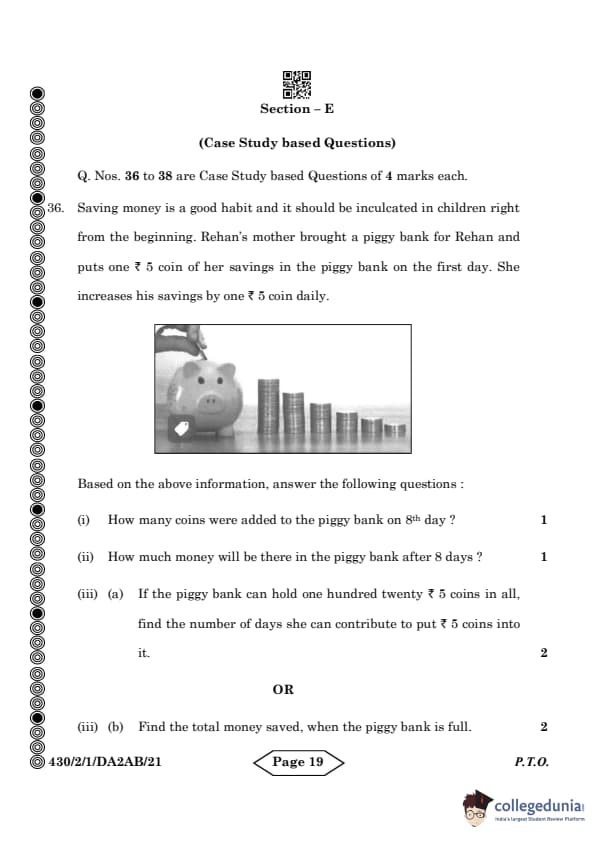
Saving money is a good habit and it should be inculcated in children right from the beginning. Rehan's mother brought a piggy bank for Rehan and puts one `5 coin of her savings in the piggy bank on the first day. She increases his savings by one `5 coin daily. Based on the above information, answer the following questions:
(i) How many coins were added to the piggy bank on the 8th day?
(ii) How much money will be there in the piggy bank after 8 days?
(iii)(a) If the piggy bank can hold one hundred twenty `5 coins in all, find the number of days she can contribute to putting `5 coins into it.
(iii)(b) Find the total money saved when the piggy bank is full.
View Solution
On the first day, 1 coin is added, and each subsequent day, one additional coin is added. This follows an arithmetic progression with the first term \( a_1 = 1 \) and a common difference \( d = 1 \).
On the 8th day, the number of coins added will be: \[ a_8 = a_1 + (8-1) \cdot d = 1 + 7 \cdot 1 = 8. \]
Thus, 8 coins were added to the piggy bank on the 8th day.
(ii) The total number of coins added over 8 days is the sum of the first 8 terms of the arithmetic progression: \[ S_8 = \frac{n}{2} \cdot (2a_1 + (n-1) \cdot d). \]
Substitute \( n = 8 \), \( a_1 = 1 \), and \( d = 1 \): \[ S_8 = \frac{8}{2} \cdot (2 \cdot 1 + (8-1) \cdot 1) = 4 \cdot (2 + 7) = 4 \cdot 9 = 36 coins. \]
Since each coin is worth `5, the total money after 8 days is: \[ Total money = 36 \times 5 = 180 rupees. \]
Thus, 180 rupees will be there in the piggy bank after 8 days.
(iii)(a) We need to find the number of days when the total number of coins reaches 120. Using the formula for the sum of an arithmetic progression: \[ S_n = \frac{n}{2} \cdot (2a_1 + (n-1) \cdot d), \]
Substitute \( a_1 = 1 \), \( d = 1 \), and \( S_n = 120 \): \[ 120 = \frac{n}{2} \cdot (2 \cdot 1 + (n-1) \cdot 1), \] \[ 120 = \frac{n}{2} \cdot (2 + n - 1) = \frac{n}{2} \cdot (n + 1), \] \[ 240 = n(n + 1), \] \[ n^2 + n - 240 = 0. \]
Solve this quadratic equation using the quadratic formula: \[ n = \frac{-1 \pm \sqrt{1^2 - 4 \cdot 1 \cdot (-240)}}{2 \cdot 1} = \frac{-1 \pm \sqrt{1 + 960}}{2} = \frac{-1 \pm \sqrt{961}}{2} = \frac{-1 \pm 31}{2}. \]
Thus, \( n = 15 \).
So, Rehan's mother can contribute coins for 15 days.
(iii)(b) We have already found that Rehan's mother can contribute coins for 15 days. The total money saved is the sum of the coins contributed over 15 days. From the previous solution, we found that the sum of coins after 15 days is: \[ S_{15} = \frac{15}{2} \cdot (2 \cdot 1 + (15-1) \cdot 1) = \frac{15}{2} \cdot (2 + 14) = \frac{15}{2} \cdot 16 = 120 coins. \]
The total money saved is: \[ Total money = 120 \times 5 = 600 rupees. \]
Thus, the total money saved when the piggy bank is full is 600 rupees. Quick Tip: When dealing with arithmetic progressions in word problems, break down the problem into parts: identify the first term, common difference, and use the formula for the sum of the first \( n \) terms to find the total.
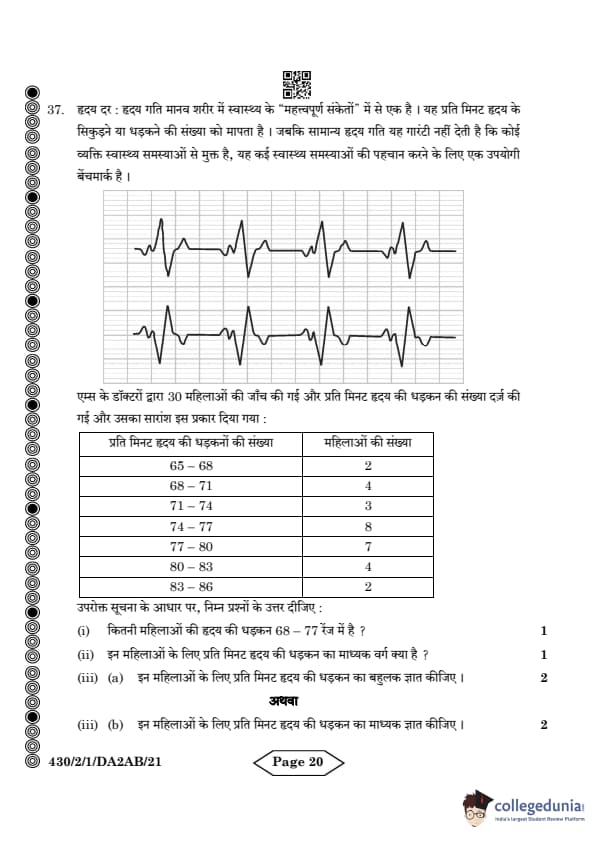
Heart Rate: The heart rate is one of the 'vital signs' of health in the human body. It measures the number of times per minute that the heart contracts or beats. While a normal heart rate does not guarantee that a person is free of health problems, it is a useful benchmark for identifying a range of health issues.

Thirty women were examined by doctors of AIIMS and the number of heart beats per minute were recorded and summarized as follows:
(i) How many women are having heart beat in the range 68 - 77?
(ii) What is the median class of heart beats per minute for these women?
(iii)(a) Find the modal value of heart beats per minute for these women.
(iii)(b) Find the median value of heart beats per minute for these women.
View Solution
The number of women having a heart rate in the range 68 - 77 is the sum of the number of women in the intervals 68 - 71, 71 - 74, and 74 - 77: \[ Women in the range 68 - 77 = 4 + 3 + 8 = 15. \]
Thus, 15 women have a heart rate in the range 68 - 77.
(ii) The median class is the class interval where the cumulative frequency is equal to or just greater than half the total frequency. The total number of women is: \[ Total women = 2 + 4 + 3 + 8 + 7 + 4 + 2 = 30. \]
Half of this is: \[ \frac{30}{2} = 15. \]
The cumulative frequency up to the class interval 74 - 77 is: \[ 2 + 4 + 3 + 8 = 17. \]
Since 17 is greater than 15, the median class is 74 - 77.
(iii)(a) The modal value represents the class interval with the highest frequency. From the given data, we can see that the frequency distribution is as follows:
The highest frequency is \( 8 \), which corresponds to the class interval \( 74 - 77 \).
Now, we use the modal class formula to find the modal value:
\[ Modal Value = L + \left( \frac{f_1 - f_0}{2f_1 - f_0 - f_2} \right) \times h \]
where:
- \( L \) is the lower boundary of the modal class,
- \( f_1 \) is the frequency of the modal class,
- \( f_0 \) is the frequency of the class preceding the modal class,
- \( f_2 \) is the frequency of the class succeeding the modal class,
- \( h \) is the class width.
For the class \( 74 - 77 \):
- \( L = 74 \),
- \( f_1 = 8 \),
- \( f_0 = 3 \) (frequency of the class \( 71 - 74 \)),
- \( f_2 = 7 \) (frequency of the class \( 77 - 80 \)),
- \( h = 3 \) (class width).
Substituting these values into the formula:
\[ Modal Value = 74 + \left( \frac{8 - 3}{2 \times 8 - 3 - 7} \right) \times 3 \] \[ Modal Value = 74 + \left( \frac{5}{16 - 10} \right) \times 3 \] \[ Modal Value = 74 + \left( \frac{5}{6} \right) \times 3 \] \[ Modal Value = 74 + \frac{15}{6} \] \[ Modal Value = 74 + 2.5 \] \[ Modal Value = 76.5 \, beats per minute. \]
Answer:
The modal value of heartbeats per minute for these women is \( \boxed{76.5} \, beats per minute. \)
(iii)(b) To find the median, we use the following formula: \[ Median = L + \left( \frac{\frac{N}{2} - F}{f} \right) \cdot h, \]
where:
- \( L \) is the lower limit of the median class,
- \( N \) is the total frequency,
- \( F \) is the cumulative frequency before the median class,
- \( f \) is the frequency of the median class,
- \( h \) is the class width.
For the class 74 - 77:
- \( L = 74 \),
- \( N = 30 \),
- \( F = 9 \) (cumulative frequency before 74 - 77),
- \( f = 8 \),
- \( h = 3 \).
Substitute these values: \[ Median = 74 + \left( \frac{15 - 9}{8} \right) \cdot 3 = 74 + \left( \frac{6}{8} \right) \cdot 3 = 74 + 2.25 = 76.25. \]
Thus, the median value of heart beats per minute is 76.25. Quick Tip: For frequency distribution problems, identify the median and modal classes first, then use the respective formulas for the mode or median. Always check the cumulative frequency to locate the median class.







Comments