




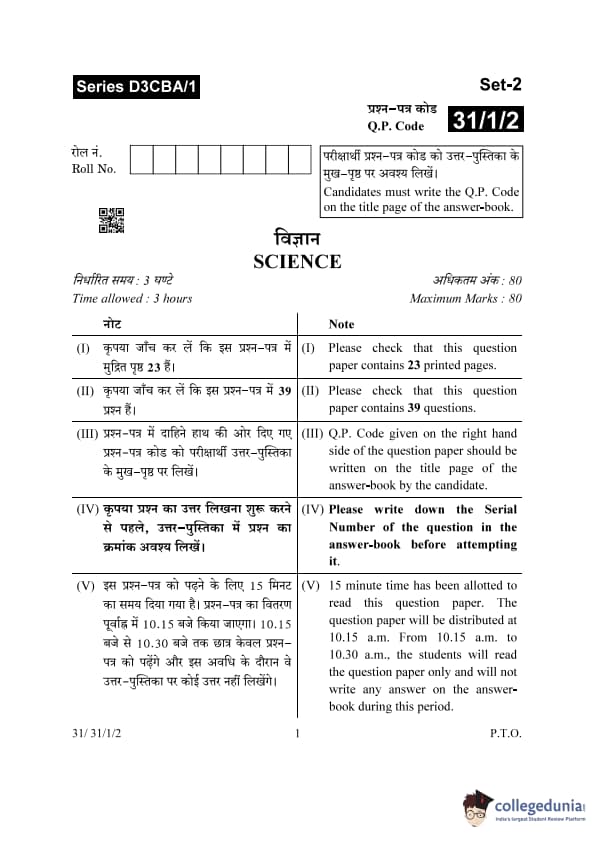
CBSE Class 10 Science Question Paper 2024 PDF (Set 2 - 31/1/2) is available for download here. CBSE conducted the Science exam on March 2, 2024, from 10:30 AM to 1:30 PM. The total marks for the theory paper are 80. The question paper contains 20% MCQ-based questions, 40% competency-based questions, and 40% short and long answer type questions.
CBSE Class 10 Science Question Paper 2024 (Set 2 - 31/1/2) with Answer Key
| CBSE Class 10 Science Question Paper 2024 (Set 2 - 31/1/2) with Answer Key |  Download Download |
Check Solutions |
| Question | Answer | Detailed Solution | ||||||||||||||||
|---|---|---|---|---|---|---|---|---|---|---|---|---|---|---|---|---|---|---|
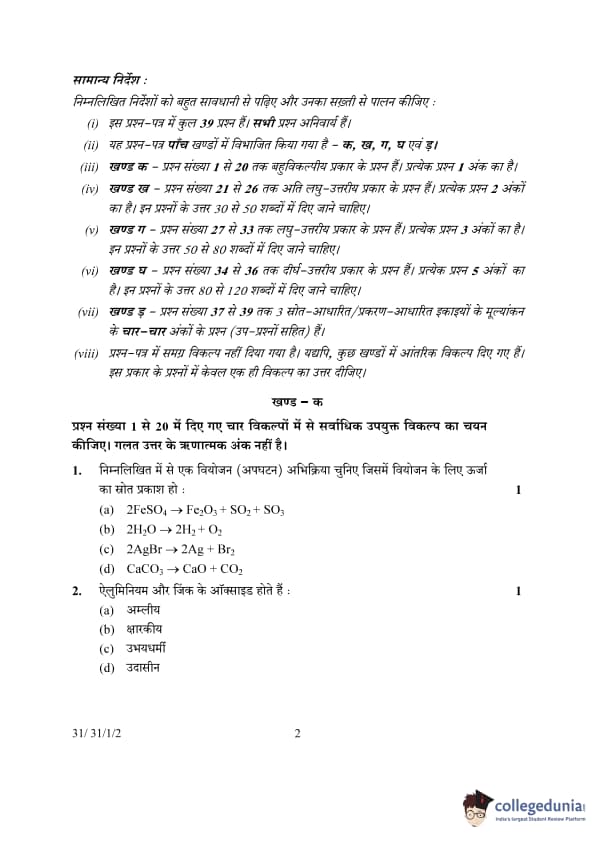
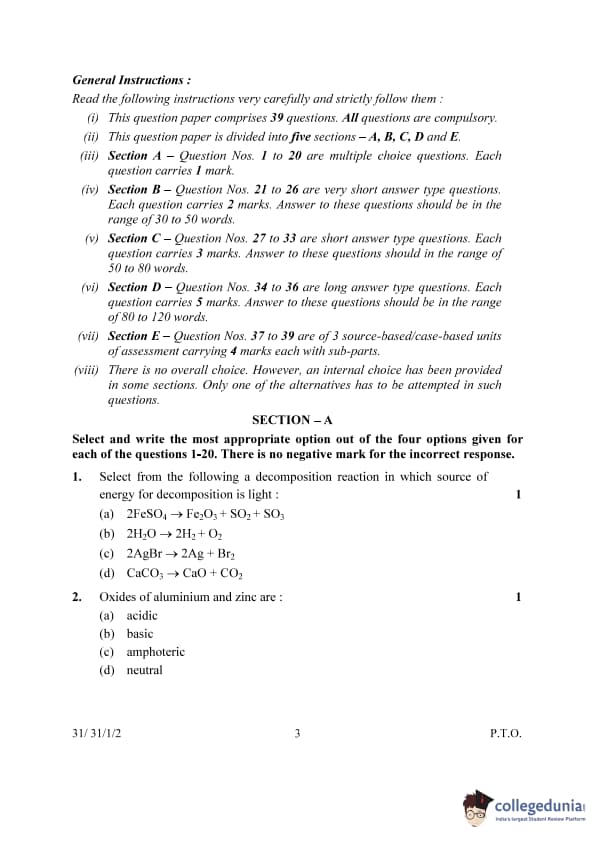
| 1. Select from the following a decomposition reaction in which the source of energy for decomposition is light: (A) 2FeSO4 → Fe2O3 + SO2 + SO3 (B) 2H2O → 2H2 + O2 (C) 2AgBr → 2Ag + Br2 (D) CaCO3 → CaO + CO2 |
(C) 2AgBr → 2Ag + Br2 | Photolysis refers to a decomposition reaction driven by light energy. Silver bromide (AgBr) decomposes under light to form silver (Ag) and bromine (Br2): 2AgBr → 2Ag + Br2 This reaction is extensively used in photographic films, where light exposure causes the breakdown of silver halides. |
||||||||||||||||
| 2. Oxides of aluminium and zinc are: (A) Acidic (B) Basic (C) Amphoteric (D) Neutral |
(C) Amphoteric | Amphoteric oxides react with both acids and bases to form salts. Aluminium oxide (Al2O3) and zinc oxide (ZnO) exhibit this dual behavior. | ||||||||||||||||
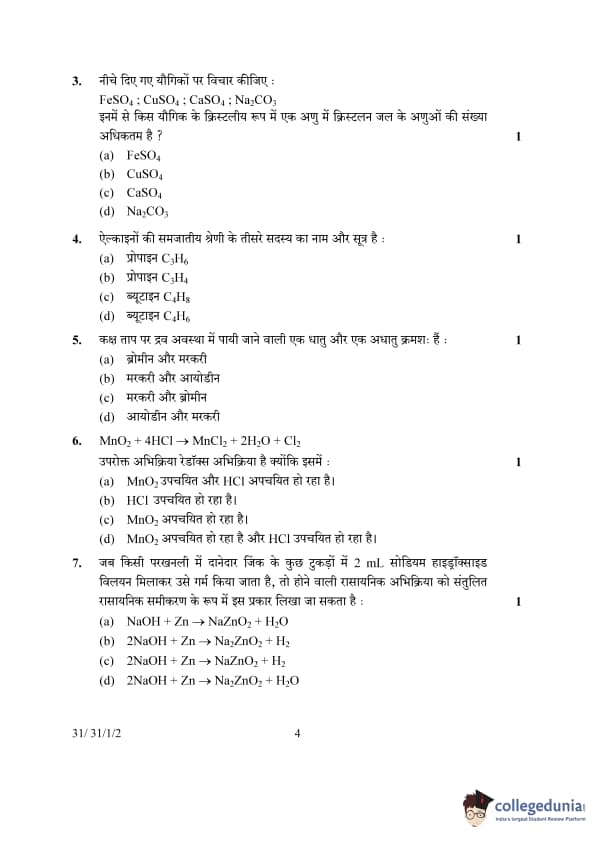
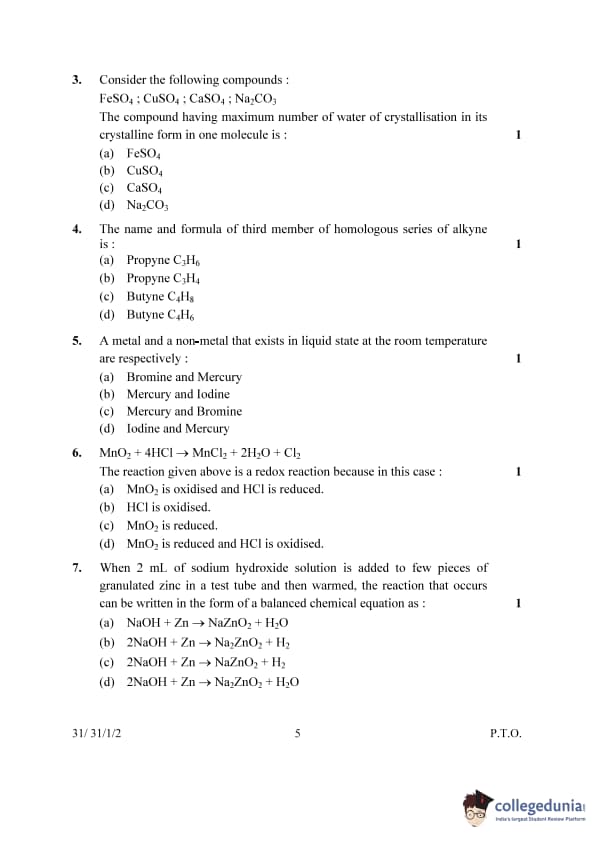
| 3. Consider the following compounds: FeSO4, CuSO4, CaSO4, Na2CO3. The compound having the maximum number of water of crystallization in its crystalline form in one molecule is: (A) FeSO4 (B) CuSO4 (C) CaSO4 (D) Na2CO3 |
(D) Na2CO3 | Na2CO3·10H2O (sodium carbonate decahydrate) contains 10 water molecules of crystallization, the highest among the given compounds. FeSO4·7H2O has 7 water molecules, CuSO4·5H2O has 5 water molecules, while CaSO4 has no significant water of crystallization. | ||||||||||||||||
| 4. The name and formula of the third member of the homologous series of alkyne is: (A) Propyne C3H6 (B) Propyne C3H4 (C) Butyne C4H8 (D) Butyne C4H6 |
(D) Butyne C4H6 | The general formula for alkynes is CnH2n−2. The third member of the alkyne homologous series corresponds to n = 4, giving C4H6. The name of this compound is Butyne. | ||||||||||||||||
| 5. A metal and a non-metal that exist in liquid state at room temperature are, respectively: (A) Bromine and Mercury (B) Mercury and Iodine (C) Mercury and Bromine (D) Iodine and Mercury |
(C) Mercury and Bromine | Mercury is the only metal that exists in a liquid state at room temperature. Bromine is the only non-metal in liquid state at room temperature. Hence, the correct combination is Mercury and Bromine. | ||||||||||||||||
| 6. The reaction given below is a redox reaction because: MnO2 + 4HCl → MnCl2 + 2H2O + Cl2 (A) MnO2 is oxidized and HCl is reduced. (B) HCl is oxidized. (C) MnO2 is reduced. (D) MnO2 is reduced and HCl is oxidized. |
(D) MnO2 is reduced and HCl is oxidized. | In the given reaction, MnO2 is reduced to MnCl2, losing oxygen atoms, while HCl is oxidized to Cl2, losing hydrogen atoms. | ||||||||||||||||
| 7. When 2 mL of sodium hydroxide solution is added to few pieces of granulated zinc in a test tube and then warmed, the reaction that occurs can be written in the form of a balanced chemical equation as: (A) NaOH + Zn → Na2ZnO2 + H2O (B) 2NaOH + Zn → Na2ZnO2 + H2 (C) 2NaOH + Zn → Na2ZnO2 + H2 (D) 2NaOH + Zn → Na2ZnO2 + H2O |
(B) 2NaOH + Zn → Na2ZnO2 + H2 | Sodium hydroxide reacts with zinc to form sodium zincate (Na2ZnO2) and hydrogen gas (H2). The balanced reaction is: 2NaOH + Zn → Na2ZnO2 + H2 This reaction demonstrates the amphoteric nature of zinc, which reacts with alkali to release hydrogen gas. |
||||||||||||||||
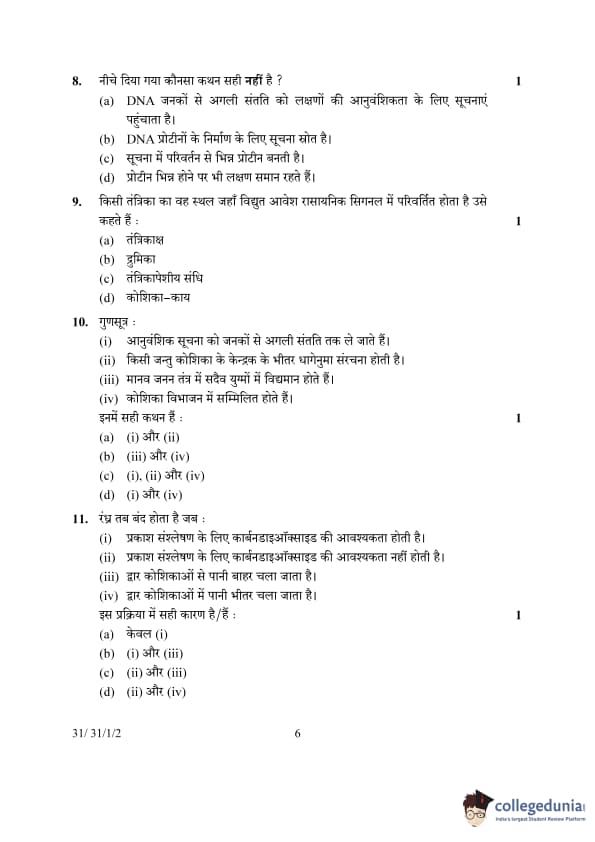
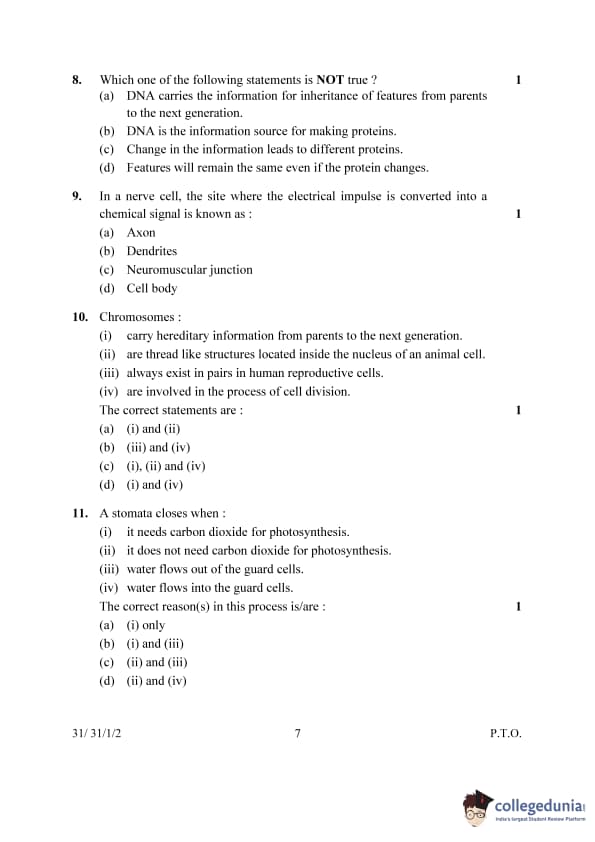
| 8. Which one of the following statements is NOT true? (A) DNA carries the information for inheritance of features from parents to the next generation. (B) DNA is the information source for making proteins. (C) Change in the information leads to different proteins. (D) Features will remain the same even if the protein changes. |
(D) Features will remain the same even if the protein changes. | Statement (D) is NOT true because proteins determine the structure and function of cells. If proteins change, the features or traits of an organism may also change. DNA serves as the blueprint for protein synthesis, and mutations in DNA can lead to different traits due to altered proteins. | ||||||||||||||||
| 9. In a nerve cell, the site where the electrical impulse is converted into a chemical signal is known as: (A) Axon (B) Dendrites (C) Neuromuscular junction (D) Cell body |
(C) Neuromuscular junction | The neuromuscular junction is a specialized synapse where electrical impulses from the motor neurons are converted into chemical signals. This facilitates communication between neurons and muscle fibers, enabling movement. | ||||||||||||||||
|
10. Chromosomes:
|
(D) (i) and (iv) | Chromosomes carry hereditary information from parents to the next generation (i) and are actively involved in the process of cell division (iv). While chromosomes are thread-like structures in the nucleus, they do not always exist in pairs in reproductive cells (gametes), as these are haploid and contain a single set of chromosomes. | ||||||||||||||||
|
11. A stomata closes when:
|
(C) (ii) and (iii) | Stomata close when the plant does not need carbon dioxide for photosynthesis and water flows out of the guard cells. This causes the guard cells to become flaccid, closing the stomatal pore. | ||||||||||||||||
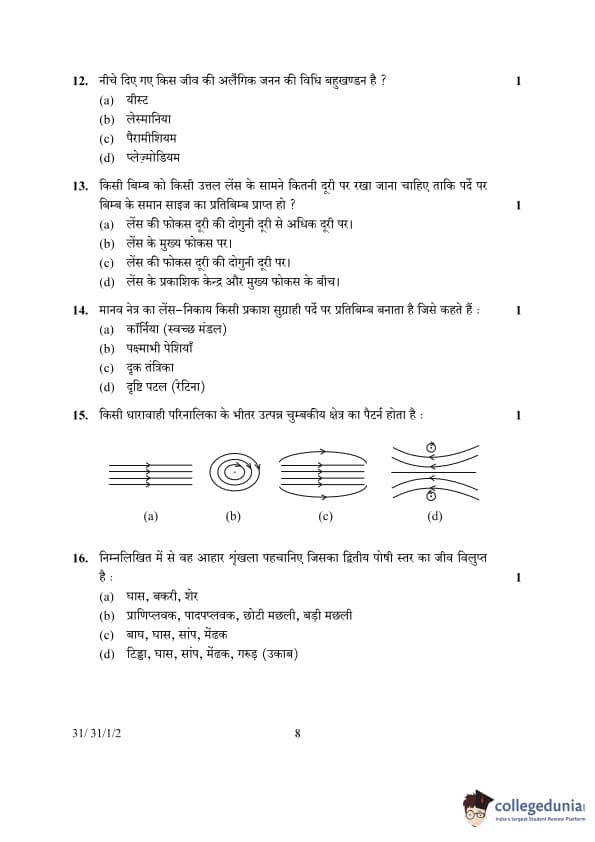
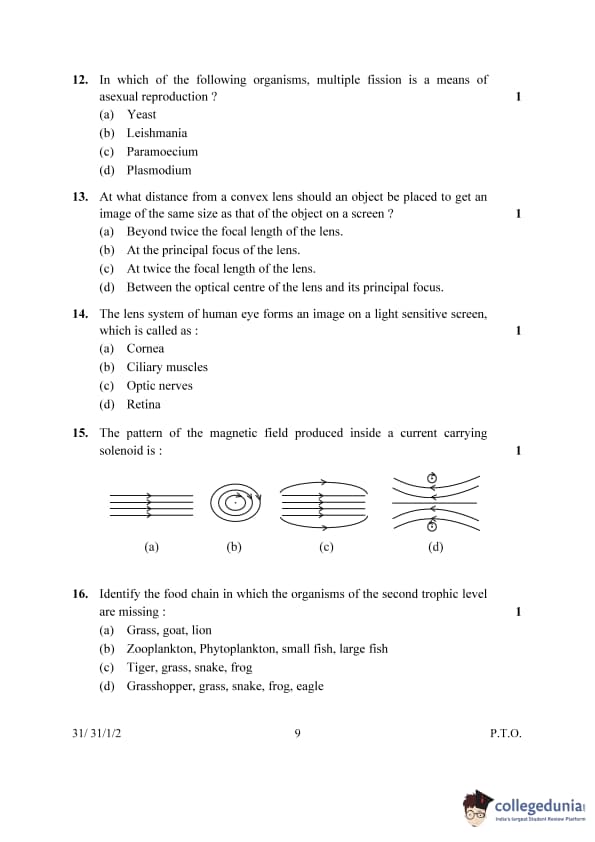
| 12. In which of the following organisms, multiple fission is a means of asexual reproduction? (A) Yeast (B) Leishmania (C) Paramecium (D) Plasmodium |
(D) Plasmodium | Multiple fission occurs when a single organism divides into multiple offspring simultaneously. This process is commonly observed in Plasmodium, a protozoan parasite. | ||||||||||||||||
| 13. At what distance from a convex lens should an object be placed to get an image of the same size as that of the object on a screen? (A) Beyond twice the focal length of the lens (B) At the principal focus of the lens (C) At twice the focal length of the lens (D) Between the optical centre of the lens and its principal focus |
(C) At twice the focal length of the lens | When an object is placed at twice the focal length (2F) of a convex lens, the image formed is real, inverted, and of the same size as the object. | ||||||||||||||||
| 14. The lens system of human eye forms an image on a light-sensitive screen, which is called as: (A) Cornea (B) Ciliary muscles (C) Optic nerves (D) Retina |
(D) Retina | The retina is the light-sensitive screen at the back of the eye where the lens system focuses the image. It contains photoreceptors that detect light and send signals to the brain. | ||||||||||||||||
| 15. The pattern of the magnetic field produced inside a current-carrying solenoid is: (A) (B) (C) (D) |
(A) | The magnetic field inside a current-carrying solenoid is uniform and straight, represented by field lines running parallel to each other along the length of the solenoid. This pattern aligns with diagram (A), showing uniform field lines within the solenoid. | ||||||||||||||||
| 16. Identify the food chain in which the organisms of the second trophic level are missing: (A) Grass, goat, lion (B) Zooplankton, Phytoplankton, small fish, large fish (C) Tiger, grass, snake, frog (D) Grasshopper, grass, snake, frog, eagle |
(C) Tiger, grass, snake, frog | The second trophic level consists of primary consumers (herbivores). In the food chain "Tiger, grass, snake, frog," there are no herbivores (primary consumers) present. The grass is a producer, and the tiger, snake, and frog are secondary or tertiary consumers. Hence, the second trophic level is missing in this food chain. | ||||||||||||||||
|
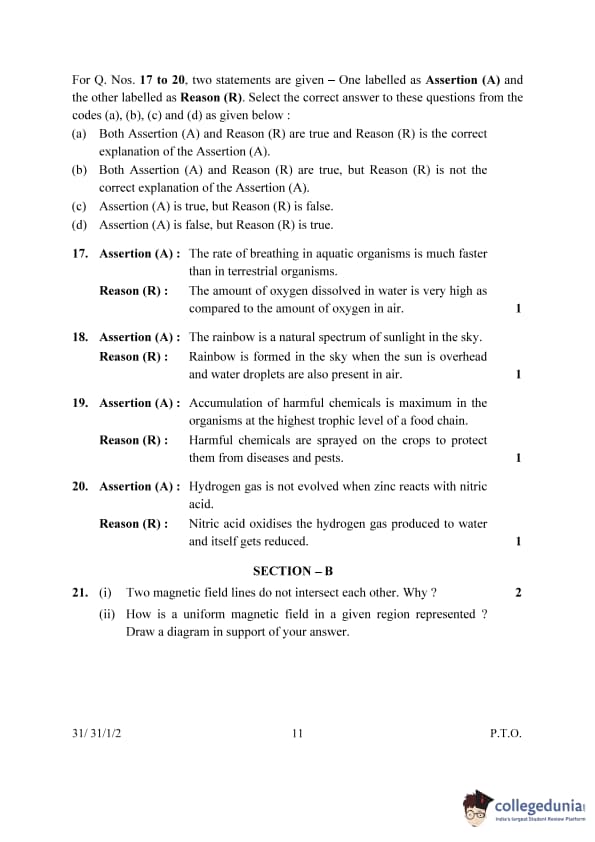
17. Assertion (A): The rate of breathing in aquatic organisms is much faster than in terrestrial organisms.
|
(A) Assertion (A) is true, but Reason (R) is false. | Aquatic organisms breathe faster because oxygen availability in water is much lower compared to air, not higher. Water contains significantly less dissolved oxygen than air. | ||||||||||||||||
|
18. Assertion (A): The rainbow is a natural spectrum of sunlight in the sky.
|
(A) Assertion (A) is true, but Reason (R) is false. | Rainbows form due to refraction, dispersion, and reflection of sunlight in water droplets, typically when the sun is low in the sky (morning or late afternoon), not overhead. | ||||||||||||||||
|
19. Assertion (A): Accumulation of harmful chemicals is maximum in the organisms at the highest trophic level of a food chain.
|
(B) Both Assertion (A) and Reason (R) are true, but Reason (R) is not the correct explanation of Assertion (A). | Harmful chemicals like pesticides accumulate in organisms through the process of biomagnification. While chemicals are sprayed to protect crops, their accumulation in the food chain leads to higher concentrations in organisms at the top trophic level. | ||||||||||||||||
|
20. Assertion (A): Hydrogen gas is not evolved when zinc reacts with nitric acid.
|
(A) Both Assertion (A) and Reason (R) are true, and Reason (R) is the correct explanation of Assertion (A). | When zinc reacts with nitric acid, the hydrogen gas that is produced is immediately oxidised to water by nitric acid, which itself undergoes reduction. Hence, hydrogen gas is not released. | ||||||||||||||||
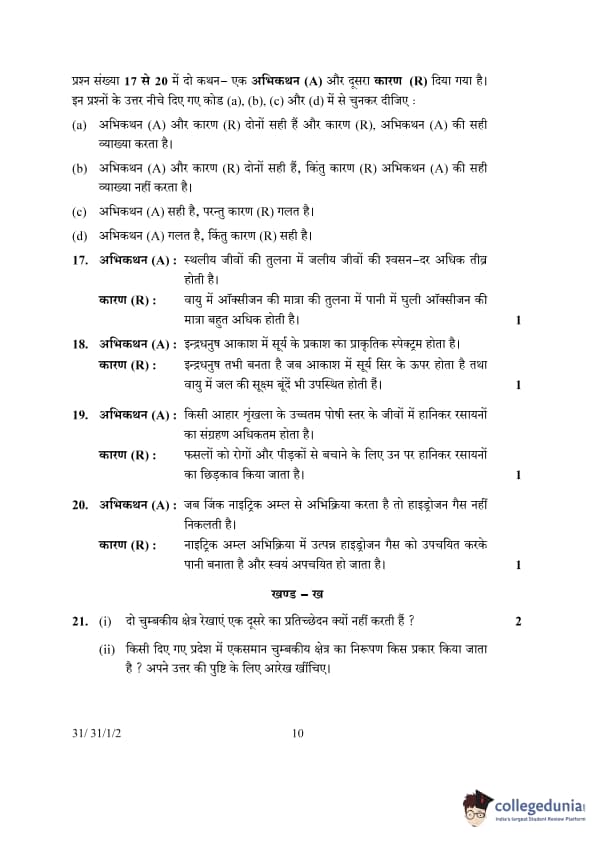
| 21. (i) Two magnetic field lines do not intersect each other. Why? (ii) How is a uniform magnetic field in a given region represented? Draw a diagram in support of your answer. |
(i) Magnetic field lines do not intersect. (ii) Represented by parallel and equally spaced lines. |
(i) Magnetic field lines never intersect because at the point of intersection, the magnetic field would have two different directions, which is not possible. (ii) A uniform magnetic field is represented by parallel and equally spaced straight lines. This indicates that the field strength and direction are the same at every point. Diagram: |
||||||||||||||||
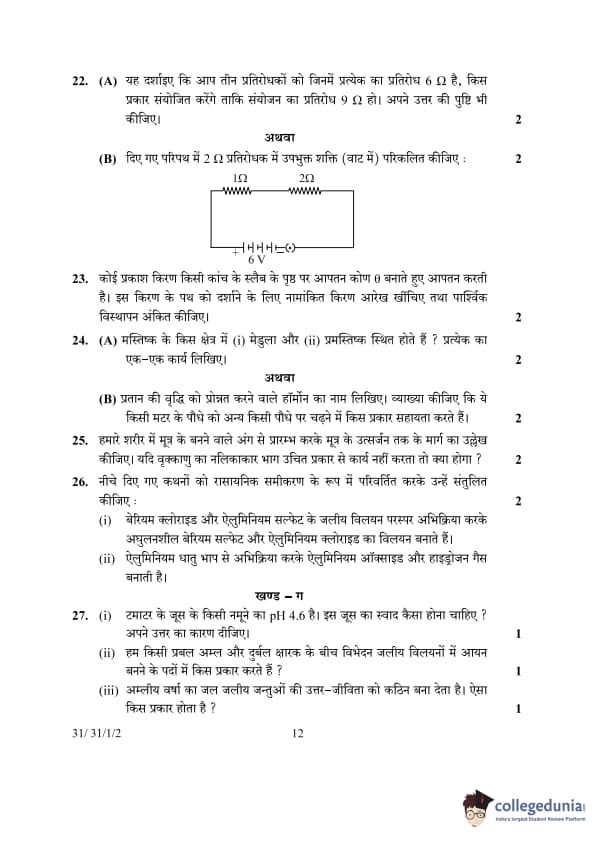
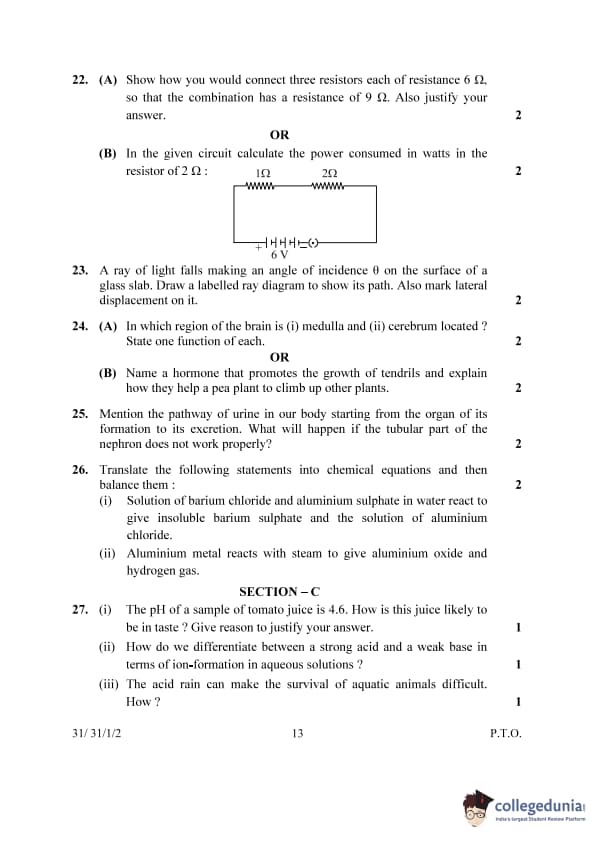
| 22. (A) Show how you would connect three resistors each of resistance 6 Ω, so that the combination has a resistance of 9 Ω. Also justify your answer: | Combination achieved with \( R_{total} = 9 \, \Omega \). | To achieve a total resistance of 9 Ω, two resistors are connected in parallel, and the third resistor is connected in series with the combination. 1. Parallel combination of two resistors: \[ \frac{1}{R_p} = \frac{1}{R_1} + \frac{1}{R_2} = \frac{1}{6} + \frac{1}{6} = \frac{2}{6}, \quad R_p = \frac{6}{2} = 3 \, \Omega. \] 2. Series combination with the third resistor: \[ R_{total} = R_p + R_3 = 3 + 6 = 9 \, \Omega. \] Thus, the required combination is achieved. |
||||||||||||||||
| 22. (B) In the given circuit, calculate the power consumed in watts in the resistor of 2 Ω: | 8 W | The circuit has a 6V source with two resistors R1 = 1 Ω and R2 = 2 Ω connected in series. Calculate the equivalent resistance: Req = R1 + R2 = 1 Ω + 2 Ω = 3 Ω. Calculate the current using Ohm’s Law: I = V / Req = 6 V / 3 Ω = 2 A. Calculate the electric power: Power consumed in the R2 = 2 Ω resistor is: P = I2 × R = (2 A)2 × 2 Ω = 4 × 2 W = 8 W. The power consumed in the 2 Ω resistor is 8 watt. |
||||||||||||||||
| 23. A ray of light falls making an angle of incidence \( i \) on the surface of a glass slab. Draw a labelled ray diagram to show its path. Also mark lateral displacement on it: | Ray diagram with lateral displacement marked. | When a ray of light passes through a parallel-sided glass slab, it undergoes refraction twice – once when entering the slab and once when exiting the slab. Due to this, the ray gets laterally displaced but remains parallel to the incident ray. Steps to explain the diagram: • When the ray of light enters the glass slab, it bends towards the normal because glass is denser than air. • The ray travels through the glass slab and refracts again at the opposite surface while emerging into air. This time, the ray bends away from the normal. • The emergent ray is parallel to the incident ray but shifted sideways. This sideways shift is called lateral displacement. Ray Diagram: Lateral Displacement: The lateral displacement \( LM \) depends on: • The thickness of the glass slab (\( t \)), • The angle of incidence (\( i \)), • The refractive index of the glass slab (\( \mu \)). |
||||||||||||||||
| 24. (A) In which region of the brain is (i) medulla and (ii) cerebrum located? State one function of each. | (i) Medulla: Brainstem (ii) Cerebrum: Forebrain |
(i) Medulla: • Location: The medulla is located in the brainstem, at the base of the brain where it connects to the spinal cord. • Function: It controls involuntary actions like breathing, heartbeat, and regulation of blood pressure. (ii) Cerebrum: • Location: The cerebrum is part of the forebrain and is the largest region of the brain. It is divided into two hemispheres. • Function: It is responsible for voluntary actions and higher cognitive functions like thinking, memory, reasoning, and learning. |
||||||||||||||||
| 24. (B) Name a hormone that promotes the growth of tendrils and explain how they help a pea plant to climb up other plants. | Auxin | The hormone that promotes the growth of tendrils is Auxin. How tendrils help pea plants climb: • Tendrils are specialized, thin structures that help climbing plants attach to supports such as other plants or structures. • Auxin accumulates on the shaded side of the tendril (the side away from the support), promoting faster growth on that side. • This differential growth causes the tendril to curl around the support, anchoring the plant and enabling it to climb upward. |
||||||||||||||||
| 25. Mention the pathway of urine in our body starting from the organ of its formation to its excretion. What will happen if the tubular part of the nephron does not work properly? | Pathway: Kidneys → Ureters → Urinary Bladder → Urethra | Pathway of Urine: 1. Kidneys: Urine is formed in the kidneys through the process of filtration, reabsorption, and secretion. 2. Ureters: Urine travels from the kidneys to the urinary bladder via the ureters, which are tube-like structures. 3. Urinary Bladder: The urinary bladder stores urine temporarily until it is expelled. 4. Urethra: Urine is finally expelled from the body through the urethra. Malfunctioning of the Tubular Part of the Nephron: • The nephron, the functional unit of the kidney, filters blood and regulates urine formation. • The tubular part of the nephron reabsorbs essential substances like glucose, amino acids, water, and salts back into the bloodstream. • If the tubular part does not function properly: – Essential substances may not be reabsorbed and will be lost in urine. – This can result in dehydration, loss of electrolytes, and imbalances in glucose and salts. – Over time, it may lead to serious health complications like kidney failure. |
||||||||||||||||
| 26. Translate the following statements into chemical equations and then balance them: (i) Solution of barium chloride and aluminium sulphate in water react to give insoluble barium sulphate and the solution of aluminium chloride. |
3BaCl2 (aq) + Al2(SO4)3 (aq) → 3BaSO4 (s) ↓ + 2AlCl3 (aq) |
Unbalanced Equation: The downward arrow (↓) indicates that barium sulphate (BaSO4) forms as a precipitate, which is an insoluble solid. |
||||||||||||||||
| 26. (ii) Translate the following statement into a chemical equation and then balance it: Aluminium metal reacts with steam to give aluminium oxide and hydrogen gas. |
2Al (s) + 3H2O (g) → Al2O3 (s) + 3H2 (g) | Unbalanced Equation: Al (s) + H2O (g) → Al2O3 (s) + H2 (g) Balanced Equation: 2Al (s) + 3H2O (g) → Al2O3 (s) + 3H2 (g) Steam is represented as H2O (g), which reacts with aluminium to produce aluminium oxide (Al2O3) and hydrogen gas (H2). |
||||||||||||||||
| 27. (i) The pH of a sample of tomato juice is 4.6. How is this juice likely to be in taste? Give reason to justify your answer. | Slightly sour | The taste of tomato juice will be slightly sour. The pH value of 4.6 indicates that tomato juice is acidic, as substances with a pH less than 7 are acids. Acids are typically sour in taste. | ||||||||||||||||
| 27. (ii) How do we differentiate between a strong acid and a weak base in terms of ion-formation in aqueous solutions? | Strong acid: Complete ionization Weak base: Partial ionization |
• A strong acid ionizes completely in water, releasing a large number of H+ ions. Example: HCl → H+ + Cl−. • A weak base partially ionizes in water, releasing fewer OH− ions. Example: NH4OH ⇌ NH4+ + OH−. |
||||||||||||||||
| 27. (iii) The acid rain can make the survival of aquatic animals difficult. How? | Lowers the pH of water bodies | Acid rain lowers the pH of water bodies, making the water acidic. This affects aquatic life because: • It damages the gills of fish and other aquatic organisms. • It reduces the availability of essential minerals by dissolving toxic metals like aluminum. |
||||||||||||||||
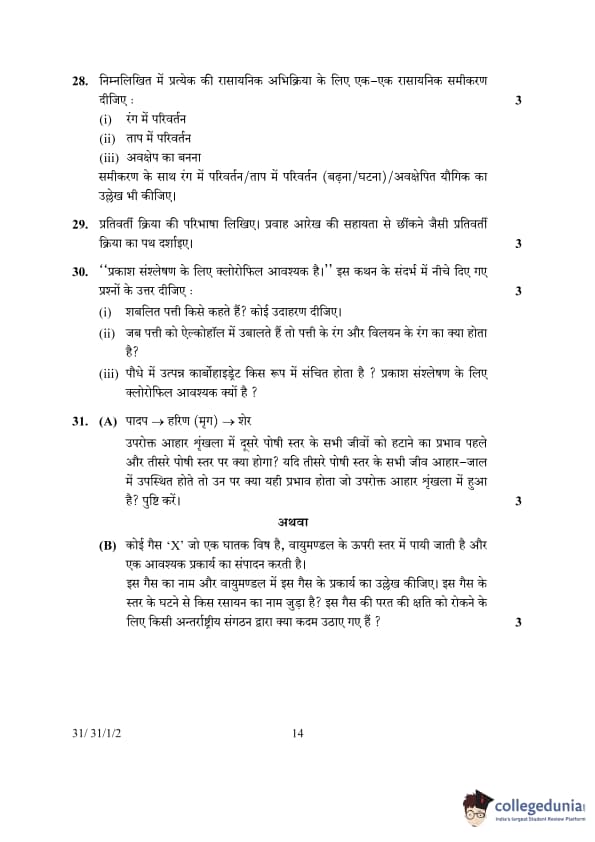
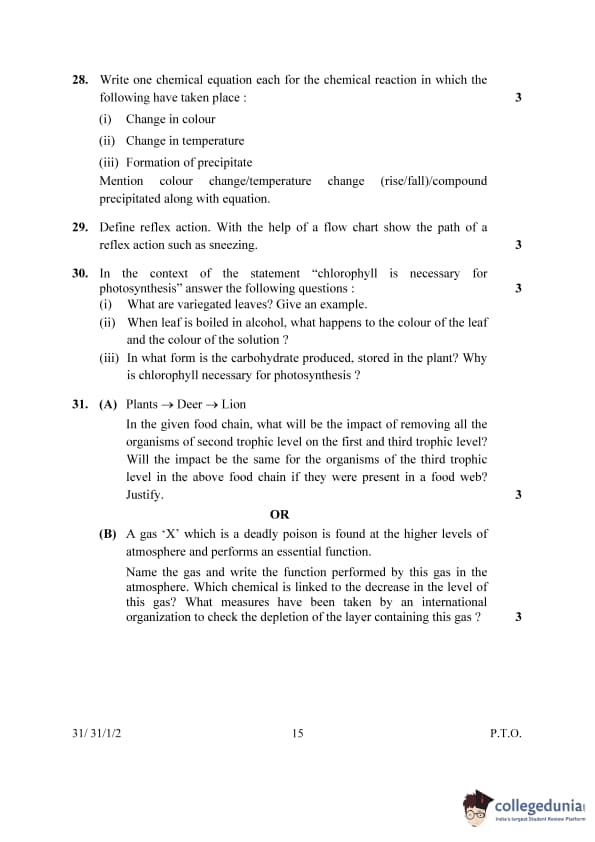
| 28. Write one chemical equation each for the chemical reaction in which the following have taken place: (i) Change in colour: (ii) Change in temperature: (iii) Formation of precipitate: |
(i) CuCO3 → CuO + CO2 (ii) CaO + H2O → Ca(OH)2 (iii) Na2SO4 + BaCl2 → BaSO4 ↓ + 2NaCl |
(i) Change in colour: A chemical reaction that causes a colour change is the heating of copper carbonate: CuCO3 (heat) → CuO + CO2. Observation: Copper carbonate (green) changes to copper oxide (black). (ii) Change in temperature: An example is the exothermic reaction of quicklime with water: CaO + H2O → Ca(OH)2. Observation: The reaction releases heat, causing a rise in temperature. (iii) Formation of precipitate: An example is the reaction between sodium sulfate and barium chloride: Na2SO4 + BaCl2 → BaSO4 ↓ + 2NaCl. Observation: A white precipitate of barium sulfate (BaSO4) is formed. |
||||||||||||||||
| 29. Define reflex action. With the help of a flow chart, show the path of a reflex action such as sneezing. | Reflex action: Automatic, involuntary response to a stimulus. | A reflex action is an automatic, involuntary response to a stimulus that does not involve the conscious part of the brain. Reflex actions are designed to protect the body from harm and enable quick responses. For example, sneezing helps expel irritants from the nasal passages. Characteristics of Reflex Actions: • They are rapid and automatic. • They are protective in nature. • They bypass the brain, involving only the spinal cord and nerves. Flow Chart: Stimulus → Sensory Receptor → Sensory Neuron → Spinal Cord → Motor Neuron → Response (Diaphragm activation). Example: Sneezing Reflex: When an irritant like dust or pollen enters the nose, sensory nerves detect the irritant and send a signal to the spinal cord. The motor nerves activate muscles in the diaphragm, causing a sudden forceful expulsion of air, removing the irritant. |
||||||||||||||||
| 30. In the context of the statement “chlorophyll is necessary for photosynthesis” answer the following questions: (i) What are variegated leaves? Give an example. |
Variegated leaves: Coleus, Croton, Prayer Plant | Variegated leaves: These are leaves that have zones of different colors, typically green and white or yellow, due to varying chlorophyll distribution. • The green parts of the leaf contain chlorophyll and can perform photosynthesis. • The white or yellow parts lack chlorophyll and cannot carry out photosynthesis. Example: Coleus, Croton, and Prayer Plant. |
||||||||||||||||
| 30. (ii) When a leaf is boiled in alcohol, what happens to the colour of the leaf and the colour of the solution? | Leaf: Pale or whitish Solution: Green |
When a leaf is boiled in alcohol: • Colour of the leaf: The leaf loses its green colour as chlorophyll dissolves in the alcohol. It turns pale or whitish. • Colour of the solution: The alcohol solution turns green because the dissolved chlorophyll gives it a green tint. |
||||||||||||||||
| 30. (iii) In what form is the carbohydrate produced stored in the plant? Why is chlorophyll necessary for photosynthesis? | Stored as starch | Form of Carbohydrate: • The carbohydrate produced during photosynthesis is stored in the plant as starch. • Starch is a complex, insoluble polysaccharide composed of glucose units. It does not dissolve in water and thus does not disturb the osmotic balance of plant cells. Why chlorophyll is necessary: • Chlorophyll is the primary pigment responsible for absorbing light energy from the sun, specifically from the red and blue wavelengths of visible light. • This absorbed energy powers the light-dependent reactions of photosynthesis, splitting water molecules into oxygen, hydrogen, and energy-rich molecules like ATP and NADPH. • The energy-carrying molecules are then used in the Calvin cycle to convert carbon dioxide into glucose, which is further stored as starch. |
||||||||||||||||
| 31. Plants → Deer → Lion (A) In the given food chain, what will be the impact of removing all the organisms of the second trophic level on the first and third trophic levels? Will the impact be the same for the organisms of the third trophic level in a food web? Justify. |
First level: Increase Third level: Decline |
Food Chain: Plants → Deer → Lion - The second trophic level (deer) is the primary consumer. Impact: • On the first trophic level (plants): Their population will increase due to reduced grazing pressure. • On the third trophic level (lion): Their population will decline due to the absence of food. In a food web: The impact on the third trophic level may be less severe because the lion can depend on other prey as a food source. |
||||||||||||||||
| 31. (B) A gas ‘X’ which is a deadly poison is found at the higher levels of atmosphere and performs an essential function. Name the gas and write the function performed by this gas in the atmosphere. Which chemical is linked to the decrease in the level of this gas? What measures have been taken by an international organization to check the depletion of the layer containing this gas? | Gas: Ozone Chemical: Chlorofluorocarbons (CFCs) |
• Gas ‘X’: Ozone • Function: It protects life on Earth by absorbing harmful ultraviolet (UV) radiation. • Chemical causing depletion: Chlorofluorocarbons (CFCs). • Measures: The Montreal Protocol was adopted to phase out the production and use of ozone-depleting substances like CFCs. |
||||||||||||||||
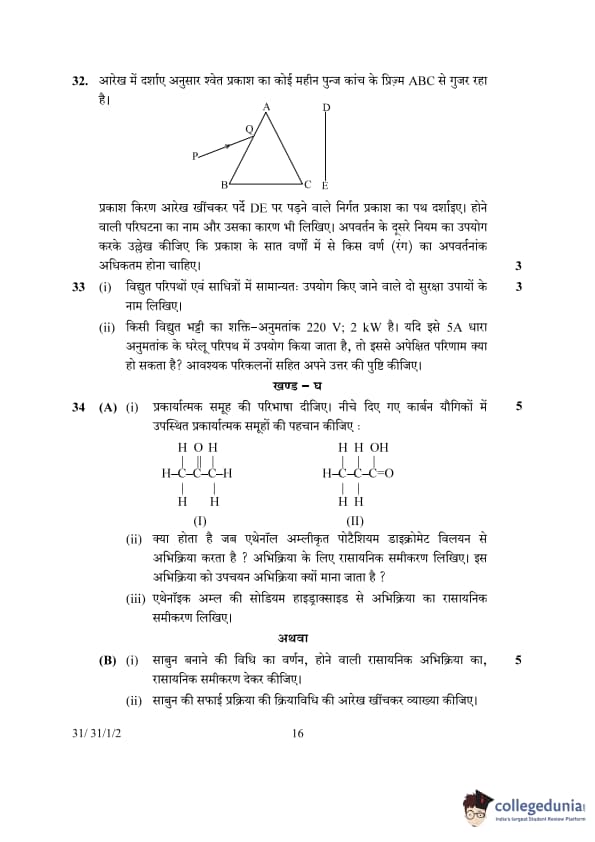
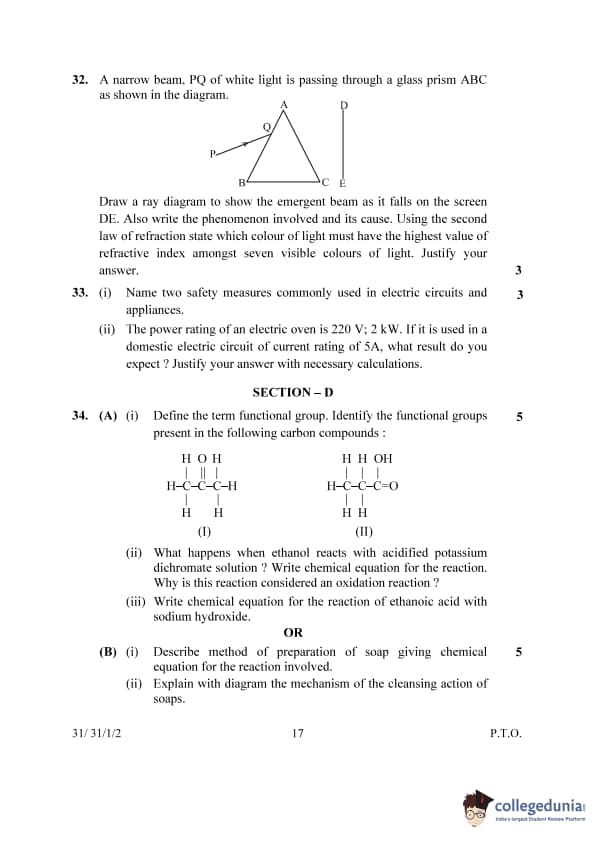
| 32. A narrow beam, PQ of white light is passing through a glass prism ABC as shown in the diagram. Draw a ray diagram to show the emergent beam as it falls on the screen DE. Also write the phenomenon involved and its cause. Using the second law of refraction, state which colour of light must have the highest value of refractive index amongst seven visible colours of light. Justify your answer. | Phenomenon: Dispersion Colour with highest refractive index: Violet |
Ray Diagram: Phenomenon: The phenomenon involved is the dispersion of light. Cause: • Dispersion occurs because different colors of light have different wavelengths and hence different refractive indices in a glass prism. • When white light enters the prism, the colors bend at different angles, separating into a spectrum of colors (VIBGYOR). Second Law of Refraction and Highest Refractive Index: • According to the second law of refraction: \[ \mu = \frac{\sin i}{\sin r} \] where \( \mu \) is the refractive index, \( i \) is the angle of incidence, and \( r \) is the angle of refraction. • The color that bends the most has the smallest angle of refraction and hence the highest refractive index. • In the visible spectrum, violet light bends the most due to its shortest wavelength. Therefore, violet light has the highest refractive index in a glass prism. |
||||||||||||||||
| 33. (i) Name two safety measures commonly used in electric circuits and appliances. | Fuse and Earthing | Two common safety measures used in electric circuits and appliances are: • Fuse: A fuse is a safety device that protects electrical circuits from overloading and short circuits. It contains a thin wire that melts and breaks the circuit if the current exceeds a safe limit, preventing damage to the appliances and wiring. • Earthing: Earthing involves connecting the metal casing of an appliance to the ground. This provides a direct path for fault currents to flow into the ground, preventing electric shocks to the user. |
||||||||||||||||
| 33. (ii) The power rating of an electric oven is 220 V; 2 kW. If it is used in a domestic electric circuit of current rating of 5 A, what result do you expect? Justify your answer with necessary calculations. | The fuse will blow, and the oven will not work. | Given: • \( P = 2 \, \text{kW} = 2000 \, \text{W} \) (Power rating of the oven) • \( V = 220 \, \text{V} \) (Voltage rating of the oven) • \( I_{\text{circuit}} = 5 \, \text{A} \) (Current rating of the circuit) Current drawn by the oven: Using the formula for power: \[ P = V \cdot I \implies I = \frac{P}{V} \] Substitute the values: \[ I_{\text{oven}} = \frac{2000 \, \text{W}}{220 \, \text{V}} \approx 9.1 \, \text{A} \] Expected Result: • The current drawn by the oven (9.1 A) is greater than the current rating of the circuit (5 A). • This will cause the fuse to blow (melt), breaking the circuit to prevent damage to the wiring or the appliance. • As a result, the oven will not work. |
||||||||||||||||
| 34. (A) (i) Define the term functional group. Identify the functional groups present in the following carbon compounds. (ii) What happens when ethanol reacts with acidified potassium dichromate solution? Write a chemical equation for the reaction. Why is this reaction considered an oxidation reaction? (iii) Write the chemical equation for the reaction of ethanoic acid with sodium hydroxide. |
(i) Ketone (−C=O) and Carboxylic acid (−COOH) (ii) Ethanol oxidized to ethanoic acid (iii) CH3COOH + NaOH → CH3COONa + H2O |
(i) Functional Group: A functional group is a specific atom or group of atoms within a molecule that determines its characteristic chemical reactions. Functional groups in the given compounds: • Compound (I): The functional group is a ketone (−C=O) [propanone]. • Compound (II): The functional group is a carboxylic acid (−COOH) [propanoic acid]. (ii) Reaction of ethanol with acidified potassium dichromate: When ethanol reacts with acidified potassium dichromate, it is oxidized to ethanoic acid: CH3CH2OH + 2[O] (K2Cr2O7/H2SO4) → CH3COOH + H2O Why oxidation? • Ethanol undergoes oxidation as it gains oxygen atoms to form ethanoic acid. • Potassium dichromate acts as an oxidizing agent, as it gets reduced during the reaction. (iii) Reaction of ethanoic acid with sodium hydroxide: Ethanoic acid reacts with sodium hydroxide to form sodium ethanoate (sodium acetate) and water: CH3COOH + NaOH → CH3COONa + H2O |
||||||||||||||||
| 34. (B) (i) Describe the method of preparation of soap giving the chemical equation for the reaction involved. (ii) Explain with a diagram the mechanism of the cleansing action of soaps. |
(i) Saponification (ii) Micelle formation for cleansing |
(i) Preparation of soap (Saponification): Soap is prepared by the alkaline hydrolysis of fats or oils (esters) in a reaction known as saponification. Fats/oils react with sodium hydroxide to produce soap and glycerol: RCOO)3C3H5 + 3NaOH → 3RCOONa + C3H5(OH)3 Here: • RCOONa: Soap (salt of a fatty acid). • C3H5(OH)3: Glycerol. (ii) Cleansing action of soaps: Explanation: • Soap molecules have two ends: – Hydrophilic head: Water-attracting part. – Hydrophobic tail: Oil/grease-attracting part. • The hydrophobic tail attaches to grease/oil, while the hydrophilic head remains in water. This forms structures called micelles, where the oil is trapped inside and surrounded by soap molecules. • The micelles allow the oil/grease to be washed away with water. Diagram: |
||||||||||||||||
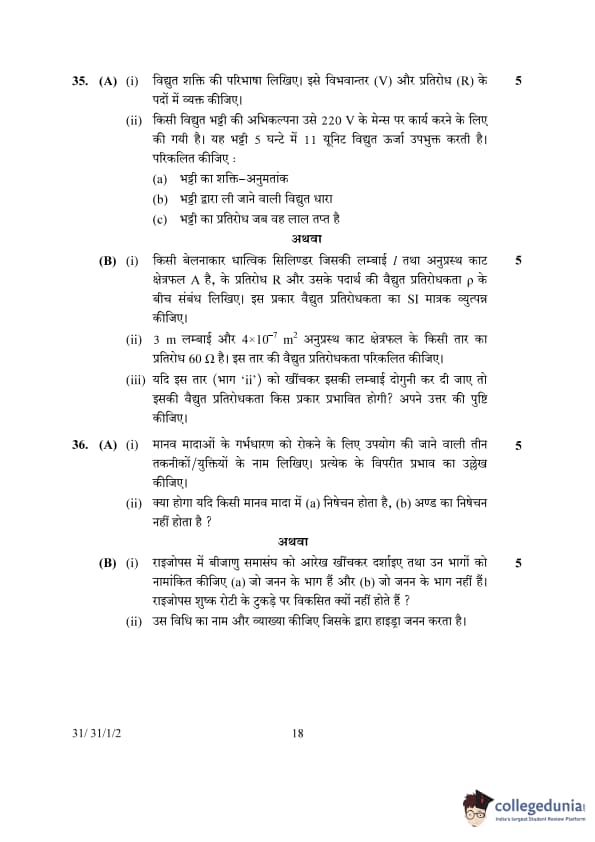
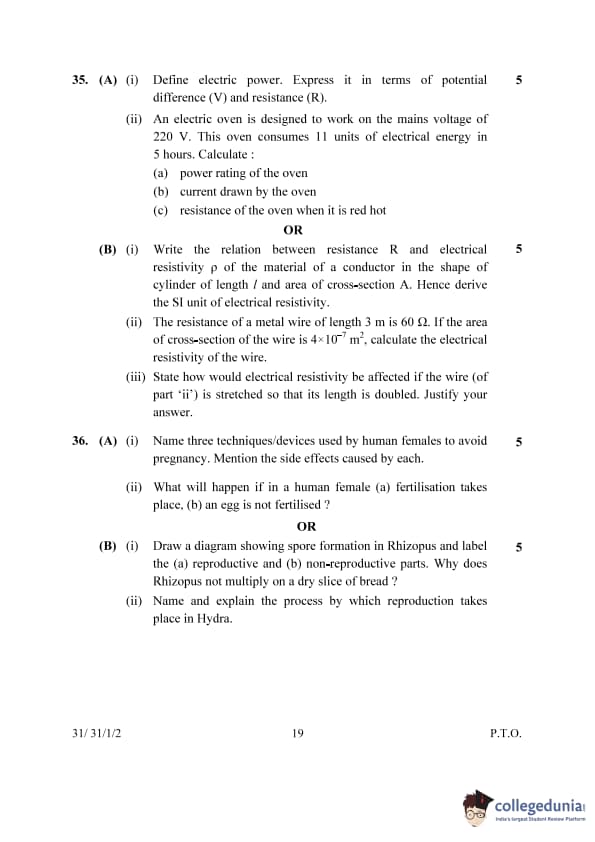
| 35. (A) (i) Define electric power. Express it in terms of potential difference (V) and resistance (R). (ii) An electric oven is designed to work on the mains voltage of 220 V. This oven consumes 11 units of electrical energy in 5 hours. Calculate: (a) Power rating of the oven. (b) Current drawn by the oven. (c) Resistance of the oven when it is red hot. |
(i) Electric power: \( P = \frac{V^2}{R} \) (ii) (a) 2200 W (b) 10 A (c) 22 Ω |
(i) Definition of Electric Power: Electric power is the rate at which electrical energy is consumed or converted into another form of energy. Formula: \( P = \frac{V^2}{R} \), where \( P \) is power, \( V \) is potential difference, and \( R \) is resistance. (ii) Calculations: (a) Power rating of the oven: Energy consumed in 5 hours = 11 units (1 unit = 1 kWh) = \( 11 \times 1000 = 11000 \, \text{Wh} \) Power rating, \( P = \frac{\text{Energy consumed}}{\text{Time}} = \frac{11000}{5} = 2200 \, \text{W} \). (b) Current drawn by the oven: Using \( P = VI \): \( I = \frac{P}{V} = \frac{2200}{220} = 10 \, \text{A} \). (c) Resistance of the oven when it is red hot: Using \( R = \frac{V^2}{P} \): \( R = \frac{220^2}{2200} = 22 \, \Omega \). |
||||||||||||||||
| 35. (B) (i) Write the relation between resistance \( R \) and electrical resistivity \( \rho \) of the material of a conductor in the shape of a cylinder of length \( l \) and area of cross-section \( A \). Hence derive the SI unit of electrical resistivity. (ii) The resistance of a metal wire of length 3 m is 60 Ω. If the area of cross-section of the wire is \( 4 \times 10^{-7} \, \text{m}^2 \), calculate the electrical resistivity of the wire. (iii) State how electrical resistivity would be affected if the wire (of part ’ii’) is stretched so that its length is doubled. Justify your answer. |
(i) \( R = \rho \frac{l}{A} \); SI Unit: \( \Omega \cdot \text{m} \) (ii) \( 8 \times 10^{-6} \, \Omega \cdot \text{m} \) (iii) No change in resistivity |
(i) Relation between resistance and resistivity: \[ R = \rho \frac{l}{A}, \quad \text{where } \rho = \frac{RA}{l} \] SI Unit of Resistivity: \[ \rho = \frac{\text{Resistance} \times \text{Area}}{\text{Length}} = \frac{\Omega \cdot \text{m}^2}{\text{m}} = \Omega \cdot \text{m}. \] (ii) Calculation of electrical resistivity: Given: \( R = 60 \, \Omega, \, A = 4 \times 10^{-7} \, \text{m}^2, \, l = 3 \, \text{m} \) \[ \rho = \frac{R \cdot A}{l} = \frac{60 \cdot 4 \times 10^{-7}}{3} = 8 \times 10^{-6} \, \Omega \cdot \text{m}. \] (iii) Effect of stretching on resistivity: Electrical resistivity is a material property and does not depend on the dimensions of the conductor. Stretching the wire will not change its resistivity as it depends only on the material, not its shape or size. |
||||||||||||||||
| 36. (A) (i) Name three techniques/devices used by human females to avoid pregnancy. Mention the side effects caused by each. (ii) What will happen if in a human female: (a) Fertilisation takes place? (b) An egg is not fertilised? |
(i) Pills, IUDs, Barrier methods (ii) (a) Zygote forms and implants (b) Egg disintegrates, menstruation occurs |
(i) Techniques to avoid pregnancy and their side effects: • Oral Contraceptive Pills: Prevent ovulation. Side Effects: Nausea, weight gain, mood swings. • Intrauterine Devices (IUDs): Prevent implantation of the embryo. Side Effects: Cramps, irregular bleeding. • Barrier Methods (e.g., condoms): Prevent sperm from reaching the egg. Side Effects: None significant; rare latex allergies. (ii) What will happen: (a) If fertilisation takes place: The zygote is formed, implants in the uterus, and develops into an embryo. (b) If an egg is not fertilised: The egg disintegrates, and the uterine lining sheds during menstruation. |
||||||||||||||||
| 36. (B) (i) Draw a diagram showing spore formation in Rhizopus and label the: (a) Reproductive parts (b) Non-reproductive parts Why does Rhizopus not multiply on a dry slice of bread? (ii) Name and explain the process by which reproduction takes place in Hydra. |
(i) Requires moisture for spore germination (ii) Budding in Hydra |
(i) Spore Formation in Rhizopus: Reason: Rhizopus requires moisture for spore germination and growth. A dry slice of bread lacks sufficient moisture. Diagram: (a) Reproductive parts: Sporangium, spores (b) Non-reproductive parts: Hyphae, stolons (ii) Reproduction in Hydra: Reproduction in Hydra occurs through budding. A small outgrowth (bud) develops on the parent body, grows, and detaches to form a new individual. This is an asexual reproduction process. |
||||||||||||||||
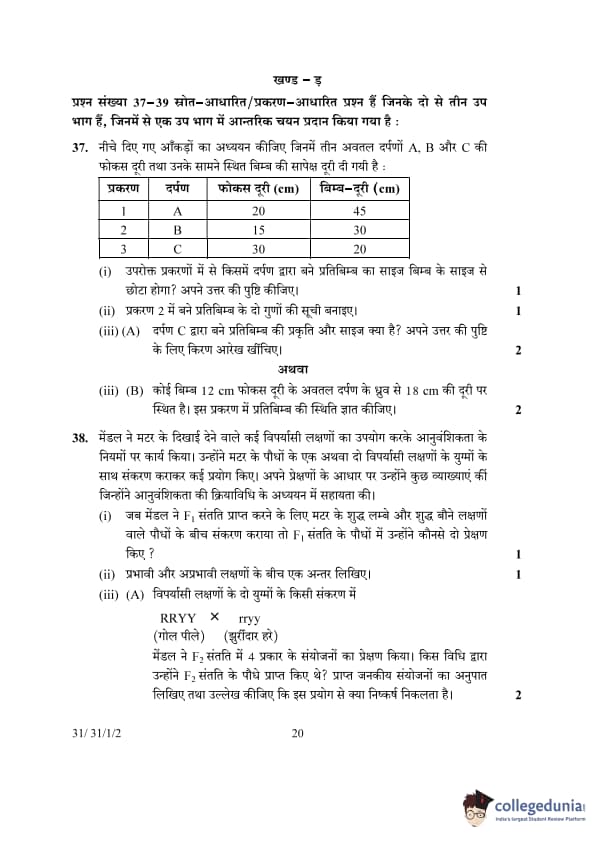
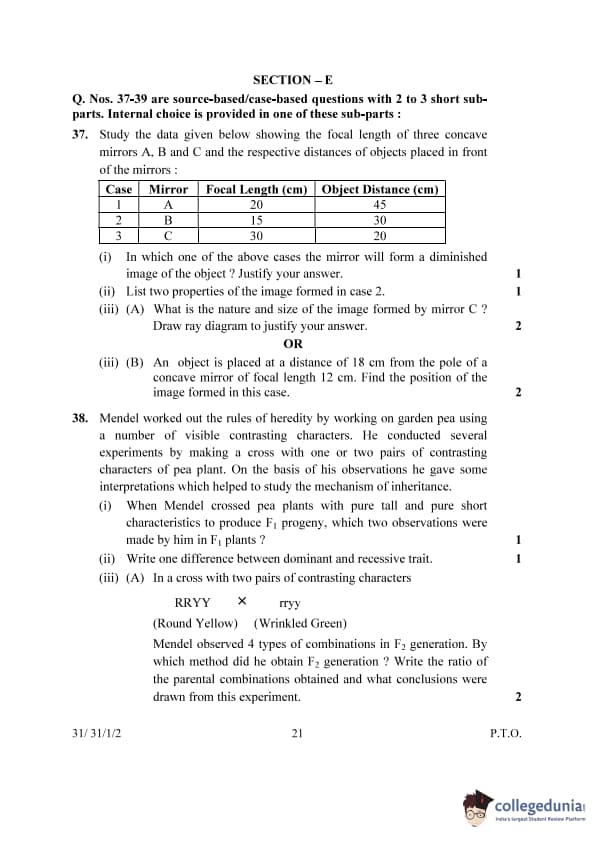
37. Study the data given below showing the focal length of three concave mirrors A, B, and C and the respective distances of objects placed in front of the mirrors:
(i) In which one of the above cases the mirror will form a diminished image of the object? Justify your answer. (ii) List two properties of the image formed in case 2. (iii) (A) What is the nature and size of the image formed by mirror C? Draw ray diagram to justify your answer. |
(i) Case 1 (Mirror A) (ii) Real, inverted, same size (iii) Virtual, erect, magnified |
(i) Case 1 (Mirror A): The object distance (45 cm) is beyond the center of curvature (\( C = 2f = 40 \, \text{cm} \)). When the object is beyond \( C \), the image formed is diminished, inverted, and between \( f \) and \( C \). (ii) Properties of the image in Case 2 (Mirror B): • The image is real and inverted. • The image is of the same size as the object (object distance is at the center of curvature). (iii) Nature and size of the image formed by Mirror C: In Case 3 (Mirror C): The object distance (20 cm) is less than the focal length (30 cm). • Nature of Image: Virtual, erect, and magnified. Ray Diagram: Draw a ray originating from the object parallel to the principal axis and refracting through the focal point. Another ray passes through the center of curvature, and the virtual rays appear to meet behind the mirror. |
||||||||||||||||
| 37. (B) An object is placed at a distance of 18 cm from the pole of a concave mirror of focal length 12 cm. Find the position of the image formed in this case. | Image position: -36 cm | Using the mirror formula: \[ \frac{1}{f} = \frac{1}{v} + \frac{1}{u} \] Here, \( f = -12 \, \text{cm} \) (concave mirror), \( u = -18 \, \text{cm} \) (object distance). \[ \frac{1}{v} = \frac{1}{f} - \frac{1}{u} \] Substituting the values: \[ \frac{1}{v} = \frac{1}{-12} - \frac{1}{-18} \] To simplify, take the LCM of 12 and 18, which is 36: \[ \frac{1}{v} = \frac{-3}{36} + \frac{2}{36} \] \[ \frac{1}{v} = \frac{-1}{36} \] Therefore, \[ v = -36 \, \text{cm}. \] The image is formed 36 cm in front of the mirror from the pole of the concave mirror. The image is real, inverted, and larger than the object. |
||||||||||||||||
| 38. Mendel worked out the rules of heredity by working on garden pea using a number of visible contrasting characters. He conducted several experiments by making a cross with one or two pairs of contrasting characters of pea plant. On the basis of his observations he gave some interpretations which helped to study the mechanism of inheritance. (i) When Mendel crossed pea plants with pure tall and pure short characteristics to produce F1 progeny, which two observations were made by him in F1 plants? (ii) Write one difference between dominant and recessive trait. (iii) (A) In a cross with two pairs of contrasting characters. RRYY (Round Yellow) × rryy (Wrinkled Green) Mendel observed 4 types of combinations in F2 generation. By which method did he obtain F2 generation? Write the ratio of the parental combinations obtained and what conclusions were drawn from this experiment. |
(i) All F1 plants were tall; short trait not expressed. (ii) Dominant: Expressed in both homozygous and heterozygous. Recessive: Expressed only in homozygous. (iii) Method: Self-pollination of F1 progeny (RrYy). Phenotypic Ratio: 9:3:3:1 |
(i) Observations in F1 Plants: • All F1 plants were tall, showing that tallness is a dominant trait. • The short (recessive) trait was not expressed in the F1 generation. (ii) Difference between Dominant and Recessive Traits: • Dominant Trait: Expressed in the presence of both homozygous and heterozygous alleles. • Recessive Trait: Expressed only in the homozygous condition. (iii) Method and Results of the Experiment with Two Pairs of Contrasting Characters: • Method: Self-pollination of F1 progeny (RrYy). • F2 Generation Phenotypic Ratio: 9 (Round Yellow): 3 (Round Green): 3 (Wrinkled Yellow): 1 (Wrinkled Green). • Conclusions: Traits segregate independently, demonstrating the Law of Independent Assortment. |
||||||||||||||||
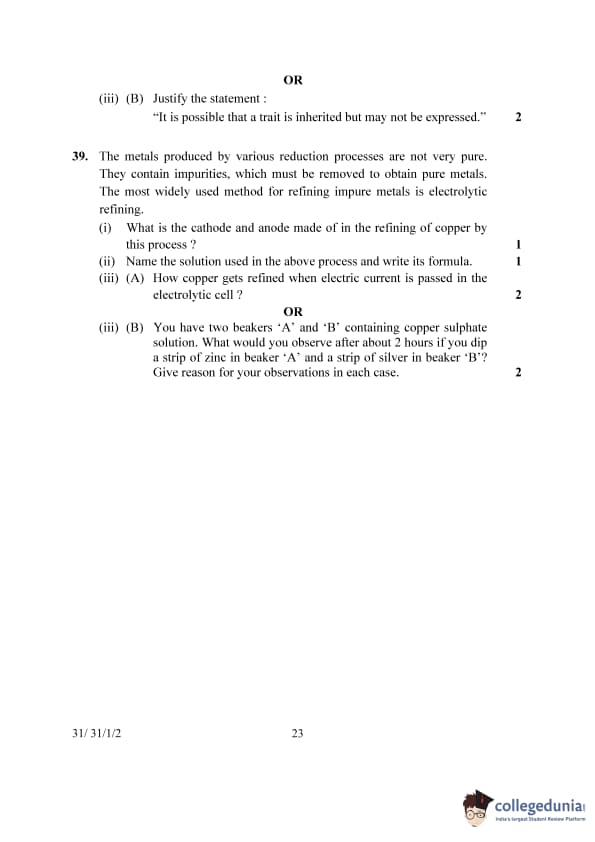
| 38. (B) Justify the statement: "It is possible that a trait is inherited but may not be expressed." | A recessive trait may be inherited but not expressed if the individual has a dominant allele. | A trait can be inherited but not expressed if it is recessive and the individual possesses a dominant allele for that trait. In heterozygous conditions, the dominant trait masks the recessive trait, making it unexpressed but still inheritable. | ||||||||||||||||
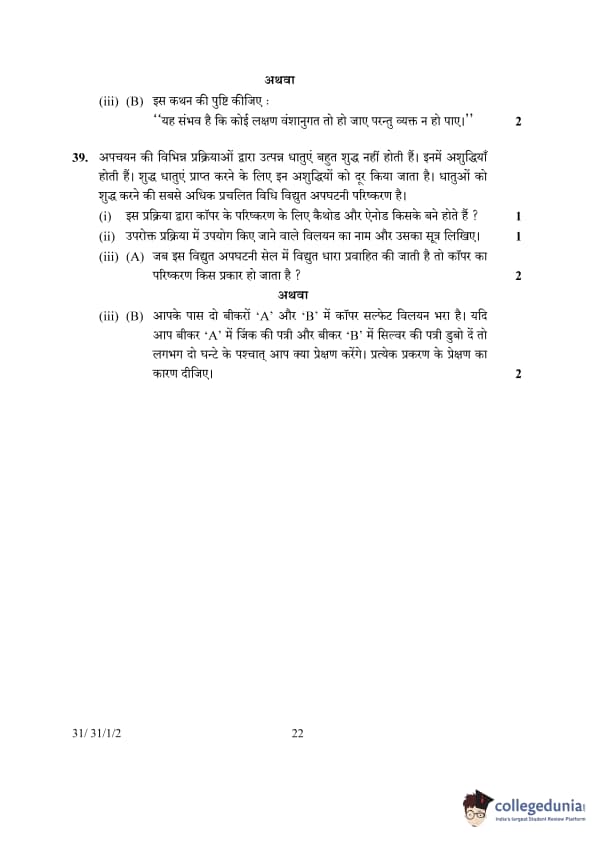
| 39. The metals produced by various reduction processes are not very pure. They contain impurities, which must be removed to obtain pure metals. The most widely used method for refining impure metals is electrolytic refining. (i) What is the cathode and anode made of in the refining of copper by this process? (ii) Name the solution used in the above process and write its formula. (iii) (A) How does copper get refined when electric current is passed in the electrolytic cell? |
(i) Cathode: Pure copper plate Anode: Impure copper block (ii) Solution: Acidified copper sulphate solution Formula: CuSO4 (iii) Copper ions are reduced at cathode; impurities settle at anode. |
(i) Cathode and Anode in Copper Refining: - Cathode: Pure copper plate. - Anode: Impure copper block. (ii) Solution and Formula: - Solution: Acidified copper sulphate solution. - Formula: CuSO4 (iii) Refining Process: When electric current is passed through the electrolytic cell: - Copper ions (Cu2+) from the solution are reduced at the cathode, depositing pure copper. - At the anode, impure copper oxidizes, releasing Cu2+ ions into the solution. Impurities settle as anode mud. |
||||||||||||||||
| 39. (B) You have two beakers 'A' and 'B' containing copper sulphate solution. What would you observe after about 2 hours if you dip a strip of zinc in beaker 'A' and a strip of silver in beaker 'B'? Give reason for your observations in each case. | Beaker A (Zinc strip): Zinc gets coated with copper, CuSO₄ blue color fades. Beaker B (Silver strip): No change observed. |
• Beaker 'A' (Zinc strip): The zinc strip gets coated with copper, and the blue color of CuSO₄ fades. Reason: Zinc is more reactive than copper and displaces Cu2+ ions from the solution. • Beaker 'B' (Silver strip): No change is observed. Reason: Silver is less reactive than copper and cannot displace Cu2+ ions from the solution. |





Comments