




CBSE Class 10 Science Question Paper 2024 PDF (Set 2 - 31/2/2) is available for download here. CBSE conducted the Science exam on March 2, 2024, from 10:30 AM to 1:30 PM. The total marks for the theory paper are 80. The question paper contains 20% MCQ-based questions, 40% competency-based questions, and 40% short and long answer type questions.
CBSE Class 10 Science Question Paper 2024 (Set 2 - 31/2/2) with Answer Key
| CBSE Class 10 Science Question Paper 2024 (Set 2 - 31/2/2) with Answer Key |  Download Download |
Check Solutions |
CBSE Science Question Paper (Set 2 – 31/2/2) 2024 Solution
| Question | Answer | Detailed Solution |
|---|---|---|
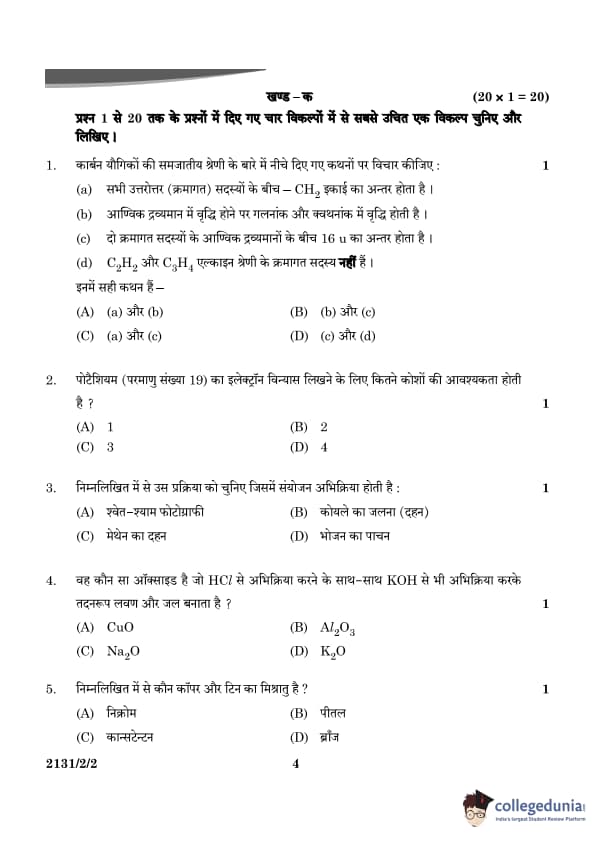
| 1. Consider the following statements about homologous series of carbon compounds: (a) All succeeding members differ by –CH2 unit. (b) Melting point and boiling point increases with increasing molecular mass. (c) The difference in molecular masses between two successive members is 16 u. (d) C2H2 and C3H4 are NOT the successive members of alkyne series. The correct statements are: (A) (a) and (b) (B) (b) and (c) (C) (a) and (c) (D) (c) and (d) |
(A) (a) and (b) | In a homologous series, consecutive members differ by a –CH2 unit (statement a). Melting and boiling points increase with molecular mass (statement b). The difference in molecular mass is 14 u, not 16 u (statement c is incorrect). C2H2 and C3H4 are successive members of the alkyne series (statement d is incorrect). |
| 2. The number of shells required to write the electronic configuration of Potassium (At. No. 19): (A) 1 (B) 2 (C) 3 (D) 4 |
(D) 4 | Potassium has 19 electrons. Its electronic configuration is 2, 8, 8, 1, requiring 4 shells. |
| 3. Select from the following a process in which a combination reaction is involved: (A) Black and White photography (B) Burning of coal (C) Burning of methane (D) Digestion of food |
(B) Burning of coal | Burning of coal involves carbon reacting with oxygen to form CO2, a combination reaction. |
| 4. The oxide which can react with HCl as well as KOH to give corresponding salt and water is: (A) CuO (B) Al2O3 (C) Na2O (D) K2O |
(B) Al2O3 | Aluminum oxide (Al2O3) is an amphoteric oxide, reacting with both acids and bases to form salts and water. |
| 5. Which of the following is an alloy of copper and tin? (A) Nichrome (B) Brass (C) Constantan (D) Bronze |
(D) Bronze | Bronze is an alloy of copper and tin, known for its hardness and use in tools and sculptures. |
| 6. Tooth decay begins at the pH of: (A) 5.1 (B) 5.8 (C) 6.5 (D) 8.0 |
(A) 5.1 | Tooth decay begins when pH falls below 5.5. At pH 5.1, enamel starts demineralizing due to acid produced by mouth bacteria. |
| 7. Solid Calcium oxide reacts vigorously with water to form Calcium hydroxide accompanied by the liberation of heat. From the information given above, it may be concluded that this reaction: (A) is endothermic and pH of the solution formed is more than 7. (B) is exothermic and pH of the solution formed is 7. (C) is endothermic and pH of the solution formed is 7. (D) is exothermic and pH of the solution formed is more than 7. |
(D) is exothermic and pH of the solution formed is more than 7 | The reaction between calcium oxide (CaO) and water forms calcium hydroxide (Ca(OH)2), releasing heat. The solution is basic with a pH greater than 7. |
| 8. In the human respiratory system, when a person breathes in, the position of ribs and diaphragm will be: (A) lifted ribs and curve/dome-shaped diaphragm. (B) lifted ribs and flattened diaphragm. (C) relaxed ribs and flattened diaphragm. (D) relaxed ribs and curve/dome-shaped diaphragm. |
(B) lifted ribs and flattened diaphragm | During inhalation, the ribs are lifted and the diaphragm flattens, increasing the volume of the thoracic cavity and allowing air to rush in. |
| 9. Select out of the following a gland which does NOT occur as a pair in the human body: (A) Pituitary (B) Ovary (C) Testis (D) Adrenal |
(A) Pituitary | The pituitary gland is a single structure located at the base of the brain. Other glands like ovaries, testes, and adrenals are paired. |
| 10. Which of the following statements is (are) true about the human heart? (a) Right atrium receives oxygenated blood from lungs through the pulmonary artery. (b) Left atrium transfers oxygenated blood to left ventricle, which sends it to various parts of the body. (c) Right atrium receives deoxygenated blood through vena cava from upper and lower body. (d) Left atrium transfers oxygenated blood to aorta, which sends it to different parts of the body. (A) (a) (B) (a) and (d) (C) (b) and (c) (D) (b) and (d) |
(C) (b) and (c) | Statements (b) and (c) are correct: the left atrium pumps oxygenated blood to the left ventricle, and the right atrium receives deoxygenated blood through the vena cava. |
| 11. Which one of the following organisms is represented by this diagram? (A) Spirogyra (B) Planaria (C) Yeast (D) Rhizopus |
(D) Rhizopus | The diagram shows a fungus with sporangia containing spores, characteristic of Rhizopus, a common bread mold. |
| 12. A cross made between two pea plants produces 50% tall and 50% short pea plants. The gene combination of the parental pea plants must be: (A) Tt and Tt (B) TT and Tt (C) Tt and tt (D) TT and tt |
(C) Tt and tt | A cross between Tt (heterozygous tall) and tt (homozygous short) produces 50% tall (Tt) and 50% short (tt) offspring. |
| 13. Strength of magnetic field produced by a current-carrying solenoid DOES NOT depend upon: (A) number of turns in the solenoid (B) direction of the current flowing through it (C) radius of the solenoid (D) material of the core of the solenoid |
(B) direction of the current flowing through it | The strength depends on factors like the number of turns, current magnitude, radius, and core material. Current direction affects field direction, not strength. |
| 14. S.I. unit of electrical resistivity is: (A) ohm per meter3 (B) ohm per meter2 (C) ohm meter (D) ohm meter3 |
(C) ohm meter | Resistivity is calculated as ρ = R × A / l. The unit is ohm meter (Ω·m). |
| 15. The minimum resistance which can be made using five resistors each of resistance 10Ω is: (A) 1/50 Ω (B) 1/5 Ω (C) 2Ω (D) 1Ω |
(C) 2Ω | Connecting all resistors in parallel results in minimum resistance: 1/R = 1/10 + 1/10 + 1/10 + 1/10 + 1/10 = 5/10. R = 2Ω. |
| 16. Consider the following statements in the context of the human eye: (a) The diameter of the eyeball is about 2.3 cm. (b) Iris is a dark muscular diaphragm that controls the size of the pupil. (c) Most of the refraction for the light rays entering the eye occurs at the crystalline lens. (d) While focusing on objects at different distances, the distance between the crystalline lens and the retina is adjusted by ciliary muscles. The correct statements are: (A) (a) and (b) (B) (a), (b), and (c) (C) (b), (c), and (d) (D) (a), (c), and (d) |
(A) (a) and (b) | Statements (a) and (b) are correct. The diameter of the human eyeball is about 2.3 cm. The iris controls the size of the pupil. Most refraction occurs at the cornea, not the crystalline lens, and the distance between the lens and retina is fixed. |
| 17. Assertion (A): The deflection of a compass needle placed near a current-carrying wire decreases when the magnitude of an electric current in the wire is increased. Reason (R): Strength of the magnetic field at a point due to a current-carrying conductor increases on increasing the current in the conductor. (A) Both (A) and (R) are true, and (R) is the correct explanation of (A). (B) Both (A) and (R) are true, but (R) is not the correct explanation of (A). (C) (A) is true, but (R) is false. (D) (A) is false, but (R) is true. |
(D) (A) is false, but (R) is true | Assertion is false as deflection increases with current. Reason is true: magnetic field strength is proportional to current. |
| 18. Assertion (A): Human females have a perfect pair of sex chromosomes. Reason (R): The sex chromosome contributed by the human male in the zygote decides the sex of a child. (A) Both (A) and (R) are true, and (R) is the correct explanation of (A). (B) Both (A) and (R) are true, but (R) is not the correct explanation of (A). (C) (A) is true, but (R) is false. (D) (A) is false, but (R) is true. |
(B) Both (A) and (R) are true, but (R) is not the correct explanation of (A) | Females have XX chromosomes, a perfect pair. The sex of the child is determined by the father’s contribution of X or Y, making the reason true but not the direct explanation. |
| 19. Assertion (A): Myopic eyes cannot see distant objects distinctly. Reason (R): For the correction of myopia, converging lenses of appropriate power are prescribed by eye-surgeons. (A) Both (A) and (R) are true, and (R) is the correct explanation of (A). (B) Both (A) and (R) are true, but (R) is not the correct explanation of (A). (C) (A) is true, but (R) is false. (D) (A) is false, but (R) is true. |
(C) (A) is true, but (R) is false | Myopic eyes focus images in front of the retina, causing blurry distant vision. Concave lenses are used for correction, not converging lenses. |
| 20. Assertion (A): Metals in the middle of the activity series are found in nature as sulfides or carbonates. Reason (R): The sulfide ores are calcinated whereas carbonate ores are roasted to extract metals from them. (A) Both (A) and (R) are true, and (R) is the correct explanation of (A). (B) Both (A) and (R) are true, but (R) is not the correct explanation of (A). (C) (A) is true, but (R) is false. (D) (A) is false, but (R) is true. |
(C) (A) is true, but (R) is false | Metals in the middle of the reactivity series are found as sulfides or carbonates. The statement about calcination and roasting is incorrect. |
| 21. (a) Define a decomposition reaction. Write an equation to show the thermal decomposition of ferrous sulfate crystals. | (a) Defined and equation given. | (a) Decomposition reaction: A compound breaks down into simpler substances. Example: 2FeSO4 → Fe2O3 + SO2 + SO3. |
| 21. (b) What is meant by a balanced chemical equation? Why is it necessary for the equation to be balanced? | (b) Explained the necessity of balancing. | (b) Balancing ensures the law of conservation of mass is followed, maintaining equal atom numbers for each element on both sides. |
| 22. Two test tubes A and B are taken, each containing one mL of starch solution. Add 1 mL of saliva to test tube 'A' only and leave both undisturbed for a few minutes. Now add a few drops of dilute iodine solution to both. (a) Which one of the two test tubes shows change in color? Write the changed color observed. (b) What can we conclude from this activity? |
(a) Test tube B shows blue-black color. (b) Saliva digests starch in test tube A. |
(a) Test tube B turns blue-black as it contains undigested starch. (b) Saliva contains amylase, which breaks down starch, so no starch remains in test tube A for iodine to react with. |
| 23. Name two types of germ cells present in human beings. List two structural differences between them. | Sperm and Egg | Germ cells in humans are: - Sperm (male gamete): Small, motile with a flagellum. - Egg (female gamete): Large, non-motile. Structural differences: 1. Size: Egg cells are larger, while sperm cells are microscopic. 2. Motility: Sperm cells are motile; egg cells are non-motile. |
| 24 (a). State two laws of refraction of light. | Stated | 1. The incident ray, refracted ray, and the normal lie in the same plane. 2. The ratio of the sine of the angle of incidence to the sine of the angle of refraction is constant for a given pair of media (Snell’s Law) |
| 24 (b). Define the term absolute refractive index of a medium. A ray of light enters from vacuum to glass of absolute refractive index 1.5. Find the speed of light in glass. The speed of light in vacuum is 3×10⁸ m/s. | Defined and Calculated | Absolute refractive index (mu) is the ratio of the speed of light in a vacuum to its speed in a medium. mu = c/v where ( c = 3×10^8 ) m/s. Given mu = 1.5 , solve for v: v = c/mu = 3×10^8/1.5 = 2×10^8 m/s. Speed of light in glass is 2×10^8 m/s. |
| 25. Use Ohm’s law to determine the potential difference across the 3 Ω resistor in the circuit shown in the diagram when the key is closed. | V = 1V | Total resistance R_s = R_1 + R_2 + R_3 = 1 + 2 + 3 = 6 . Current (I = V/R = 2/6 = 1/3) Potential difference across 3 Ω resistor V = I * R = 1/3 * 3 = 1 |
| 26. Name the term used for the materials which cannot be broken down by biological processes. Give two ways by which they harm various components of an ecosystem. | Non-biodegradable materials | Non-biodegradable materials cannot be broken down by biological processes. Harm caused: 1. Pollution: Accumulation leads to soil, water, and air pollution. 2. Disruption of food chains: Enters food chains and magnifies toxicity at higher trophic levels (biomagnification). |
| 27 (a). Give reasons for the following: (i) Alveoli in lungs are richly supplied with blood capillaries. (ii) Respiratory pigment in blood takes up oxygen and not carbon dioxide. (iii) During anaerobic respiration, a 3-carbon molecule is formed as an end product instead of CO2 in human beings. |
Reasons provided | (i) Alveoli have a large surface area and are surrounded by capillaries to maximize gas exchange. (ii) Hemoglobin has a higher affinity for oxygen, enabling efficient oxygen transport. (iii) Anaerobic respiration forms lactic acid (a 3-carbon molecule) instead of CO2. |
| 27 (b). (i) Name the movements that occur all along the gut in the human digestive system. How do they help in digestion? (ii) Where is bile juice stored in the human body? List two roles of bile juice. |
(i) Peristalsis (ii) Gallbladder |
(i) Peristalsis involves rhythmic contractions, propelling food and mixing it with digestive juices for efficient digestion. (ii) Bile juice is stored in the gallbladder. Roles: Emulsification of fats. Absorption of fat-soluble vitamins (A, D, E, K). |
| 28 (a). In angiosperms, why can fertilization not take place in flowers if pollination does not occur? Where is the zygote located in a flower after fertilization? What does it develop into? | Explained and located | Fertilization requires pollination to transfer pollen grains to the stigma. Without pollination, male gametes cannot reach ovules. The zygote is located inside the ovule, which develops into a seed. |
| 28 (b). Write the names of those parts of a flower which serve the same function as the following do in animals: (i) Testis (ii) Ovary |
(i) Anther (ii) Ovary |
(i) Anther produces pollen grains containing male gametes, similar to how testes produce sperm. (ii) Ovary contains ovules, which are fertilized by male gametes to form seeds, akin to the function of ovaries in animals. |
| 29 (a). State any two observations when an electric current is passed through acidulated water, in a container having each electrode covered by test tubes filled with water. (b) Write the ratio of the mass of the gas collected at the cathode to the mass of the gas collected at the anode. |
Observations provided | (a) Observations: 1. Gas bubbles form at both electrodes. 2. Volume of hydrogen gas at the cathode is approximately twice that of oxygen gas at the anode. (b) The mass ratio of hydrogen to oxygen gases is approximately 1:8 based on their molar masses. |
| 30. Draw a labeled diagram to show electrolytic refining of copper. State what happens when electric current is passed through the electrolyte. | Explained with steps | Electrolytic Refining Process: Anode: Impure copper dissolves into the solution as Cu2+ ions. Cathode: Cu2+ ions gain electrons to form pure copper. Impurities settle as anode mud. Reaction at anode: Cu → Cu2+ + 2e⁻. Reaction at cathode: Cu2+ + 2e⁻ → Cu. |
| 31 (a). An object is placed in front of a concave mirror of focal length 12 cm. If the distance of the object from the pole of the mirror is 8 cm, then use the mirror formula to determine the position of the image formed. | Image distance = 24 cm | Mirror formula: 1/f = 1/v + 1/u Given: f = -12 cm, u = -8 cm Calculation: 1/v = 1/f - 1/u = (-1/12) - (-1/8) = -2/24 + 3/24 = 1/24 v = 24 cm The image is formed 24 cm on the same side as the object, real and magnified. |
| 31 (b). (i) The image of an object formed by a mirror is real, inverted, and of magnification -1. If the image is at a distance of 30 cm from the mirror, where is the object placed? Give reason. (ii) Where would the image be if the object is moved 15 cm towards the mirror? Draw a ray diagram for the new position. |
(i) -30 cm (ii) 30 cm |
(i) Magnification m = -1, so v = -u = -30 cm. Object is placed 30 cm from the mirror. (ii) New object distance u' = -15 cm: 1/f = 1/v' + 1/u' 1/v' = (1/-30) + (1/-15) = -1/30 - 2/30 = -3/30 v' = 30 cm |
| 32 (a). State Fleming’s left-hand rule. Apply this rule to determine the direction of force experienced by a straight current-carrying conductor AB placed in a uniform magnetic field. | Outwards | Fleming’s left-hand rule: Stretch thumb, forefinger, and middle finger of the left hand such that: - Forefinger: Direction of magnetic field. - Middle finger: Direction of current. - Thumb: Direction of force. Applying the rule, the force acts outwards, perpendicular to the plane. |
| 32 (b). What will happen to an electron which enters in the same field in the same direction in which the current is flowing in the conductor AB? Give reason to justify your answer. | Force into the plane | The electron, being negatively charged, will experience a force opposite to the direction of the force experienced by the current in the conductor. Using Fleming’s left-hand rule, the force on the electron will be directed into the plane of the paper, as the electron moves opposite to conventional current. |
| 33. Use of pesticides to protect our crops affects organisms at various trophic levels, especially humans. Name the phenomenon involved and explain how it happens. | Biomagnification | Biomagnification is the increasing concentration of toxic substances in organisms at higher trophic levels of a food chain. Steps: 1. Pesticides enter soil and water, absorbed by plants and small organisms. 2. Predators consume multiple prey, accumulating toxins at each level. 3. Top-level organisms, including humans, face the highest concentration of toxins, leading to health issues. |
| 34 (a). Upper half of a convex lens is covered with black paper. Draw a ray diagram to show the formation of an image of an object placed at a distance of 2F from such a lens. Mention the position and nature of the image formed. State the observable difference in the image obtained if the lens is uncovered. Give reason to justify your answer. | Image: At 2F, inverted, real, same size | Position: The image is formed at 2F on the opposite side of the lens. Nature: Real, inverted, and same size as the object. Observable Difference: The image formed with the lens covered will be dimmer as fewer rays are allowed to pass through the lens. Reason: Even with half of the lens covered, rays from the uncovered part still converge to form a complete image, albeit with reduced brightness. |
| 34 (b). An object is placed at a distance of 30 cm from the optical center of a concave lens of focal length 15 cm. Use the lens formula to determine the distance of the image from the optical center of the lens. | Image distance = -10 cm | Lens formula: 1/f = 1/v - 1/u Given: f = -15 cm, u = -30 cm Calculation: 1/v = 1/f + 1/u 1/v = (-1/15) + (-1/30) 1/v = -2/30 - 1/30 1/v = -3/30 v = -10 cm The negative sign indicates that the image is virtual, upright, and on the same side as the object. |
| 35 (a). (i) Give reason why carbon can neither form C4+ cations nor C4- anions but form covalent compounds. (ii) What is a homologous series of carbon compounds? Write the molecular formula of any two consecutive members of the homologous series of aldehydes. (iii) Draw the structure of the molecule of cyclohexane (C6H12). |
Explained with examples | (i) Carbon does not form C4+ cations (high energy needed to lose 4 electrons) or C4- anions (high repulsion from added electrons). Instead, it shares electrons, forming covalent bonds. (ii) Homologous series: A group of organic compounds with the same functional group differing by a CH2 unit. Consecutive aldehydes: Methanal (HCHO), Ethanal (CH3CHO). (iii) Structure of cyclohexane: A six-carbon ring with each carbon attached to two hydrogens. |
| OR 35 (b). (i) Name a commercially important carbon compound having functional group -OH and write its molecular formula. (ii) Write chemical equations for its reaction with: - Sodium metal - Excess concentrated sulfuric acid - Ethanoic acid in the presence of an acid catalyst - Acidified potassium dichromate. Write the name of the product formed in each case. |
Ethanol (C2H5OH) | (i) Ethanol, C2H5OH. (ii) Reactions: - With sodium: 2C2H5OH + 2Na → 2C2H5ONa + H2. Product: Sodium ethoxide. - With H2SO4: C2H5OH → C2H4 + H2O. Product: Ethene. - With ethanoic acid: C2H5OH + CH3COOH → CH3COOC2H5 + H2O. Product: Ethyl ethanoate. - With acidified potassium dichromate: C2H5OH → CH3COOH. Product: Ethanoic acid. |
| 36 (a). (i) Distinguish between hormonal coordination in plants and animals. (ii) Which part of the brain is responsible for: - Intelligence - Riding a bicycle - Vomiting - Controlling hunger (iii) How are the brain and spinal cord protected against mechanical injuries? |
Differences, regions, and protection methods | (i) Plant hormones are slower, act on growth and development; animal hormones are faster, target specific organs. (ii) Brain regions: - Intelligence: Cerebrum - Riding a bicycle: Cerebellum - Vomiting: Medulla oblongata - Hunger: Hypothalamus (iii) Protection: - Skull and vertebral column provide structural protection. - Meninges (protective layers) cushion and stabilize. - Cerebrospinal fluid absorbs shocks and minimizes impact. |
| 36 (b). (i) What are tropic movements? Give an example of a plant hormone which (1) inhibits growth and (2) promotes cell division. (ii) Explain the directional movement of a tendril in a pea plant in response to touch. Name the hormone responsible for this movement. |
Tropic movements and auxin explained | (i) Tropic movements are directional responses to stimuli (e.g., light, gravity). - Inhibits growth: Abscisic acid (ABA). - Promotes cell division: Cytokinin. (ii) Tendrils exhibit thigmotropism (response to touch). Cells on the opposite side of contact elongate due to auxin, causing the tendril to bend and coil around the support. |
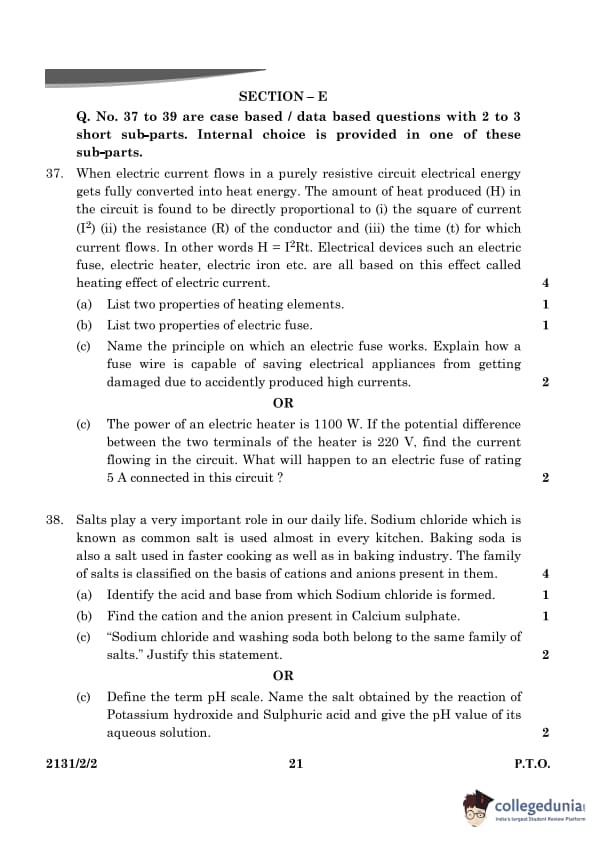
| 37 (a). List two properties of heating elements. (b) List two properties of an electric fuse. (c) Name the principle on which an electric fuse works. Explain how a fuse wire is capable of saving electrical appliances from getting damaged due to accidentally produced high currents. |
Heating element properties and fuse principle explained | (a) Properties of heating elements: - High resistivity to convert electrical energy into heat. - High melting point to withstand high temperatures. (b) Properties of a fuse: - Low melting point to melt during excessive current flow. - High conductivity to prevent resistance in normal operation. (c) Principle: An electric fuse works on the heating effect of current. When current exceeds a certain limit, the fuse wire heats up and melts, breaking the circuit. This prevents damage to appliances by stopping the flow of high current. |
| OR 37 (c). The power of an electric heater is 1100 W. If the potential difference between the two terminals of the heater is 220 V, find the current flowing in the circuit. What will happen to an electric fuse of rating 5 A connected in this circuit? | Current = 5 A, Fuse will melt | Power formula: P = V × I Given: P = 1100 W, V = 220 V Calculate current (I): I = P / V I = 1100 / 220 I = 5 A The current in the circuit is exactly 5 A. If a 5 A fuse is connected, it will melt if the current increases even slightly, breaking the circuit to protect the heater. |
| 38 (a). Identify the acid and base from which sodium chloride is formed. (b) Find the cation and the anion present in calcium sulfate. (c) “Sodium chloride and washing soda both belong to the same family of salts.” Justify this statement. |
Explained with examples | (a) Acid: Hydrochloric acid (HCl). Base: Sodium hydroxide (NaOH). Reaction: HCl + NaOH → NaCl + H2O. (b) Cation: Calcium (Ca2+), Anion: Sulfate (SO42-). (c) Sodium chloride (NaCl) and washing soda (Na2CO3) belong to the sodium salt family as they share the common cation Na+. |
| OR 38 (c). Define the term pH scale. Name the salt obtained by the reaction of Potassium hydroxide and Sulphuric acid and give the pH value of its aqueous solution. | pH scale defined, Salt: Potassium sulfate, pH = 7 | The pH scale measures the acidity or basicity of a solution, ranging from 0 to 14. A pH of 7 indicates neutrality, values below 7 indicate acidity, and above 7 indicate alkalinity. Reaction: 2KOH + H2SO4 → K2SO4 + 2H2O Salt: Potassium sulfate (K2SO4). Aqueous solution of potassium sulfate has a neutral pH of 7 as it is formed from a strong acid and a strong base. |
| 39 (a). Which of the cut pieces of the two Planaria (L, M, N and O, P) could regenerate to form a complete organism? (b) Give an example of another organism which follows the same mode of reproduction as Planaria. (c) What is the meaning of 'development' in regeneration? |
Explained with examples | (a) All pieces (L, M, N, O, and P) of Planaria could regenerate into complete organisms due to their high regenerative capacity. (b) Example: Starfish, which can regenerate arms or even a whole body from a single part. (c) Development in regeneration refers to the process of cells proliferating, differentiating, and organizing to restore the original body structure and functionality. |
| OR 39 (c). Differentiate between regeneration and fragmentation. | Differences provided | Regeneration: - Regeneration is the process by which certain organisms regrow their lost or damaged body parts. - It is primarily a repair mechanism and does not necessarily result in new individuals. - Example: Starfish regenerating arms. Fragmentation: - Fragmentation is a mode of asexual reproduction where an organism's body breaks into pieces, each of which develops into a new individual. - It always leads to the formation of new individuals. - Example: Spirogyra splitting into fragments. |








Comments