




CBSE Class 10 Science Question Paper 2024 PDF (Set 2 - 31/3/2) is available for download here. CBSE conducted the Science exam on March 2, 2024, from 10:30 AM to 1:30 PM. The total marks for the theory paper are 80. The question paper contains 20% MCQ-based questions, 40% competency-based questions, and 40% short and long answer type questions.
CBSE Class 10 Science Question Paper 2024 (Set 2 - 31/3/2) with Answer Key
| CBSE Class 10 Science Question Paper 2024 (Set 2 - 31/3/2) with Answer Key |  Download Download |
Check Solutions |
CBSE Science Question Paper (Set 2 – 31/3/2) 2024 Solution
| Question | Answer | Detailed Solution |
|---|---|---|
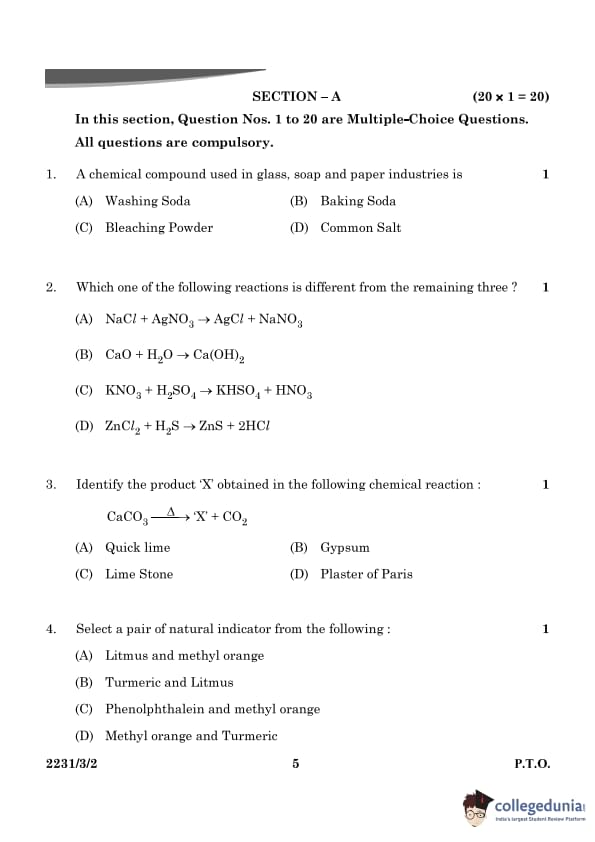
| 1. A chemical compound used in glass, soap, and paper industries is: (A) Washing Soda (B) Baking Soda (C) Bleaching Powder (D) Common Salt |
(A) Washing Soda | Washing soda (Na₂CO₃) is widely used in industries for glassmaking, soap production, and paper manufacturing due to its properties as a cleaning and softening agent. |
| 2. Which one of the following reactions is different from the remaining three? (A) NaCl + AgNO₃ → AgCl + NaNO₃ (B) CaO + H₂O → Ca(OH)₂ (C) KNO₃ + H₂SO₄ → KHSO₄ + HNO₃ (D) ZnCl₂ + H₂S → ZnS + 2HCl |
(B) CaO + H₂O → Ca(OH)₂ | Reaction (B) is a combination reaction where two reactants form a single product, unlike the others which are double displacement reactions. |
| 3. Identify the product 'X' obtained in the reaction: CaCO₃ → X + CO₂ (A) Quick lime (B) Gypsum (C) Lime Stone (D) Plaster of Paris |
(A) Quick lime | Heating calcium carbonate (CaCO₃) produces quick lime (CaO) and carbon dioxide (CO₂), a thermal decomposition reaction. |
| 4. Select a pair of natural indicators from the following: (A) Litmus and methyl orange (B) Turmeric and Litmus (C) Phenolphthalein and methyl orange (D) Methyl orange and Turmeric |
(B) Turmeric and Litmus | Litmus (from lichens) and turmeric (from plants) are natural indicators, distinguishing them from synthetic ones like methyl orange. |
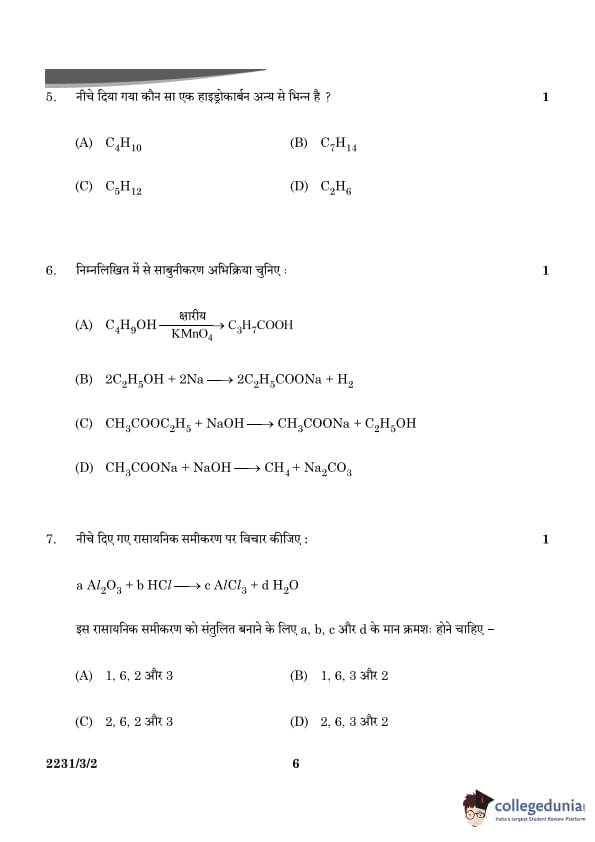
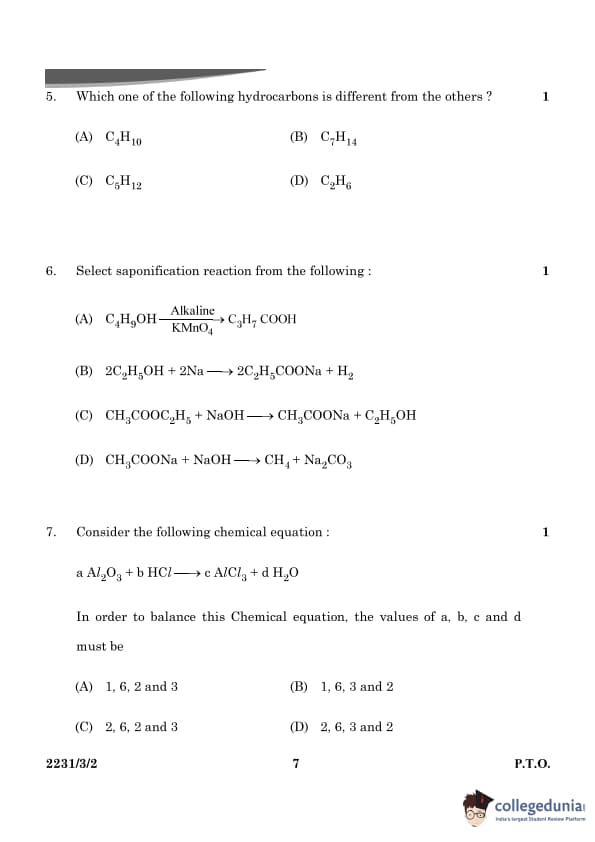
| 5. Which one of the following hydrocarbons is different from the others? (A) C₄H₁₀ (B) C₇H₁₄ (C) C₅H₁₂ (D) C₂H₆ |
(B) C₇H₁₄ | Hydrocarbon (B) is an alkene (CnH2n), while the others are alkanes (CnH2n+2), making it different. |
| 6. Select the saponification reaction from the following: (A) C₄H₉OH + Alkaline KMnO₄ → C₃H₇COOH (B) 2C₂H₅OH + 2Na → 2C₂H₅COONa + H₂ (C) CH₃COOC₂H₅ + NaOH → CH₃COONa + C₂H₅OH (D) CH₃COONa + NaOH → CH₄ + Na₂CO₃ |
(C) CH₃COOC₂H₅ + NaOH → CH₃COONa + C₂H₅OH | Saponification is the alkaline hydrolysis of an ester, producing soap (carboxylate salt) and alcohol. |
| 7. To balance the chemical equation: Al₂O₃ + bHCl → cAlCl₃ + dH₂O The values of a, b, c, and d must be: (A) 1, 6, 2, 3 (B) 1, 6, 3, 2 (C) 2, 6, 2, 3 (D) 2, 6, 3, 2 |
(A) 1, 6, 2, 3 | The balanced equation is Al₂O₃ + 6HCl → 2AlCl₃ + 3H₂O. Balance atoms systematically. |
| 8. For four wires of the same material, the resistance will be minimum if the diameter and length are: (A) D/2 and L/4 (B) D/4 and 4L (C) 2D and L (D) 4D and 2L |
(D) 4D and 2L | Resistance is inversely proportional to the square of the diameter and directly proportional to the length. Larger diameter and shorter length reduce resistance. |
| 9. United Nations Environment Programme forged an agreement to: (A) Control CO₂ emissions (B) Conserve biodiversity (C) Control water pollution (D) Reduce CFC production |
(D) Reduce CFC production | The Montreal Protocol by UNEP aims to reduce chlorofluorocarbon (CFC) production to protect the ozone layer. |
| 10. Which one of the following statements is TRUE for Hydra, Amoeba, and Spirogyra? (A) They are multicellular. (B) They are unicellular. (C) They reproduce sexually. (D) They reproduce asexually. |
(D) They reproduce asexually. | All three reproduce asexually: Hydra by budding, Amoeba by binary fission, and Spirogyra by fragmentation. |
| 11. A cross between two tall pea plants resulted in offspring having some dwarf plants. The gene combination of the parental plants must be: (A) Tt and Tt (B) Tt and tt (C) TT and tt (D) TT and Tt |
(A) Tt and Tt | Both parents must be heterozygous (Tt) to produce a 3:1 ratio of tall to dwarf plants. Homozygous dominant (TT) parents would not result in dwarf offspring. |
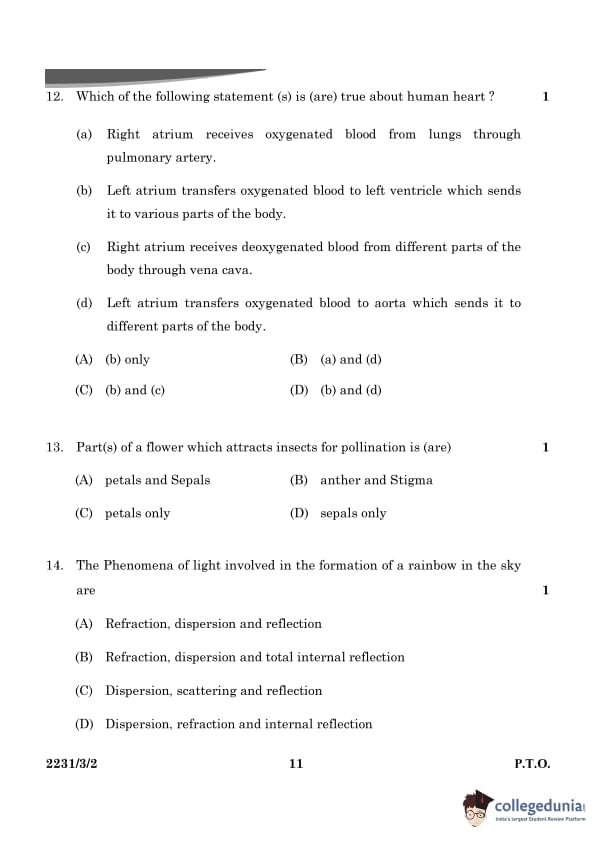
| 12. Which of the following statement(s) is (are) true about the human heart? (a) Right atrium receives oxygenated blood from lungs through the pulmonary artery. (b) Left atrium transfers oxygenated blood to the left ventricle, which sends it to various parts of the body. (c) Right atrium receives deoxygenated blood from different parts of the body through the vena cava. (d) Left atrium transfers oxygenated blood to the aorta, which sends it to different parts of the body. (A) (b) only (B) (a) and (d) (C) (b) and (c) (D) (b) and (d) |
(C) (b) and (c) | Statement (b) is true as the left atrium sends oxygenated blood to the left ventricle, and statement (c) is true as the right atrium receives deoxygenated blood from the body. Statements (a) and (d) are incorrect. |
| 13. Part(s) of a flower which attracts insects for pollination is (are): (A) Petals and Sepals (B) Anther and Stigma (C) Petals only (D) Sepals only |
(C) Petals only | Petals attract pollinators with their bright colors and fragrances, while sepals, anthers, and stigmas serve other functions. |
| 14. The phenomena of light involved in the formation of a rainbow in the sky are: (A) Refraction, dispersion, and reflection (B) Refraction, dispersion, and total internal reflection (C) Dispersion, scattering, and reflection (D) Dispersion, refraction, and internal reflection |
(D) Dispersion, refraction, and internal reflection | A rainbow forms due to sunlight being refracted, dispersed into its spectrum, and internally reflected within water droplets in the atmosphere. |
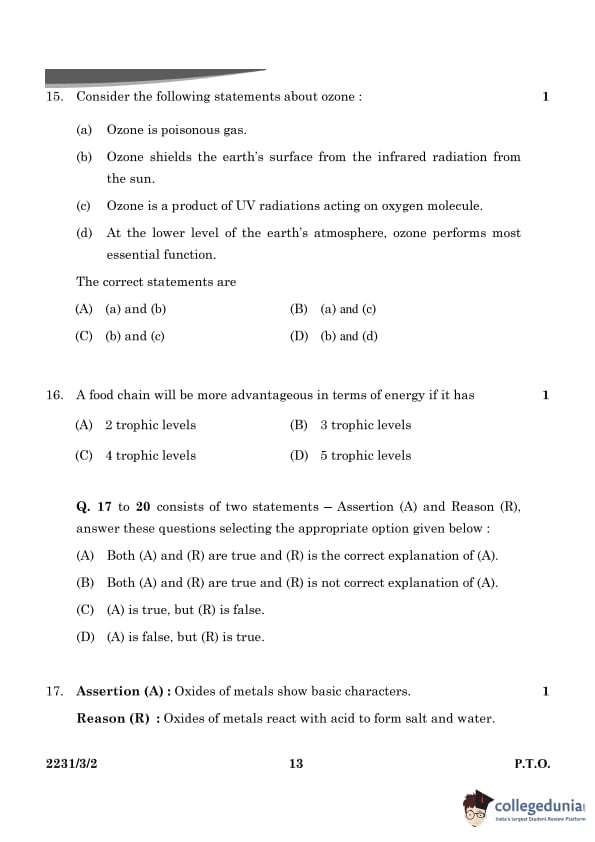
| 15. Consider the following statements about ozone: (a) Ozone is a poisonous gas. (b) Ozone shields the Earth's surface from infrared radiation from the sun. (c) Ozone is a product of UV radiation acting on oxygen molecules. (d) At the lower level of the Earth's atmosphere, ozone performs an essential function. The correct statements are: (A) (a) and (b) (B) (a) and (c) (C) (b) and (c) (D) (b) and (d) |
(B) (a) and (c) | Ozone is poisonous and forms when UV radiation acts on oxygen molecules. It shields Earth from UV, not infrared, radiation. |
| 16. A food chain will be more advantageous in terms of energy if it has: (A) 2 trophic levels (B) 3 trophic levels (C) 4 trophic levels (D) 5 trophic levels |
(A) 2 trophic levels | Energy loss occurs at each trophic level. A shorter food chain with 2 levels ensures maximum energy transfer. |
| 17. Assertion (A): Oxides of metals show basic characters. Reason (R): Oxides of metals react with acid to form salt and water. (A) Both (A) and (R) are true and (R) is the correct explanation of (A). (B) Both (A) and (R) are true, but (R) is not the correct explanation of (A). (C) (A) is true, but (R) is false. (D) (A) is false, but (R) is true. |
(A) Both (A) and (R) are true and (R) is the correct explanation of (A). | Metal oxides are basic as they react with acids to form salt and water, confirming the assertion and reason. |
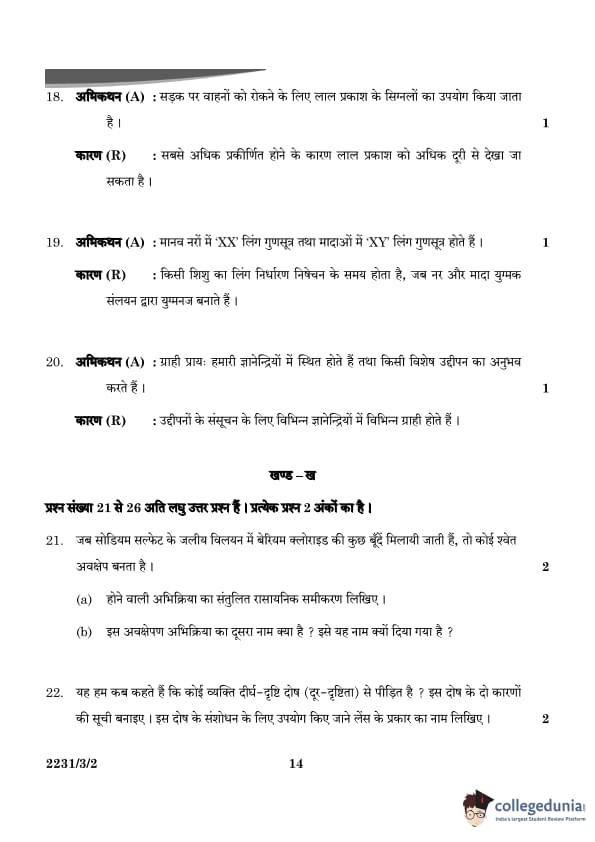
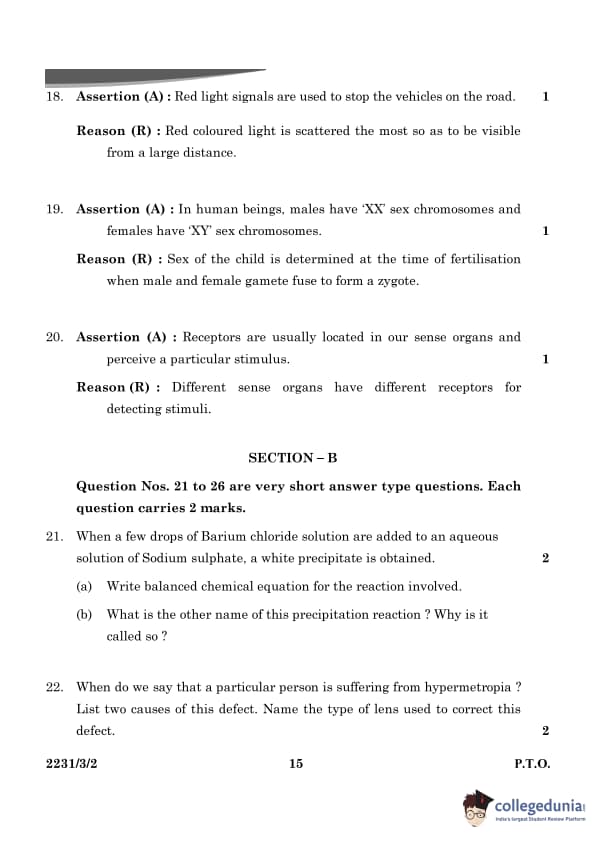
| 18. Assertion (A): Red light signals are used to stop vehicles on the road. Reason (R): Red light is scattered the most, making it visible from a large distance. (A) Both (A) and (R) are true and (R) is the correct explanation of (A). (B) Both (A) and (R) are true, but (R) is not the correct explanation of (A). (C) (A) is true, but (R) is false. (D) (A) is false, but (R) is true. |
(C) (A) is true, but (R) is false. | Red light is used due to its long wavelength, making it scatter the least, not the most, and visible over long distances. |
| 19. Assertion (A): In humans, males have 'XX' sex chromosomes, and females have 'XY'. Reason (R): The sex of a child is determined during fertilization when male and female gametes fuse to form a zygote. (A) Both (A) and (R) are true and (R) is the correct explanation of (A). (B) Both (A) and (R) are true, but (R) is not the correct explanation of (A). (C) (A) is true, but (R) is false. (D) (A) is false, but (R) is true. |
(D) (A) is false, but (R) is true. | Males have 'XY' and females have 'XX' chromosomes. The reason is correct as the sex of a child is determined during fertilization. |
| 20. Assertion (A): Receptors are usually located in our sense organs and perceive a particular stimulus. Reason (R): Different sense organs have different receptors for detecting stimuli. (A) Both (A) and (R) are true and (R) is the correct explanation of (A). (B) Both (A) and (R) are true, but (R) is not the correct explanation of (A). (C) (A) is true, but (R) is false. (D) (A) is false, but (R) is true. |
(B) Both (A) and (R) are true, but (R) is not the correct explanation of (A). | Receptors in sense organs detect specific stimuli, but the reason does not explain the assertion directly. |
| 21. When a few drops of Barium chloride solution are added to an aqueous solution of Sodium sulphate, a white precipitate is obtained. (a) Write the balanced chemical equation for the reaction involved. (b) What is the other name of this precipitation reaction? Why is it called so? |
Double displacement reaction | (a) Balanced chemical equation: BaCl₂ (aq) + Na₂SO₄ (aq) → BaSO₄ (s) + 2NaCl (aq) (b) This is a double displacement reaction, also called a precipitation reaction, because the insoluble product (barium sulfate) precipitates out of the solution. |
| 22. When do we say that a person is suffering from hypermetropia? List two causes of this defect. Name the type of lens used to correct it. | Convex lens corrects hypermetropia | Hypermetropia (farsightedness) occurs when a person can see distant objects clearly but struggles to see nearby objects. Causes: 1. Shorter than normal eyeball. 2. Inability of the eye lens to become thick enough. Corrective lens: A convex lens is used to converge light rays onto the retina. |
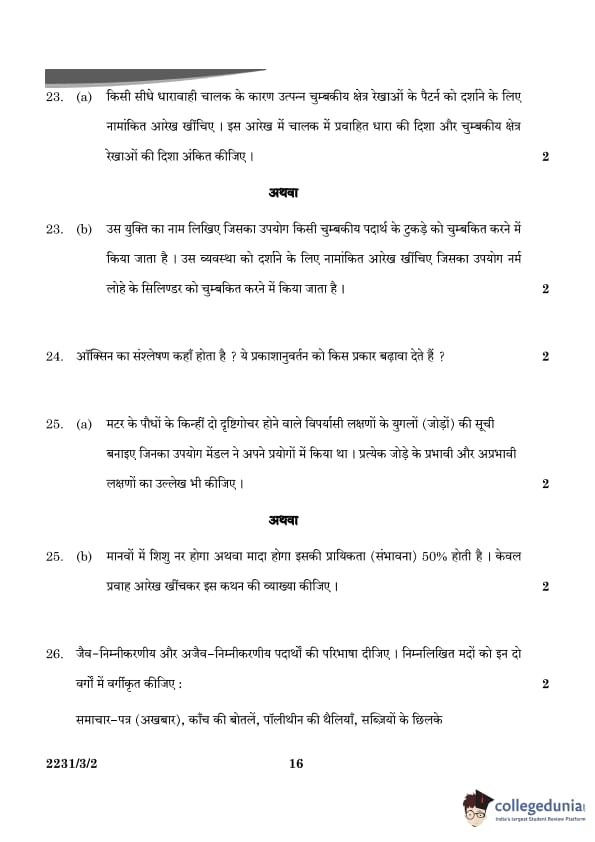
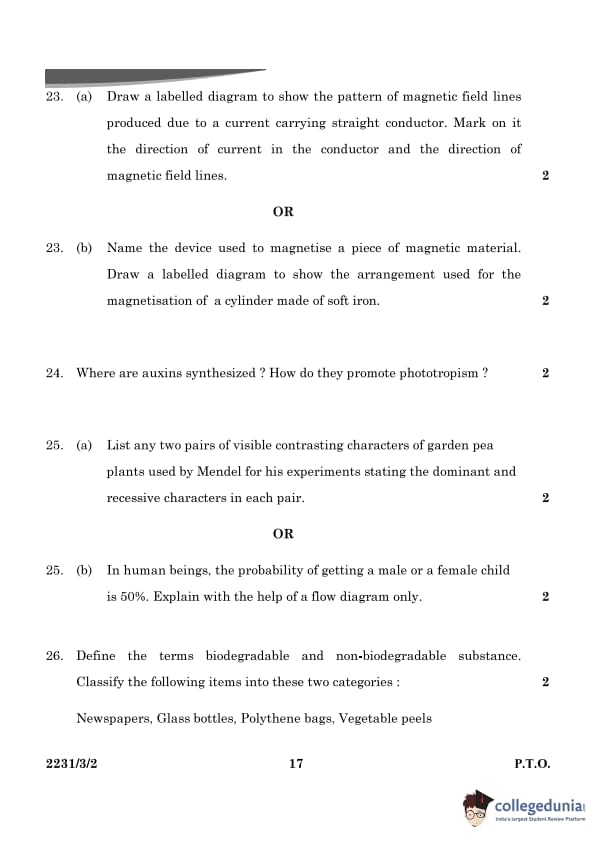
| 23 (a). Draw a labeled diagram to show the pattern of magnetic field lines around a current-carrying straight conductor. Mark the direction of current and the magnetic field. | Diagram with magnetic field lines | Magnetic field lines around a current-carrying straight conductor form concentric circles. Use the right-hand thumb rule to determine the direction of the field: thumb indicates current direction, fingers curl in the magnetic field direction. |
| OR 23 (b). Name the device used to magnetize a piece of magnetic material. Draw a labeled diagram for magnetizing a soft iron cylinder. | Solenoid | Device: Solenoid. When a current flows through a solenoid, it creates a strong magnetic field that aligns the magnetic domains in the soft iron, magnetizing it. |
| 24. Where are auxins synthesized? How do they promote phototropism? | Auxins synthesized at shoot tips | Auxins are synthesized in the shoot tips of plants. Phototropism: Auxins migrate to the shaded side of the plant, causing cells on that side to elongate more, making the plant bend towards the light source. |
| 25 (a). List any two pairs of contrasting characters of garden pea plants used by Mendel. Mention the dominant and recessive traits in each pair. | Mendel's pea plant traits | 1. Seed shape: Round (dominant), Wrinkled (recessive). 2. Seed color: Yellow (dominant), Green (recessive). |
| OR 25 (b). In human beings, the probability of having a male or a female child is 50%. Explain using a flow diagram. | Probability: 50% male, 50% female | Flow Diagram: - Male gametes: 50% carry X, 50% carry Y. - Female gamete: Always X. - X (from male) + X (from female) = Female child (XX). - Y (from male) + X (from female) = Male child (XY). |
| 26. Define the terms biodegradable and non-biodegradable substances. Classify the following items into these categories: Newspapers, Glass bottles, Polythene bags, Vegetable peels. | Definitions and classifications | Biodegradable substances: Materials that decompose naturally through microorganisms (e.g., bacteria, fungi). Non-biodegradable substances: Materials that cannot decompose naturally and remain in the environment for long periods. Classification: - Biodegradable: Newspapers, Vegetable peels. - Non-biodegradable: Glass bottles, Polythene bags. |
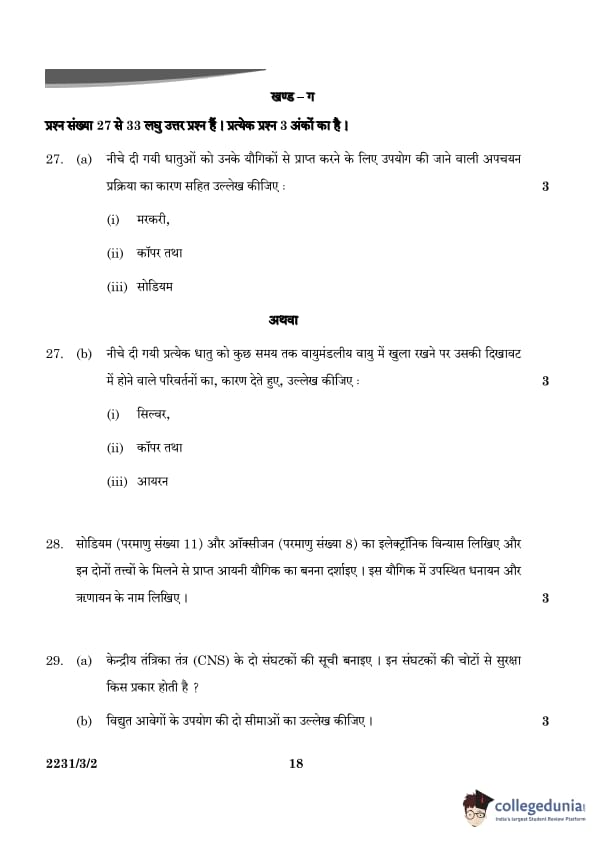
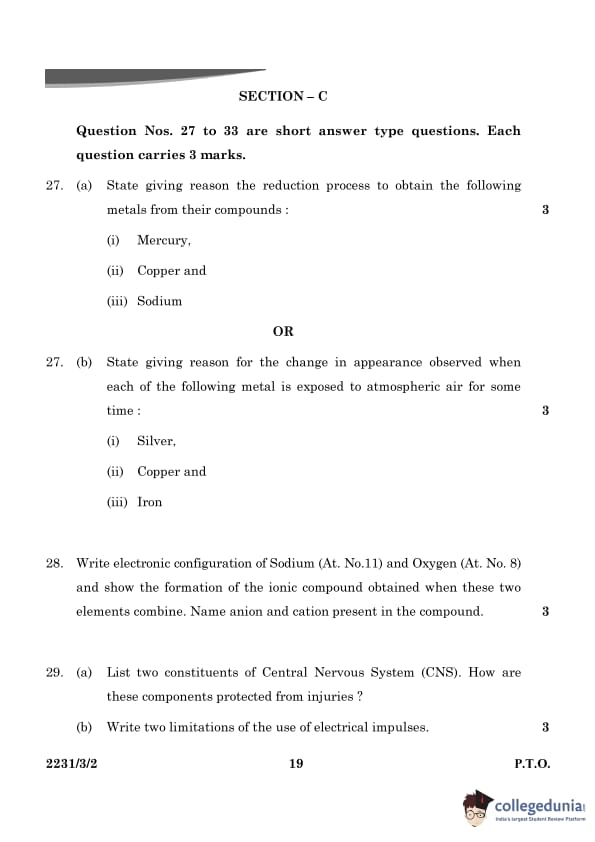
| 27 (a). State the reduction processes used to obtain the following metals: (i) Mercury (ii) Copper (iii) Sodium |
Reduction processes explained | (i) Mercury: Obtained by heating its ore (cinnabar, HgS) in air. First oxidized to HgO, then reduced to mercury by further heating. (ii) Copper: Obtained from its oxide by heating it with carbon (reduction by smelting). (iii) Sodium: Extracted by the electrolysis of molten sodium chloride, as it is highly reactive and cannot be reduced by carbon. |
| 27 (b). Explain the changes observed when these metals are exposed to air: (i) Silver (ii) Copper (iii) Iron |
Metal reactions with air | (i) Silver: Reacts with sulfur in air to form black silver sulfide (tarnish). (ii) Copper: Forms a green layer of basic copper carbonate (patina) when exposed to air and moisture. (iii) Iron: Rusts, forming hydrated iron oxide due to reaction with air and water. |
| 28. Write the electronic configuration of Sodium (Atomic no. 11) and Oxygen (Atomic no. 8). Show the formation of the ionic compound formed when these elements combine. Name the cation and anion. | Ionic bond formation | Electronic Configurations: - Sodium: 1s² 2s² 2p⁶ 3s¹. - Oxygen: 1s² 2s² 2p⁴. Ionic Compound: Sodium donates one electron, and oxygen gains two electrons to form Na₂O. Cation: Na⁺ (Sodium ion). Anion: O²⁻ (Oxide ion). |
| 29 (a). List two constituents of the Central Nervous System (CNS). How are they protected? | Brain and spinal cord | Constituents: Brain and Spinal Cord. Protection: - Brain: Enclosed in the skull and protected by cerebrospinal fluid and meninges. - Spinal Cord: Enclosed in the vertebral column and surrounded by cerebrospinal fluid. |
| 29 (b). Write two limitations of using electrical impulses for communication in the body. | Electrical impulse limitations | 1. They are effective only over short distances. 2. They require specialized structures (like neurons) for transmission, making them less versatile than chemical signals. |
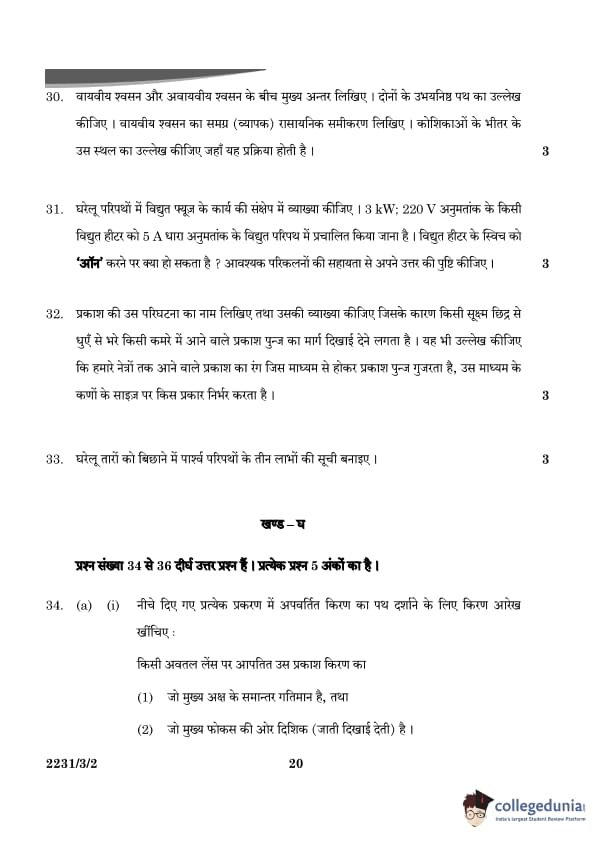
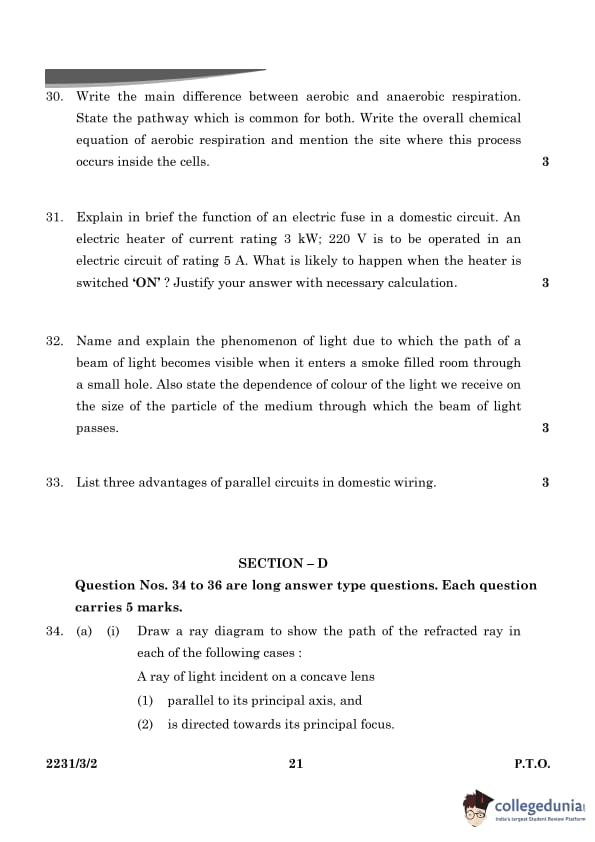
| 30. Write the main difference between aerobic and anaerobic respiration. State the common pathway for both. Write the overall chemical equation for aerobic respiration and mention its site in the cell. | Differences and pathway explained | Aerobic vs. Anaerobic Respiration: - Aerobic: Requires oxygen, occurs in mitochondria, produces CO₂ and H₂O, high energy yield (38 ATP). - Anaerobic: Does not require oxygen, occurs in cytoplasm, produces ethanol/lactic acid and CO₂, low energy yield (2 ATP). Common Pathway: Glycolysis (occurs in cytoplasm). Chemical Equation (Aerobic): C₆H₁₂O₆ + 6O₂ → 6CO₂ + 6H₂O + Energy (38 ATP). Site: Mitochondria. |
| 31. Explain the function of an electric fuse in a domestic circuit. An electric heater of power rating 3 kW, 220 V is connected in a circuit with a 5 A fuse. Will the fuse blow? Justify your answer with calculations. | Fuse will blow | Function of a Fuse: An electric fuse protects circuits from excessive current by melting and breaking the circuit when the current exceeds a safe limit. Calculation: Power (P) = 3 kW = 3000 W Voltage (V) = 220 V Current (I) = P / V = 3000 / 220 = 13.64 A Since the heater draws 13.64 A, which is greater than the 5 A fuse rating, the fuse will blow to protect the circuit. |
| 32. Name and explain the phenomenon that makes a light beam visible when it enters a smoke-filled room. Also, state how the size of the medium's particles affects the color of scattered light. | Tyndall effect explained | Phenomenon: Tyndall effect. Explanation: When light passes through a colloidal medium like smoke, particles scatter the light in all directions, making the beam visible. Particle size and color: - Small particles scatter shorter wavelengths (blue light). - Larger particles scatter longer wavelengths (red light). Example: Blue sky due to smaller particles; red sunset due to larger particles. |
| 33. List three advantages of using parallel circuits in domestic wiring. | Advantages of parallel circuits | 1. Independent operation: Appliances work independently; failure of one does not affect others. 2. Equal voltage: Each appliance receives the same voltage as the source. 3. Safety and flexibility: Allows safe operation of devices with different power ratings. |
| 34 (a). (i) Draw a ray diagram to show the path of light rays in a concave lens when: (1) A ray is parallel to the principal axis. (2) A ray is directed toward the focus on the other side. |
Ray diagram and calculations | (i) Ray Diagram: (1) A ray parallel to the principal axis diverges and appears to come from the focus on the same side. (2) A ray directed toward the focus refracts parallel to the principal axis. |
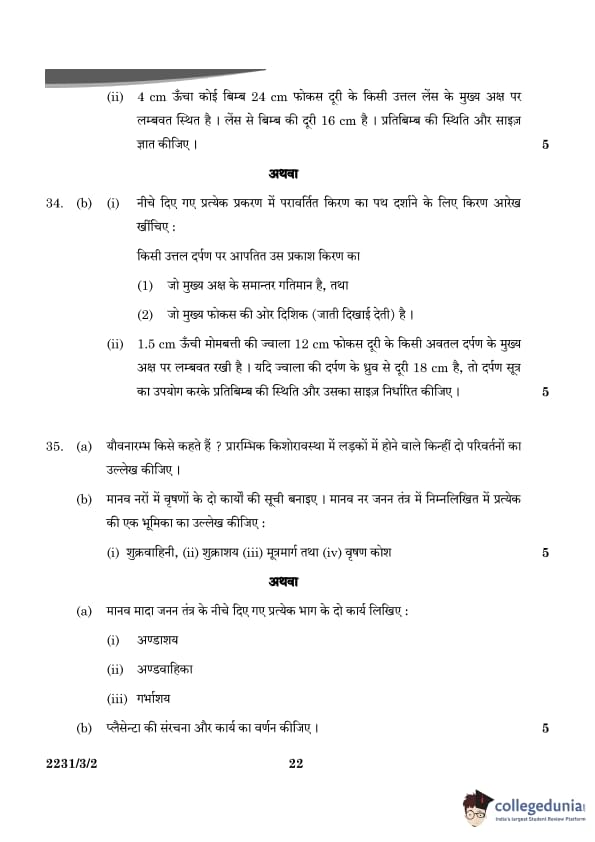
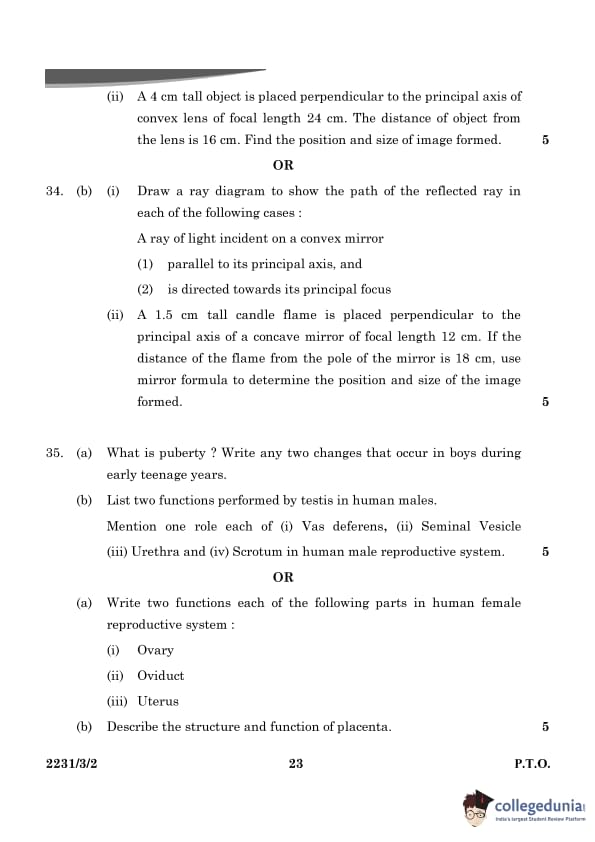
| 34 (a) (ii). A 4 cm tall object is placed perpendicular to the principal axis of a convex lens of focal length 24 cm. The distance of the object from the lens is 16 cm. Find the position and size of the image formed. | Position: 48 cm; Size: 12 cm | Given: Object height (ho) = 4 cm Focal length (f) = +24 cm (convex lens) Object distance (u) = -16 cm (negative because it is on the same side as the object). Using the lens formula: 1/f = 1/v - 1/u Substituting values: 1/24 = 1/v - 1/(-16) 1/v = 1/24 + 1/16 = (2 + 3)/48 = 5/48 v = 48/5 = 9.6 cm The image is formed at 48 cm on the opposite side of the lens. Magnification (m): m = v/u = 48/(-16) = -3 Image height (hi): hi = m × ho = -3 × 4 = -12 cm The negative sign indicates the image is inverted. - Position of the image: 48 cm (on the opposite side). - Size of the image: 12 cm (inverted). |
| 34 (b) (i). Draw a ray diagram to show the path of the reflected ray in each of the following cases: A ray of light incident on a convex mirror: (1) Parallel to its principal axis. (2) Directed towards its principal focus. |
Ray diagram explanation provided | (1) Ray parallel to principal axis: A ray of light parallel to the principal axis, after reflection from a convex mirror, appears to diverge from the principal focus. (2) Ray directed towards principal focus: A ray of light directed towards the principal focus of a convex mirror, after reflection, will emerge parallel to the principal axis. |
| 34 (b) (ii). A 1.5 cm tall candle flame is placed perpendicular to the principal axis of a concave mirror of focal length 12 cm. If the distance of the flame from the pole of the mirror is 18 cm, use the mirror formula to determine the position and size of the image formed. | Position: -36 cm; Size: -3 cm | Using the mirror formula: 1/f = 1/v + 1/u Substituting values: 1/(-12) = 1/v + 1/(-18) 1/v = 1/(-12) - 1/(-18) = (-3 + 2)/36 = -1/36 v = -36 cm The negative sign indicates that the image is real and formed on the same side as the object. Magnification (m): m = v/u = -36/(-18) = 2 Image height (hi): hi = m × ho = 2 × 1.5 = 3 cm The negative sign of height indicates that the image is inverted - Position of the image: -36 cm (real image). - Size of the image: -3 cm (inverted). |
| 35 (a). What is puberty? Write two changes that occur in boys during early teenage years. List two functions of the testis and one role each of: (i) Vas deferens (ii) Seminal vesicle (iii) Urethra (iv) Scrotum |
Puberty and male reproductive system | Puberty: A stage during which boys and girls undergo physical, hormonal, and emotional changes, leading to sexual maturity. Changes in boys: 1. Growth of facial and body hair. 2. Deepening of the voice. Functions of the testis: 1. Production of sperm. 2. Secretion of testosterone. Roles: (i) Vas deferens: Transports sperm from the testis. (ii) Seminal vesicle: Produces seminal fluid for sperm motility. (iii) Urethra: Transports semen and urine. (iv) Scrotum: Maintains optimal testis temperature for sperm production. |
| 35 (b). Write two functions each of: (i) Ovary (ii) Oviduct (iii) Uterus (b) Describe the structure and function of the placenta. |
Female reproductive system | Functions: (i) Ovary: - Produces eggs (ova). - Secretes hormones (estrogen, progesterone). (ii) Oviduct: - Transports egg to the uterus. - Site of fertilization. (iii) Uterus: - Site of implantation of the fertilized egg. - Supports fetal development. Placenta: Structure: Disc-shaped organ with villi for nutrient exchange. Function: Transfers nutrients, oxygen, and waste between mother and fetus. Produces hormones to support pregnancy. |
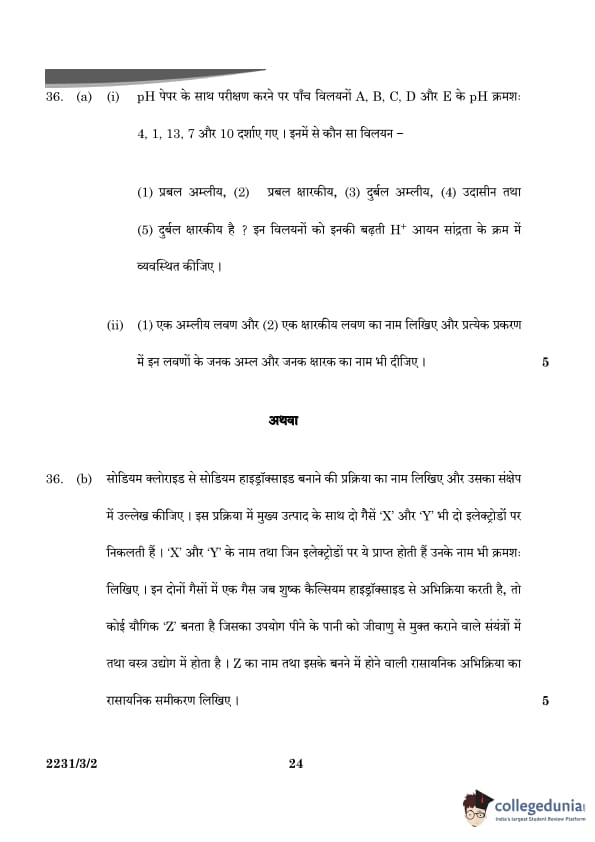
| 36 (a). Five solutions A, B, C, D, and E show pH values of 4, 1, 13, 7, and 10 respectively. Identify which solution is: (i) Strongly acidic (ii) Strongly alkaline (iii) Weakly acidic (iv) Neutral (v) Weakly alkaline Arrange these solutions in increasing order of H⁺ ion concentration. |
Solutions identified and arranged | (i) Strongly acidic: B (pH 1) (ii) Strongly alkaline: C (pH 13) (iii) Weakly acidic: A (pH 4) (iv) Neutral: D (pH 7) (v) Weakly alkaline: E (pH 10) Increasing order of H⁺ ion concentration: C (13), E (10), D (7), A (4), B (1). |
| 36 (b). Name and state the process used to prepare sodium hydroxide from sodium chloride. Name the gases produced at each electrode, and the compound formed when one of these gases reacts with calcium hydroxide. | Chlor-alkali process | Process: Chlor-alkali process (electrolysis of brine). Gases: - Chlorine (Cl₂) at the anode. - Hydrogen (H₂) at the cathode. Compound: Bleaching powder (Ca(OCl)₂) is formed when chlorine reacts with calcium hydroxide. Reaction: \( Ca(OH)₂ + Cl₂ → Ca(OCl)₂ + H₂O \). |
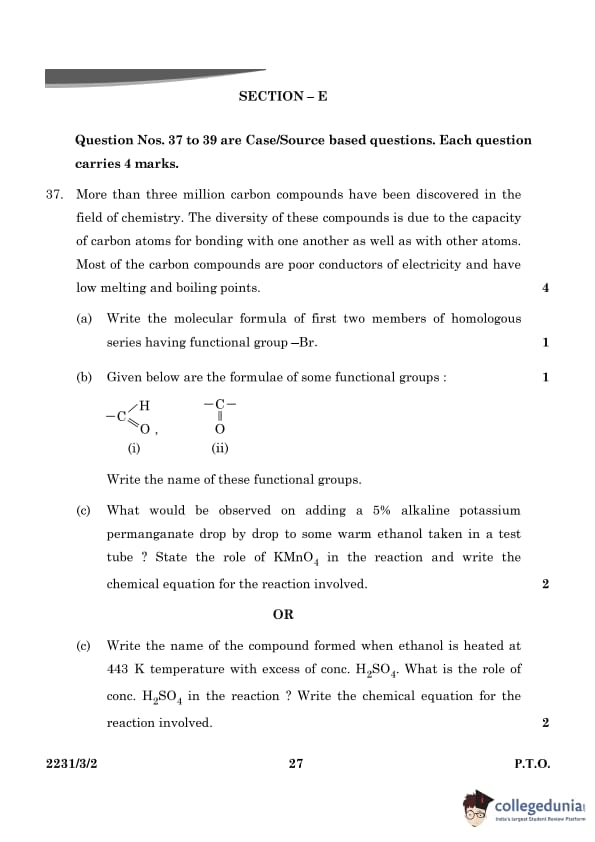
| 37 (a). Write the molecular formula of the first two members of the homologous series having the functional group -Br. | CH₃Br and C₂H₅Br | The homologous series with the functional group -Br are alkyl bromides (haloalkanes). First member: CH₃Br (Methyl bromide). Second member: C₂H₅Br (Ethyl bromide). |
| 37 (b). Write the name of the following functional groups: (i) -CHO (ii) -CO- |
Aldehyde and Ketone | (i) -CHO: Aldehyde functional group. (ii) -CO-: Ketone functional group. |
| 37 (c). Describe what happens when 5% alkaline potassium permanganate is added to warm ethanol. Write the reaction involved. | Ethanol oxidized to ethanoic acid | Observation: The purple color of potassium permanganate disappears. Reaction: Potassium permanganate oxidizes ethanol to ethanoic acid.( C₂H₅OH + 2[O] → CH₃COOH + H₂O ). |
| OR 37 (c). Write the name of the compound formed when ethanol is heated at 443 K with excess of concentrated H2SO4. What is the role of concentrated H2SO4 in the reaction? Write the chemical equation for the reaction involved. | Ethene; Dehydrating agent | Name of compound: Ethene (C2H4). Role of concentrated H2SO4: Acts as a dehydrating agent, removing a water molecule from ethanol. - Chemical equation: C2H5OH (conc. H2SO4, 443 K) → C2H4 + H2O The reaction involves the elimination of water to form ethene, an unsaturated hydrocarbon. |
| 38 (a). Name the glands present in the buccal cavity and the food component on which their secretion acts. | Salivary glands act on starch | Glands: Salivary glands (parotid, submandibular, sublingual). Secretion: Saliva contains salivary amylase (ptyalin), which acts on starch, breaking it into maltose. |
| 38 (b). Name two organs that have sphincter muscles at their exit. | Stomach and Anus | 1. Stomach: Pyloric sphincter controls chyme release into the small intestine. 2. Anus: Anal sphincter regulates the release of feces. |
| 38 (c). Explain why bile juice is important for digestion despite containing no enzymes. | Emulsifies fats and neutralizes acid | 1. Emulsification: Bile salts break down large fat globules into smaller droplets, increasing the surface area for lipase to act. 2. Neutralization: Bile neutralizes acidic chyme entering the small intestine, providing an optimal pH for pancreatic enzymes. |
| OR 38 (c). “Bile juice does not contain any enzyme, yet it has important roles in digestion.” Justify the statement. | Emulsifies fats and neutralizes acid | Bile juice, produced by the liver and stored in the gallbladder, does not contain digestive enzymes. Important roles of bile juice: 1. Emulsification of fats: Bile salts break down large fat globules into smaller droplets, increasing the surface area for lipase to act. 2. Neutralization: Bile is alkaline and neutralizes the acidic chyme entering the small intestine from the stomach, providing a suitable pH for the action of pancreatic enzymes. - Thus, bile juice plays a crucial role in fat digestion and enzymatic efficiency. |
| 39 (a). State what happens when: (i) Key K1 is closed. (ii) Key K2 is closed. |
Key operation effects | (i) When K1 is closed: Bulb A (22 W) glows as it is directly connected to the 220 V supply. (ii) When K2 is closed: Bulbs B, C, D, and E (11 W each) glow as they are in parallel, receiving their rated voltage of 55 V. |
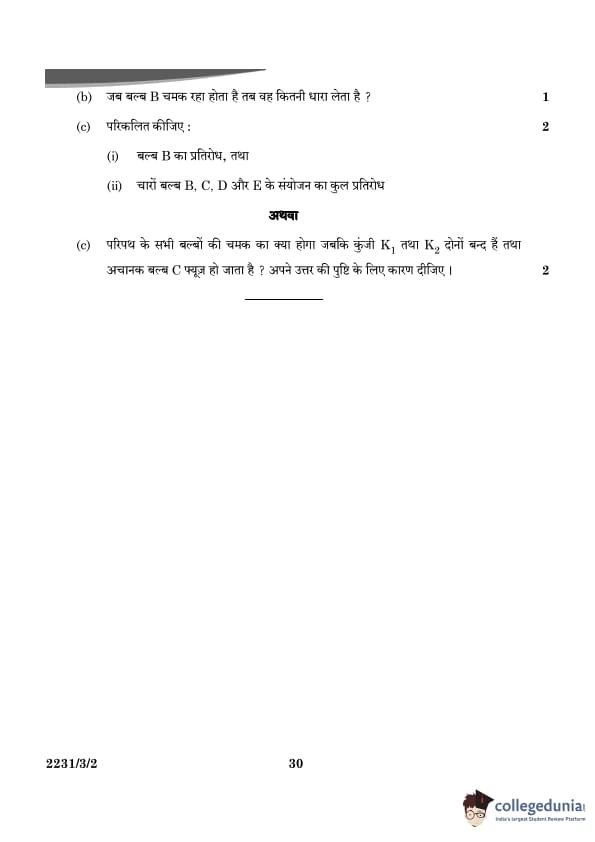
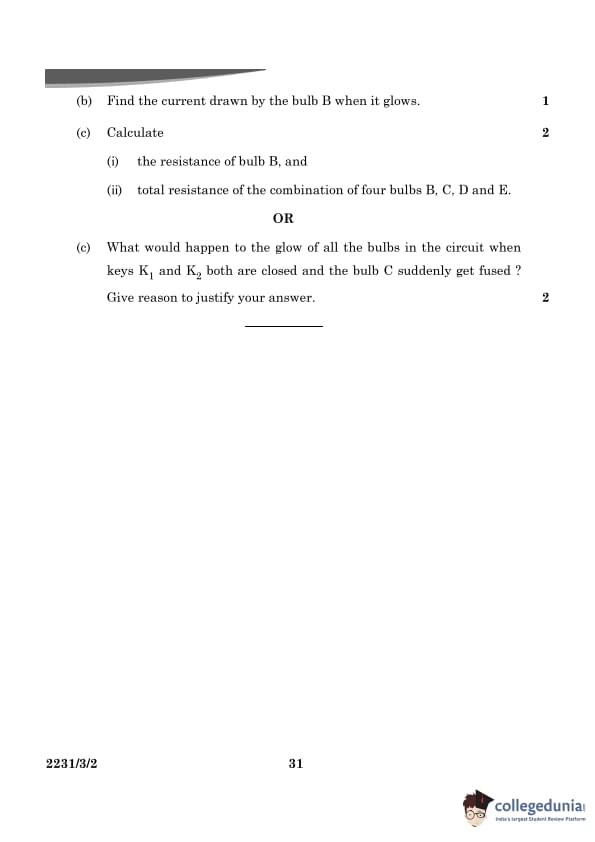
| 39 (b). Find the current drawn by bulb B and calculate its resistance. | Current: 0.2 A, Resistance: 275 Ω | Current: ( I = P/V = 11 , W / 55 , V = 0.2 , A). Resistance: R = V/I = 55 / 0.2 = 275 ). |
| 39 (c). What happens to the circuit when K1 and K2 are closed, and bulb C is fused? | Bulb A unaffected; B, D, E stop | Bulb A remains unaffected as it is in parallel and directly connected to the source. Bulbs B, D, and E stop glowing because they are in series with the fused bulb C, breaking the circuit. |
| OR 39 (c). What would happen to the glow of all the bulbs in the circuit when keys K1 and K2 are both closed, and the bulb C suddenly gets fused? Justify your answer. | Bulb A unaffected; B, D, E stop | - When bulb C gets fused: 1. Bulbs B, D, and E stop glowing because they are in a series with bulb C. A fused bulb breaks the circuit, preventing current flow. 2. Bulb A remains unaffected as it is in parallel with the other bulbs and has its independent connection to the source. - This demonstrates the advantage of parallel circuits for independent operation of components. |














Comments