




CBSE Class 10 Science Question Paper 2024 PDF (Set 3 - 31/2/3) is available for download here. CBSE conducted the Science exam on March 2, 2024, from 10:30 AM to 1:30 PM. The total marks for the theory paper are 80. The question paper contains 20% MCQ-based questions, 40% competency-based questions, and 40% short and long answer type questions.
CBSE Class 10 Science Question Paper 2024 (Set 3 - 31/2/3) with Answer Key
| CBSE Class 10 Science Question Paper 2024 (Set 3 - 31/2/3) with Answer Key |  Download Download |
Check Solutions |
CBSE Science Question Paper (Set 3 – 31/2/3) 2024 Solution
| Question | Answer | Detailed Solution |
|---|---|---|
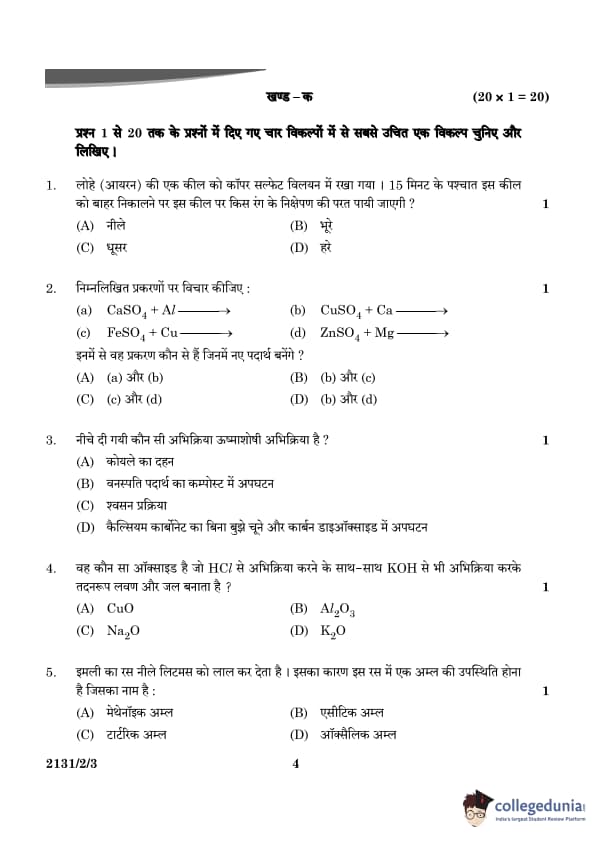
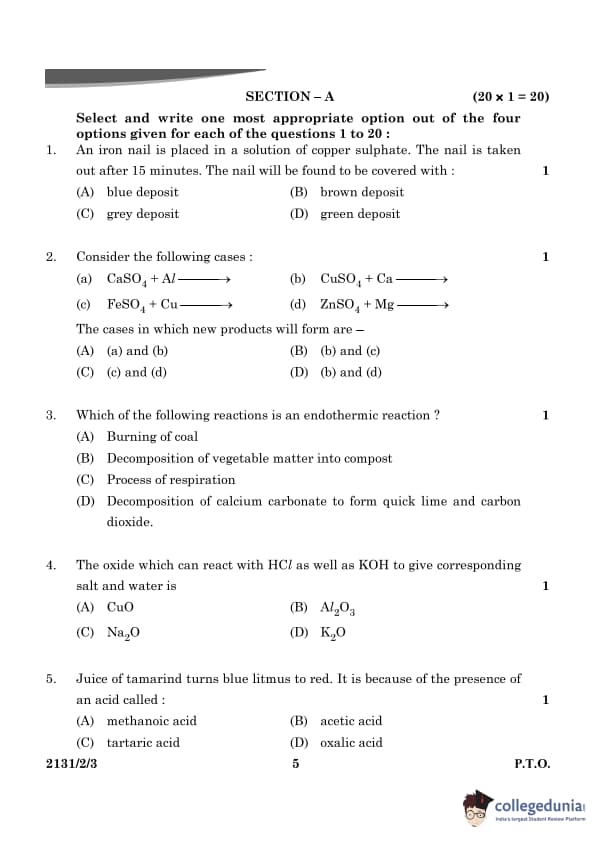
| 1. An iron nail is placed in a solution of copper sulphate. The nail is taken out after 15 minutes. The nail will be found to be covered with: (A) blue deposit (B) brown deposit (C) grey deposit (D) green deposit |
(B) brown deposit | When an iron nail is dipped in copper sulphate (CuSO4) solution, iron displaces copper from the solution due to its higher reactivity. This forms a brown deposit of copper on the nail. Reaction: Fe + CuSO4 → FeSO4 + Cu |
| 2. Consider the following cases: (a) CaSO4 + Al → (b) CuSO4 + Ca → (c) FeSO4 + Cu → (d) ZnSO4 + Mg → The cases in which new products will form are: (A) (a) and (b) (B) (b) and (c) (C) (c) and (d) (D) (b) and (d) |
(D) (b) and (d) | Displacement reactions occur when a more reactive metal displaces a less reactive one. Here, calcium displaces copper in (b) and magnesium displaces zinc in (d), forming new products. |
| 3. Which of the following reactions is an endothermic reaction? (A) Burning of coal (B) Decomposition of vegetable matter into compost (C) Process of respiration (D) Decomposition of calcium carbonate to form quick lime and carbon dioxide |
(D) Decomposition of calcium carbonate to form quick lime and carbon dioxide | Decomposition of calcium carbonate (CaCO3) into calcium oxide (CaO) and carbon dioxide (CO2) requires heat energy, making it an endothermic reaction. Reaction: CaCO3 → CaO + CO2 (heat absorbed) |
| 4. The oxide which can react with HCl as well as KOH to give corresponding salt and water is: (A) CuO (B) Al2O3 (C) Na2O (D) K2O |
(B) Al2O3 | Aluminum oxide (Al2O3) is an amphoteric oxide. It reacts with both acids and bases to form salts and water: Reaction with HCl: Al2O3 + 6HCl → 2AlCl3 + 3H2O Reaction with KOH: Al2O3 + 2KOH → 2K[Al(OH)4] |
| 5. Juice of tamarind turns blue litmus to red. It is because of the presence of an acid called: (A) methanoic acid (B) acetic acid (C) tartaric acid (D) oxalic acid |
(C) tartaric acid | Tamarind contains tartaric acid, a weak organic acid, which turns blue litmus red, indicating its acidic nature. |
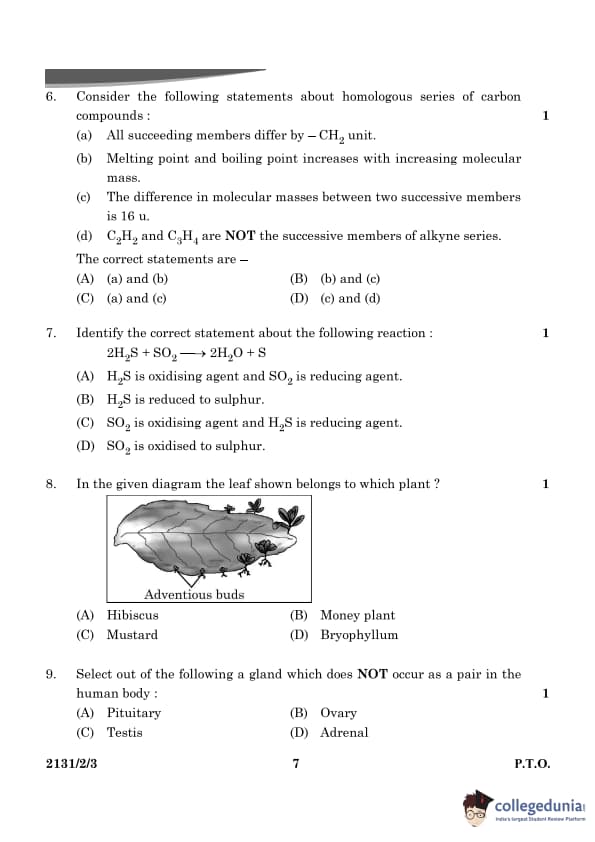
| 6. Consider the following statements about homologous series of carbon compounds: (a) All succeeding members differ by -CH2 unit. (b) Melting point and boiling point increase with increasing molecular mass. (c) The difference in molecular masses between two successive members is 16 u. (d) C2H2 and C2H4 are NOT the successive members of the alkyne series. The correct statements are: (A) (a) and (b) (B) (b) and (c) (C) (a) and (c) (D) (c) and (d) |
(A) (a) and (b) | Statements (a) and (b) are correct because members differ by -CH2 and melting/boiling points increase. Statement (c) is incorrect because the molecular mass difference is 14 u. |
| 7. Identify the correct statement about the following reaction: 2H2S + SO2 → 2H2O + S (A) H2S is oxidizing agent and SO2 is reducing agent. (B) H2S is reduced to sulphur. (C) SO2 is oxidizing agent and H2S is reducing agent. (D) SO2 is oxidized to sulphur. |
(C) SO2 is oxidizing agent and H2S is reducing agent. | In the reaction, H2S is oxidized to sulphur, acting as a reducing agent. SO2 is reduced to water, acting as an oxidizing agent. |
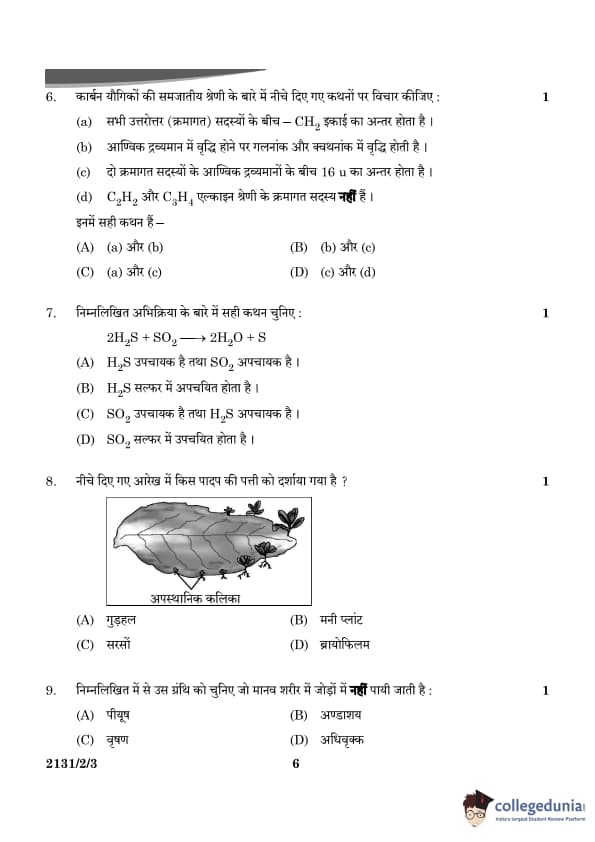
| 8. In the given diagram, the leaf shown belongs to which plant? (A) Hibiscus (B) Money plant (C) Mustard (D) Bryophyllum |
(D) Bryophyllum | The diagram shows adventitious buds along the leaf margins, a feature of Bryophyllum. These buds grow into new plants under suitable conditions. |
| 9. Select out of the following a gland which does NOT occur as a pair in the human body: (A) Pituitary (B) Ovary (C) Testis (D) Adrenal |
(A) Pituitary | The pituitary gland is a single gland located at the base of the brain. All other glands listed (ovary, testis, adrenal) occur as pairs. |
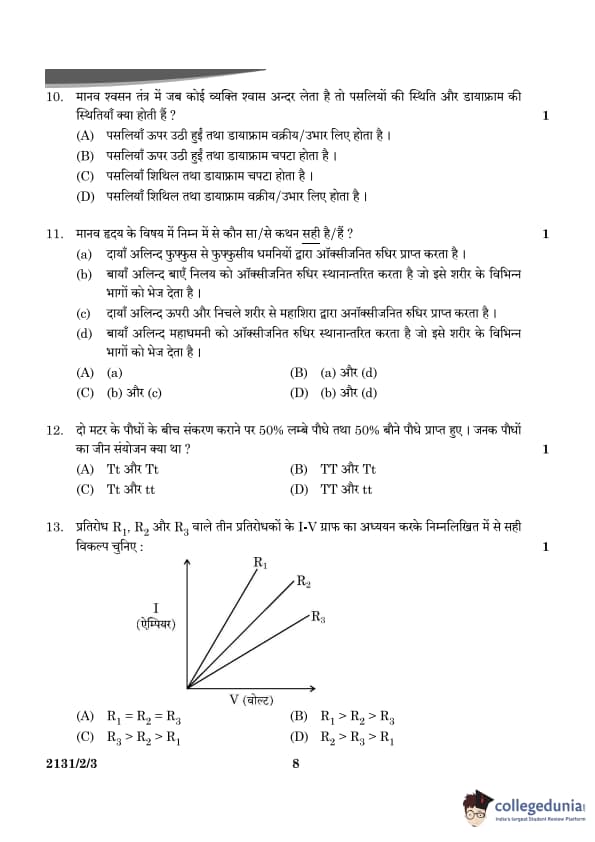
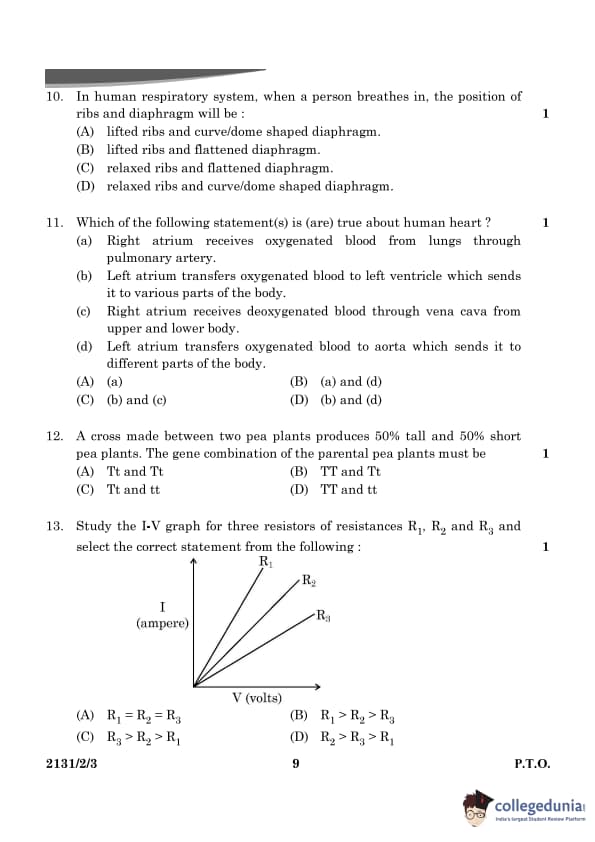
| 10. In the human respiratory system, when a person breathes in, the position of ribs and diaphragm will be: (A) lifted ribs and curve/dome-shaped diaphragm. (B) lifted ribs and flattened diaphragm. (C) relaxed ribs and flattened diaphragm. (D) relaxed ribs and curve/dome-shaped diaphragm. |
(B) lifted ribs and flattened diaphragm | During inhalation, the ribs lift upward and outward, and the diaphragm flattens, increasing the chest cavity volume and drawing air into the lungs. |
| 11. Which of the following statements is (are) true about the human heart? (a) Right atrium receives oxygenated blood from lungs through pulmonary artery. (b) Left atrium transfers oxygenated blood to left ventricle, which sends it to various parts of the body. (c) Right atrium receives deoxygenated blood through vena cava from upper and lower body. (d) Left atrium transfers oxygenated blood to aorta, which sends it to different parts of the body. The correct statements are: (A) (a) (B) (a) and (d) (C) (b) and (c) (D) (b) and (d) |
(C) (b) and (c) | Statements (b) and (c) are correct. The left atrium transfers oxygenated blood to the left ventricle, which pumps it to the body. The right atrium receives deoxygenated blood through the vena cava. |
| 12. A cross made between two pea plants produces 50% tall and 50% short pea plants. The gene combination of the parental pea plants must be: (A) Tt and Tt (B) TT and Tt (C) Tt and tt (D) TT and tt |
(C) Tt and tt | Crossing Tt (heterozygous tall) with tt (homozygous short) gives a 1:1 ratio of tall (Tt) to short (tt) plants. |
| 13. Study the I-V graph for three resistors of resistances R1, R2, and R3, and select the correct statement from the following: (A) R1 = R2 = R3 (B) R1 > R2 > R3 (C) R3 > R2 > R1 (D) R2 > R3 > R1 |
(C) R3 > R2 > R1 | The slope of the I-V graph determines resistance (R = V/I). A steeper slope corresponds to higher resistance. From the graph, R3 has the highest slope, followed by R2, and then R1. |
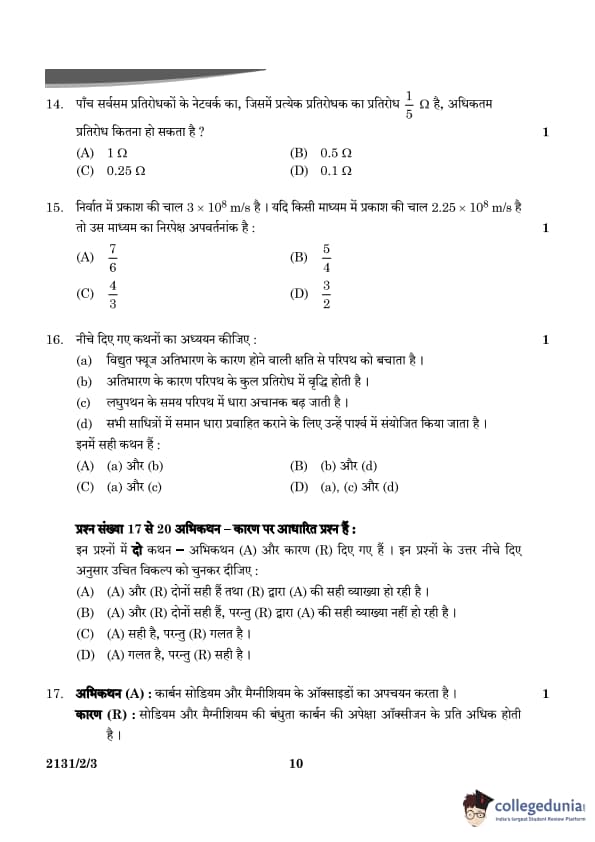
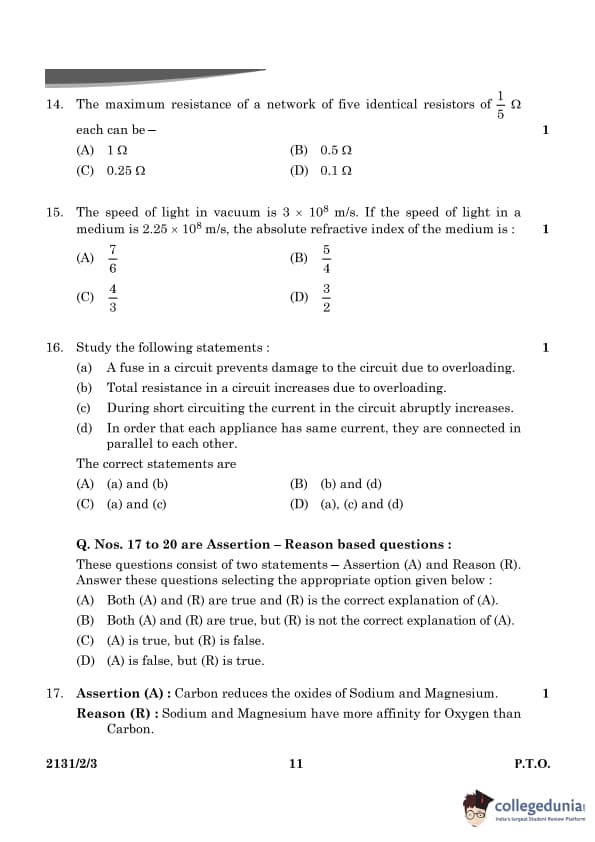
| 14. The maximum resistance of a network of five identical resistors of 1/5 Ω each can be: (A) 1 Ω (B) 0.5 Ω (C) 0.25 Ω (D) 0.1 Ω |
(A) 1 Ω | Maximum resistance occurs when resistors are connected in series. For five resistors, Rtotal = 1/5 + 1/5 + 1/5 + 1/5 + 1/5 = 1 Ω. |
| 15. The speed of light in vacuum is 3 × 10⁸ m/s. If the speed of light in a medium is 2.25 × 10⁸ m/s, the absolute refractive index of the medium is: (A) 7/6 (B) 5/4 (C) 4/3 (D) 3/2 |
(C) 4/3 | Refractive index n = c/v. Given c = 3 × 10⁸ m/s, v = 2.25 × 10⁸ m/s: n = 3 / 2.25 = 4/3. |
| 16. Study the following statements: (a) A fuse in a circuit prevents damage to the circuit due to overloading. (b) Total resistance in a circuit increases due to overloading. (c) During short circuiting, the current in the circuit abruptly increases. (d) In order that each appliance has the same current, they are connected in parallel to each other. The correct statements are: (A) (a) and (b) (B) (b) and (d) (C) (a) and (c) (D) (a), (c), and (d) |
(C) (a) and (c) | (a) True: A fuse protects circuits from overloading. (c) True: Short circuits cause a sharp increase in current. Statements (b) and (d) are incorrect. |
| 17. Assertion (A): Carbon reduces the oxides of Sodium and Magnesium. Reason (R): Sodium and Magnesium have more affinity for Oxygen than Carbon. (A) Both (A) and (R) are true, and (R) is the correct explanation of (A). (B) Both (A) and (R) are true, but (R) is not the correct explanation of (A). (C) (A) is true, but (R) is false. (D) (A) is false, but (R) is true. |
(D) (A) is false, but (R) is true | Carbon cannot reduce oxides of highly reactive metals like sodium and magnesium. The reason is correct, as sodium and magnesium have greater affinity for oxygen than carbon. |
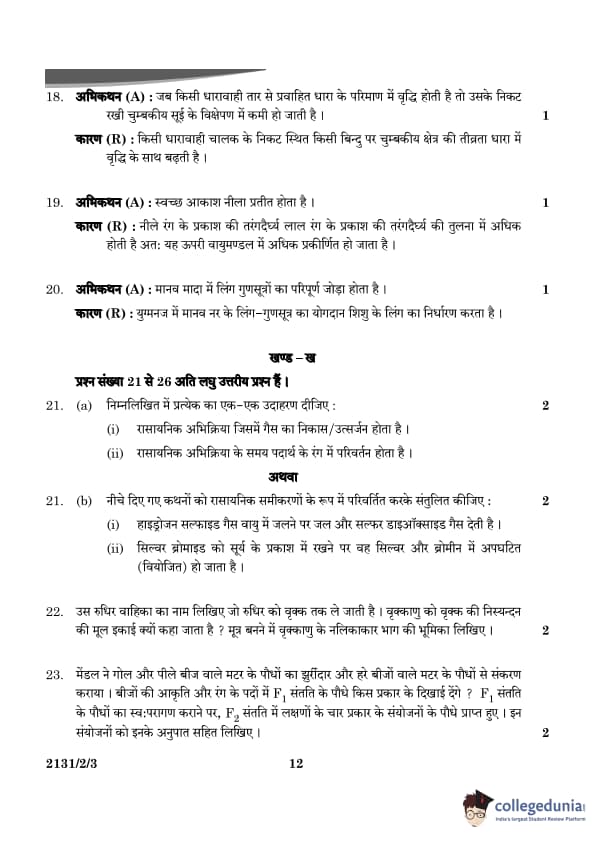
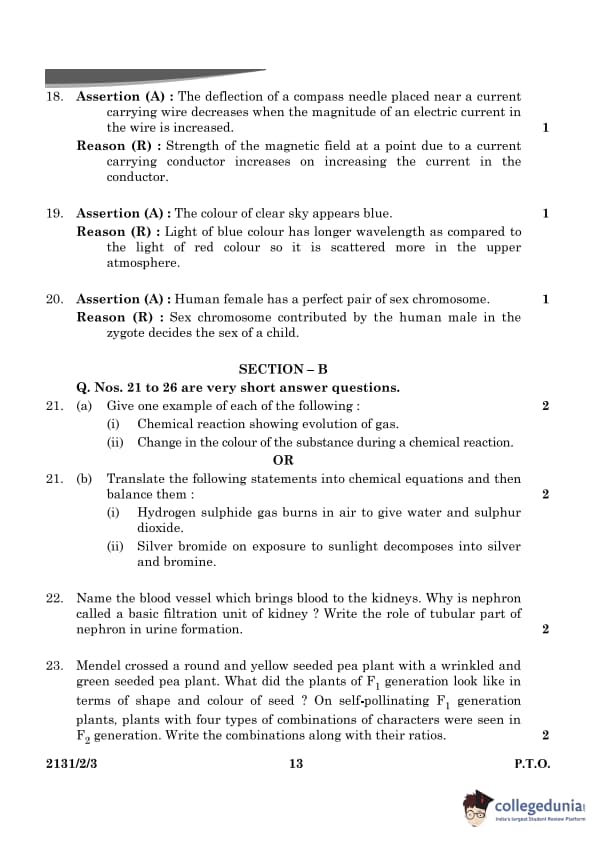
| 18. Assertion (A): The deflection of a compass needle placed near a current-carrying wire decreases when the magnitude of an electric current in the wire is increased. Reason (R): Strength of the magnetic field at a point due to a current-carrying conductor increases on increasing the current in the conductor. (A) Both (A) and (R) are true, and (R) is the correct explanation of (A). (B) Both (A) and (R) are true, but (R) is not the correct explanation of (A). (C) (A) is true, but (R) is false. (D) (A) is false, but (R) is true. |
(D) (A) is false, but (R) is true | The deflection increases, not decreases, as the magnetic field strength increases with current. Thus, (A) is false, but (R) is true. |
| 19. Assertion (A): The colour of the clear sky appears blue. Reason (R): Light of blue colour has a longer wavelength compared to the light of red colour, so it is scattered more in the upper atmosphere. (A) Both (A) and (R) are true, and (R) is the correct explanation of (A). (B) Both (A) and (R) are true, but (R) is not the correct explanation of (A). (C) (A) is true, but (R) is false. (D) (A) is false, but (R) is true. |
(C) (A) is true, but (R) is false | The clear sky appears blue because blue light, with a shorter wavelength, is scattered more. The reason provided is incorrect, as blue light does not have a longer wavelength than red. |
| 20. Assertion (A): Human female has a perfect pair of sex chromosomes. Reason (R): Sex chromosome contributed by the human male in the zygote decides the sex of a child. (A) Both (A) and (R) are true, and (R) is the correct explanation of (A). (B) Both (A) and (R) are true, but (R) is not the correct explanation of (A). (C) (A) is true, but (R) is false. (D) (A) is false, but (R) is true. |
(B) Both (A) and (R) are true, but (R) is not the correct explanation of (A) | Human females have two X chromosomes, forming a perfect pair. The sex of a child is determined by the male's contribution of X or Y. However, this does not explain the assertion about perfect chromosomes in females. |
| 21 (a) (i). Give an example of a chemical reaction showing evolution of gas. | 2NaCl(aq) + H2SO4(aq) → Na2SO4(aq) + 2HCl(g) | Hydrogen chloride gas (HCl) is evolved when sodium chloride reacts with sulfuric acid. |
| 21 (a) (ii). Give an example of a chemical reaction showing a change in colour. | Cl2(g) + 2NaBr(aq) → 2NaCl(aq) + Br2(aq) | The solution changes from colourless to orange due to the displacement of bromine. |
| 21 (b) (i). Translate into a chemical equation and balance: Hydrogen sulphide gas burns in air to give water and sulphur dioxide. | 2H2S(g) + 3O2(g) → 2H2O(l) + 2SO2(g) | Burning hydrogen sulphide in air produces water and sulphur dioxide gas. |
| 21 (b) (ii). Translate into a chemical equation and balance: Silver bromide on exposure to sunlight decomposes into silver and bromine. | 2AgBr(s) → 2Ag(s) + Br2(g) | Under sunlight, silver bromide decomposes into silver and bromine. |
| 22. Name the blood vessel which brings blood to the kidneys. | Renal artery | The renal artery carries oxygenated blood to the kidneys for filtration. |
| 23. What did the plants of the F1 generation look like in terms of seed shape and colour? | Round and Yellow | F1 plants had round and yellow seeds, as these are dominant traits. |
| 23. Mendel crossed a round and yellow-seeded pea plant with a wrinkled and green-seeded pea plant. What did the plants of the F1 generation look like in terms of seed shape and colour? On self-pollinating F1 plants, four types of combinations of characters were seen in the F2 generation. Write these combinations along with their ratios. | F1: Round, Yellow F2: 9:3:3:1 |
F1 generation: All plants had round, yellow seeds (dominant traits). F2 generation combinations and ratios: - Round, Yellow: 9/16 - Round, Green: 3/16 - Wrinkled, Yellow: 3/16 - Wrinkled, Green: 1/16 This demonstrates Mendel's law of independent assortment. |
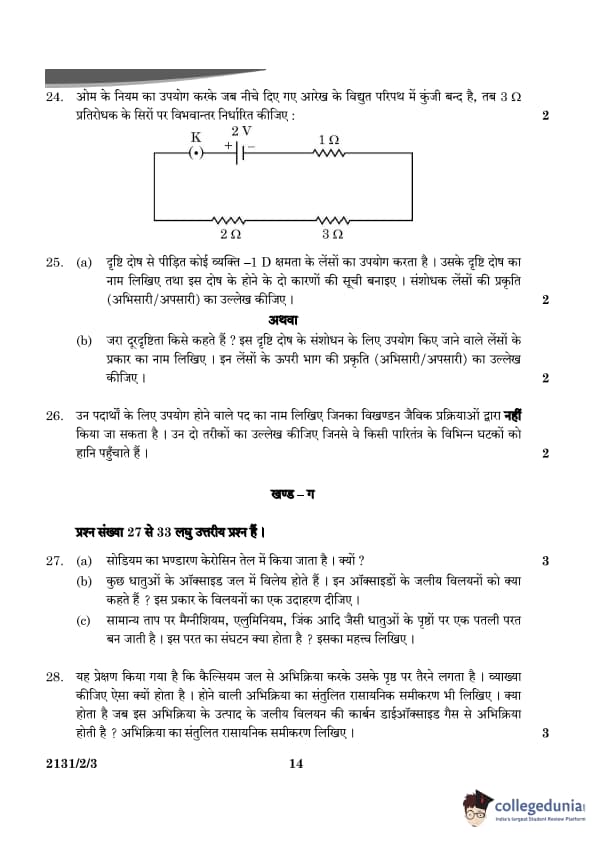
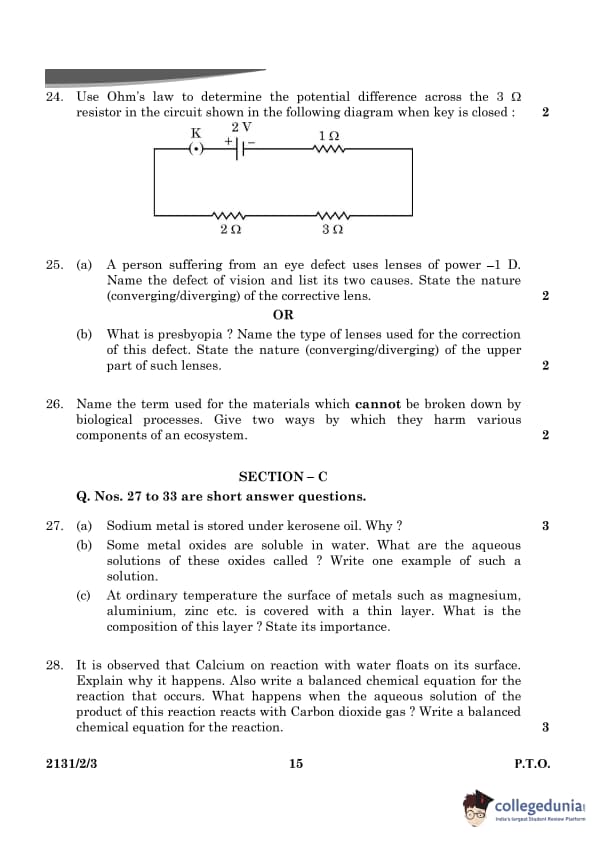
| 24. Use Ohm’s law to determine the potential difference across the 3Ω resistor in the circuit shown below when the key is closed: | Potential difference = 1V | Total resistance Rs = R1 + R2 + R3 = 1Ω + 2Ω + 3Ω = 6Ω. Current I = V / Rs = 2V / 6Ω = 1/3 A. Potential difference across 3Ω resistor: V = I × R = (1/3) × 3 = 1V. |
| 25 (a). A person suffering from an eye defect uses lenses of power -1D. Name the defect of vision and list two causes. State the nature of the corrective lens. | Myopia: Concave lens Presbyopia: Bifocal lens |
(a) Defect: Myopia (near-sightedness). Causes: - Elongated eyeball. - Over-curved cornea. Corrective lens: Diverging (concave) lens. |
| 25 OR (b) What is presbyopia? Name the type of lenses used for its correction. State the nature of the upper part of such lenses. |
Myopia: Concave lens Presbyopia: Bifocal lens |
(b) Presbyopia: Age-related loss of flexibility in the lens. Corrective lens: Bifocal lens. Nature: Upper part diverging (concave) for distance; lower part converging (convex) for near vision. |
| 26. Name the term used for the materials which cannot be broken down by biological processes. Give two ways by which they harm various components of an ecosystem. | Non-biodegradable materials | The term used for materials that cannot be broken down by biological processes is non-biodegradable materials. Ways they harm the ecosystem: 1. Pollution: Accumulate in the environment, causing soil, water, and air pollution. 2. Disruption of food chains: Enter the food chain, leading to biomagnification and toxicity in higher trophic levels. |
| 27 (a). Sodium metal is stored under kerosene oil. Why? (b) Some metal oxides are soluble in water. What are the aqueous solutions of these oxides called? Write one example of such a solution. (c) At ordinary temperature, the surface of metals such as magnesium, aluminium, and zinc is covered with a thin layer. What is the composition of this layer? State its importance. |
Reasons and examples explained | (a) Sodium is highly reactive and can react explosively with moisture or oxygen in air. Storing it under kerosene prevents its contact with air or water. (b) Aqueous solutions of metal oxides are called alkalis. Example: Na2O + H2O → 2NaOH. (c) Metals like magnesium, aluminium, and zinc form oxide layers such as MgO, Al2O3, and ZnO. These layers prevent further oxidation and protect the metal from corrosion. |
| 28. It is observed that calcium on reaction with water floats on its surface. Explain why it happens. Write a balanced chemical equation for the reaction. What happens when the aqueous solution of the product reacts with carbon dioxide gas? Write a balanced chemical equation. | Reactions and reasons provided | Calcium floats on water because the reaction produces hydrogen gas, which sticks to its surface, reducing its density. Reaction with water: Ca(s) + 2H2O(l) → Ca(OH)2(aq) + H2(g). Reaction with CO2: Ca(OH)2(aq) + CO2(g) → CaCO3(s) + H2O(l). The reaction with carbon dioxide forms calcium carbonate, which appears as a white precipitate. |
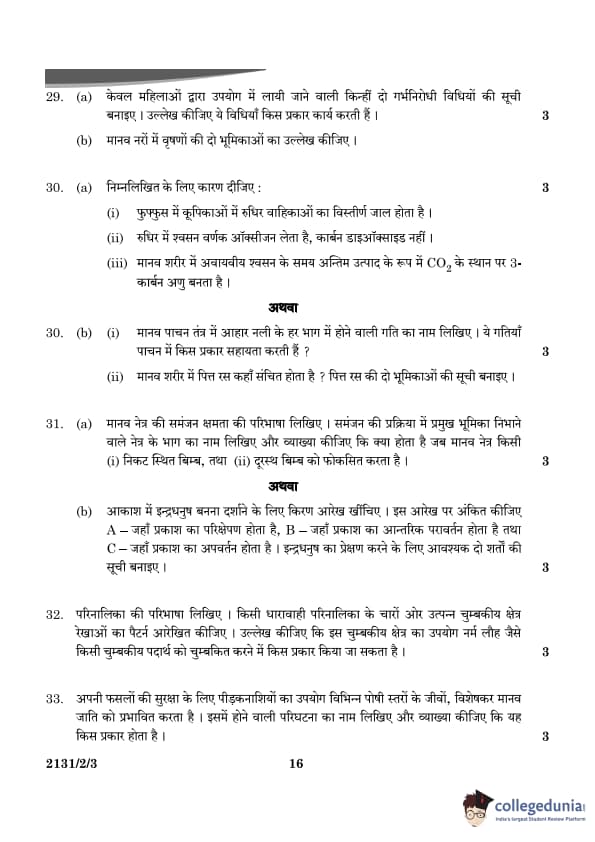
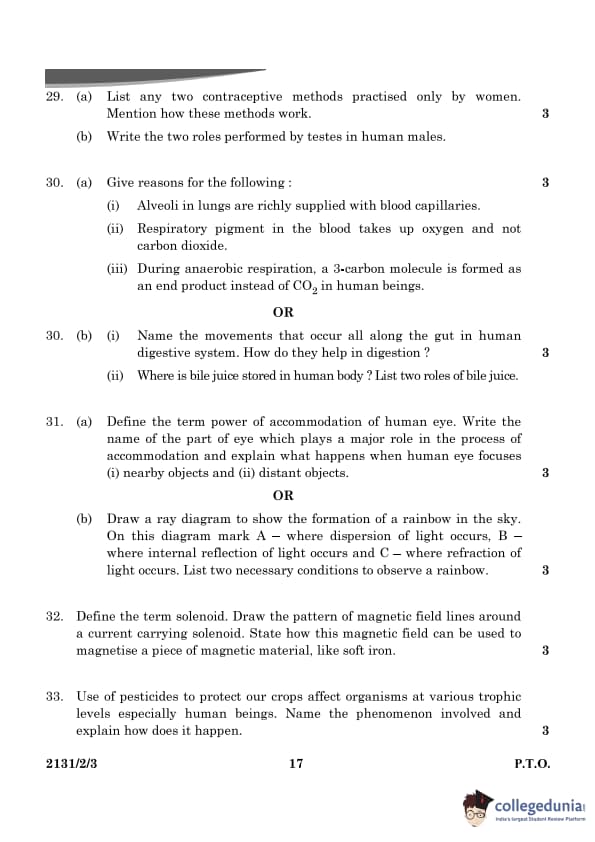
| 29 (a). List any two contraceptive methods practised only by women. Mention how these methods work. (b) Write the two roles performed by testes in human males. |
Methods and roles explained | (a) Contraceptive methods: 1. Oral pills: Contain hormones to inhibit ovulation and thicken cervical mucus, preventing fertilization. 2. IUDs: Devices placed in the uterus to prevent implantation or release copper ions toxic to sperm. (b) Roles of testes: 1. Produce sperm for reproduction. 2. Secrete testosterone, responsible for male secondary sexual characteristics. |
| 30. (a) Give reasons for the following: (i) Alveoli in lungs are richly supplied with blood capillaries. (ii) Respiratory pigment in the blood takes up oxygen and not carbon dioxide. (iii) During anaerobic respiration, a 3-carbon molecule is formed as an end product instead of CO2 in human beings. |
Reasons and functions explained | (a) Reasons: (i) Alveoli have a large surface area and are surrounded by capillaries for efficient gas exchange. (ii) Hemoglobin binds to oxygen due to its higher affinity compared to carbon dioxide. (iii) In anaerobic respiration, glucose is partially broken down into lactic acid, a 3-carbon molecule. |
| 30.OR (b) (i) Name the movements that occur all along the gut in the human digestive system. How do they help in digestion? (ii) Where is bile juice stored in the human body? List two roles of bile juice. |
Reasons and functions explained | (b) (i) Movements: Peristalsis involves rhythmic contractions of the gut walls, propelling food and mixing it with digestive juices. (ii) Bile juice is stored in the gallbladder. Roles: 1. Emulsification of fats. 2. Absorption of fat-soluble vitamins (A, D, E, K). |
| 31 (a). Define the term power of accommodation of the human eye. Write the name of the part of the eye which plays a major role in the process of accommodation. Explain what happens when the human eye focuses (i) nearby objects and (ii) distant objects. | Accommodation defined, diagrams drawn | (a) Power of accommodation: The ability of the eye to adjust its focal length to clearly see objects at different distances. Part: Ciliary muscles. (i) For nearby objects: Ciliary muscles contract, reducing tension on the lens, making it thicker and more convex, increasing its refractive power. (ii) For distant objects: Ciliary muscles relax, increasing tension on the lens, making it thinner and less convex, decreasing its refractive power. |
| 31 OR (b) (i) Draw a ray diagram to show the formation of a rainbow in the sky. On this diagram, mark A – where dispersion of light occurs, B – where internal reflection of light occurs, and C – where refraction of light occurs. (ii) List two necessary conditions to observe a rainbow. |
Accommodation defined, diagrams drawn | (b) (i) Rainbow diagram: - A: Dispersion of light into constituent colors. - B: Internal reflection inside raindrops. - C: Refraction as light exits the raindrop. (ii) Conditions to observe a rainbow: 1. Sunlight must be present. 2. Water droplets in the atmosphere are required to refract and reflect light. |
| 32. Define the term solenoid. Draw the pattern of magnetic field lines around a current-carrying solenoid. State how this magnetic field can be used to magnetize a piece of magnetic material, like soft iron. | Solenoid and magnetization explained | Solenoid: A cylindrical coil of wire wound closely in many turns. When current passes through it, a magnetic field similar to a bar magnet is produced. Magnetic field pattern: Uniform inside the solenoid; resembles a bar magnet outside. Magnetizing soft iron: - Place soft iron inside the solenoid. - The solenoid's magnetic field aligns the magnetic domains of the iron, creating a temporary magnet. - Used in electromagnets for increased magnetic strength. |
| 33. Use of pesticides to protect our crops affects organisms at various trophic levels, especially human beings. Name the phenomenon involved and explain how it happens. | Biomagnification explained | Phenomenon: Biomagnification (biological magnification). Process: 1. Pesticides enter the environment through runoff, soil, or plants. 2. Primary producers (plants) absorb these toxins. 3. Herbivores feeding on plants accumulate toxins (bioaccumulation). 4. Carnivores and apex predators (including humans) consume contaminated prey, leading to higher toxin concentrations at each trophic level. Effects on humans: - Neurological disorders. - Reproductive issues. - Increased cancer risks. |
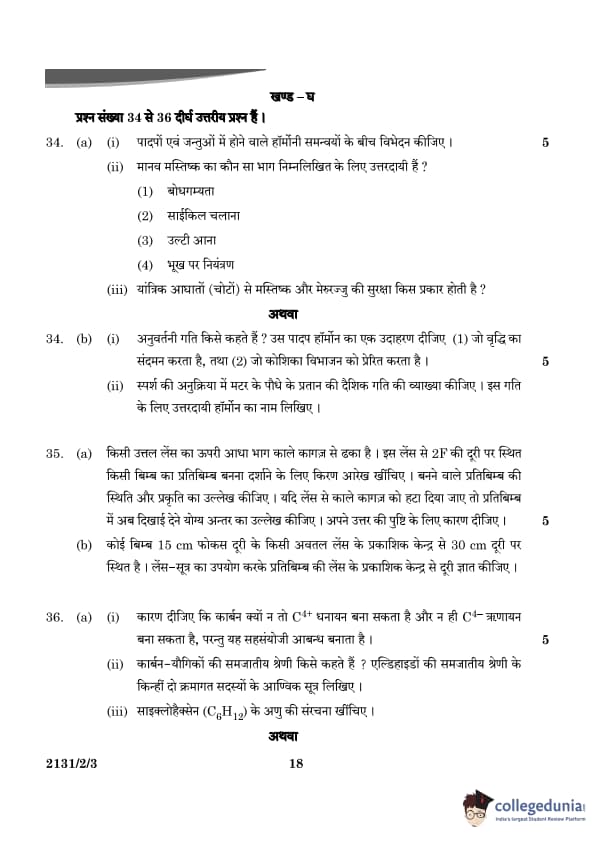
| 34 (a). (i) Distinguish between hormonal coordination in plants and animals. (ii) Which part of the brain is responsible for: (1) intelligence (2) riding a bicycle (3) vomiting (4) controlling hunger (iii) How are the brain and spinal cord protected against mechanical injuries? |
Distinctions, brain regions, protective mechanisms | (i) Hormonal Coordination: Plants rely on organic compounds like auxins for growth, while animals use hormones secreted by glands. (ii) Brain regions: (1) Intelligence: Cerebrum (2) Riding a bicycle: Cerebellum (3) Vomiting: Medulla oblongata (4) Hunger: Hypothalamus (iii) Protection: Skull and vertebral column shield these organs; cerebrospinal fluid and meninges act as cushions. |
| OR 34 (b). (i) What are tropic movements? Give an example of a plant hormone which (1) inhibits growth and (2) promotes cell division. (ii) Explain the directional movement of a tendril in a pea plant in response to touch. Name the hormone responsible for this movement. |
Tropic movements; auxin's role explained | (i) Tropic movements are directional growth responses of plants toward or away from a stimulus. Hormones: (1) Inhibits growth: Abscisic acid (ABA). (2) Promotes cell division: Cytokinins. (ii) Tendril's movement: In response to touch, the cells on the opposite side of contact elongate more due to auxin distribution, causing the tendril to coil around the support. |
| 35 (a). Upper half of a convex lens is covered with black paper. Draw a ray diagram to show the formation of the image of an object placed at a distance of 2F from such a lens. Mention the position and nature of the image formed. State the observable difference in the image obtained if the lens is uncovered. Give reason to justify your answer. | Real, inverted, diminished image; dimmer with covered lens | Image is real, inverted, and formed at 2F. When half the lens is covered, brightness reduces but position and size remain unchanged. This demonstrates that even a part of the lens can form a complete image due to its refractive nature. |
| 35 (b). An object is placed at a distance of 30 cm from the optical center of a concave lens of focal length 15 cm. Use the lens formula to determine the distance of the image from the optical center of the lens. | Distance of the image: -10 cm | Lens formula: 1/v - 1/u = 1/f Given: u = -30 cm, f = -15 cm. Substituting values: 1/v = 1/(-15) + 1/(-30) 1/v = -2/30 + (-1/30) = -3/30 v = -10 cm. The image is virtual, upright, and diminished. |
| 36 (a). (i) Give a reason why carbon can neither form C⁴⁺ cations nor C⁴⁻ anions but forms covalent compounds. (ii) What is a homologous series of carbon compounds? Write the molecular formula of any two consecutive members of the homologous series of aldehydes. (iii) Draw the structure of the molecule cyclohexane (C₆H₁₂). |
Covalent bonding; homologous series; aldehydes | (i) Carbon avoids forming ions due to energy instability. Instead, it shares electrons forming covalent bonds. (ii) Homologous series are compounds with similar properties and differ by a CH₂ group. Examples: Methanal (HCHO) and Ethanal (CH₃CHO). (iii) Cyclohexane is a cyclic compound with alternating single bonds between six carbon atoms. |
| 36 (b). (i) Name a commercially important carbon compound having the functional group –OH and write its molecular formula. (ii) Write chemical equations for its reactions with: (1) Sodium metal (2) Excess concentrated sulfuric acid (3) Ethanoic acid in the presence of an acid catalyst (4) Acidified potassium dichromate. Also, name the product formed in each case. |
Ethanol reactions detailed | (i) Ethanol (C₂H₅OH) is a commercially important compound with the –OH group. (ii) Reactions: (1) With Sodium Metal: \( 2C₂H₅OH + 2Na \rightarrow 2C₂H₅ONa + H₂ \) (Sodium ethoxide is formed). (2) With Concentrated Sulfuric Acid: \( C₂H₅OH \xrightarrow{\text{H₂SO₄}} C₂H₄ + H₂O \) (Ethene is formed). (3) With Ethanoic Acid (Esterification): \( C₂H₅OH + CH₃COOH \xrightarrow{\text{H⁺}} CH₃COOC₂H₅ + H₂O \) (Ethyl ethanoate is formed). (4) With Acidified Potassium Dichromate: \( C₂H₅OH + [O] \rightarrow CH₃COOH + H₂O \) (Ethanoic acid is formed). |
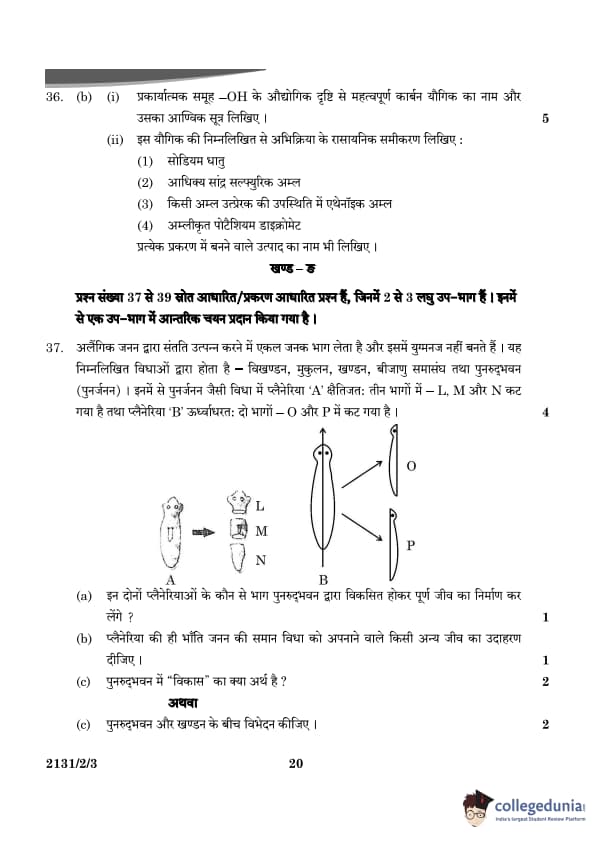
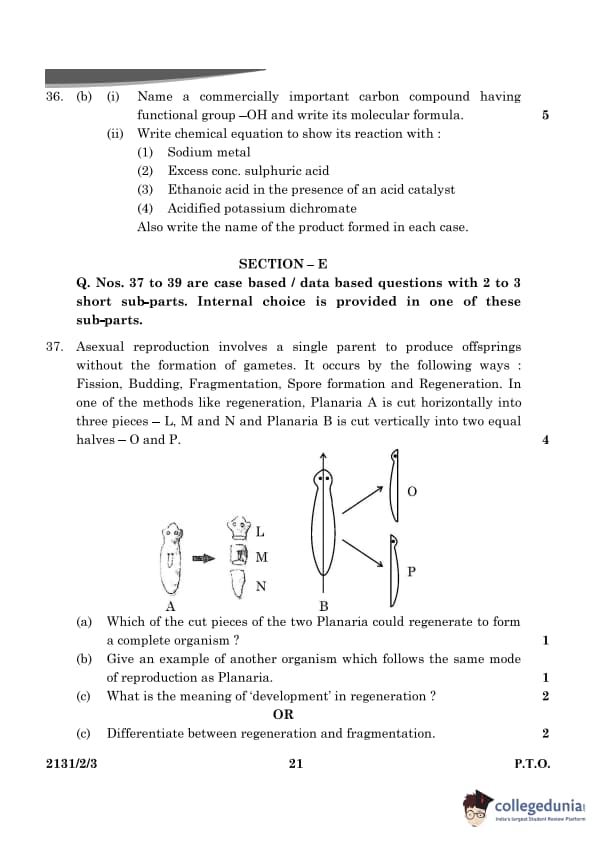
| 37. Asexual reproduction involves a single parent to produce offspring without the formation of gametes. It occurs through methods like Fission, Budding, Fragmentation, Spore Formation, and Regeneration. In one of the methods, Planaria A is cut horizontally into three pieces (L, M, and N) and Planaria B is cut vertically into two equal halves (O and P). (a) Which of the cut pieces of the two Planaria could regenerate to form a complete organism? (b) Give an example of another organism which follows the same mode of reproduction as Planaria. (c) What is the meaning of 'development' in regeneration? |
Regeneration explained with examples | (a) All pieces (L, M, N, O, P) can regenerate into complete organisms because Planaria has specialized stem cells called neoblasts, enabling regeneration. (b) Hydra is an example of another organism capable of regeneration. (c) Development in regeneration refers to the process where specialized cells proliferate, differentiate, and organize to form the missing or damaged parts of an organism. |
| 37 (c) OR. Differentiate between regeneration and fragmentation. | Differences listed | Regeneration: 1. A cut or damaged part of an organism regenerates into a complete organism. 2. Involves specialized cells (e.g., neoblasts in Planaria). Example: Planaria. Fragmentation: 1. The body breaks into fragments, and each grows into a new individual. 2. Does not require specialized cells. Example: Spirogyra. |
| 38. When electric current flows in a purely resistive circuit, electrical energy is fully converted into heat energy. The heat produced (H) in the circuit is given by \( H = I^2Rt \), where \( I \) is the current, \( R \) is the resistance, and \( t \) is the time for which current flows. Electrical devices such as electric fuses, heaters, and irons are based on this effect. (a) List two properties of heating elements. (b) List two properties of electric fuses. (c) Name the principle on which an electric fuse works. Explain how a fuse wire is capable of saving electrical appliances from high currents. |
Heating effect of current explained | (a) Properties of heating elements: 1. High resistivity to produce heat efficiently. 2. High melting point to withstand generated heat. (b) Properties of electric fuses: 1. Low melting point to break the circuit easily. 2. Specific current rating to prevent overheating of circuits. (c) Principle: An electric fuse works on the heating effect of electric current. When a high current flows through the fuse wire, it heats up and melts, breaking the circuit and protecting appliances from damage caused by excessive current. |
| 38 (c) OR. The power of an electric heater is 1100 W. If the potential difference between the two terminals of the heater is 220 V, find the current flowing in the circuit. What will happen to an electric fuse of rating 5 A connected in this circuit? | Current: 5 A; Fuse may blow | Given: Power (P) = 1100 W Voltage (V) = 220 V Formula: ( P = V * I) Current (I) = P / V = 1100 / 220 = 5 A. Since the current flowing in the circuit matches the fuse rating (5 A), the fuse will not blow under normal conditions. However, if the current increases even slightly above 5 A, the fuse will melt and disconnect the circuit to protect the heater. |
| 39. Salts play an important role in daily life. Sodium chloride (common salt) is used in kitchens, and baking soda is essential in cooking and baking industries. (a) Identify the acid and base from which sodium chloride is formed. (b) Find the cation and anion present in calcium sulfate. (c) Sodium chloride and washing soda belong to the same family of salts. Justify this statement. |
Salts explained with examples | (a) Sodium chloride is formed from: Acid: Hydrochloric acid (HCl). Base: Sodium hydroxide (NaOH). (b) Calcium sulfate (CaSO₄) contains: Cation: Calcium ion (Ca²⁺). Anion: Sulfate ion (SO₄²⁻). (c) Sodium chloride (NaCl) and washing soda (Na₂CO₃) both belong to the sodium family because they share the sodium cation (Na⁺) in their composition. |
| 39 (c) OR. Define the term pH scale. Name the salt obtained by the reaction of Potassium hydroxide and Sulphuric acid and give the pH value of its aqueous solution. | pH scale defined, salt identified | Definition: The pH scale is a logarithmic scale used to measure the acidity or alkalinity of an aqueous solution. It ranges from 0 (strongly acidic) to 14 (strongly basic), with 7 being neutral. Salt: The reaction of Potassium hydroxide (KOH) and Sulphuric acid (H₂SO₄) produces Potassium sulfate (K₂SO₄). pH: The aqueous solution of Potassium sulfate has a pH of 7, as it is a neutral salt formed from a strong acid (H₂SO₄) and a strong base (KOH). |









Comments