




CBSE Class 10 Science Question Paper 2024 PDF (Set 3 - 31/3/3) is available for download here. CBSE conducted the Science exam on March 2, 2024, from 10:30 AM to 1:30 PM. The total marks for the theory paper are 80. The question paper contains 20% MCQ-based questions, 40% competency-based questions, and 40% short and long answer type questions.
CBSE Class 10 Science Question Paper 2024 (Set 3 - 31/3/3) with Answer Key
| CBSE Class 10 Science Question Paper 2024 (Set 3 - 31/3/3) with Answer Key |  Download Download |
Check Solutions |
CBSE Science Question Paper (Set 3 – 31/3/3) 2024 Solution
| Question | Answer | Detailed Solution |
|---|---|---|
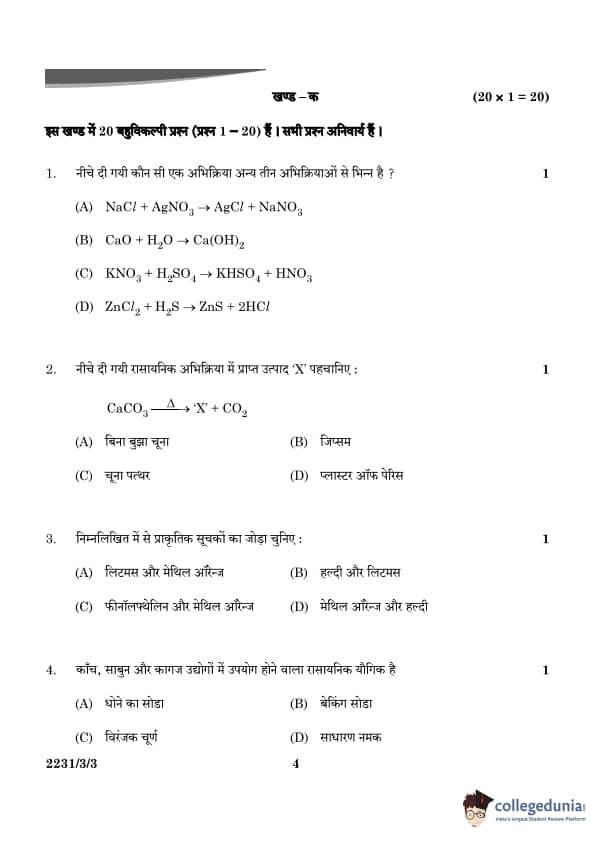
| 1. Which one of the following reactions is different from the remaining three? (A) NaCl + AgNO₃ → AgCl + NaNO₃ (B) CaO + H₂O → Ca(OH)₂ (C) KNO₃ + H₂SO₄ → KHSO₄ + HNO₃ (D) ZnCl₂ + H₂S → ZnS + 2HCl |
(B) CaO + H₂O → Ca(OH)₂ | This is a combination reaction where two substances combine to form a single product, whereas the other options are double displacement reactions. |
| 2. Identify the product 'X' obtained in the following reaction: CaCO₃ → X + CO₂ (A) Quick lime (B) Gypsum (C) Limestone (D) Plaster of Paris |
(A) Quick lime | When heated, calcium carbonate decomposes into calcium oxide (quick lime) and carbon dioxide. This is a thermal decomposition reaction. |
| 3. Select a pair of natural indicators from the following: (A) Litmus and methyl orange (B) Turmeric and Litmus (C) Phenolphthalein and methyl orange (D) Methyl orange and Turmeric |
(B) Turmeric and Litmus | Turmeric and litmus are natural indicators, while methyl orange and phenolphthalein are synthetic indicators. |
| 4. A chemical compound used in glass, soap, and paper industries is: (A) Washing Soda (B) Baking Soda (C) Bleaching Powder (D) Common Salt |
(A) Washing Soda | Washing soda (sodium carbonate) is extensively used in the glass, soap, and paper industries due to its alkaline properties. |
| 5. The products obtained when lead nitrate is heated in a boiling tube are: (A) PbO, N₂O, and O₂ (B) NO, PbO, and O₂ (C) Pb(NO₂)₂ and O₂ (D) NO₂, PbO, and O₂ |
(D) NO₂, PbO, and O₂ | On heating, lead nitrate decomposes to produce lead monoxide (PbO), nitrogen dioxide (NO₂), and oxygen (O₂). |
| 6. Identify a group of unsaturated hydrocarbons from the following: (A) Propane, Ethene, Butyne (B) Ethene, Propane, Hexane (C) Cyclohexane, Methane, Ethane (D) Butyne, Ethene, Propyne |
(D) Butyne, Ethene, Propyne | Unsaturated hydrocarbons contain double or triple bonds, as seen in Butyne, Ethene, and Propyne. |
| 7. The structural formula of Cyclohexane is: (A) Contains a double bond (B) Contains a six-membered ring with single bonds (C) Contains triple bonds (D) Represents benzene |
(B) Contains a six-membered ring with single bonds | Cyclohexane is a cyclic alkane with single bonds between carbon atoms. |
| 8. Which of the following statements is true about the human heart? (a) Right atrium receives oxygenated blood from the lungs. (b) Left atrium transfers oxygenated blood to the left ventricle. (c) Right atrium receives deoxygenated blood through the vena cava. (d) Left atrium transfers oxygenated blood to the aorta. (A) (b) only (B) (a) and (d) (C) (b) and (c) (D) (b) and (d) |
(C) (b) and (c) | The right atrium receives deoxygenated blood from the vena cava, and the left atrium transfers oxygenated blood to the left ventricle. |
| 9. In a dihybrid cross, the ratio of different combinations in the F2 progeny would be: (A) 1:3 (B) 1:2:1 (C) 9:3:3:1 (D) 9:1:1:3 |
(C) 9:3:3:1 | The 9:3:3:1 ratio arises from the independent assortment of alleles in a dihybrid cross. |
| 10. Select the plant hormone which promotes cell division: (A) Gibberellins (B) Auxins (C) Abscisic Acid (D) Cytokinins |
(D) Cytokinins | Cytokinins are plant hormones that promote cell division and differentiation. |
| 11. Offsprings formed as a result of sexual reproduction produce more variations because: (A) Genetic material is contributed by many parents. (B) Sexual reproduction is a lengthy process. (C) Genetic material is contributed by two individuals of the same species to produce a new generation. (D) DNA copying is not accompanied by the creation of cellular apparatus. |
(C) Genetic material is contributed by two individuals of the same species to produce a new generation. | Sexual reproduction involves the fusion of genetic material from two parents, leading to genetic variations in offspring, which are crucial for survival and evolution. |
| 12. Sex determination depends upon the environment in: (A) Birds (B) Amphibians (C) Reptiles (D) Fishes |
(C) Reptiles | In reptiles like turtles and crocodiles, the temperature during incubation determines the sex of the offspring, a phenomenon known as Temperature-Dependent Sex Determination (TSD). |
| 13. In case of four wires of the same material, the resistance will be minimum if the diameter and length of the wire respectively are: (A) D/2 and L/4 (B) D/4 and 4L (C) 2D and L (D) 4D and 2L |
(D) 4D and 2L | Resistance is inversely proportional to the square of the diameter. A larger diameter and shorter length result in minimal resistance. |
| 14. In the given circuit, the total resistance between X and Y is: (A) 12 Ω (B) 4 Ω (C) 6 Ω (D) 1 Ω |
(D) 1 Ω | Using the parallel resistance formula and calculating step-by-step, the total resistance between X and Y is found to be 1 Ω. |
| 15. Consider the following statements about ozone: (a) Ozone is poisonous gas. (b) Ozone shields the earth’s surface from infrared radiation from the sun. (c) Ozone is a product of UV radiation acting on oxygen molecules. (d) At the lower level of the earth’s atmosphere, ozone performs the most essential function. The correct statements are: (A) (a) and (b) (B) (a) and (c) (C) (b) and (c) (D) (b) and (d) |
(B) (a) and (c) | Ozone is a poisonous gas and is formed by UV radiation acting on oxygen molecules. It primarily protects the Earth from UV radiation, not infrared radiation. |
| 16. A food chain will be more advantageous in terms of energy if it has: (A) 2 trophic levels (B) 3 trophic levels (C) 4 trophic levels (D) 5 trophic levels |
(A) 2 trophic levels | Shorter food chains with fewer trophic levels retain more energy due to less energy loss at each level. |
| 17. Assertion (A): Red light signals are used to stop vehicles on the road. Reason (R): Red coloured light is scattered the most so as to be visible from a large distance. (A) Both (A) and (R) are true, and (R) is the correct explanation of (A). (B) Both (A) and (R) are true, but (R) is not the correct explanation of (A). (C) (A) is true, but (R) is false. (D) (A) is false, but (R) is true. |
(C) (A) is true, but (R) is false. | Red light is used because it scatters the least, making it visible from long distances. The given reason incorrectly states the opposite. |
| 18. Assertion (A): A piece of Zinc metal gets a reddish-brown coating when kept in copper sulphate solution for some time. Reason (R): Copper is more reactive than Zinc. (A) Both (A) and (R) are true, and (R) is the correct explanation of (A). (B) Both (A) and (R) are true, but (R) is not the correct explanation of (A). (C) (A) is true, but (R) is false. (D) (A) is false, but (R) is true. |
(C) (A) is true, but (R) is false. | Zinc is more reactive than copper, so it displaces copper from the solution, forming a reddish-brown coating. The reason incorrectly states copper is more reactive. |
| 19. Assertion (A): Offsprings produced by asexual reproduction are genetically similar to the parents. Reason (R): Asexual reproduction involves a single parent. (A) Both (A) and (R) are true, and (R) is the correct explanation of (A). (B) Both (A) and (R) are true, but (R) is not the correct explanation of (A). (C) (A) is true, but (R) is false. (D) (A) is false, but (R) is true. |
(A) Both (A) and (R) are true, and (R) is the correct explanation of (A). | Asexual reproduction involves a single parent, resulting in genetically identical offspring. The reason explains the assertion correctly. |
| 20. Assertion (A): Producers are capable of using light energy from the sun to make food available in an ecosystem. Reason (R): All food chains in an ecosystem start with a producer. (A) Both (A) and (R) are true, and (R) is the correct explanation of (A). (B) Both (A) and (R) are true, but (R) is not the correct explanation of (A). (C) (A) is true, but (R) is false. (D) (A) is false, but (R) is true. |
(B) Both (A) and (R) are true, but (R) is not the correct explanation of (A). | Producers use sunlight to make food (photosynthesis), making them the base of the food chain. However, the reason does not directly explain the assertion. |
| 21. (a) Write the essential conditions for the following reaction to take place and name its types: 2AgCl → 2Ag + Cl2 |
(a) Reaction occurs in the presence of sunlight, and it is a photochemical decomposition reaction. | (a) Silver chloride decomposes in the presence of sunlight into silver and chlorine gas. It is called a photochemical decomposition reaction. |
| 21. (b) Complete the following chemical reaction in the form of a balanced equation: FeSO4 → Fe2O3 + ... + ... |
(b) FeSO4 → Fe2O3 + SO2 + SO3 | (b) When ferrous sulfate is heated, it decomposes into ferric oxide, sulfur dioxide, and sulfur trioxide. The balanced equation is: 2FeSO4 → Fe2O3 + SO2 + SO3. |
| 22. (a) List any two pairs of visible contrasting characters of garden pea plants used by Mendel for his experiments, stating the dominant and recessive characters in each pair. | (a) Seed shape: Round (dominant) vs. Wrinkled (recessive). Seed color: Yellow (dominant) vs. Green (recessive). |
(a) Mendel used contrasting characters in his experiments, such as: - Seed shape: Round (dominant) vs. Wrinkled (recessive). - Seed color: Yellow (dominant) vs. Green (recessive). |
| OR 22. (b) In human beings, the probability of getting a male or a female child is 50%. Explain with the help of a flow diagram only. | (b) Probability is 50% due to equal chance of X and Y sperm fertilizing the egg. | (b) A flow diagram explains that male sperm (X or Y chromosome) determines the sex, with a 50% probability of producing either male (XY) or female (XX) offspring. |
| 23. Where are auxins synthesized? How do they promote phototropism? | Auxins are synthesized in the shoot apex. They promote phototropism by redistributing to the shaded side, causing elongation and bending towards the light. | Auxins are synthesized in the shoot apex and young leaves. They promote phototropism by moving to the shaded side of the stem, causing cells on that side to elongate more and the plant to bend towards the light source. |
| 24. (a) Draw a labelled diagram to show the pattern of magnetic field lines produced due to a current-carrying straight conductor. Mark the direction of current and magnetic field lines. | (a) Diagram of magnetic field lines around a current-carrying conductor. | (a) The magnetic field lines form concentric circles around a current-carrying straight conductor. The direction is determined using the right-hand thumb rule. |
| OR 24.(b) Name the device used to magnetize a piece of magnetic material. Draw a labelled diagram to show the arrangement used for magnetizing a cylinder made of soft iron. | (b) Device: Solenoid. Diagram shows soft iron inside the solenoid. | (b) A solenoid (coil of wire) is used to magnetize a soft iron cylinder. When current flows through the solenoid, it generates a magnetic field, aligning the domains of the soft iron. |
| 25. When do we say that a particular person is suffering from hypermetropia? List two causes of this defect. Name the type of lens used to correct this defect. | Hypermetropia occurs when a person can see distant objects clearly but not nearby objects. Causes: Short eyeball and weak ciliary muscles. Corrected using a convex lens. | Hypermetropia is a condition where a person has difficulty seeing nearby objects clearly. It occurs due to: Short eyeball, causing the image to form behind the retina. Weak ciliary muscles, unable to focus light on the retina. A convex lens is used to converge light rays and correct hypermetropia. |
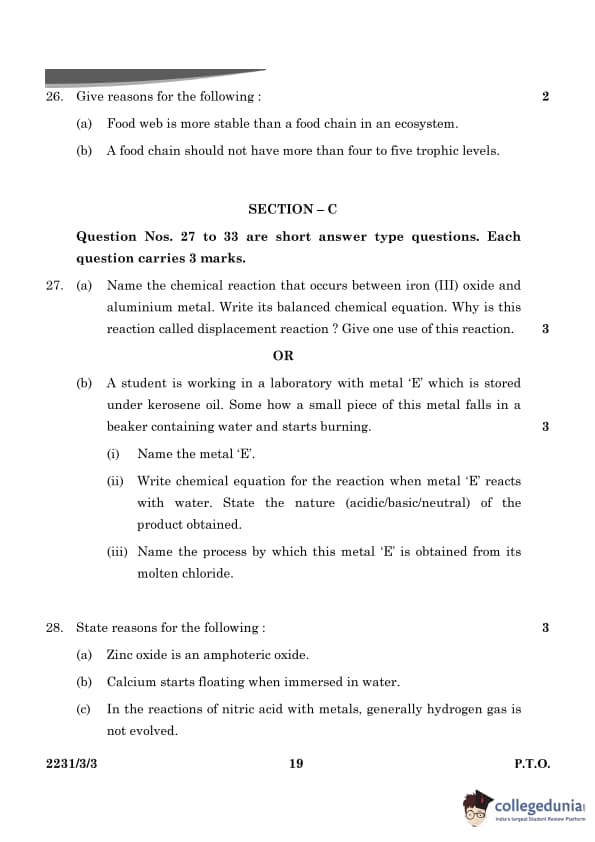
| 26. Give reasons for the following: (a) Food web is more stable than a food chain in an ecosystem. (b) A food chain should not have more than four to five trophic levels. |
(a) A food web provides alternate energy pathways, ensuring stability. (b) Energy loss limits the number of trophic levels. |
(a) A food web consists of multiple interconnected food chains. If one link fails, energy can flow through alternative pathways, ensuring stability. (b) Energy is lost at each trophic level due to the 10% energy transfer law. This limits the food chain to four to five levels to maintain sufficient energy for the top level. |
| 26. Give reasons for the following: (a) Food web is more stable than a food chain in an ecosystem. (b) A food chain should not have more than four to five trophic levels. |
(a) A food web provides alternate energy pathways, ensuring stability. (b) Energy loss limits the number of trophic levels. |
(a) A food web consists of multiple interconnected food chains. If one link fails, energy can flow through alternative pathways, ensuring stability. (b) Energy is lost at each trophic level due to the 10% energy transfer law. This limits the food chain to four to five levels to maintain sufficient energy for the top level. |
| 27. (a) Name the chemical reaction that occurs between iron (III) oxide and aluminium metal. Write its balanced chemical equation. Why is this reaction called a displacement reaction? Give one use of this reaction. |
(a) Thermite reaction. Fe2O3 + 2Al → 2Fe + Al2O3 + Heat. Used in welding railway tracks. |
(a) The reaction between iron (III) oxide and aluminium metal is called the thermite reaction. Aluminium displaces iron due to its higher reactivity: Fe2O3 + 2Al → 2Fe + Al2O3 + Heat. This reaction is used in welding railway tracks as it releases a significant amount of heat. |
| 27. (b) A student is working with metal ‘E’ stored under kerosene. A small piece falls in water and starts burning. Name the metal, write the reaction, and name the process for obtaining this metal from its molten chloride. | (b) Metal: Sodium. Reaction: 2Na + 2H2O → 2NaOH + H2. Process: Electrolysis. |
(b) The metal is sodium, stored under kerosene to prevent reaction with air or moisture. When sodium reacts with water, it forms sodium hydroxide and hydrogen gas: 2Na + 2H2O → 2NaOH + H2. Sodium is obtained from molten sodium chloride via electrolysis. |
| 28. State reasons for the following: (a) Zinc oxide is an amphoteric oxide. |
(a) Reacts with both acids and bases. |
(a) Zinc oxide reacts with acids to form salts and water and with bases to form complex salts, showing amphoteric behavior. |
| 28. (b) Sodium metal is stored in a bottle filled with kerosene oil. | (b) Prevents violent reaction with air or moisture. | (b) Sodium reacts violently with air and moisture. Storing it under kerosene prevents such reactions. |
| 28. (c) In the reactions of nitric acid with metals, generally hydrogen gas is not evolved. | (c) Nitric acid oxidizes hydrogen to water. | (c) Nitric acid is a strong oxidizing agent and oxidizes hydrogen to water during metal reactions, preventing hydrogen gas evolution. |
| 29. We water the soil, but it reaches the topmost leaves of the plants. Explain in brief the process involved. | Transpiration pull drives water upward through xylem. Cohesion and adhesion maintain the water column. | Water absorbed by roots travels upward through xylem due to transpiration pull. Water evaporates from stomata, creating negative pressure. Cohesion (between water molecules) and adhesion (water and xylem walls) maintain a continuous column, helping water reach the leaves. |
| 30. Write the name and location of a hormone that helps a person to respond when chased by a dog. Mention the responses in the body that help deal with the situation. | Hormone: Adrenaline. Location: Adrenal glands on kidneys. Responses: Increases heart rate, breathing, and glucose levels. |
The hormone is adrenaline, secreted by adrenal glands located above the kidneys. It prepares the body for a "fight or flight" response by: - Increasing heart rate and breathing for more oxygen supply. - Converting glycogen to glucose for instant energy. - Diverting blood to muscles and dilating pupils for better vision. |
| 31. Explain in brief the function of an electric fuse in a domestic circuit. An electric heater of current rating 3 kW, 220 V is to be operated in an electric circuit of rating 5 A. What is likely to happen when the heater is switched ‘ON’? Justify your answer with necessary calculation. | The fuse prevents circuit damage by breaking the circuit during overcurrent. The heater will blow the fuse due to excess current (13.64 A). | An electric fuse is a safety device that melts and breaks the circuit when the current exceeds its rating, protecting appliances and preventing fires. Heater current calculation: Power (P) = 3000 W Voltage (V) = 220 V Current (I) = P / V = 3000 / 220 ≈ 13.64 A. Since 13.64 A exceeds the circuit rating of 5 A, the fuse will blow to prevent damage. |
| 32. Draw a schematic diagram of a circuit consisting of a battery of four dry cells of 1.5 V each, a 2 Ω resistor, a 6 Ω resistor, a 16 Ω resistor, and a plug key all connected in series. Put an ammeter to measure the current in the circuit and a voltmeter across the 16 Ω resistor to measure potential difference across its two ends. Use Ohm’s law to determine: (a) Ammeter reading. (b) Voltmeter reading when the key is closed. |
(a) Ammeter reading: 0.25 A. (b) Voltmeter reading: 4 V. |
Total voltage = 1.5 × 4 = 6 V. Total resistance = 2 Ω + 6 Ω + 16 Ω = 24 Ω. Using Ohm’s law: I = V / R = 6 / 24 = 0.25 A. Voltage across 16 Ω resistor: V = I × R = 0.25 × 16 = 4 V. The schematic diagram shows all components in series, with an ammeter in the circuit and a voltmeter across the 16 Ω resistor. |
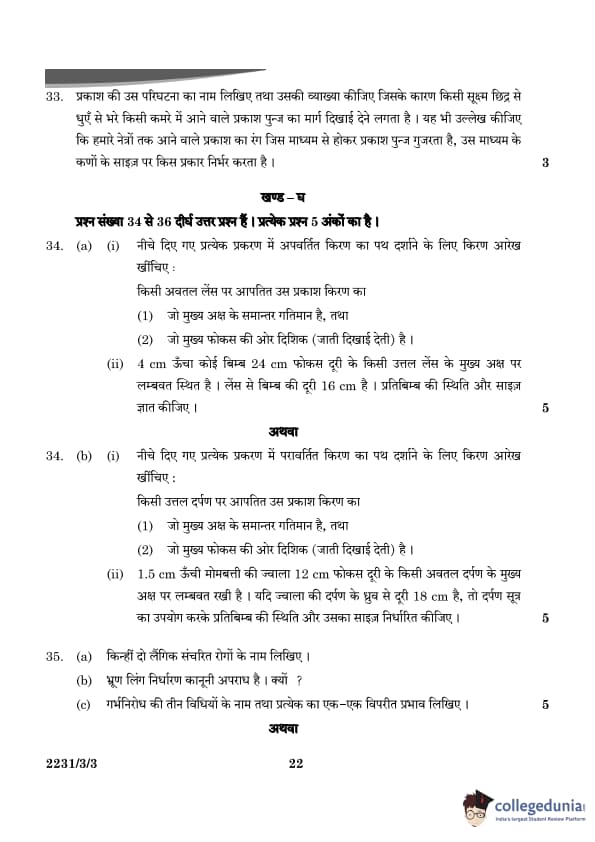
| 33. Name and explain the phenomenon of light due to which the path of a beam of light becomes visible when it enters a smoke-filled room through a small hole. Also, state the dependence of the color of the light we receive on the size of the particles of the medium through which the beam of light passes. | Tyndall effect causes light scattering, making the path visible. Smaller particles scatter blue light; larger particles scatter red light. | The phenomenon is the Tyndall effect, where light is scattered by particles in a colloidal solution, making the beam of light visible. Dependence on particle size: - Smaller particles scatter shorter wavelengths (blue and violet). - Larger particles scatter longer wavelengths (red and orange). This explains why the sky appears blue and sunsets appear red. |
| 34. (a) (i) Draw a ray diagram to show the path of the refracted ray in each of the following cases: A ray of light incident on a concave lens (1) parallel to its principal axis, and (2) is directed towards its principal focus. (a) (ii) A 4 cm tall object is placed perpendicular to the principal axis of a convex lens of focal length 24 cm. The distance of the object from the lens is 16 cm. Find the position and size of the image formed. |
(a) (ii) Image distance: -48 cm. Image size: 12 cm. |
(a) (i) A concave lens refracts light such that rays parallel to the principal axis appear to diverge from the principal focus. (ii) Using lens formula: ( 1/v - 1/u = 1/f ), substitute values ( u = -16 ), ( f = 24 ). Image distance ( v = -48 ) cm. Magnification ( m = v/u = -48/-16 = 3 ). Image height = 3 × 4 = 12 cm. |
| OR 34. (b) (i) Draw a ray diagram to show the path of the reflected ray in each of the following cases: A ray of light incident on a convex mirror (1) parallel to its principal axis, and (2) is directed towards its principal focus. (b) (ii) A 1.5 cm tall candle flame is placed perpendicular to the principal axis of a concave mirror of focal length 12 cm. If the distance of the flame from the pole of the mirror is 18 cm, use the mirror formula to determine the position and size of the image formed. |
(b) (ii) Image distance: -36 cm. Image size: -3 cm. |
(b) (i) A convex mirror reflects rays such that parallel rays diverge as if they come from the focus. (ii) Using mirror formula: ( 1/v + 1/u = 1/f ), substitute values ( u = -18 ), ( f = -12 ). Image distance ( v = -36 ) cm. Magnification ( m = -v/u = -(-36)/(-18) = -2 ). Image height = -2 × 1.5 = -3 cm. |
| 35. (a) Name any two sexually transmitted diseases. (b) Prenatal sex determination is prohibited by law. Why? (c) Name any three methods of contraception, stating one side effect of each. |
(a) HIV/AIDS, Syphilis. (b) Prevents female foeticide and promotes gender equality. (c) Barrier (allergic reactions), hormonal (irregular cycles), IUD (abdominal pain). |
(a) Two STDs: HIV/AIDS and Syphilis. (b) Prenatal sex determination promotes female foeticide and disrupts the sex ratio. It is banned under the PCPNDT Act to ensure gender equality. (c) Methods of contraception: - Barrier methods (e.g., condoms): May cause allergies. - Hormonal methods (e.g., pills): May cause irregular menstrual cycles. - IUD (e.g., Copper-T): May cause abdominal pain or heavy bleeding. |
| OR 35.(a) Name a unisexual and a bisexual flower. (b) Define cross-pollination. State how it is carried out. (c) Observe the diagram and name the parts marked as ‘A’ and ‘B’. Mention their functions. |
(a) Unisexual flower: Papaya. Bisexual flower: Hibiscus. (b) Cross-pollination transfers pollen from one flower's anther to another's stigma via wind, insects, or water. (c) Part A: Pollen grain (male gamete). Part B: Pollen tube (transports male gametes to the ovule for fertilization). |
(a) Unisexual flower: Papaya. Bisexual flower: Hibiscus. (b) Cross-pollination transfers pollen from one flower's anther to another's stigma via wind, insects, or water. (c) Part A: Pollen grain (male gamete). Part B: Pollen tube (transports male gametes to the ovule for fertilization). |
| 36. (a) (i) Five solutions A, B, C, D, and E when tested with pH paper showed pH as 4, 1, 13, 7, and 10, respectively. Which solution is: (1) Strongly acidic (2) Strongly alkaline (3) Weakly acidic (4) Neutral (5) Weakly alkaline? (ii) Write the name and formula of: (1) An acidic salt (2) A basic salt giving the name of the parent acid and base used to form the salt in each case. |
(a) (i) Strongly acidic: B (pH 1), Strongly alkaline: C (pH 13), Weakly acidic: A (pH 4), Neutral: D (pH 7), Weakly alkaline: E (pH 10). (ii) Acidic salt: Sodium hydrogen sulfate (NaHSO4), Basic salt: Magnesium hydroxide chloride (Mg(OH)Cl). |
(a) (i) Based on pH: - Strongly acidic: B (pH 1) - Strongly alkaline: C (pH 13) - Weakly acidic: A (pH 4) - Neutral: D (pH 7) - Weakly alkaline: E (pH 10) (ii) Acidic salt: Sodium hydrogen sulfate (NaHSO4) formed from sulfuric acid and sodium hydroxide. Basic salt: Magnesium hydroxide chloride (Mg(OH)Cl) formed from hydrochloric acid and magnesium hydroxide. |
| OR 36. (b) Name and state in brief the process used to prepare sodium hydroxide from sodium chloride. In this process, two gases 'X' and 'Y' are given off. Name 'X' and 'Y' and specify the electrode at which each is obtained. Name the compound 'Z' formed when gas 'X' reacts with dry calcium hydroxide. Write the chemical equation for its formation. | (b) Process: Chlor-alkali process. Gases: X - Chlorine (at anode), Y - Hydrogen (at cathode). Compound Z: Bleaching powder (CaOCl2). |
(b) Process: The chlor-alkali process electrolyzes brine to produce sodium hydroxide, chlorine gas (X), and hydrogen gas (Y). Chlorine is released at the anode, and hydrogen at the cathode. Chlorine reacts with calcium hydroxide to form bleaching powder (CaOCl2). Chemical equation: Ca(OH)2 + Cl2 → CaOCl2 + H2O. |
| 37. More than three million carbon compounds have been discovered in chemistry. The diversity of these compounds is due to the capacity of carbon atoms to bond with one another as well as with other atoms. Most of the carbon compounds are poor conductors of electricity and have low melting and boiling points. (a) Write the molecular formula of the first two members of the homologous series having the functional group -Br. |
(a) CH3Br, C2H5Br. |
(a) Molecular formulas of alkyl bromides: - First member: CH3Br (Methyl bromide). - Second member: C2H5Br (Ethyl bromide). |
| (b) Write the names of the functional groups with the following formulae: (i) -CHO (ii) -CO- |
(b) (i) Aldehyde, (ii) Ketone. |
(b) Functional groups: - (i) -CHO: Aldehyde group. - (ii) -CO-: Ketone group. |
| (c) What would be observed when a 5% alkaline potassium permanganate solution is added drop by drop to warm ethanol in a test tube? State the role of KMnO4 in the reaction and write the chemical equation for the reaction involved. | (c) KMnO4 decolorizes ethanol, oxidizing it to ethanoic acid. | (c) Observation: The purple color of KMnO4 fades, indicating oxidation of ethanol to ethanoic acid. Role: KMnO4 acts as an oxidizing agent. Reaction: C2H5OH + 2[O] → CH3COOH + H2O. |
| OR 37. (c) Write the name of the compound formed when ethanol is heated at 443 K temperature with excess of conc. H2SO4. What is the role of conc. H2SO4 in the reaction? Write the chemical equation for the reaction involved. | Compound: Ethene Role: Dehydrating agent. |
When ethanol is heated to 443 K with excess concentrated sulfuric acid, ethene is formed. Conc. H2SO4 acts as a dehydrating agent, removing a water molecule from ethanol. Chemical equation: C2H5OH → C2H4 + H2O |
| 38. Human digestive system is a tube running from mouth to anus. Its main function is to break down complex food molecules for absorption into the body. (a) Name the glands present in the buccal cavity and write the components of food acted upon by their secretion. (b) Name two organs with a sphincter muscle at their exit. (c) What will happen if: (i) Mucus is not secreted by gastric glands. (ii) Villi are absent in the small intestine. |
(a) Salivary glands, act on starch. (b) Stomach, anus. (c) (i) Stomach ulcers. (ii) Poor nutrient absorption. |
(a) Salivary glands in the mouth secrete saliva, containing amylase to break down starch into maltose. (b) Organs with sphincter muscles: - Stomach: Pyloric sphincter. - Anus: Anal sphincter. (c) (i) Without mucus, stomach acid damages the lining, causing ulcers. (ii) Absence of villi reduces surface area, leading to poor nutrient absorption. |
| OR 38. (c) "Bile juice does not contain enzymes but plays an important role in digestion." Justify the statement. | Emulsifies fats, neutralizes chyme. | Bile emulsifies fats into smaller droplets, increasing surface area for enzymes. It neutralizes acidic chyme for better enzyme action. |
| 39. In a domestic circuit, five LED bulbs are arranged as shown. The source voltage is 220 V, and the power rating of each bulb is marked. Answer the following: (a) What happens when: (i) Key K1 is closed. (ii) Key K2 is closed. (b) Find the current drawn by bulb B when it glows. (c) Calculate: (i) Resistance of bulb B. (ii) Total resistance of the combination of bulbs B, C, D, and E connected in parallel. |
(a) (i) Bulb A glows. (ii) Bulbs B, C, D, and E glow. (b) 0.2 A. (c) (i) 275 Ω. (ii) 68.75 Ω. |
(a) (i) Closing K1 causes bulb A to glow. (ii) Closing K2 causes bulbs B, C, D, and E to glow as they are connected in parallel. (b) Current for bulb B: I = P / V = 11 / 55 = 0.2 A. (c) (i) Resistance of B: R = V2 / P = 552 / 11 = 275 Ω. (ii) Total resistance: 1 / Rtotal = 1 / 275 + 1 / 275 + 1 / 275 + 1 / 275 = 4 / 275. Rtotal = 275 / 4 = 68.75 Ω. |
| (c) What would happen to the glow of all bulbs if both K1 and K2 are closed and bulb C gets fused? Justify. | Only A glows; others go off. | If C fuses, bulbs B, D, and E go off as they are in series with C. Bulb A remains unaffected and glows. |













Comments