




CBSE Class 10th Board Science exam was conducted on February 20, 2025. The question paper along with the solution PDF is available here to download along with solutions in pdf form.
The CBSE 10th Board Science exam is divided into five sections, A, B, C, D, and E. The total marks for the A Section is 20. For B and C sections it is of 12 marks and 21 marks, respectively. The D and E sections is of 15 marks and 12 marks each. CBSE Class 10 Science Question Paper 2025 is total of 80 marks.
CBSE Board Class 10 Science Question Paper 2025 Set 3 (31/4/3) with Solutions
| CBSE Class 10 Science 2024 Question Paper with Answer Key (Set 3 - 31/4/3) |  Download Download |
Check Solution |
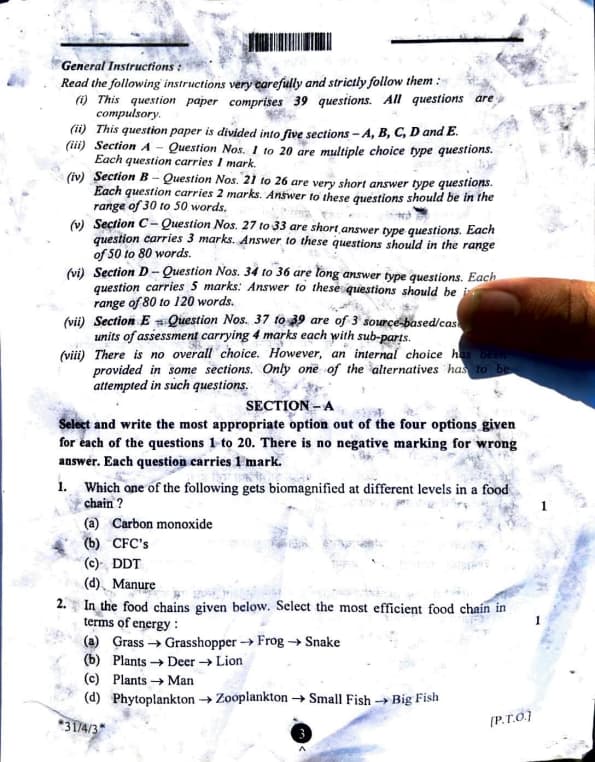
Which one of the following gets biomagnified at different levels in a food chain ?
View Solution
In the food chains given below. Select the most efficient food chain in terms of energy :
View Solution
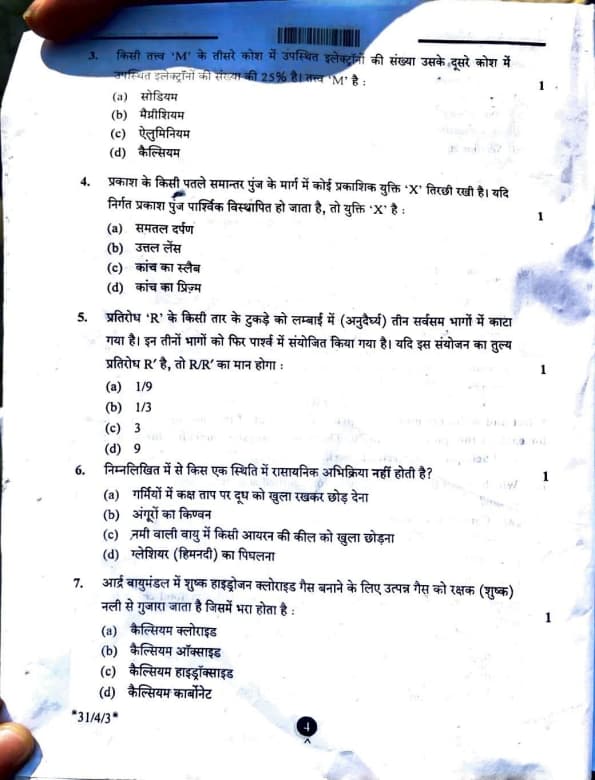
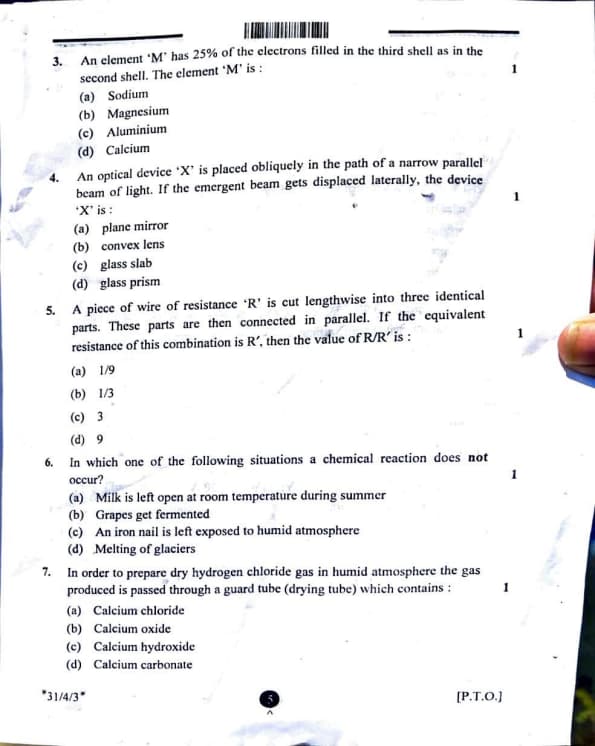
An element 'M' has 25% of the electrons filled in the third shell as in the second shell. The element 'M' is :
View Solution
The second shell (L-shell) can hold a maximum of 8 electrons. Assuming the second shell is completely filled for an element progressing to the third shell, it has 8 electrons.
Number of electrons in the third shell = 25% of electrons in the second shell
Number of electrons in the third shell = 0.25 \(\times\) 8 = 2 electrons.
The electronic configuration of element 'M' is:
First shell (K-shell): 2 electrons
Second shell (L-shell): 8 electrons
Third shell (M-shell): 2 electrons
So, the electronic configuration is 2, 8, 2.
The atomic number of element 'M' = Total number of electrons = 2 + 8 + 2 = 12.
The element with atomic number 12 is Magnesium (Mg).
Electronic configurations of the given options:
(a) Sodium (Na, Z=11): 2, 8, 1
(b) Magnesium (Mg, Z=12): 2, 8, 2
(c) Aluminium (Al, Z=13): 2, 8, 3
(d) Calcium (Ca, Z=20): 2, 8, 8, 2
Element 'M' is Magnesium. \[ \boxed{Magnesium} \] Quick Tip: \textbf{Quick Tip:} The maximum number of electrons in the first shell (K) is 2, second shell (L) is 8, and third shell (M) is 18 (but it starts filling the fourth shell after 8 electrons in the third shell for elements like K, Ca). Calculate the number of electrons in the third shell based on the second shell's count (usually assumed to be full if the third shell is being filled). Determine the atomic number and identify the element.
An optical device 'X' is placed obliquely in the path of a narrow parallel beam of light. If the emergent beam gets displaced laterally, the device 'X' is :
View Solution
A piece of wire of resistance 'R' is cut lengthwise into three identical parts. These parts are then connected in parallel. If the equivalent resistance of this combination is R', then the value of R/R' is :
View Solution
In which one of the following situations a chemical reaction does \textbf{not} occur?
View Solution
In order to prepare dry hydrogen chloride gas in humid atmosphere the gas produced is passed through a guard tube (drying tube) which contains :
View Solution
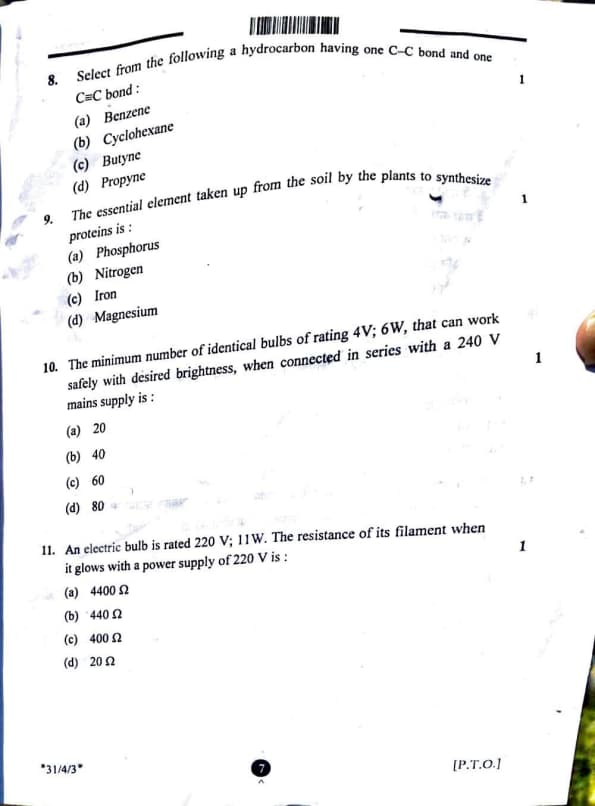
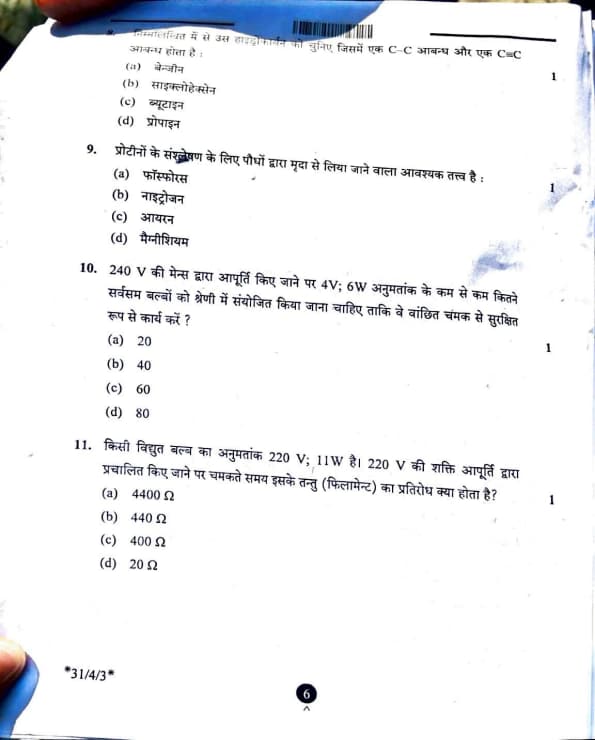
Select from the following a hydrocarbon having one C--C bond and one C=C bond :
View Solution
The essential element taken up from the soil by the plants to synthesize proteins is :
View Solution
The minimum number of identical bulbs of rating 4V; 6W, that can work safely with desired brightness, when connected in series with a 240 V mains supply is :
View Solution
An electric bulb is rated 220 V; 11W. The resistance of its filament when it glows with a power supply of 220 V is :
View Solution
Select TRUE statements about lymph from the following :
[A.] Lymph vessels carry lymph through the body and finally open into larger arteries.
[B.] Lymph contains some amount of plasma, proteins and blood cells.
[C.] Lymph contains some amount of plasma, proteins and red blood cells.
[D.] Lymph vessels carry lymph through the body and finally open into larger veins.
The true statements are :
View Solution
Plants like rose and banana have lost the capacity to produce :
View Solution
When a pure-tall pea plant is crossed with a pure-dwarf pea plant, the percentage of tall pea plants in F\(_1\) and F\(_2\) generation pea plants will be respectively :
View Solution
In a bisexual flower the male gametes are present in the :
View Solution
In a bisexual flower, the male reproductive part is the stamen, which consists of the anther and the filament.
(a) Anther: The anther is the part of the stamen that produces pollen grains. Pollen grains contain the male gametes.
(b) Ovary: The ovary is part of the pistil (female reproductive part) and contains ovules, which house the female gamete (egg cell).
(c) Stigma: The stigma is the receptive tip of the pistil where pollen lands.
(d) Filament: The filament is the stalk that supports the anther.
The male gametes are developed within the pollen grains, which are produced in the anther. \[ \boxed{anther} \] Quick Tip: \textbf{Quick Tip:} Stamen = Anther + Filament (Male part) Pistil/Carpel = Stigma + Style + Ovary (Female part) Anthers produce pollen grains, which contain male gametes. Ovules (inside the ovary) contain the female gamete (egg cell).
To get an image of magnification --1 on a screen using a lens of focal length 20 cm, the object distance must be :
View Solution
Assertion (A) : In reptiles, the temperature at which the fertilized eggs are kept decides the sex of the offsprings.
Reason (R) : Sex is not genetically determined in some animals.
View Solution
Assertion (A) : In large animals, oxygen can reach different parts of the animal's body easily.
Reason (R) : Respiratory pigments take up oxygen from the air and carry it to body tissues.
View Solution
Assertion (A): In large animals, oxygen cannot reach different parts of the animal's body "easily" just by simple diffusion from the surface. The surface area to volume ratio is too small, and diffusion distances are too large for efficient oxygen supply to all cells. Specialized respiratory and circulatory systems are required. So, the statement "easily" makes the assertion false.
Reason (R): Respiratory pigments (like hemoglobin in vertebrates or hemocyanin in some invertebrates) bind to oxygen in areas of high oxygen concentration (e.g., lungs, gills) and release it in areas of low oxygen concentration (body tissues). They play a crucial role in transporting oxygen. This statement is true.
Explanation: Assertion (A) is false because oxygen transport in large animals is a complex process, not "easy" by simple means. Reason (R) is a true statement about how oxygen is transported, which is precisely why such pigments are needed in large animals where simple diffusion is insufficient. The reason highlights a mechanism that makes oxygen transport possible but doesn't support the idea that it's "easy" without these mechanisms. \[ \boxed{Assertion (A) is false, but Reason (R) is true.} \] Quick Tip: \textbf{Quick Tip:} Simple diffusion is only efficient for oxygen transport over very short distances or in small organisms with a high surface area to volume ratio. Large, complex animals require specialized respiratory surfaces (lungs, gills) and circulatory systems with respiratory pigments to transport oxygen effectively to all body tissues.
Assertion (A) : Concentrated nitric acid is diluted by adding water slowly to acid with constant stirring.
Reason (R) : Concentrated nitric acid is easily soluble in water.
View Solution
Assertion (A) : White light is dispersed by a glass prism into seven colours.
Reason (R) : The red light bends the least while the violet the most when a beam of white light passes through a glass prism.
View Solution
Assertion (A): When white light passes through a glass prism, it splits into its constituent spectrum of colors (typically observed as violet, indigo, blue, green, yellow, orange, red - VIBGYOR). This phenomenon is called dispersion. The assertion states it splits into seven colors, which is a common way to describe the visible spectrum. This is true.
Reason (R): Different colors of light have different wavelengths. The refractive index of glass varies slightly with the wavelength of light. Violet light (shorter wavelength) has a higher refractive index in glass than red light (longer wavelength). Due to this difference in refractive index, violet light bends (deviates) more than red light when passing through a prism. Red light bends the least. This statement is true.
Explanation: The reason (R) correctly explains why dispersion (Assertion A) occurs. The differential bending of different colors of light due to their different speeds (and hence refractive indices) in the prism material is the cause of white light splitting into its spectrum. \[ \textbf{Both (A) and (R) are true, and (R) correctly explains (A).} \] Quick Tip: \textbf{Quick Tip:} Dispersion of light is the splitting of white light into its constituent colors. This occurs because the refractive index of the prism material is different for different wavelengths (colors) of light. Shorter wavelengths (like violet) bend more, and longer wavelengths (like red) bend less.
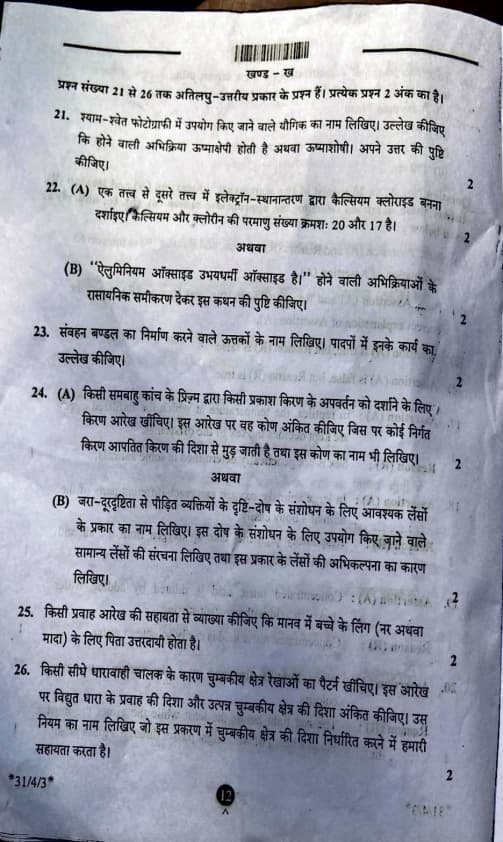
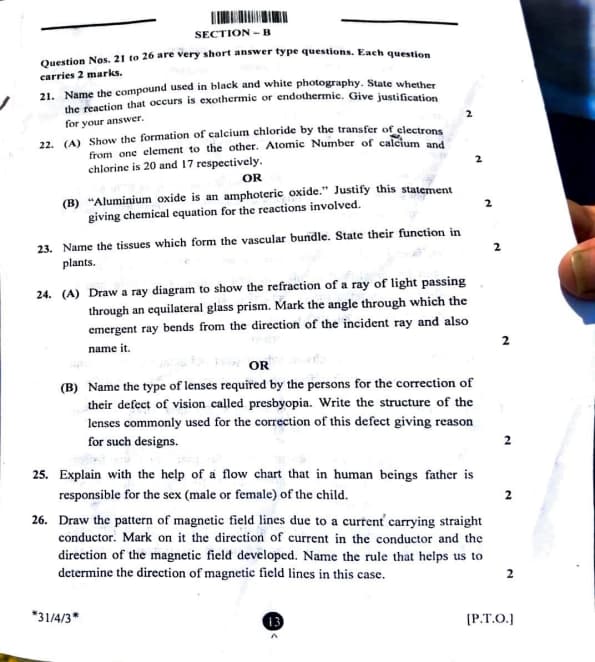
Name the compound used in black and white photography. State whether the reaction that occurs is exothermic or endothermic. Give justification for your answer.
View Solution
The compound commonly used in black and white photography is silver chloride (AgCl) or silver bromide (AgBr).
The reaction that occurs is a photochemical decomposition reaction, which is endothermic.
Justification:
The decomposition of silver chloride (or silver bromide) into silver and chlorine (or bromine) occurs when light energy is absorbed. For example: \[ 2AgCl(s) \xrightarrow{Sunlight} 2Ag(s) + Cl_2(g) \]
Since the reaction requires energy (in the form of light) to proceed, it is an endothermic reaction. Energy is absorbed from the surroundings (light) to break the bonds in AgCl. \[ \textbf{Compound: Silver Chloride (AgCl) or Silver Bromide (AgBr).}
\textbf{Reaction: Endothermic.}
\textbf{Justification: Requires light energy for decomposition.} \] Quick Tip: \textbf{Quick Tip:} Photochemical reactions are those initiated by the absorption of light. Endothermic reactions absorb energy from their surroundings. Exothermic reactions release energy. Decomposition reactions often require an input of energy (heat, light, or electricity).
(A) Show the formation of calcium chloride by the transfer of electrons from one element to the other. Atomic Number of calcium and chlorine is 20 and 17 respectively.
View Solution
Question 22:
(B) "Aluminium oxide is an amphoteric oxide." Justify this statement giving chemical equation for the reactions involved.
View Solution
N/A Quick Tip: \textbf{Quick Tip:} For ionic bond formation, show electron loss by metal and electron gain by non-metal leading to ion formation and then the ionic compound. Amphoteric oxides react with both acids and bases. Common examples include Al\(_2\)O\(_3\), ZnO, PbO, SnO. When writing reactions of amphoteric oxides, show one reaction with an acid and one with a base.
Name the tissues which form the vascular bundle. State their function in plants.
View Solution
The tissues that form the vascular bundle in plants are:
1. Xylem
2. Phloem
Functions:
1. Xylem:
Its primary function is the transport of water and dissolved minerals from the roots to all other parts of the plant (stems, leaves).
It also provides mechanical support to the plant due to its lignified cell walls.
2. Phloem:
Its primary function is the transport of food (mainly sugars like sucrose), synthesized during photosynthesis in the leaves, to other parts of the plant where it is needed for growth or storage (e.g., roots, fruits, seeds, growing tips). This process is called translocation.
\[ \textbf{Plant Vascular Tissues:}
\textbf{Xylem (water/minerals/support), Phloem (sugars).} \] Quick Tip: \textbf{Quick Tip:} Vascular bundles are the transport system in vascular plants. Xylem transports "sap" upwards (water and minerals). Phloem transports "food" (sugars) both upwards and downwards to where it's needed.
(A) Draw a ray diagram to show the refraction of a ray of light passing through an equilateral glass prism. Mark the angle through which the emergent ray bends from the direction of the incident ray and also name it.
View Solution
Question 24:
(B) Name the type of lenses required by the persons for the correction of their defect of vision called presbyopia. Write the structure of the lenses commonly used for the correction of this defect giving reason for such designs.
View Solution
Explain with the help of a flow chart that in human beings father is responsible for the sex (male or female) of the child.
View Solution
Flow Chart Explaining Father's Role in Sex Determination:
\fbox{Human Parents
\(\downarrow\)
\begin{tabular{c c c
\fbox{\parbox{3cm{\centering Mother (Female)
Genotype: XX
Produces eggs with X chromosome only & & \fbox{\parbox{3cm{\centering Father (Male)
Genotype: XY
Produces sperms:
50% with X chromosome
50% with Y chromosome
\end{tabular
\(\swarrow \quad \searrow\)
Fertilization
\(\↙ \quad \quad \quad \↘\)
\begin{tabular{c c
\fbox{\parbox{4.5cm{\centering If egg (X) is fertilized by sperm with X chromosome:
Child's Genotype: XX
\(\downarrow\)
Sex of Child: Female & \fbox{\parbox{4.5cm{\centering If egg (X) is fertilized by sperm with Y chromosome:
Child's Genotype: XY
\(\downarrow\)
Sex of Child: Male
\end{tabular
Explanation:
Human females have two X chromosomes (XX) and produce eggs that all carry an X chromosome. Human males have one X and one Y chromosome (XY) and produce two types of sperm: half carry an X chromosome and half carry a Y chromosome.
During fertilization, if an egg (X) is fertilized by a sperm carrying an X chromosome, the resulting zygote will have an XX genotype, developing into a female child.
If an egg (X) is fertilized by a sperm carrying a Y chromosome, the resulting zygote will have an XY genotype, developing into a male child.
Since the mother can only contribute an X chromosome, the sex of the child is determined by the type of chromosome (X or Y) carried by the sperm from the father that fertilizes the egg. Therefore, the father is responsible for the sex of the child. \[ \begin{tabular}{p{\linewidth}} \textbf{Parental Contribution:}
Mother (XX) \(\rightarrow\) Only X eggs
Father (XY) \(\rightarrow\) X or Y sperm (50% each)
\textbf{Offspring Sex Determination:}
\begin{tabular}{cc} X (egg) + X (sperm) & \(\rightarrow\) XX \(\female\)
X (egg) + Y (sperm) & \(\rightarrow\) XY \(\male\)
\end{tabular}
\textbf{Critical Factor:} Paternal sperm chromosome
\end{tabular} \] Quick Tip: \textbf{Quick Tip:} Human sex determination is based on XX (female) and XY (male) chromosomes. Females are homogametic (produce only X-bearing gametes). Males are heterogametic (produce X-bearing and Y-bearing gametes). The Y chromosome carries genes responsible for male development.
Draw the pattern of magnetic field lines due to a current carrying straight conductor. Mark on it the direction of current in the conductor and the direction of the magnetic field developed. Name the rule that helps us to determine the direction of magnetic field lines in this case.
View Solution
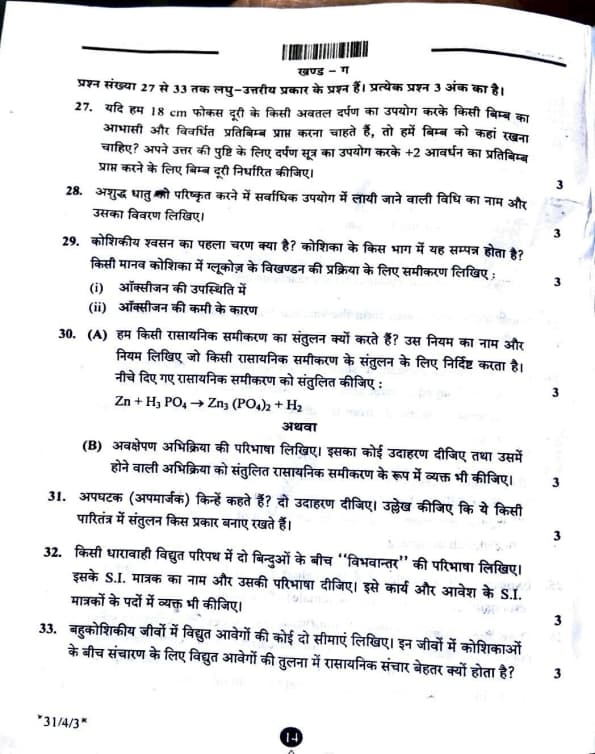
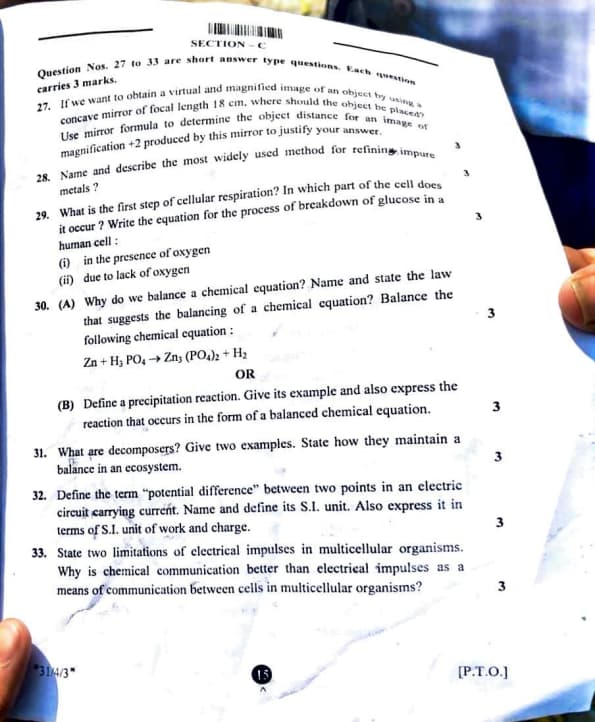
If we want to obtain a virtual and magnified image of an object by using a concave mirror of focal length 18 cm, where should the object be placed? Use mirror formula to determine the object distance for an image of magnification +2 produced by this mirror to justify your answer.
View Solution
Name and describe the most widely used method for refining impure metals?
View Solution
The most widely used method for refining impure metals is electrolytic refining.
Description of Electrolytic Refining:
Electrolytic refining is a process used to obtain high-purity metals from impure metals. It is based on the principle of electrolysis.
Setup:
Anode: A thick block of the impure metal is made the anode.
Cathode: A thin strip of pure metal is made the cathode.
Electrolyte: A solution of a soluble salt of the metal being refined is used as the electrolyte.
Process:
When an electric current is passed through the electrolytic solution:
At the anode (impure metal), metal atoms from the impure block lose electrons (oxidize) and go into the electrolyte solution as positive ions.
Example: \(M(impure) \rightarrow M^{n+}(aq) + ne^-\)
These metal ions (\(M^{n+}\)) from the electrolyte move towards the cathode (pure metal strip).
At the cathode, the metal ions gain electrons (reduce) and get deposited as pure metal on the cathode.
Example: \(M^{n+}(aq) + ne^- \rightarrow M(pure)\)
Impurities:
Soluble impurities from the anode dissolve in the electrolyte.
Insoluble impurities from the anode settle down below the anode as anode mud or anode slime. These often contain valuable metals like gold, silver, platinum.
This method is very effective for refining metals like copper, zinc, tin, nickel, silver, gold, etc., to a high degree of purity. \[ \begin{tabular}{p{\linewidth}} \textbf{Electrolytic Refining Process:}
Anode (Impure): M → M\(^{n+}\) + ne\(^-\) (Oxidation)
Cathode (Pure): M\(^{n+}\) + ne\(^-\) → M (Reduction)
\textbf{Impurity Fate:}
• Soluble: Remain in electrolyte
• Insoluble: Anode mud (Au, Ag, Pt in Cu refining)
\end{tabular} \] Quick Tip: \textbf{Quick Tip:} Remember \textbf{OIL RIG}: Oxidation Is Loss (of electrons), Reduction Is Gain (of electrons). Or \textbf{LEO says GER}: Loss of Electrons is Oxidation, Gain of Electrons is Reduction. In electrolytic refining: Anode = Impure metal (gets thinner), Cathode = Pure metal (gets thicker). Anode mud can be a valuable byproduct.
What is the first step of cellular respiration? In which part of the cell does it occur ? Write the equation for the process of breakdown of glucose in a human cell :
(i) in the presence of oxygen
(ii) due to lack of oxygen
View Solution
The first step of cellular respiration is Glycolysis.
It occurs in the cytoplasm of the cell.
Equation for the process of breakdown of glucose in a human cell:
(i) In the presence of oxygen (Aerobic Respiration):
Glucose (C\(_6\)H\(_{12}\)O\(_6\)) is first broken down into pyruvate through glycolysis in the cytoplasm. Then, in the presence of oxygen, pyruvate enters the mitochondria and is completely oxidized.
The overall equation for aerobic respiration is: \[ C_6H_{12}O_6 (Glucose) + 6O_2 (Oxygen) \xrightarrow{In mitochondria} 6CO_2 (Carbon dioxide) + 6H_2O (Water) + Energy (ATP) \]
More detailed steps:
Glycolysis (in cytoplasm): Glucose \(\rightarrow\) 2 Pyruvate + Energy (ATP, NADH)
Link reaction & Krebs Cycle (in mitochondria): Pyruvate \(\rightarrow\) Acetyl-CoA \(\rightarrow\) CO\(_2\) + Energy (ATP, NADH, FADH\(_2\))
Oxidative Phosphorylation (in mitochondria): Uses O\(_2\) to produce a large amount of ATP.
(ii) Due to lack of oxygen (Anaerobic Respiration in human muscle cells - Lactic Acid Fermentation):
When there is a lack of oxygen, such as during strenuous exercise, human muscle cells undergo anaerobic respiration. Pyruvate formed during glycolysis is converted into lactic acid.
Equation: \[ C_6H_{12}O_6 (Glucose) \xrightarrow{Glycolysis in cytoplasm} 2 Pyruvate \xrightarrow{Lack of O_2 in cytoplasm} 2 Lactic Acid + Small amount of Energy (ATP) \]
Specifically for the conversion of pyruvate: \[ Pyruvic acid \xrightarrow{Lack of O_2} Lactic acid + Energy \]
The overall from glucose would be: \[ C_6H_{12}O_6 (Glucose) \xrightarrow{In cytoplasm, lack of O_2} 2C_3H_6O_3 (Lactic Acid) + Energy (2 ATP) \] \[ \begin{tabular}{p{\linewidth}} \textbf{1. Glycolysis:} Cytoplasmic glucose breakdown
\textbf{2. Aerobic:} C\(_6\)H\(_{12}\)O\(_6\) + 6O\(_2\) \(\rightarrow\) 6CO\(_2\) + 6H\(_2\)O + ATP
\textbf{3. Anaerobic:} C\(_6\)H\(_{12}\)O\(_6\) \(\rightarrow\) 2C\(_3\)H\(_6\)O\(_3\) (lactate) + 2ATP
\end{tabular} \] Quick Tip: \textbf{Quick Tip:} Glycolysis is common to both aerobic and anaerobic respiration. Aerobic respiration yields significantly more ATP than anaerobic respiration. Anaerobic respiration in human muscles produces lactic acid, which can cause muscle fatigue.
(A) Why do we balance a chemical equation? Name and state the law that suggests the balancing of a chemical equation? Balance the following chemical equation : \[ Zn + H_3PO_4 \rightarrow Zn_3(PO_4)_2 + H_2 \]
View Solution
Question 30:
(B) Define a precipitation reaction. Give its example and also express the reaction that occurs in the form of a balanced chemical equation.
View Solution
What are decomposers? Give two examples. State how they maintain a balance in an ecosystem.
View Solution
Define the term "potential difference" between two points in an electric circuit carrying current. Name and define its S.I. unit. Also express it in terms of S.I. unit of work and charge.
View Solution
Definition of Potential Difference:
Potential difference (V) between two points in an electric circuit carrying current is defined as the work done (W) to move a unit positive charge (q) from one point to the other.
Mathematically, \(V = \frac{W}{q}\).
S.I. Unit of Potential Difference:
The S.I. unit of potential difference is the Volt (symbol: V).
Definition of Volt:
One volt is defined as the potential difference between two points in a current-carrying conductor when 1 joule of work is done to move a charge of 1 coulomb from one point to the other.
So, \(1 Volt = \frac{1 Joule}{1 Coulomb}\) or \(1 V = 1 J/C\).
Expression in terms of S.I. unit of work and charge:
As per the definition, potential difference (V) is work done (W) per unit charge (q).
The S.I. unit of work is the Joule (J).
The S.I. unit of charge is the Coulomb (C).
Therefore, the S.I. unit of potential difference (Volt) can be expressed as: \[ Volt (V) = \frac{Joule (J)}{Coulomb (C)} \] \[ [\(\bullet\)] \textbf{Definition:} Work done per unit charge [\(\bullet\)] \textbf{Mathematical Form:} \(\Delta V = \frac{W}{q}\) [\(\bullet\)] \textbf{S.I. Unit:} Volt (V) [\(\bullet\)] \textbf{Dimensional Formula:} [ML\(^2\)T\(^{-3}\)I\(^{-1}\)] [\(\bullet\)] \textbf{Base Unit Equivalence:} 1 V = 1 J/C \] Quick Tip: \textbf{Quick Tip:} Potential difference is also known as voltage. It is the "electrical pressure" or "force" that causes current to flow. Remember the relationship: \(V = W/q\).
State two limitations of electrical impulses in multicellular organisms. Why is chemical communication better than electrical impulses as a means of communication between cells in multicellular organisms?
View Solution
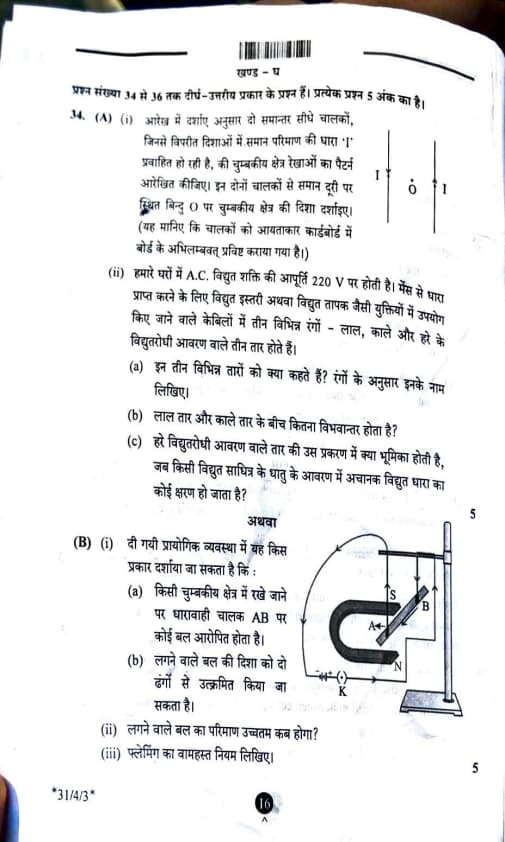
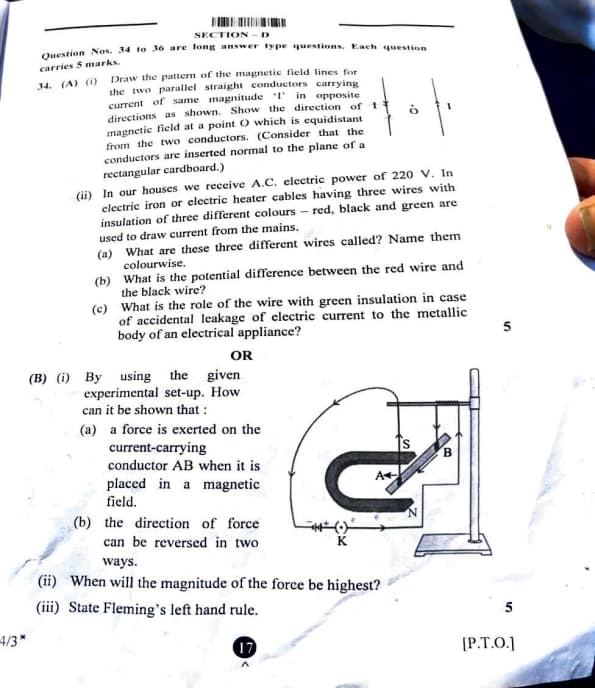
(A) (i) Draw the pattern of the magnetic field lines for the two parallel straight conductors carrying current of same magnitude 'I' in opposite directions as shown. Show the direction of magnetic field at a point O which is equidistant from the two conductors. (Consider that the conductors are inserted normal to the plane of a rectangular cardboard.)
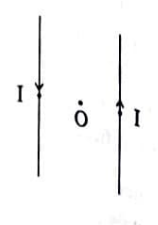
View Solution
(A)(ii) In our houses we receive A.C. electric power of 220 V. In electric iron or electric heater cables having three wires with insulation of three different colours – red, black and green are used to draw current from the mains.
(a) What are these three different wires called? Name them colourwise.
(b) What is the potential difference between the red wire and the black wire?
(c) What is the role of the wire with green insulation in case of accidental leakage of electric current to the metallic body of an electrical appliance?
View Solution
Question 34:
(B) (i) By using the given experimental set-up. How can it be shown that :
% Image placeholder for experimental setup for 34(B)

The figure shows a horseshoe magnet with North (N) and South (S) poles. A conductor AB is suspended horizontally between the poles, connected to a battery via a key K.
(a) a force is exerted on the current-carrying conductor AB when it is placed in a magnetic field.
(b) the direction of force can be reversed in two ways.
(ii) When will the magnitude of the force be highest?
(iii) State Fleming's left hand rule.
View Solution
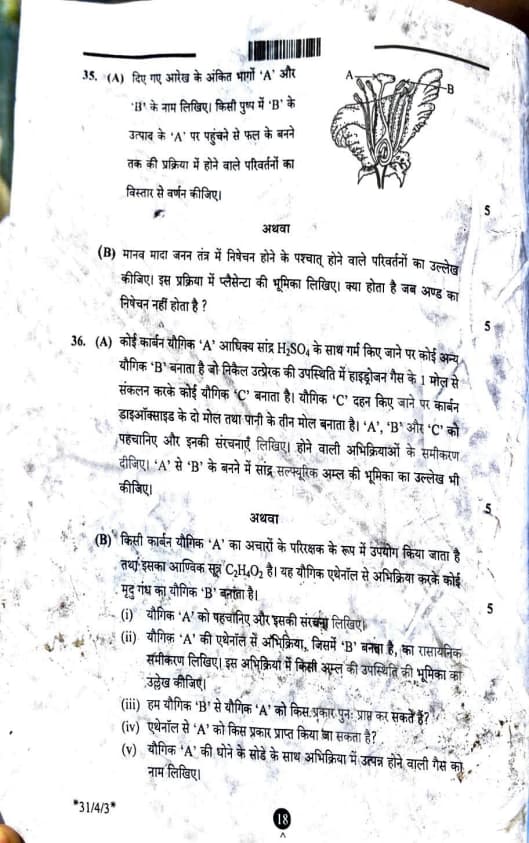
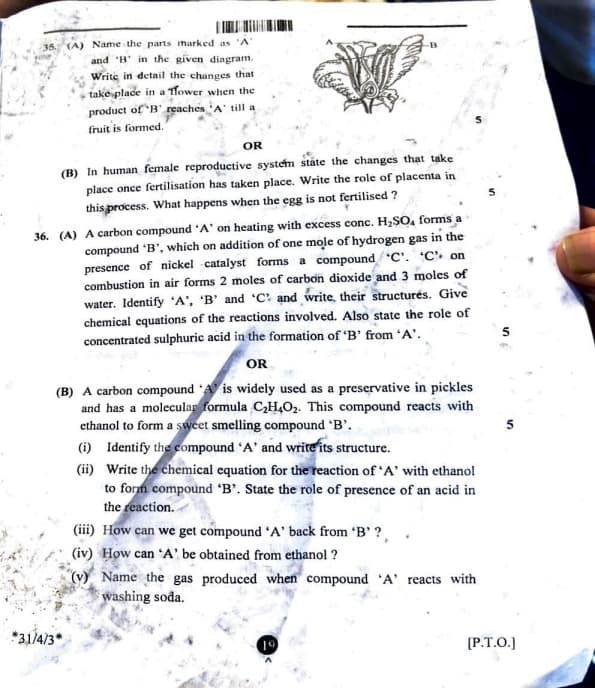
(A) Name the parts marked as 'A' and 'B' in the given diagram. Write in detail the changes that take place in a flower when the product of 'B' reaches 'A' till a fruit is formed.

View Solution
N/A
Question 35:
(B) In human female reproductive system state the changes that take place once fertilisation has taken place. Write the role of placenta in this process. What happens when the egg is not fertilised ?
View Solution
N/A Quick Tip: \textbf{Quick Tip:} For 35(A): Pollination \(\rightarrow\) Fertilization \(\rightarrow\) Ovule to Seed \(\rightarrow\) Ovary to Fruit. For 35(B): Placenta is the lifeline between mother and fetus. If no fertilization, the uterine lining sheds (menstruation).
(A) A carbon compound 'A' on heating with excess conc. H\(_2\)SO\(_4\) forms a compound 'B', which on addition of one mole of hydrogen gas in the presence of nickel catalyst forms a compound 'C'. 'C'. on combustion in air forms 2 moles of carbon dioxide and 3 moles of water. Identify 'A', 'B' and 'C' and write their structures. Give chemical equations of the reactions involved. Also state the role of concentrated sulphuric acid in the formation of 'B' from 'A'.
View Solution
N/A
Question 36:
(B) A carbon compound 'A' is widely used as a preservative in pickles and has a molecular formula C\(_2\)H\(_4\)O\(_2\). This compound reacts with ethanol to form a sweet smelling compound 'B'.
(i) Identify the compound 'A' and write its structure.
(ii) Write the chemical equation for the reaction of 'A' with ethanol to form compound 'B'. State the role of presence of an acid in the reaction.
(iii) How can we get compound 'A' back from 'B' ?
(iv) How can 'A' be obtained from ethanol ?
(v) Name the gas produced when compound 'A' reacts with washing soda.
View Solution
N/A Quick Tip: \textbf{Quick Tip:} For 36(A): Work backwards from combustion products. Dehydration of alcohols gives alkenes. Hydrogenation of alkenes gives alkanes. For 36(B): Ethanoic acid is C\(_2\)H\(_4\)O\(_2\). Esterification: Acid + Alcohol \(\rightleftharpoons\) Ester + Water. Hydrolysis is the reverse. Acids react with carbonates to give CO\(_2\).
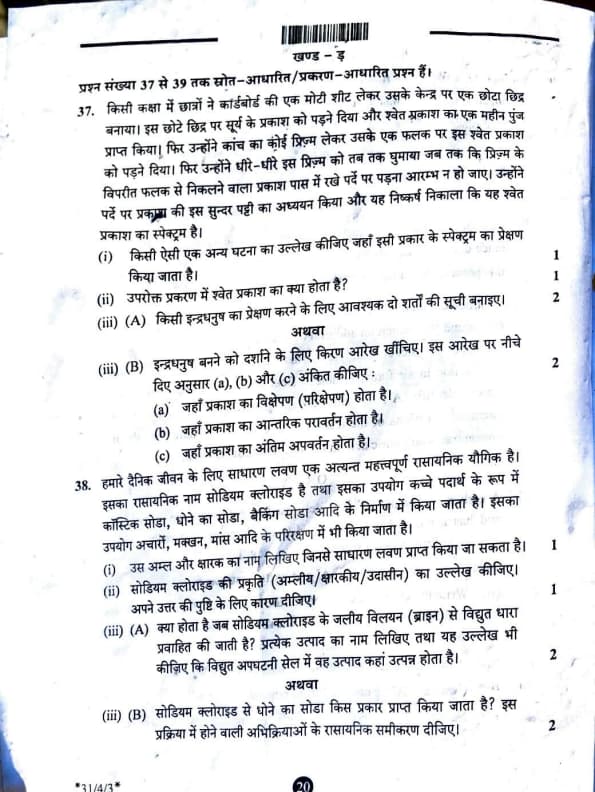
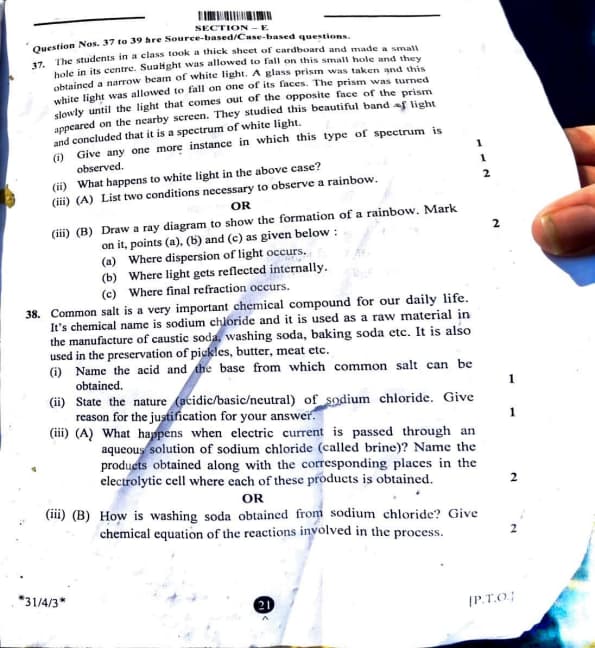
The students in a class took a thick sheet of cardboard and made a small hole in its centre. Sunlight was allowed to fall on this small hole and they obtained a narrow beam of white light. A glass prism was taken and this white light was allowed to fall on one of its faces. The prism was turned slowly until the light that comes out of the opposite face of the prism appeared on the nearby screen. They studied this beautiful band of light and concluded that it is a spectrum of white light.
(i) Give any one more instance in which this type of spectrum is observed.
(ii) What happens to white light in the above case?
(iii) (A) List two conditions necessary to observe a rainbow.
OR
(iii) (B) Draw a ray diagram to show the formation of a rainbow. Mark on it, points (a), (b) and (c) as given below :
(a) Where dispersion of light occurs.
(b) Where light gets reflected internally.
(c) Where final refraction occurs.
View Solution
Common salt is a very important chemical compound for our daily life. It's chemical name is sodium chloride and it is used as a raw material in the manufacture of caustic soda, washing soda, baking soda etc. It is also used in the preservation of pickles, butter, meat etc.
(i) Name the acid and the base from which common salt can be obtained.
(ii) State the nature (acidic/basic/neutral) of sodium chloride. Give reason for the justification for your answer.]
(iii) (A) What happens when electric current is passed through an aqueous solution of sodium chloride (called brine)? Name the products obtained along with the corresponding places in the electrolytic cell where each of these products is obtained.
OR
(iii) (B) How is washing soda obtained from sodium chloride? Give chemical equation of the reactions involved in the process.
View Solution
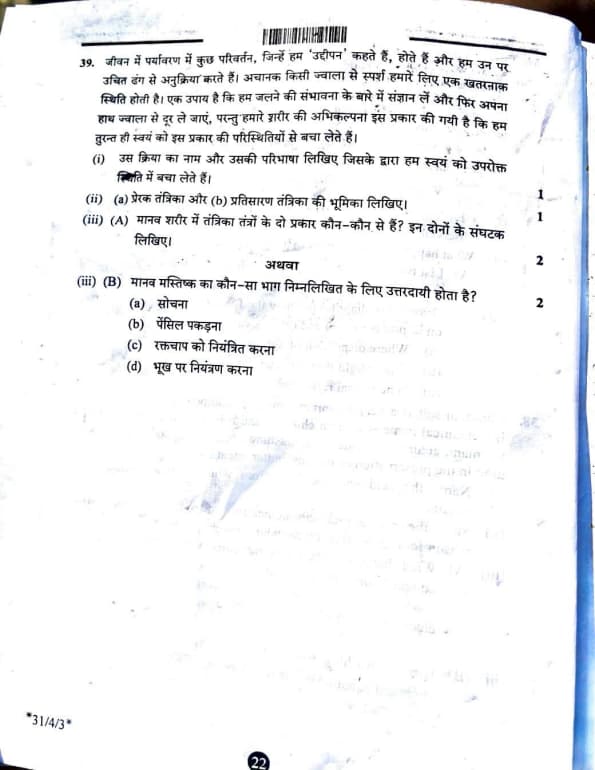
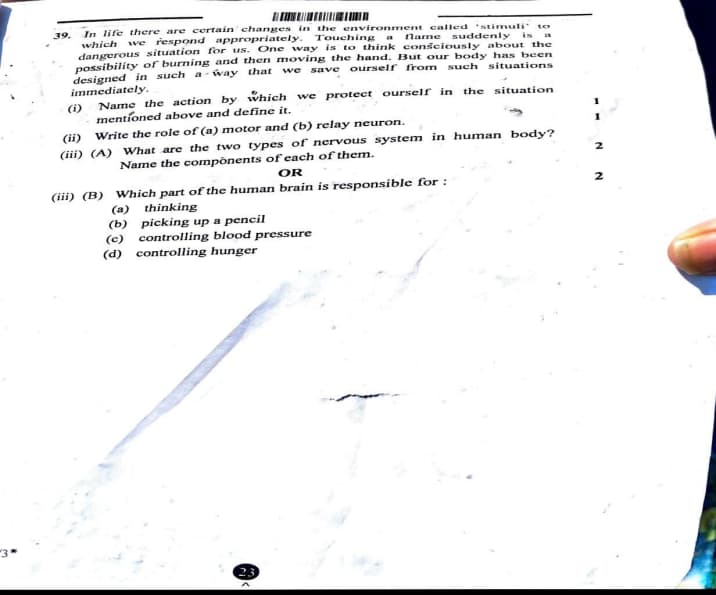
In life there are certain changes in the environment called 'stimuli' to which we respond appropriately. Touching a flame suddenly is a dangerous situation for us. One way is to think consciously about the possibility of burning and then moving the hand. But our body has been designed in such a way that we save ourself from such situations immediately.
(i) Name the action by which we protect ourself in the situation mentioned above and define it.
(ii) Write the role of (a) motor and (b) relay neuron.
(iii) (A) What are the two types of nervous system in human body? Name the components of each of them.
OR
(iii) (B) Which part of the human brain is responsible for :
(a) thinking
(b) picking up a pencil
(c) controlling blood pressure
(d) controlling hunger Correct Answer:



Comments