




CBSE Class 10 Social Science Question Paper 2024 PDF (Set 1 - 32/1/1) is available for download here. CBSE conducted the Social Science exam on March 7, 2024, from 10:30 AM to 1:30 PM. The total marks for the theory paper are 80. The question paper contains 20% MCQ-based questions, 40% competency-based questions, and 40% short and long answer type questions. As per the students, the overall difficulty level of the exam was easy to moderate.
CBSE Class 10 Social Science Question Paper 2024 (Set 1 - 32/1/1) with Answer Key
| CBSE Class 10 Social Science Question Paper 2024 (Set 1 - 32/1/1) with Answer Key |  Download Download |
Check Solutions |
CBSE Social Science Question Paper (Set 1 – 32/1/1) 2024 Solution
| Question | Answer | Detailed Solution |
|---|---|---|
| 1. From which of the following countries did Giuseppe Garibaldi belong to? (a) Austria (b) Italy (c) Greece (d) Spain |
(b) Italy | Giuseppe Garibaldi was a pivotal figure in the unification of Italy. Known as the "Hero of Two Worlds," he played a crucial role in Italy’s Risorgimento through campaigns such as the Expedition of the Thousand. |
| 2. Two statements are given below. They are Assertion (A) and Reason (R). Choose the correct option: Assertion (A): The most serious source of nationalist tension in Europe after 1871 was the Balkans. Reason (R): A large part of the Balkans was under the control of the Ottoman Empire. (a) Both (A) and (R) are true and (R) is the correct explanation of (A). (b) Both (A) and (R) are true but (R) is not the correct explanation of (A). (c) (A) is true but (R) is false. (d) (A) is false but (R) is true. |
(a) Both (A) and (R) are true and (R) is the correct explanation of (A). | After 1871, the Balkans became a hotspot for nationalist tensions due to their ethnic diversity and the weakening Ottoman Empire. Competing national ambitions and external interventions made the region highly volatile. |
| 3. Arrange the following events in chronological order: I. Treaty of Constantinople II. Defeat of Napoleon III. Unification of Italy IV. Unification of Germany (a) I, II, IV, III (b) II, I, III, IV (c) II, IV, I, III (d) IV, I, III, II |
(b) II, I, III, IV | The correct order is: II. Defeat of Napoleon (1815) I. Treaty of Constantinople (1832) III. Unification of Italy (1861) IV. Unification of Germany (1871). |
| 4. Which one of the following pairs regarding Indian nationalism is correctly matched? (a) Sardar Patel - Hindustan Socialist Republican Army (b) Bhagat Singh - Swaraj Party (c) C.R. Das - Bardoli Satyagraha (d) Jawahar Lal Nehru - Oudh Kisan Sabha |
(d) Jawahar Lal Nehru - Oudh Kisan Sabha | Jawahar Lal Nehru was actively involved in grassroots movements such as the Oudh Kisan Sabha, advocating for peasant rights and mobilizing them against oppressive practices. |
| 5. Choose the correctly matched pair: (a) Ferrous - Natural Gas (b) Non-Ferrous - Nickel (c) Non-Metallic Minerals - Limestone (d) Energy Minerals - Cobalt |
(c) Non-Metallic Minerals - Limestone | Limestone is a non-metallic mineral widely used in construction and cement production. The other options are incorrectly matched with their categories. |
| 6. Choose the correct statements with regard to Rabi cropping season: I. Rabi crops are sown in winter. II. Sown from October to December and harvested from April to June. III. Important crops are Maize, Cotton, Jute. IV. Punjab, Haryana, Uttar Pradesh are important for wheat production. (a) I, III, IV (b) II, III, IV (c) I, II, IV (d) I, II, III |
(c) I, II, IV | Maize, Cotton, and Jute are Kharif crops. Rabi crops like wheat are sown in winter and harvested in summer, with Punjab, Haryana, and Uttar Pradesh being significant producers. |
| 7. Identify the soil with the help of the following information: • It develops in areas with high temperature. • It is the result of intense leaching due to heavy rain. • Humus content is low. Soil: (a) Arid soil (b) Yellow soil (c) Laterite soil (d) Black soil |
(c) Laterite soil | Laterite soil is typical in regions with high temperatures and heavy rainfall, leading to leaching of nutrients and low humus content. |
| 8. Which of the following terms refers to the belief in and advocacy for the social, political, and economic equality of women? (a) Patriarchy (b) Matriarchy (c) Socialist (d) Feminists |
(d) Feminists | Feminists advocate for gender equality, challenging societal norms like patriarchy and striving for equal opportunities for women in all areas. |
| 9. Read the given statements and choose the correct option: • India has no official religion. • All communities have freedom to profess and practice any religion in India. Which one of the following constitutional terms is used for the above statements? (a) Republic (b) Secular (c) Sovereign (d) Socialist |
(b) Secular | "Secular" in the Indian Constitution signifies the state’s neutrality towards all religions, ensuring freedom of practice and equality for all communities. |
| 10. Match the items in Column I with those in Column II and choose the correct option: Column I (List) | Column II (Jurisdiction Sphere) I. Union list subjects A. State Governments alone make laws on it. II. State list subjects B. For uniformity, Central Government legislates on it. III. Concurrent subjects C. Subjects under the jurisdiction of both Centre and State Governments. IV. Residuary subjects D. Central Government legislates on new subjects. (a) A, B, C, D (b) C, D, A, B (c) D, C, B, A (d) B, A, C, D |
(d) B, A, C, D | Correct Matching: I. Union list subjects - Central Government legislates for uniformity. II. State list subjects - State Governments legislate on local matters. III. Concurrent subjects - Shared by Centre and States. IV. Residuary subjects - Central Government legislates on new subjects. |
| 11. Which of the following was the primary objective of Belgium to form the separate government in Brussels? (a) Promoting cultural events (b) Managing international relations (c) Enforcing local laws (d) Ensuring linguistic accommodation |
(d) Ensuring linguistic accommodation | The government in Brussels was created to balance the linguistic needs of French and Dutch-speaking communities, ensuring harmony and preventing conflicts in the bilingual region. |
| 12. Which one of the following countries has a two-party system? (a) China (b) United Kingdom (c) India (d) Pakistan |
(b) United Kingdom | The United Kingdom operates a two-party system dominated by the Conservative Party and the Labour Party, although smaller parties exist. |
| 13. What role do "checks and balances" play in a democratic country? (a) To establish a direct form of government without representatives. (b) To create a separation of powers to prevent authoritarianism. (c) To prevent any change to the Constitution. (d) To ensure absolute power for one branch of government. |
(b) To create a separation of powers to prevent authoritarianism | Checks and balances ensure no single branch of government becomes too powerful by distributing power among the executive, legislative, and judicial branches. |
| 14. Suppose the monthly income of the family members is as follows: Mother - Rs. 50,000 Father - Rs. 40,000 Son - Rs. 20,000 Daughter - Rs. 20,000 The average income of the family would be: (a) Rs. 32,000 (b) Rs. 30,000 (c) Rs. 32,500 (d) Rs. 33,000 |
(c) Rs. 32,500 | The total income is Rs. 1,30,000 (50,000 + 40,000 + 20,000 + 20,000). Dividing by 4 family members gives an average income of Rs. 32,500. |
| 15. Which one of the following indices is given priority by the World Bank with respect to development? (a) Infant Mortality Rate (b) Equality (c) Body Mass Index (d) Per Capita Income |
(d) Per Capita Income | The World Bank prioritizes Per Capita Income as an indicator of development, categorizing countries into low, middle, or high-income economies. |
| 16. Removing barriers or restrictions on business and trade set by the government is called: (a) Disinvestment (b) Special Economic Zones (c) Liberalisation (d) Foreign Direct Investment |
(c) Liberalisation | Liberalisation refers to the removal of restrictions on trade and business to encourage private enterprise and foreign investments, promoting economic growth. |
| 17. Which one of the following is an example of organized sector activities? (a) A farmer irrigating his field (b) A handloom weaver working in her house (c) A headload worker carrying cement (d) A teacher taking classes in a government school |
(d) A teacher taking classes in a government school | The organized sector provides regular wages, job security, and legal protections. A government school teacher fits this category, unlike the other options, which belong to the unorganized sector. |
| 18. Which of the following are developmental goals of a prosperous farmer? 1. Better wages 2. Higher support prices for crops 3. Assured high family income 4. More days for work (a) Only I and II are correct (b) Only I and IV are correct (c) Only II and III are correct (d) Only I and IV are correct |
(c) Only II and III are correct | A prosperous farmer’s developmental goals include higher support prices for crops and assured high family income. The other options are more relevant to laborers or marginal farmers. |
| 19. Why do lenders often require collateral before lending a loan? (a) To lower interest rates for borrowers (b) To establish personal relations (c) To increase their profit margins (d) To mitigate the risk of loan default |
(d) To mitigate the risk of loan default | Collateral serves as a security measure for lenders, ensuring that their financial risk is minimized in case the borrower defaults on the loan repayment. |
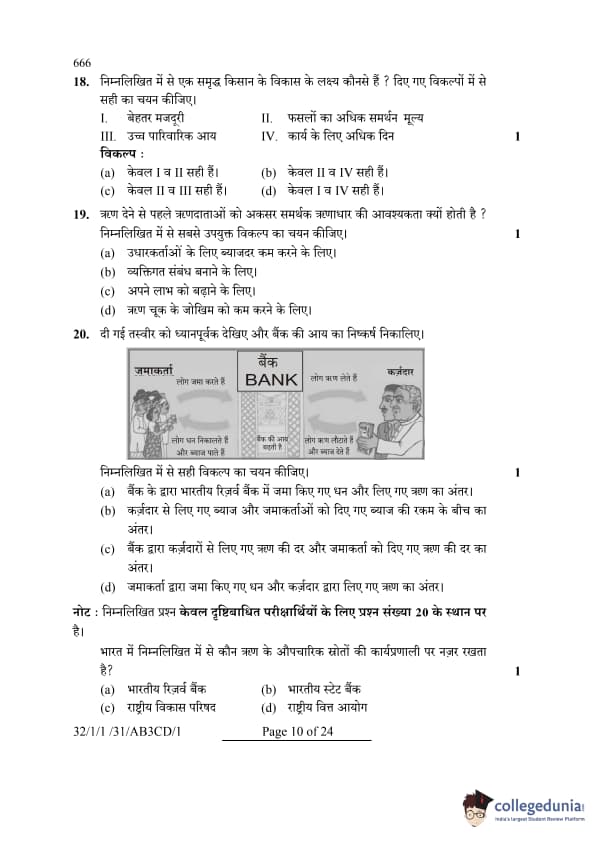
| 20. Look at the given picture carefully and infer the income of the bank: (a) The difference between the amount deposited and borrowed by the bank to Reserve Bank of India. (b) The difference of amount of interest between what is charged from borrowers and what is paid to depositors. (c) The difference of interest rate between what is charged from borrowers and what is charged from depositors. (d) The difference between the amount deposited by the depositor and borrowed by the borrower. |
(b) The difference of amount of interest between what is charged from borrowers and what is paid to depositors. | The bank’s income is derived from the spread, which is the difference in interest rates charged to borrowers and paid to depositors, a key measure of profitability. |
| 21. “The Silk Route was a good example of vibrant pre-modern trade and cultural links between distant parts of the world.” Explain the statement with any two examples. | Trade and Cultural Exchange | The Silk Route connected Asia, Europe, and Africa, facilitating vibrant trade and cultural links: 1. Trade: Silk, spices, and textiles from Asia were transported to Europe, fostering economic interdependence. 2. Cultural Exchange: Religions like Buddhism spread from India to Central Asia and China through this route. |
| 22. (A) Suggest any two measures for the conservation of forests. | Afforestation and Strict Laws | 1. Promote afforestation by planting trees and restoring degraded forest lands. 2. Enforce strict laws to prevent illegal logging and encroachment on forest areas. |
| OR 22. (B) Suggest any two measures for the conservation of wildlife. | Wildlife Sanctuaries and Awareness | 1. Establish wildlife sanctuaries and national parks to protect species in their natural habitats. 2. Conduct awareness programs to educate people about the importance of wildlife conservation. |
| 23. Why is power sharing desirable? | Political Stability and Democracy | Power sharing reduces the possibility of conflicts between social groups, ensuring political stability. It promotes democracy by involving multiple stakeholders in decision-making processes. |
| 24. Differentiate between Public and Private Sector. | Ownership and Objective | Public Sector: - Owned and operated by the government. - Aims to provide essential services and welfare to the public. - Examples: Indian Railways, LIC. Private Sector: - Owned and operated by individuals or private companies. - Aims to earn profits by providing goods and services. - Examples: Reliance Industries, TCS. |
| 25. (A) Describe any three causes that led to the Non-Cooperation Movement. | Jallianwala Bagh, Rowlatt Act, and Khilafat Movement | 1. Jallianwala Bagh Massacre: The brutal killing of innocent people by British troops at Amritsar in 1919 fueled anger against colonial rule. 2. Rowlatt Act: The oppressive act allowed arrest without trial, sparking widespread protests. 3. Khilafat Movement: Gandhi’s support for the Khilafat Movement united Hindus and Muslims against British rule, leading to the Non-Cooperation Movement. |
| OR 25. (B) Describe any three causes of the Civil Disobedience Movement. | Salt Law, Economic Depression, and Simon Commission | 1. Salt Law: The British monopoly on salt and heavy taxes led to protests like the Dandi March. 2. Economic Depression: The global economic crisis worsened Indian farmers’ conditions due to falling agricultural prices. 3. Simon Commission: The all-white commission with no Indian representation was seen as an insult, sparking protests. |
| 26. ‘Manufacturing industries are considered the backbone of economic development.’ Justify the statement. | Employment, GDP Contribution, and Infrastructure | Manufacturing industries are the backbone of economic development due to the following reasons: 1. Employment Generation: They provide large-scale employment, especially in developing countries. 2. Contribution to GDP: Manufacturing industries significantly contribute to national income and export earnings. 3. Infrastructure Development: They drive the growth of infrastructure and technological advancements. |
| 27. Analyse the role of political parties in a democracy. | Representation, Policy Formation, and Accountability | Political parties play a crucial role in a democracy by: 1. Representation: They represent diverse opinions and ensure people’s participation in governance. 2. Policy Formation: Political parties formulate and implement policies to address societal needs. 3. Accountability: They keep the government accountable and provide voters with choices during elections. |
| 28. How is credit essential for economic activities? Explain with examples. | Investment, Consumption, and Growth | Credit is essential for economic activities in the following ways: 1. Facilitates Investment: Credit enables businesses to invest in equipment and expand operations. Example: Farmers use loans to buy seeds and fertilizers. 2. Promotes Consumption: It allows consumers to purchase goods and services, boosting demand. Example: Housing loans help individuals buy homes. 3. Supports Economic Growth: Credit fuels production and trade, creating a multiplier effect in the economy. |
| 29. How is the issue of sustainability important for development? Explain. | Preservation, Environmental Protection, and Growth | Sustainability is crucial for development due to the following reasons: 1. Preserving Resources: It ensures that resources are available for future generations. 2. Environmental Protection: Sustainability minimizes environmental degradation caused by overexploitation. 3. Long-term Growth: Sustainable practices maintain economic progress without compromising ecological balance. |
| 30. (A) How did the ideology of ‘liberalism’ affect Europe in the early nineteenth century? Explain. | Political, Economic, and Social Changes | The ideology of liberalism profoundly influenced Europe in the early 19th century: 1. Political Changes: Liberalism emphasized liberty, equality, and constitutional governance, inspiring revolutions like the 1830 and 1848 uprisings. 2. Economic Reforms: It supported free markets and the abolition of feudal restrictions, promoting industrial growth. 3. Nationalism: Liberalism inspired movements for unification in Italy and Germany, fostering national consciousness. 4. Individual Rights: It emphasized education, freedom of speech, and the rule of law, shaping democratic ideals. |
| OR 30. (B) Explain the process of formation of ‘United Kingdom of Great Britain’. | Union of England, Wales, Scotland, and Ireland | The United Kingdom of Great Britain was formed through a series of unions: 1. Union of England and Wales (1536): The Act of Union brought Wales under English rule. 2. Union with Scotland (1707): Scotland was integrated into England through the Act of Union. 3. Union with Ireland (1801): The Act of Union created the United Kingdom of Great Britain and Ireland. 4. Cultural and Economic Dominance: English culture and policies dominated the other regions, marginalizing local identities. |
| 30. (A) How did the ideology of ‘liberalism’ affect Europe in the early nineteenth century? Explain. | Political, Economic, and Social Changes | The ideology of liberalism had a profound impact on Europe in the early 19th century: 1. Political Changes: Advocated liberty, equality, and constitutional governance, inspiring revolutions like those in 1830 and 1848. 2. Economic Reforms: Promoted free markets and the abolition of feudal restrictions, aiding industrial growth. 3. Nationalism: Inspired movements for unification in Italy and Germany. 4. Social Reforms: Emphasized education, individual rights, and the rule of law, shaping democratic ideals. |
| 30. (B) Explain the process of formation of ‘United Kingdom of Great Britain’. | Union of England, Wales, Scotland, and Ireland | The United Kingdom of Great Britain was formed through a series of unions: 1. Union of England and Wales (1536): Brought Wales under English rule through the Act of Union. 2. Union with Scotland (1707): Integrated Scotland into England, creating Great Britain. 3. Union with Ireland (1801): Formed the United Kingdom of Great Britain and Ireland. 4. Cultural Dominance: English culture, language, and policies dominated the other regions, marginalizing local identities. |
| 31. (A) How is energy a basic requirement for economic development? Explain. | Industrial Growth, Infrastructure, and Quality of Life | Energy is essential for economic development because: 1. Industrial Growth: Powers industries, machinery, and production. 2. Transportation: Fuels systems for trade and connectivity. 3. Infrastructure Development: Supports hospitals, schools, and communication networks. 4. Quality of Life: Enhances housing, lighting, and cooking facilities. 5. Agricultural Advancements: Powers irrigation, mechanization, and food processing. |
| OR 31. (B) How are conventional sources of energy different from non-conventional sources? Explain. | Renewability, Pollution, and Usage | Conventional Sources: - Derived from fossil fuels like coal, petroleum, and natural gas. - Limited in supply and non-renewable. - Causes environmental pollution. - Examples: Coal, oil, natural gas. Non-Conventional Sources: - Includes renewable sources like solar, wind, and tidal energy. - Unlimited supply and eco-friendly. - Requires advanced technology for widespread use. - Examples: Solar energy, wind energy, hydropower. |
| 32. (A) How are democratic governments better than other forms of government? Explain. | Accountability, Representation, and Transparency | Democratic governments are better because: 1. Accountability: Leaders are accountable to the people through elections and public forums. 2. Representation: Ensures all sections of society are represented. 3. Transparency: Citizens are aware of decision-making processes. 4. Peaceful Conflict Resolution: Disputes are resolved through dialogue and negotiations. 5. Protection of Rights: Guarantees fundamental rights like freedom and equality. |
| OR 32. (B) How do democracies lead to peaceful and harmonious life among citizens? Explain. | Conflict Resolution and Inclusiveness | Democracies promote harmony by: 1. Conflict Resolution: Encouraging dialogue and negotiation to resolve disputes peacefully. 2. Equal Representation: Providing a voice to all groups, including minorities. 3. Rule of Law: Ensuring laws apply equally to everyone, fostering trust and stability. 4. Protection of Rights: Safeguarding fundamental rights like freedom and equality. 5. Political Participation: Citizens actively participate in governance through voting and discourse. |
| 33. (A) “Globalisation is the process of rapid integration or interconnection between countries.” Explain the statement with examples. | Trade, Culture, and Technology | Globalisation refers to increased integration between countries in trade, technology, and culture: 1. Trade: Companies like Apple and Nike operate globally, integrating supply chains. 2. Cultural Exchange: Spread of global food chains like McDonald’s. 3. Technology: Internet and e-commerce connect people worldwide. 4. Outsourcing: Developed countries outsource services to countries like India. 5. Institutions: WTO promotes global trade and economic integration. |
| OR 33. (B) ‘Improvement in technology has stimulated the globalisation process.’ Explain the statement with examples. | Transportation, Communication, and E-Commerce | Technological advancements have driven globalisation: 1. Transportation: Innovations in shipping and air travel reduced costs and enabled global trade. 2. Communication: Internet and mobile phones connect businesses and individuals globally. Example: Zoom enables international meetings. 3. E-Commerce: Platforms like Amazon and Alibaba facilitate global trade. 4. Media: Streaming platforms like Netflix promote cultural exchange. 5. Automation: Robotics and AI enable efficient global production. |
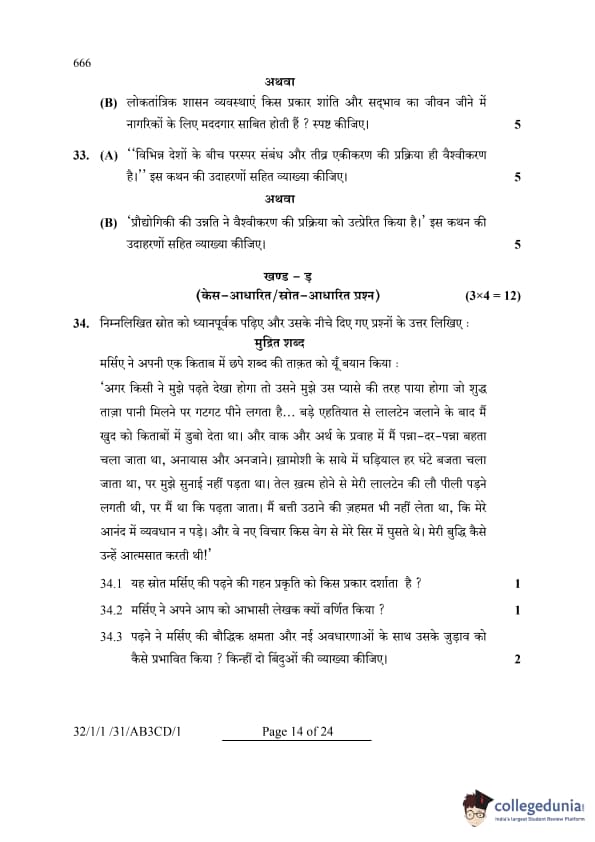
| 34.1 How does the passage reflect the immersive nature of reading of Mercier? | Immersive Reading | Mercier describes his reading experience as captivating and effortless, where he loses track of time and is completely absorbed in the act of reading. |
| 34.2. Why did Mercier describe himself as a virtual writer? | Transformative Power of Reading | Mercier described himself as a virtual writer because he felt deeply connected to the books he read, imagining and experiencing the content as if he were creating it. This reflects the transformative power of reading in shaping one’s thoughts and emotions. |
| 34.3. How did reading influence Mercier’s intellectual capacity and his engagement with new concepts? Explain in any two points. | Intellectual Growth and Critical Thinking | 1. Intellectual Growth: Reading exposed Mercier to diverse ideas and broadened his understanding of the world. 2. Critical Thinking: It encouraged him to engage deeply with evolving ideologies and question existing norms, fostering intellectual curiosity. |
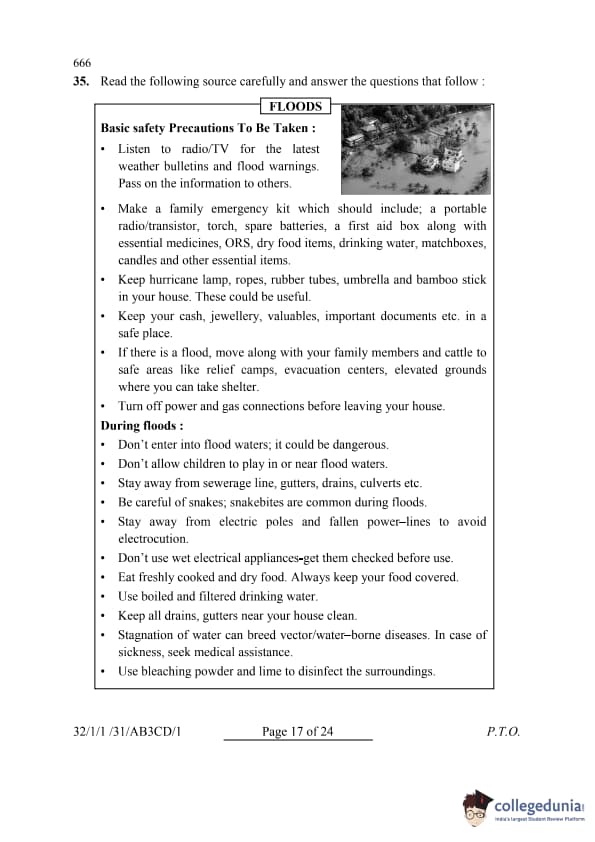
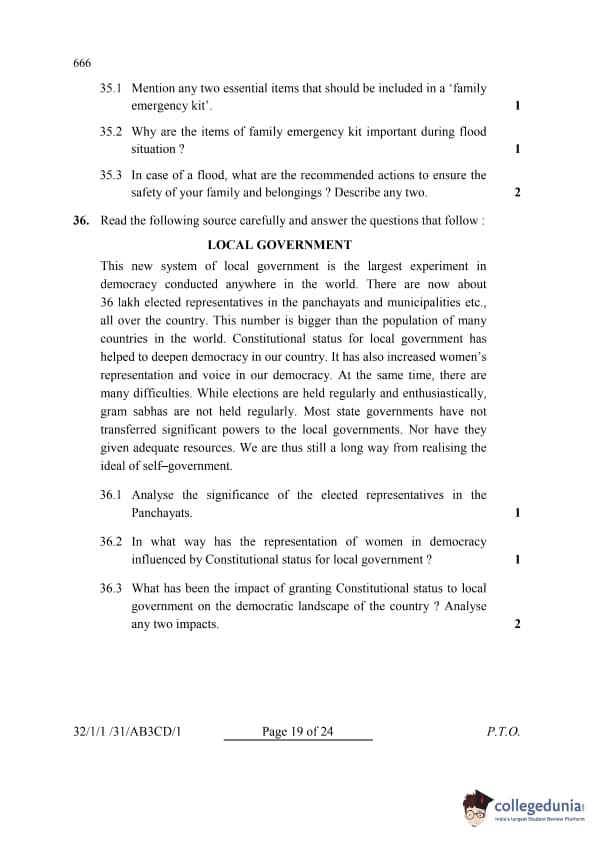
| 35.1 Mention any two essential items that should be included in a ‘family emergency kit’ during floods. | Radio and Food Supplies | 1. A portable radio to stay updated with flood warnings. 2. Dry food items and clean drinking water for survival during emergencies. |
| 35.2. Why are the items in a family emergency kit important during flood situations? | Survival and Communication | The items in a family emergency kit are vital for survival and communication during floods: 1. Portable radios provide updates on weather and evacuation instructions. 2. Dry food and clean water prevent hunger and dehydration, ensuring basic sustenance. |
| 35.3. In case of a flood, what are the recommended actions to ensure the safety of your family and belongings? Describe any two. | Evacuation and Precaution | 1. Evacuation: Move with family members to safe areas such as relief camps or elevated grounds. 2. Precaution: Turn off power and gas connections before leaving the house to avoid electrical or gas-related accidents. |
| 36.1 Analyse the significance of the elected representatives in the Panchayats. | Grassroots Governance | Elected representatives in Panchayats ensure: 1. Grassroots Governance: Direct decision-making at the local level to address specific regional issues. 2. Empowerment: Promotes participation of marginalized communities in governance. |
| 36.2 In what way has the representation of women in democracy been influenced by Constitutional status for local government? | Empowerment of Women | 1. Reservation of seats for women in Panchayats has provided a platform for women to actively participate in decision-making. 2. Promotes gender equality and empowers women in public and political life. |
| 36.3. What has been the impact of granting Constitutional status to local government on the democratic landscape of the country? Analyse any two impacts. | Decentralisation and Inclusiveness | 1. Decentralisation: Constitutional status has decentralized governance, ensuring decision-making at the local level and reducing dependency on higher authorities. 2. Inclusiveness: It has enabled marginalized groups, including Scheduled Castes, Scheduled Tribes, and women, to participate in governance, fostering inclusiveness and equality. |
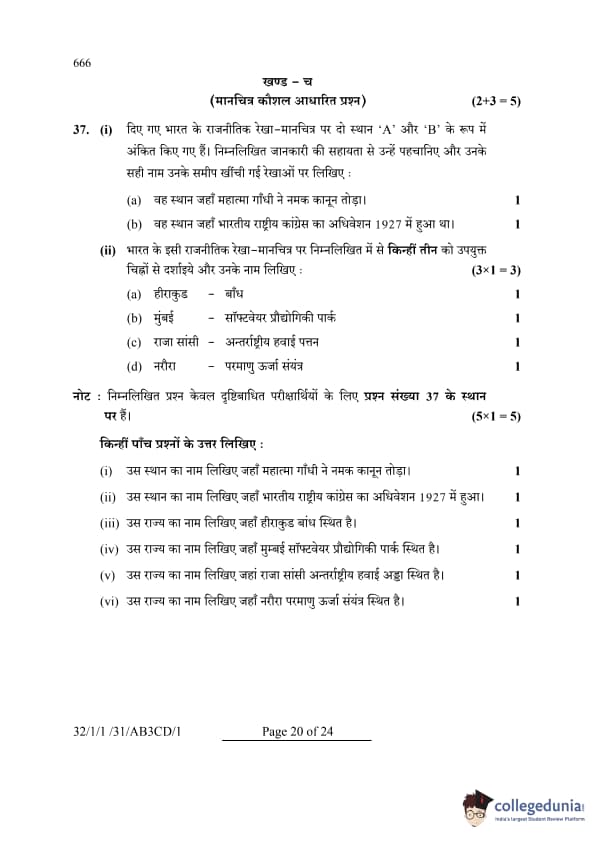
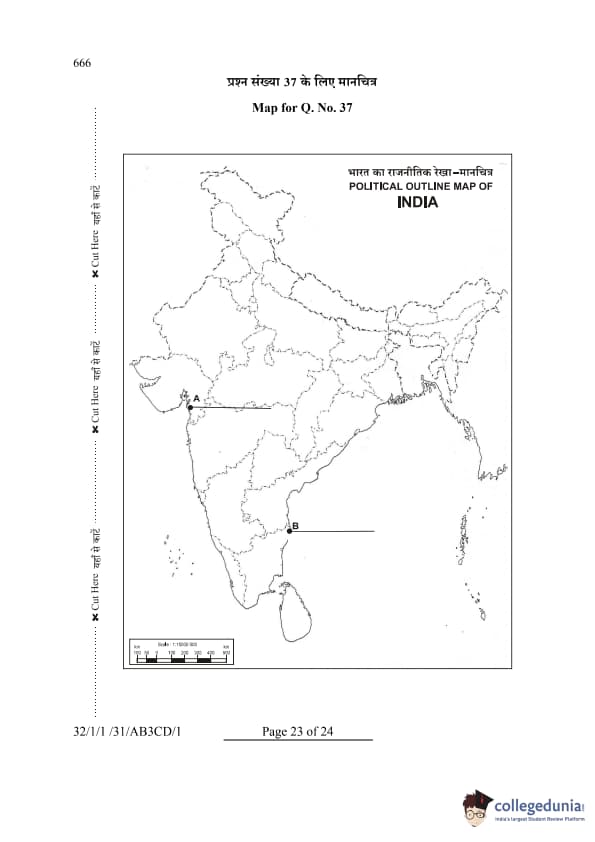
| 37. (i) Two places ‘A’ and ‘B’ have been marked on the given political outline map of India. Identify them with the following information: (a) The place where Mahatma Gandhi broke the salt law. (b) The place where a session of the Indian National Congress was held in 1927. |
(a) Dandi, (b) Madras | 1. Dandi: Where Gandhi broke the salt law during the Dandi March in 1930. 2. Madras: Hosted the session of the Indian National Congress in 1927. |
| 37. (ii) On the same political outline map of India, locate and label any three of the following: 1. Hirakud Dam 2. Mumbai Software Technology Park 3. Raja Sansi International Airport 4. Narora Nuclear Power Plant |
Hirakud, Mumbai, Narora | 1. Hirakud Dam: Located in Odisha. 2. Mumbai Software Technology Park: Located in Maharashtra. 3. Narora Nuclear Power Plant: Located in Uttar Pradesh. |














Comments