




CBSE Class 10 Social Science Question Paper 2024 PDF (Set 2 - 32/5/2) is available for download here. CBSE conducted the Social Science exam on March 7, 2024, from 10:30 AM to 1:30 PM. The total marks for the theory paper are 80. The question paper contains 20% MCQ-based questions, 40% competency-based questions, and 40% short and long answer type questions. As per the students, the exam difficulty level was easy to moderate.
CBSE Class 10 Social Science Question Paper 2024 (Set 2 - 32/5/2) with Answer Key
| CBSE Class 10 Social Science Question Paper 2024 (Set 2 - 32/5/2) with Answer Key |  Download Download |
Check Solution |
CBSE Social Science Question Paper (Set 2 – 32/5/2) 2024 Solution
| Question | Answer | Detailed Solution |
|---|---|---|
| 1. In which one of the following states is ‘bamboo drip irrigation system’ prevalent? (A) Tamil Nadu (B) West Bengal (C) Meghalaya (D) Odisha |
(C) Meghalaya | Meghalaya utilizes the bamboo drip irrigation system, a traditional and sustainable method for water management, particularly in plantation agriculture. |
| 2. Match Column I with Column II and choose the correct option: Column I (National Park) - Column II (State) i. Kaziranga - a. Madhya Pradesh ii. Jim Corbett - b. Assam iii. Sunderbans - c. Uttarakhand iv. Bandhavgarh - d. West Bengal (A) i-a, ii-b, iii-c, iv-d (B) i-d, ii-c, iii-b, iv-a (C) i-c, ii-b, iii-d, iv-a (D) i-b, ii-c, iii-d, iv-a |
(D) i-b, ii-c, iii-d, iv-a | Kaziranga is in Assam, Jim Corbett in Uttarakhand, Sunderbans in West Bengal, and Bandhavgarh in Madhya Pradesh. |
| 3. In the beginning of the 19th century, —— a girl married in a very orthodox household wrote an autobiography called ‘Amar Jiban’: (A) Pandita Ramabai (B) Rashsundari Devi (C) Tarabai Shinde (D) Kailashbashini Debi |
(B) Rashsundari Devi | Rashsundari Devi, a Bengali woman from an orthodox household, wrote her autobiography ‘Amar Jiban’ in the 19th century, considered one of the earliest examples of feminist literature in India. |
| 4. Arrange the following events in chronological order and choose the correct option: 1. Formation of Khilafat Committee in Bombay 2. Jallianwala Bagh Massacre 3. Bardoli Satyagraha 4. Withdrawal of Non-Cooperation Movement (A) I, II, III, IV (B) II, I, IV, III (C) I, II, IV, III (D) III, IV, II, I |
(C) I, II, IV, III | The chronological order is: - Formation of Khilafat Committee (1919). - Jallianwala Bagh Massacre (1919). - Withdrawal of Non-Cooperation Movement (1922). - Bardoli Satyagraha (1928). |
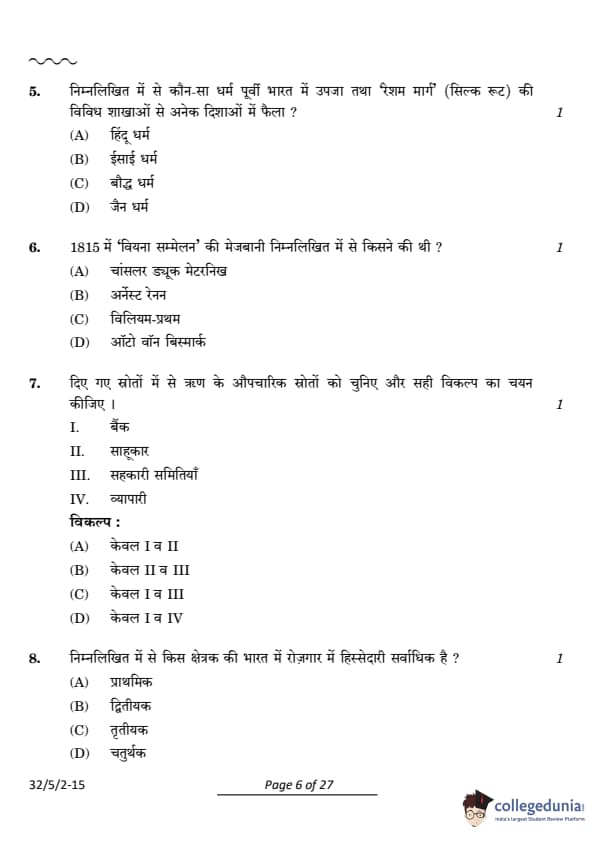
| 5. Which one of the following religions emerged from eastern India and spread in several directions through intersecting points on the ‘silk routes’? (A) Hinduism (B) Christianity (C) Buddhism (D) Jainism |
(C) Buddhism | Buddhism originated in eastern India and expanded to various regions of Asia, including China, Southeast Asia, and Central Asia, via the Silk Routes. |
| 6. Who among the following hosted the ‘Vienna Congress’ in 1815? (A) Chancellor Duke Metternich (B) Ernst Renan (C) William I (D) Otto von Bismarck |
(A) Chancellor Duke Metternich | Chancellor Duke Metternich of Austria hosted the Vienna Congress in 1815, aimed at reestablishing European stability and ensuring a balance of power after the Napoleonic Wars. |
| 7. Select the formal sources of credit from the given sources and choose the correct option: Sources: 1. Bank 2. Moneylender 3. Cooperatives 4. Businessman (A) Only I and II (B) Only II and III (C) Only I and III (D) Only I and IV |
(C) Only I and III | Formal sources of credit include institutions like banks and cooperatives, which operate under government regulations and provide loans at reasonable interest rates. |
| 8. Which one of the following sectors has the highest share in employment in India? (A) Primary (B) Secondary (C) Tertiary (D) Quaternary |
(A) Primary | The primary sector, including agriculture, employs the largest portion of India's workforce, reflecting the country’s agrarian economy. |
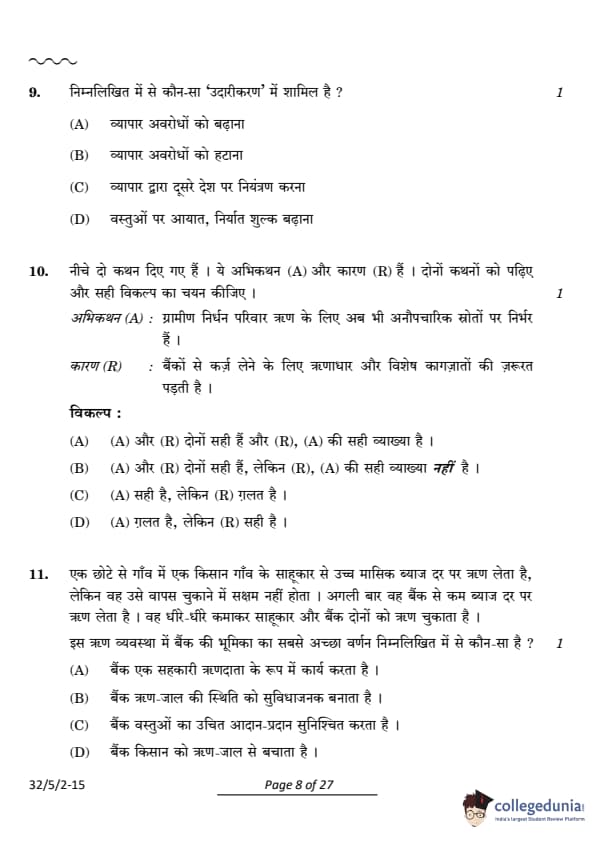
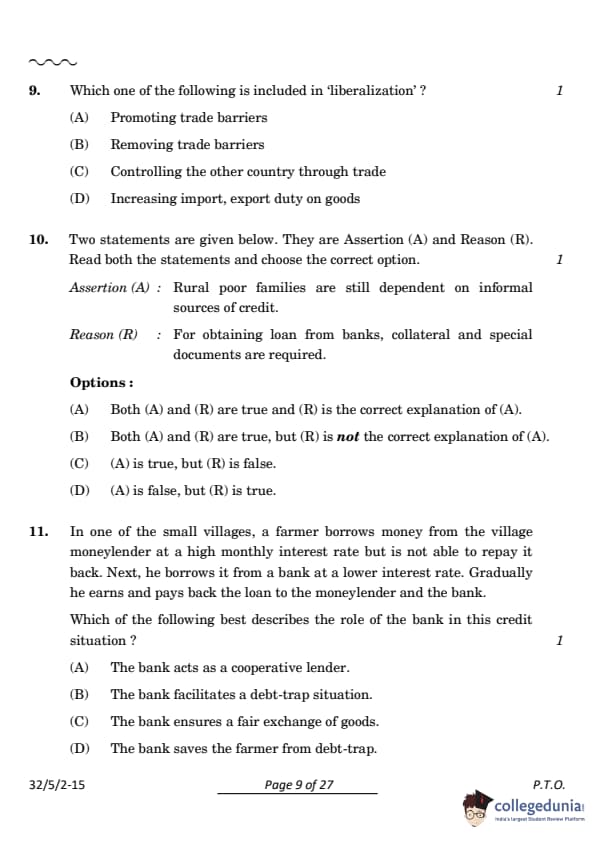
| 9. Which one of the following is included in ‘liberalization’? (A) Promoting trade barriers (B) Removing trade barriers (C) Controlling the other country through trade (D) Increasing import, export duties on goods |
(B) Removing trade barriers | Liberalization involves removing trade barriers to facilitate free trade between countries, promoting economic integration and competition. |
| 10. Two statements are given below: Assertion (A) and Reason (R). Select the correct option: Assertion (A): Rural poor families are still dependent on informal sources of credit. Reason (R): For obtaining loans from banks, collateral and special documents are required. (A) Both (A) and (R) are true, and (R) is the correct explanation of (A) (B) Both (A) and (R) are true, but (R) is not the correct explanation of (A) (C) (A) is true, but (R) is false (D) (A) is false, but (R) is true |
(A) Both (A) and (R) are true, and (R) is the correct explanation of (A) | Rural families rely on informal credit sources due to challenges like lack of collateral and documentation required for bank loans. |
| 11. In a small village, a farmer borrows money from a village moneylender at a high monthly interest rate but cannot repay it. Later, he borrows from a bank at a lower interest rate, gradually repays the moneylender and the bank. Which of the following best describes the role of the bank in this credit situation? (A) The bank acts as a cooperative lender. (B) The bank facilitates a debt-trap situation. (C) The bank ensures a fair exchange of goods. (D) The bank saves the farmer from debt-trap. |
(D) The bank saves the farmer from debt-trap | By providing credit at a lower interest rate, the bank enables the farmer to repay his debts and avoid the high-interest trap of the moneylender. This highlights the importance of formal credit systems in promoting financial security. |
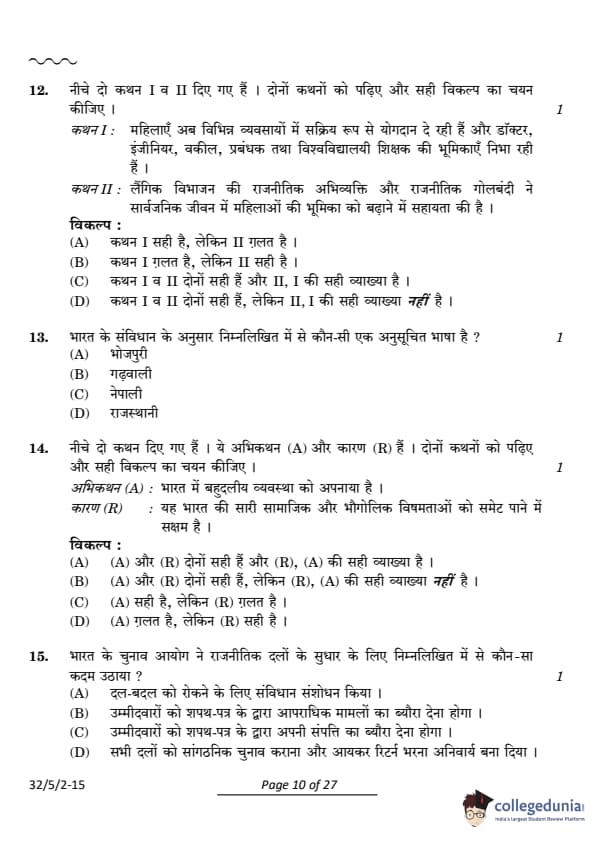
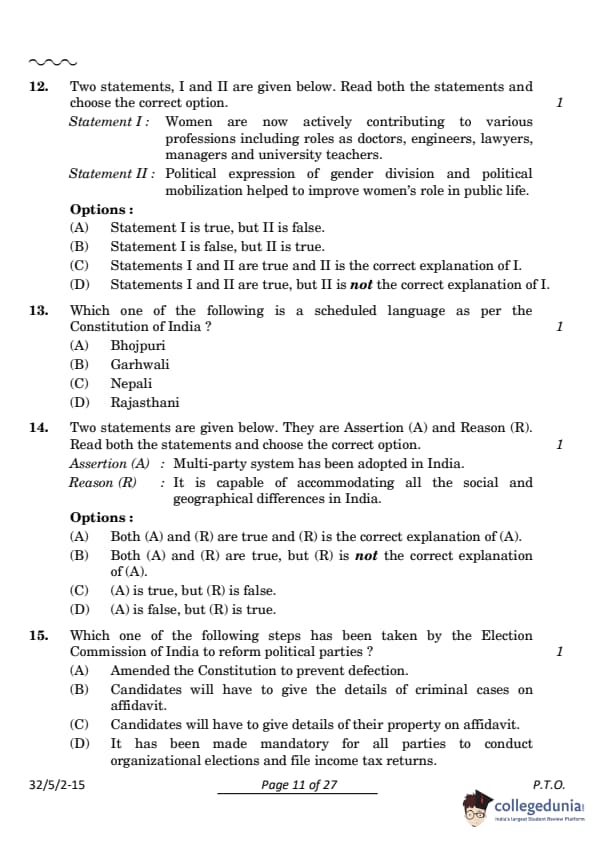
| 12. Two statements, I and II, are given below. Read both statements carefully and select the correct option: Statement I: Women are now actively contributing to various professions, including roles as doctors, engineers, lawyers, managers, and university teachers. Statement II: Political expression of gender division and political mobilization helped to improve women’s role in public life. (A) Statement I is true, but II is false. (B) Statement I is false, but II is true. (C) Statements I and II are true, and II is the correct explanation of I. (D) Statements I and II are true, but II is not the correct explanation of I. |
(C) Statements I and II are true, and II is the correct explanation of I | The increasing participation of women in professional fields has been significantly influenced by political mobilization and the expression of gender equality. These reforms have paved the way for broader opportunities in public life. |
| 13. Which of the following is listed as a scheduled language under the Constitution of India? (A) Bhojpuri (B) Garhwali (C) Nepali (D) Rajasthani |
(C) Nepali | Nepali is one of the 22 scheduled languages listed in the Eighth Schedule of the Constitution of India. However, Bhojpuri, Garhwali, and Rajasthani are not included in this list. |
| 14. Two statements are given below: Assertion (A) and Reason (R). Read both statements carefully and select the correct option: Assertion (A): India has adopted a multi-party system. Reason (R): It effectively accommodates the social and geographical diversity of the country. (A) Both (A) and (R) are true, and (R) is the correct explanation of (A). (B) Both (A) and (R) are true, but (R) is not the correct explanation of (A). (C) (A) is true, but (R) is false. (D) (A) is false, but (R) is true. |
(A) Both (A) and (R) are true, and (R) is the correct explanation of (A). | India’s diverse social and geographical landscape necessitates a multi-party system to ensure representation for various groups. This system effectively manages the diversity, fostering inclusivity and fairness. |
| 15. Which of the following reforms has the Election Commission of India implemented for political parties? (A) Amended the Constitution to prevent defection (B) Candidates must declare details of criminal cases on affidavit (C) Candidates must declare details of their property on affidavit (D) Mandated all political parties to conduct organizational elections and file income tax returns |
(D) Mandated all political parties to conduct organizational elections and file income tax returns | The Election Commission has taken significant steps to ensure transparency in political processes. By requiring political parties to conduct regular organizational elections and file their income tax returns, accountability and fairness are promoted within the political framework. |
| 16. Look at the given picture. The work being done in the picture comes under which one of the following economic sectors? (A) Primary (B) Secondary (C) Tertiary (D) Quaternary |
(C) Tertiary | The image depicts a profession providing services, which falls under the tertiary sector. This sector includes activities that offer services to individuals and businesses, such as healthcare, education, and retail. |
| 17. Read the following provisions regarding Secularism in the Indian Constitution and choose the correct option: Statement I: The Indian State has not adopted any religion as its official religion. Statement II: The Constitution gives freedom to all the citizens to practice and propagate any religion. Statement III: The Constitution declares any kind of discrimination done on the basis of religion to be legal. Statement IV: It gives the government the right to intervene in religious matters for ensuring equality within religious communities. (A) Only I, II and III are correct. (B) Only I, II and IV are correct. (C) Only I, III and IV are correct. (D) Only II, III and IV are correct. |
(B) Only I, II and IV are correct | The Indian Constitution upholds secularism by not endorsing any official religion (Statement I) and ensuring that all citizens have the freedom to practice and propagate their chosen religions (Statement II). Additionally, it empowers the government to intervene in religious matters to maintain equality and prevent discrimination (Statement IV). However, the Constitution explicitly prohibits discrimination based on religion, rendering Statement III incorrect. |
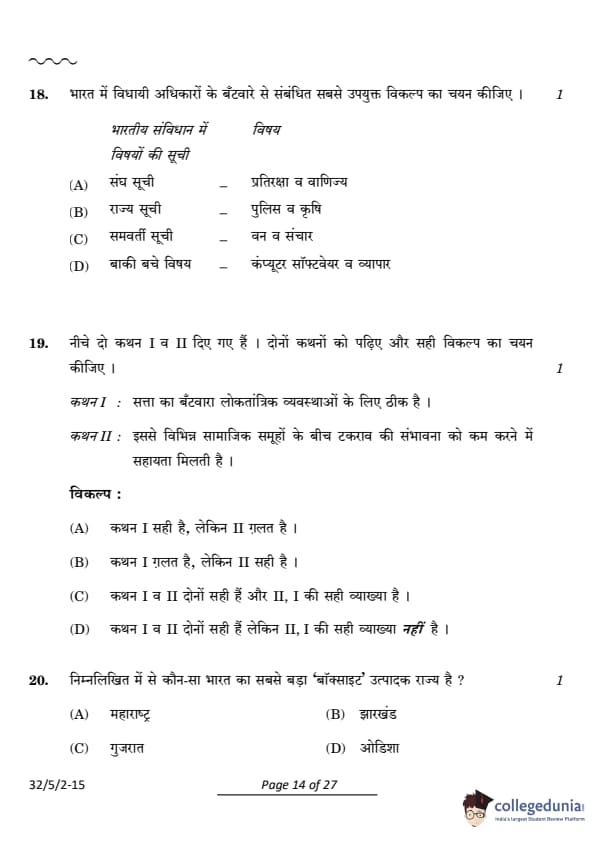
| 18. Choose the most appropriate option regarding the division of legislative rights in India: Subject List in Indian Constitution | Subjects Union List | Defence and Commerce State List | Police and Agriculture Concurrent List | Forest and Communication Residuary Subjects | Computer Software and Trade (A) Union List – Defence and Commerce (B) State List – Police and Agriculture (C) Concurrent List – Forest and Communication (D) Residuary Subjects – Computer Software and Trade |
(B) State List – Police and Agriculture | The State List in the Indian Constitution grants exclusive legislative powers to state governments over subjects such as Police and Agriculture. This ensures that these areas are managed locally, allowing for governance that is tailored to the specific needs of each state. |
| 19. Two statements, I and II are given below. Read both the statements and choose the correct option: Statement I: Division of power is good for democratic systems. Statement II: It helps to reduce the possibility of conflict between social groups. (A) Statement I is true, but II is false. (B) Statement I is false, but II is true. (C) Statements I and II are true and II is the correct explanation of I. (D) Statements I and II are true, but II is not the correct explanation of I. |
(C) Statements I and II are true and II is the correct explanation of I. | In a democratic framework, the division of power ensures balanced governance and mitigates authoritarianism. Additionally, it promotes social harmony by addressing the interests of various groups, thereby reducing potential conflicts. |
| 20. Which one of the following is the highest ‘bauxite’ producing state of India? (A) Maharashtra (B) Jharkhand (C) Gujarat (D) Odisha |
(D) Odisha | Odisha stands as India’s top bauxite producer, accounting for the largest portion of the nation’s bauxite reserves, primarily found in the state’s eastern regions. |
| 21. Why did people flee Europe for America in the nineteenth century? Explain. | Economic hardships, political instability, and social opportunities drove migration. | In the nineteenth century, Europe faced economic inequalities, famines (e.g., Irish Potato Famine), and unemployment due to industrialization. Political upheavals, like the Revolutions of 1848, and persecution of minorities (e.g., Jews) forced migration. Social opportunities like the Homestead Act in the U.S. and improvements in transportation also encouraged migration to America, promising better living conditions and prospects. |
| 22. How have developments in information and communication technology (ICT) been a major factor in enabling globalization? | ICT has revolutionized connectivity and global trade. | Advancements in ICT, such as the internet, mobile communication, and satellite technology, have enabled real-time information sharing and digital trade platforms. E-commerce, social media, and video conferencing have bridged geographical barriers, connecting businesses and cultures, thus accelerating globalization and economic integration. |
| 23. Mention the formation of Zilla Parishad. | Zilla Parishad is formed as the apex body of the Panchayati Raj system. | Zilla Parishad is established under the 73rd Constitutional Amendment Act, 1992. It is composed of elected representatives from Panchayat Samitis, MLAs, and MPs from the district. It coordinates development programs, supervises lower-tier Panchayati bodies, and promotes decentralization in governance at the district level. |
| 24(a). “Minerals occur in igneous and metamorphic rocks.” Explain the statement with an example. | Minerals crystallize under heat and pressure. | Igneous and metamorphic rocks are rich in minerals like tin, copper, and mica. For example, mica is extracted from metamorphic rocks formed under extreme heat and pressure, promoting crystallization of valuable minerals used in various industries. |
| 24(b). “The ocean waters contain vast quantities of minerals.” Explain the statement with an example. | Oceans are a source of dissolved and seabed minerals. | Oceans contain minerals like magnesium and bromine dissolved in seawater. Additionally, the seabed is rich in resources such as manganese nodules and phosphorites, which are used in industrial and technological applications. |
| 25. Describe any three characteristics of the Indian federal system. | India’s federal system has a three-tier structure. | India’s federal system divides powers between the Union and State governments under the Seventh Schedule of the Constitution. It features a three-tier structure, including Panchayati Raj Institutions, for governance at local levels. However, it also has unitary features, such as the central authority's supremacy during emergencies, ensuring national unity. |
| 26. Describe any three features of the Rabi crop season. | Rabi crops are grown in winter and harvested in spring. | Rabi crops are sown between October and December and harvested between March and April. They require a cool and dry climate for growth, utilizing residual soil moisture from monsoon rains. Major Rabi crops include wheat, barley, mustard, and gram, predominantly grown in northern and northwestern India. |
| 27. Analyse the role of political parties in shaping the outcomes of democracy. | Political parties ensure representation and accountability. | Political parties bridge the gap between the government and the public, representing diverse interests. They formulate policies, ensure accountability through elections, and educate citizens about their rights. Opposition parties scrutinize government actions, promoting transparency and conflict resolution, thus strengthening democratic institutions and processes. |
| 28(a). Explain the role of women in the Civil Disobedience Movement, with examples. | Women actively participated in protests and satyagrahas. | Women played a crucial role in the Civil Disobedience Movement by joining marches, picketing shops selling foreign goods, and participating in the salt satyagraha. Leaders like Sarojini Naidu inspired women to defy social norms. Their involvement demonstrated unity and highlighted their significant role in the nationalist struggle. |
| 28(b). How did Indian folklore and symbols strengthen the idea of nationalism during the twentieth century? Explain with examples. | Folklore and symbols fostered cultural pride and unity. | Indian folklore, such as songs, legends, and local tales, instilled pride and cultural identity. Symbols like Bharat Mata and the tricolor flag evoked patriotism. Movements like Swadeshi revived traditional crafts, fostering unity against colonial rule and strengthening the nationalist movement. |
| 29. Analyse the development of Punjab, Kerala, and Bihar states on the basis of literacy. | Literacy levels correlate with socio-economic development. | Kerala’s high literacy has led to better healthcare, gender equality, and economic progress. Punjab’s moderate literacy supports agricultural growth but limits diversification. Bihar’s low literacy hinders industrial development and perpetuates poverty. These variations highlight the importance of education in socio-economic advancement. |
| 30(a). “The first clear expression of nationalism came with the French Revolution in 1789.” Evaluate the statement. | The French Revolution laid the foundation for modern nationalism. | The French Revolution introduced nationalism by abolishing absolute monarchy and promoting liberty, equality, and fraternity. National symbols like the tricolor flag and national anthem united people. The Declaration of the Rights of Man emphasized civic rights, inspiring movements across Europe and fostering collective national identity. |
| 30(b). “Following the defeat of Napoleon in 1815, European governments were driven by a spirit of conservatism.” Evaluate the statement. | European governments sought to restore traditional institutions. | After Napoleon’s defeat, the Congress of Vienna restored monarchies and suppressed revolutionary ideals. Conservatism emphasized traditional hierarchies and repressive measures like censorship to maintain order. However, growing liberal and nationalist movements, such as the 1830 and 1848 revolutions, challenged this conservative approach. |
| 31(a). Explain with examples the role of democracy in the reduction of inequality and poverty. | Democracy promotes social welfare and inclusive growth. | Democracy ensures equal opportunities through social welfare policies. For example, India’s MGNREGA guarantees rural employment, reducing poverty. Democratic systems also empower marginalized groups through free elections, enabling them to influence policies. Programs like South Africa’s democratic transition ending apartheid exemplify how democracy reduces inequality and fosters inclusivity. |
| 31(b). How is democracy a legitimate government? Explain with examples. | Democracy derives legitimacy from public consent and accountability. | Democracy ensures legitimacy through free and fair elections where citizens choose their representatives. For example, India’s electoral process guarantees public participation. Transparency and accountability, as seen in countries like the United States, ensure peaceful power transitions and equal rights, making democracy a legitimate form of governance. |
| 32(a). “Manufacturing sector is considered the backbone of development of the country.” Justify the statement. | The manufacturing sector drives economic growth and employment. | The manufacturing sector generates jobs, increases GDP, and supports agriculture by providing machinery and fertilizers. Countries like China have achieved rapid growth through robust manufacturing. Industries contribute to exports and technological advancements, ensuring sustained national development and infrastructure enhancement. |
| 32(b). “Agriculture and Industry move hand in hand.” Justify the statement. | Agriculture and industry are interdependent sectors. | Agriculture supplies raw materials like cotton and sugarcane to industries, while industries provide inputs such as machinery and fertilizers to agriculture. For example, the sugarcane farming industry supports sugar production. This interdependence fosters balanced growth and reduces rural-urban disparities. |
| 33(a). Examine the significance of the tertiary sector in the Indian economy. | The tertiary sector drives GDP growth and improves living standards. | The tertiary sector contributes over 50% to India’s GDP and provides significant employment, particularly in urban areas. It supports primary and secondary sectors through services like transportation and communication. India’s global competitiveness in IT and software services highlights the sector’s role in improving living standards and economic progress. |
| 33(b). Explain the contribution of the primary sector in the context of employment in India. | The primary sector employs a significant portion of India’s workforce. | The primary sector, including agriculture, forestry, and fishing, employs nearly half of India’s population. It ensures food security and supplies raw materials like cotton and jute to industries. Government initiatives like MGNREGA have improved rural employment and reduced poverty, making the sector vital to India’s economy. |
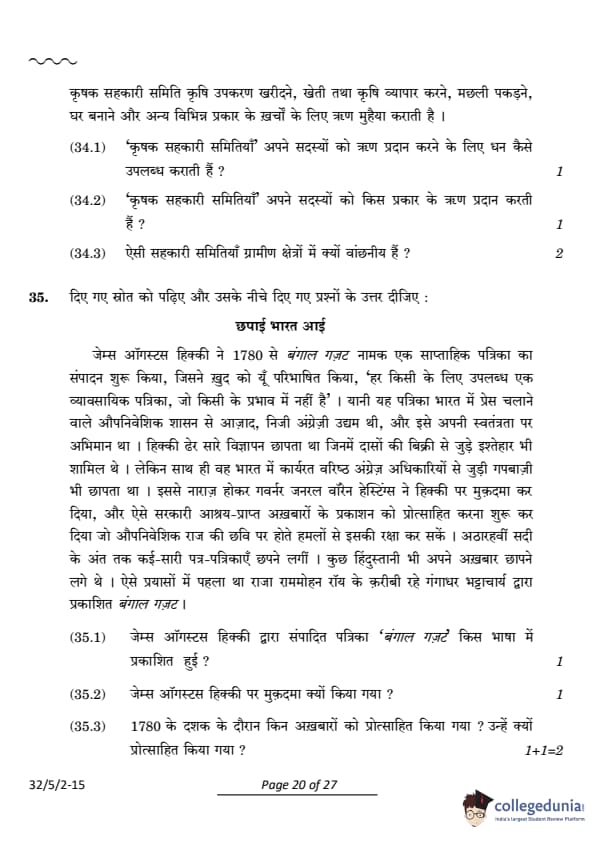
| 34.1 How do ‘Krishak Cooperatives’ secure funds for providing loans to their members? | They pool members' deposits and use them as collateral for bank loans. |
Krishak Cooperatives secure funds by pooling members’ deposits and using them as collateral to obtain larger loans from banks. |
| 34.2 What are the different types of loans that ‘Krishak Cooperatives’ offer to their members? |
Loans for agricultural implements, cultivation, fishery, and housing. | They offer various loans, including those for agricultural implements, cultivation, fishery, housing, and other essential expenses. |
| 34.3 Why are such cooperatives desirable in rural areas? | They provide accessible credit, reduce dependency on moneylenders, and promote economic activities. | Cooperatives are essential in rural areas as they provide affordable credit, encourage self-reliance, and reduce dependence on high-interest informal sources like moneylenders. |
| 35.1 In which language was ‘Bengal Gazette’ edited by James Augustus Hickey published? | English. | The Bengal Gazette, edited by James Augustus Hickey, was published in English. |
| 35.2 Why was James Augustus Hickey persecuted? | For publishing gossip and criticism about Company officials | Hickey was persecuted for publishing gossip and criticism about the senior officials of the East India Company, which angered Governor-General Warren Hastings. |
| 35.3 Which newspapers were encouraged during the 1780s? Why were they encouraged? | Official newspapers were encouraged to present a favorable image of the colonial government. | Officially sanctioned newspapers were encouraged to counter critical content in independent papers like Hickey’s Gazette and promote a positive image of the colonial government. |
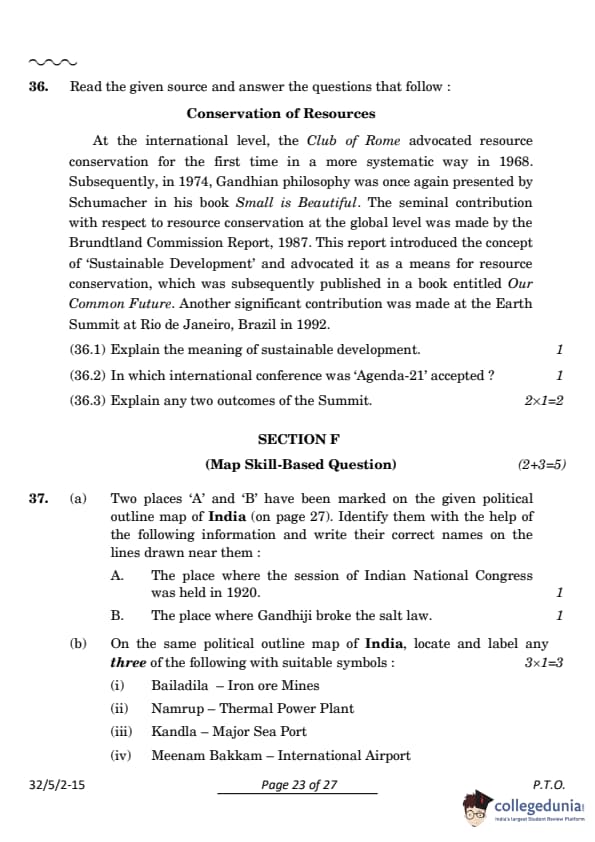
| 36.1 Explain the meaning of sustainable development. | Development that meets present needs without compromising future needs. | Sustainable development refers to development that fulfills the needs of the present generation without compromising the ability of future generations to meet their own needs. |
| 36.2 In which international conference was ‘Agenda-21’ accepted? | Earth Summit, Rio de Janeiro, 1992. |
‘Agenda-21’ was accepted at the Earth Summit held in Rio de Janeiro, Brazil, in 1992. |
| 36.3 Explain any two outcomes of the Summit. | Adoption of ‘Agenda-21’ and establishment of UNFCCC to combat climate change. | Two key outcomes of the Summit were: (1) Adoption of ‘Agenda-21,’ a global action plan for sustainable development, and (2) Establishment of the United Nations Framework Convention on Climate Change (UNFCCC) to address global warming. |
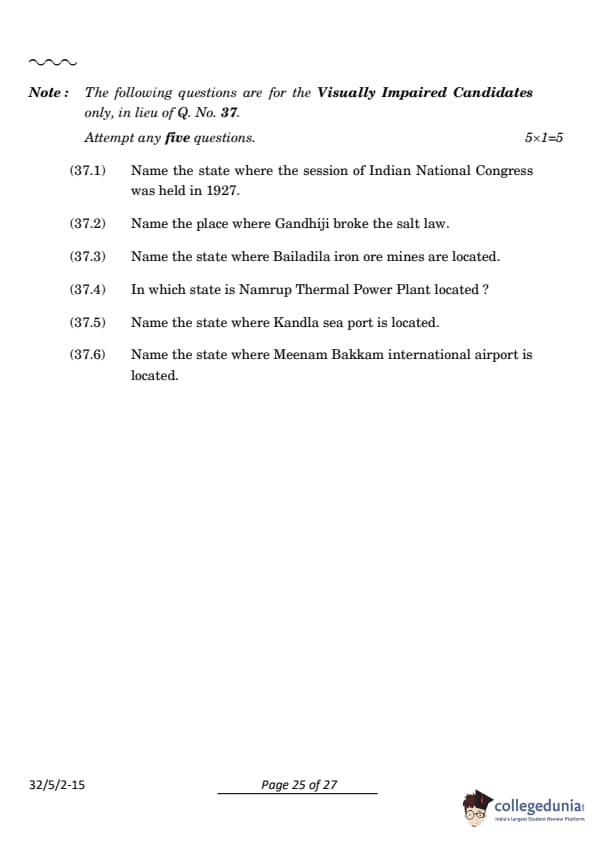
| 37(a). Identify the following places marked on the map of India: A. The place where the session of Indian National Congress was held in 1920. B. The place where Gandhiji broke the salt law. |
A. Nagpur B. Dandi |
A. Nagpur was the location of the Indian National Congress session in 1920. B. Dandi is where Gandhiji broke the salt law during the Salt March in 1930. |
| 37(b). Locate and label the following places on the same political outline map of India: (i) Bailadila – Iron Ore Mines (ii) Namrup – Thermal Power Plant (iii) Kandla – Major Sea Port (iv) Meenam Bakkam – International Airport |
(i) Chhattisgarh (ii) Assam (iii) Gujarat (iv) Tamil Nadu |
(i) Bailadila is located in Chhattisgarh. (ii) Namrup is situated in Assam. (iii) Kandla is a major port in Gujarat. (iv) Meenam Bakkam is near Chennai, Tamil Nadu. |















Comments