




CBSE Class 10 Social Science Question Paper 2024 PDF (Set 3 - 32/4/3) is available for download here. CBSE conducted the Social Science exam on March 7, 2024, from 10:30 AM to 1:30 PM. The total marks for the theory paper are 80. The question paper contains 20% MCQ-based questions, 40% competency-based questions, and 40% short and long answer type questions.
CBSE Class 10 Social Science Question Paper 2024 (Set 3 - 32/4/3) with Answer Key
| CBSE Class 10 Social Science Question Paper 2024 (Set 3 - 32/4/3) with Answer Key |  Download Download |
Check Solution |
CBSE Social Science Question Paper (Set 3 – 32/4/3) 2024 Solution
| Question | Answer | Detailed Solution |
|---|---|---|
| 1. Two statements are given below. They are Assertion (A) and Reason (R). Choose the correct option: Assertion (A): Banks are not ready to lend money to certain borrowers. Reason (R): Some people do not have collateral. (A) Both (A) and (R) are true and (R) is the correct explanation of (A). (B) Both (A) and (R) are true, but (R) is not the correct explanation of (A). (C) (A) is true, but (R) is false. (D) (A) is false, but (R) is true. |
(A) Both (A) and (R) are true and (R) is the correct explanation of (A). | Banks require collateral to mitigate risks. Borrowers without collateral often struggle to secure loans, making the assertion and reason connected and valid. |
| 2. On which of the following basis does the United Nations Development Programme (UNDP) publish the ‘Human Development Report’? (A) Manufacturing, Infrastructure, and Health (B) Education, Health, and Per Capita Income (C) National Income, Health, and Banking (D) Gross Domestic Product, Technology, and Innovation |
(B) Education, Health, and Per Capita Income | The Human Development Report evaluates countries based on education, health, and income levels, reflecting overall well-being and quality of life. |
| 3. Which one of the following statements best describes the meaning of ‘Globalization’? (A) Removal of tax barriers on trade (B) Providing higher standard of living (C) Process of rapid integration between countries (D) Taking special steps to attract foreign companies |
(C) Process of rapid integration between countries | Globalization refers to the interconnectedness of economies, facilitated by trade, technology, and investment, enhancing global interactions and integration. |
| 4. Two statements are given below. They are Assertion (A) and Reason (R). Choose the correct option: Assertion (A): No individual in India can legally refuse a payment made in rupees. Reason (R): In India, the rupee is authorized by the State Governments. (A) Both (A) and (R) are true and (R) is the correct explanation of (A). (B) Both (A) and (R) are true, but (R) is not the correct explanation of (A). (C) (A) is true, but (R) is false. (D) (A) is false, but (R) is true. |
(C) (A) is true, but (R) is false. | The Indian rupee is authorized by the Central Government and managed by the Reserve Bank of India. Refusing rupee payments is illegal since it is legal tender. |
| 5. Read the following situation regarding credit and identify the positive impact of credit: Salim obtains credit to meet the working capital needs of production. The credit helps him to meet ongoing expenses and complete production on time. (A) The burden of credit will increase on Salim. (B) Salim’s income will increase. (C) The production will decrease. (D) Salim may get stuck in a debt trap. |
(B) Salim’s income will increase. | Efficient use of credit for productive purposes leads to higher income and timely completion of production activities, improving financial stability. |
| 6. Read the following characteristics of democracy and choose the correct option: I. Free and fair elections II. Equality before law III. Dignity of a person IV. Majority rule (A) Only I, II, and III are correct. (B) Only II, III, and IV are correct. (C) Only I, III, and IV are correct. (D) Only I, II, and IV are correct. |
(A) Only I, II, and III are correct. | Democracy emphasizes free elections, legal equality, and individual dignity. Majority rule must respect minority rights to maintain balance. |
| 7. In which of the following regions was women representation the highest in their respective National Parliaments (2018)? (A) Nordic countries (B) America (North and South) (C) Europe (D) Asia |
(A) Nordic countries | Nordic countries have the highest women representation due to progressive policies and gender quotas promoting political inclusivity. |
| 8. Which one of the following countries has a two-party system? (A) China (B) Pakistan (C) United States of America (D) France |
(C) United States of America | The United States operates under a two-party system dominated by the Democratic and Republican parties, ensuring stability but limiting diversity in representation. |
| 9. Two statements are given below. They are Assertion (A) and Reason (R). Choose the correct option: Assertion (A): Modern democracy cannot function without political parties. Reason (R): Elected representatives will be accountable only to their constituencies, not towards the country. (A) (A) is true, but (R) is false. (B) (A) is false, but (R) is true. (C) Both (A) and (R) are true and (R) is the correct explanation of (A). (D) Both (A) and (R) are true, but (R) is not the correct explanation of (A). |
(C) Both (A) and (R) are true and (R) is the correct explanation of (A). | Political parties are crucial for structuring governance, enabling accountability, and ensuring the democratic process. Representatives balance constituency and national responsibilities. |
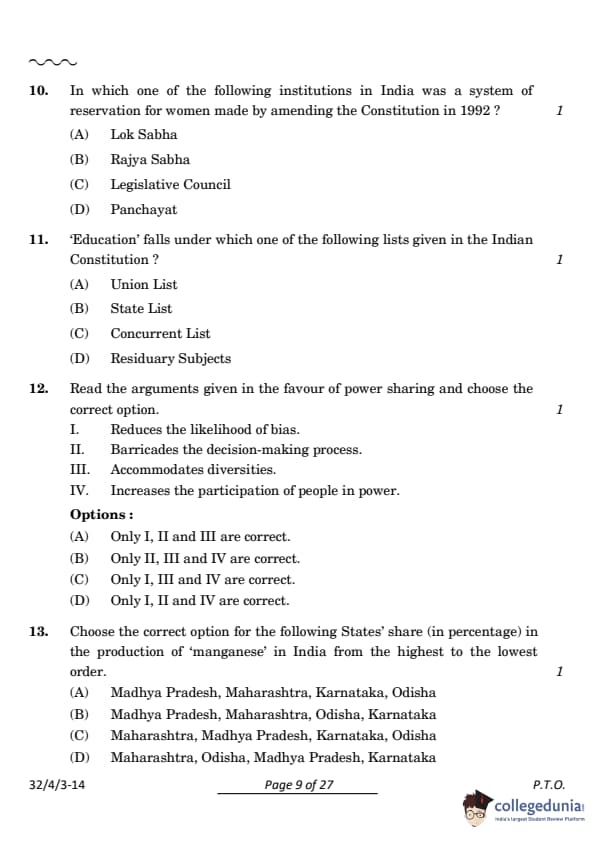
| 10. In which one of the following institutions in India was a system of reservation for women made by amending the Constitution in 1992? (A) Lok Sabha (B) Rajya Sabha (C) Legislative Council (D) Panchayat |
(D) Panchayat | The 73rd Constitutional Amendment Act mandated one-third reservation for women in Panchayati Raj institutions, ensuring their active participation in local governance. |
| 11. ‘Education’ falls under which one of the following lists given in the Indian Constitution? (A) Union List (B) State List (C) Concurrent List (D) Residuary Subjects |
(C) Concurrent List | The subject of Education is listed under the Concurrent List in the Indian Constitution, meaning both the Central and State Governments can make laws regarding education. |
| 12. Read the arguments given in favor of power sharing and choose the correct option: I. Reduces the likelihood of bias. II. Barricades the decision-making process. III. Accommodates diversities. IV. Increases the participation of people in power. (A) Only I, II and III are correct. (B) Only II, III and IV are correct. (C) Only I, III and IV are correct. (D) Only I, II and IV are correct. |
(C) Only I, III and IV are correct. | Arguments in favor of power sharing include reducing bias, accommodating diversities, and increasing people's participation in governance. Statement II is incorrect as power sharing facilitates better decision-making. |
| 13. Choose the correct option for the following States’ share (in percentage) in the production of ‘manganese’ in India from the highest to the lowest order: (A) Madhya Pradesh, Maharashtra, Karnataka, Odisha (B) Madhya Pradesh, Maharashtra, Odisha, Karnataka (C) Maharashtra, Madhya Pradesh, Karnataka, Odisha (D) Maharashtra, Odisha, Madhya Pradesh, Karnataka |
(B) Madhya Pradesh, Maharashtra, Odisha, Karnataka | India’s manganese production is led by Madhya Pradesh, followed by Maharashtra, Odisha, and Karnataka in decreasing order. |
| 14. Match Column I with Column II and choose the correct option: Column I (Dams) - Column II (Rivers) i. Sardar Sarovar - a. Sutlej ii. Hirakud - b. Krishna iii. Bhakra Nangal - c. Narmada iv. Nagarjuna Sagar - d. Mahanadi (A) i-a, ii-b, iii-c, iv-d (B) i-b, ii-a, iii-d, iv-c (C) i-c, ii-d, iii-b, iv-a (D) i-c, ii-d, iii-a, iv-b |
(D) i-c, ii-d, iii-a, iv-b | Correct matches are: - Sardar Sarovar on the Narmada River. - Hirakud on the Mahanadi River. - Bhakra Nangal on the Sutlej River. - Nagarjuna Sagar on the Krishna River. |
| 15. Two statements are given below. They are Assertion (A) and Reason (R). Read both the statements and choose the correct option: Assertion (A): The famous ‘Chipko Movement’ in the Himalayas successfully resisted deforestation in several areas. Reason (R): Through this, community afforestation campaign with indigenous species was made enormously successful. (A) Both (A) and (R) are true, but (R) is not the correct explanation of (A). (B) Both (A) and (R) are true and (R) is the correct explanation of (A). (C) (A) is true, but (R) is false. (D) (A) is false, but (R) is true. |
(B) Both (A) and (R) are true and (R) is the correct explanation of (A). | The Chipko Movement successfully resisted deforestation and promoted afforestation with indigenous species, making both the assertion and reason valid and connected. |
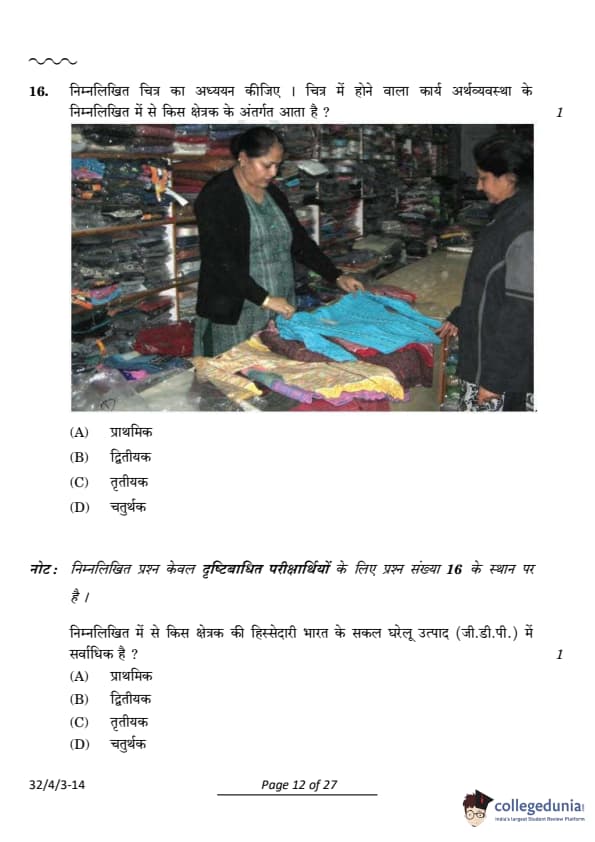
| 16. Study the following picture. The work done in the picture comes under which one of the following sectors of the economy? (A) Primary (B) Secondary (C) Tertiary (D) Quaternary |
(C) Tertiary | The activities shown in the image relate to the Tertiary sector, which involves services such as retail, healthcare, and education. It supports other sectors through specialized skills and interactions. |
| 17. Who among the following said – “Printing is the ultimate gift of God and the greatest one”? (A) Martin Luther (B) Mahatma Gandhi (C) Johannes Gutenberg (D) Rashsundari Devi |
(A) Martin Luther | Martin Luther emphasized the transformative role of the printing press, which allowed the wide dissemination of ideas and played a crucial role during the Protestant Reformation. |
| 18. Choose the correct option related to the founders of the ‘Swaraj Party’ within the Congress: (A) Subhas Chandra Bose and Jawaharlal Nehru (B) Acharya Kripalani and Jayaprakash Narayan (C) C.R. Das and Motilal Nehru (D) Mahatma Gandhi and Sardar Patel |
(C) C.R. Das and Motilal Nehru | The Swaraj Party, established in 1923 by C.R. Das and Motilal Nehru, aimed to contest elections and oppose British policies from within legislative councils. |
| 19. Choose the correct option to fill in the blank: —— from India and Southeast Asia travelled through the ‘Silk Route’ to other parts of the world. (A) Gold and silver ornaments (B) Clothes and spices (C) Grain and pulses (D) Iron and other metals |
(B) Clothes and spices | The Silk Route facilitated the trade of high-demand goods like clothes, especially silk, and spices from India and Southeast Asia to Europe and the Middle East. |
| 20. Arrange the following incidents in chronological order and choose the correct option: I. French Revolution II. Napoleon’s invasion of Italy III. Unification of Italy IV. Vienna Peace Treaty (A) I, II, IV, III (B) II, IV, I, III (C) II, III, I, IV (D) I, III, II, IV |
(A) I, II, IV, III | The sequence is: - French Revolution (1789–1799). - Napoleon’s invasion of Italy (1796). - Vienna Peace Treaty (1815). - Unification of Italy (1861). |
| 21.(a) Examine the role of the Constitution in the Federal System of India in two points: | Division of Powers and Amendment Provisions | The Constitution delineates powers between the Union and State governments through three lists (Union, State, Concurrent). It also includes amendment provisions that ensure federal integrity by requiring joint consent for changes. |
| OR 21(b). Examine the role of the Supreme Court in the Federal System of India in two points: | Guardian of the Constitution | The Supreme Court acts as the ultimate interpreter of the Constitution, resolving disputes between the Union and State governments. It also arbitrates inter-state conflicts, ensuring harmony in the federal structure. |
| 22. “India has great potential for wind power generation.” Explain the statement in context of wind energy: | Favorable Geographic Conditions | India’s coastline and wind corridors in states like Tamil Nadu and Gujarat provide ideal conditions for harnessing wind energy. Government initiatives further boost wind power infrastructure, making it a significant renewable energy source. |
| 23. “Until the nineteenth century, poverty and hunger were common in Europe.” Analyse the statement: | Agricultural Crisis and Industrial Exploitation | Europe faced frequent agricultural crises due to outdated techniques, and industrial workers suffered poor wages and living conditions, leading to widespread poverty and hunger. |
| 24. Explain the steps taken by the Indian government for globalization in 1991: | Economic Reforms | The government reduced trade barriers, encouraged FDI, privatized public enterprises, devalued the rupee, and deregulated industries to integrate India into the global economy. |
| 25. “Federal form of government is in direct contrast to the Unitary form of government.” Explain: | Power Distribution and Autonomy | Federal systems distribute power between central and state governments, ensuring autonomy. In contrast, unitary systems centralize authority with the national government. |
| 26. Describe any three features of intensive subsistence farming: | High Population Density, Labour-Intensive Methods, Multiple Cropping | Intensive subsistence farming is practiced in densely populated areas, relies heavily on manual labor, and involves growing multiple crops on small plots of land to maximize output. |
| 27. Analyse the role of political parties in making laws in India: | Policy Framing, Representation of Interests, Accountability | Political parties propose policies, represent diverse social groups in law-making, and ensure accountability by fulfilling their manifestos and challenging government proposals. |
| 28(a). How did people belonging to different communities, regions, or language groups develop a sense of collective belonging in the National Movement? Explain with examples: | Cultural Symbols, Songs and Folklore, Movements and Leaders | The use of Bharat Mata, patriotic songs like "Vande Mataram," and participation in movements led by Gandhi united diverse groups, fostering a sense of belonging to the national cause. |
| OR 28(b). “Workers had their own understanding of Mahatma Gandhi and the notion of ‘Swaraj’.” Explain the statement with examples: | Economic Aspirations, Protests and Strikes, Freedom from Exploitation | Workers interpreted Swaraj as freedom from economic exploitation, organized strikes inspired by Gandhi’s calls, and sought better working conditions and independence from oppressive industrial practices. |
| 29. “Money in your pocket cannot buy all the goods and services that you may need to live well.” Support the statement with examples: | Public Services, Community Well-Being, Environmental Resources | Essential services like healthcare depend on public infrastructure, social relationships and emotional support cannot be bought, and access to clean air and water relies on environmental conservation. |
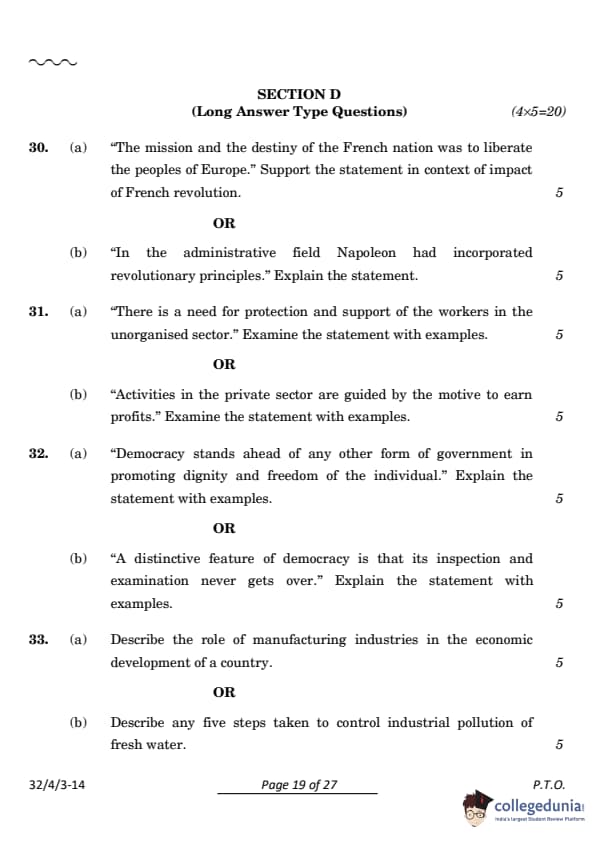
| 30(a). “The mission and the destiny of the French nation was to liberate the peoples of Europe.” Support the statement in context of the impact of the French Revolution: | Spread of Nationalism, Democratic Ideals, Universal Rights | The French Revolution abolished monarchies, spread ideas of liberty, equality, and fraternity, inspired nationalist movements, and established democratic institutions and universal human rights. |
| OR 30(b). “In the administrative field, Napoleon had incorporated revolutionary principles.” Explain the statement: | Equality Before Law, Centralized Administration, Uniform Legal System | Napoleon’s reforms included the Napoleonic Code, which ensured equality before law, centralized governance, secular education, economic reforms, and a uniform legal framework adopted globally. |
| 31(a). “There is a need for protection and support of the workers in the unorganised sector.” Examine the statement with examples: | Social Security, Regulation of Wages, Skill Development | Workers in the unorganised sector lack benefits like pensions and face low wages. Providing social security, regulating working conditions, and offering training can improve their livelihoods and dignity. |
| OR 31(b). “Activities in the private sector are guided by the motive to earn profits.” Examine the statement with examples: | Profit-Driven Approach, Innovation, CSR | Private enterprises prioritize profits, driving innovation and economic contribution. However, they may neglect social welfare, making CSR essential to balance their profit motives with societal needs. |
| 32(a). “Democracy stands ahead of any other form of government in promoting dignity and freedom of the individual.” Explain with examples: | Equality, Freedom of Expression, Empowerment | Democracy ensures equality, protects freedom of expression, and empowers marginalized groups through rights and representation. For example, India’s Constitution safeguards individual dignity and freedoms. |
| OR 32(b). “A distinctive feature of democracy is that its inspection and examination never gets over.” Explain with examples: | Continuous Accountability, Active Participation | Democracies constantly evolve through elections, judicial reviews, and public participation. Mechanisms like the Election Commission and free press ensure governments remain accountable to citizens. |
| 33(a). Describe the role of manufacturing industries in the economic development of a country: | GDP Contribution, Employment, Infrastructure Development | Manufacturing industries boost GDP, generate jobs, support exports, and foster infrastructure development. They also drive innovation and contribute to technological advancements. |
| OR 33(b). Describe any five steps taken to control industrial pollution of freshwater: | ETPs, Recycling, Regulations | Industries are mandated to install effluent treatment plants, recycle water, comply with pollution control laws, and adopt eco-friendly technologies. Continuous monitoring ensures adherence to standards. |
| 34.1: ‘Cooperative society’ is an example of which source of ‘credit’? | Institutional Source | Cooperative societies are examples of institutional credit sources, providing affordable loans for agricultural and non-agricultural purposes. |
| 34.2: Explain the contribution of Cooperative Societies in rural development: | Affordable Credit, Economic Growth | Cooperative societies provide loans for various rural needs, reducing dependence on moneylenders and improving the livelihoods of farmers and workers, fostering economic development in rural areas. |
| 34.3: Mention any two sources of capital for Self-Help Groups: | Member Savings, Bank Loans | Self-Help Groups raise capital through pooled savings from members and loans obtained from banks based on their collective resources. |
| 35.1: On which rule was the ‘Vernacular Press Act’ based? | Irish Press Laws | The Vernacular Press Act was modeled on Irish Press Laws, aimed at curbing nationalist sentiments and controlling dissent in the vernacular press. |
| 35.2: Why did the attitude of the British change towards the freedom of press after the Revolt of 1857? | Fear of Nationalism | After 1857, the British feared the vernacular press would spread nationalist propaganda, leading them to impose stringent controls on publications. |
| 35.3: Explain any two impacts of passing the ‘Vernacular Press Act’: | Censorship, Suppression of Journalism | The Act allowed extensive censorship, warning and seizing printing presses, stifling the freedom of the vernacular press and nationalist journalism. |
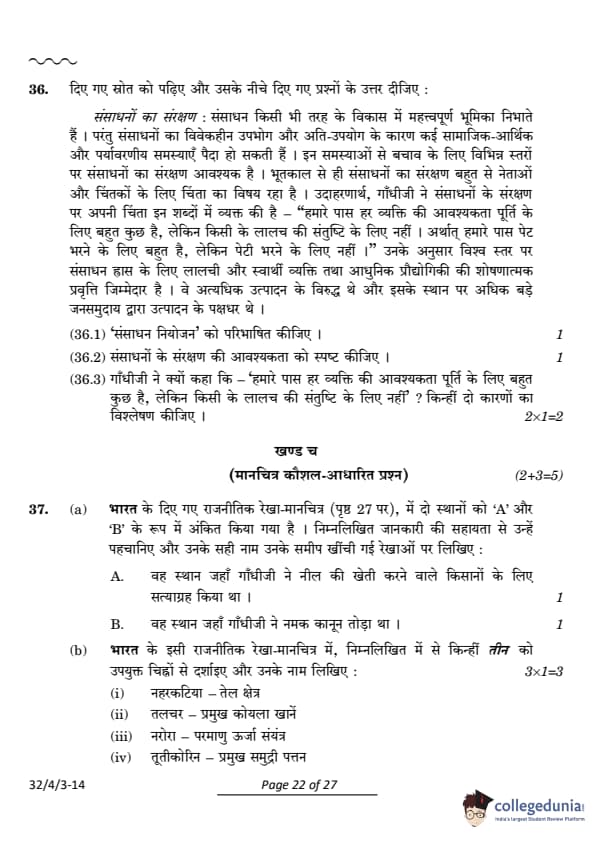
| 36.1: Define the term ‘Resource Planning’: | Systematic Resource Utilization | Resource planning involves identifying, assessing, and judiciously utilizing resources to ensure sustainability for present and future needs. |
| 36.2: Explain the need for conservation of resources: | Sustainability and Prevention of Overuse | Resource conservation prevents socio-economic and environmental problems from over-utilization and ensures sustainable development for future generations. |
| 36.3: Why did Gandhiji say – “There is enough for everybody’s need and not for anybody’s greed”? Analyse: | Equitable Distribution, Avoiding Exploitation | Gandhiji emphasized equitable resource use, criticizing greed as the root cause of depletion and promoting production by the masses to ensure fair distribution. |
| 37(a): Identify the places marked on the map of India: A. The place where Gandhiji started Satyagraha for indigo peasants. B. The place where Gandhiji broke the Salt Law. |
A. Champaran (Bihar), B. Dandi (Gujarat) | Champaran was the site of the indigo farmers’ Satyagraha, and Dandi was where Gandhiji broke the Salt Law during the Salt March. |
| 37(b): Locate and label any three of the following on the political map of India: (i) Naharkatiya – Oil field (ii) Talcher – Major Coal Mines (iii) Narora – Atomic Power Plant (iv) Tuticorin – Major Sea Port |
(i) Assam (ii) Odisha (iii) Uttar Pradesh (iv) Tamil Nadu |
Naharkatiya is in Assam, Talcher in Odisha, Narora in Uttar Pradesh, and Tuticorin in Tamil Nadu. These locations are significant for their economic and strategic contributions. |















Comments