




The Himachal Pradesh Board of School Education (HPBOSE) successfully conducted the Class 12 Physical Education (NSQF) Exam on March 30, 2026. HP Board Class 12 2026 Physical Education (NSQF) Question Paper with Solution PDF is now available for download.
The HP Board Class 12 Physical Education (NSQF) paper covers important topics from fitness training, sports skills, health education, yoga, and career-oriented physical education concepts. Students should focus on developing practical skills, understanding fitness techniques, and improving knowledge of sports and health management. The exam is typically marked out of 100 marks, with 70 marks for the theory paper and 30 marks for practical/internal assessment.
HP Board Class 12 2026 Physical Education (NSQF) Question Paper with Solution PDF
| HP Board Class 12 Physical Education (NSQF) Question Paper 2026 | Download PDF | Check Solution |
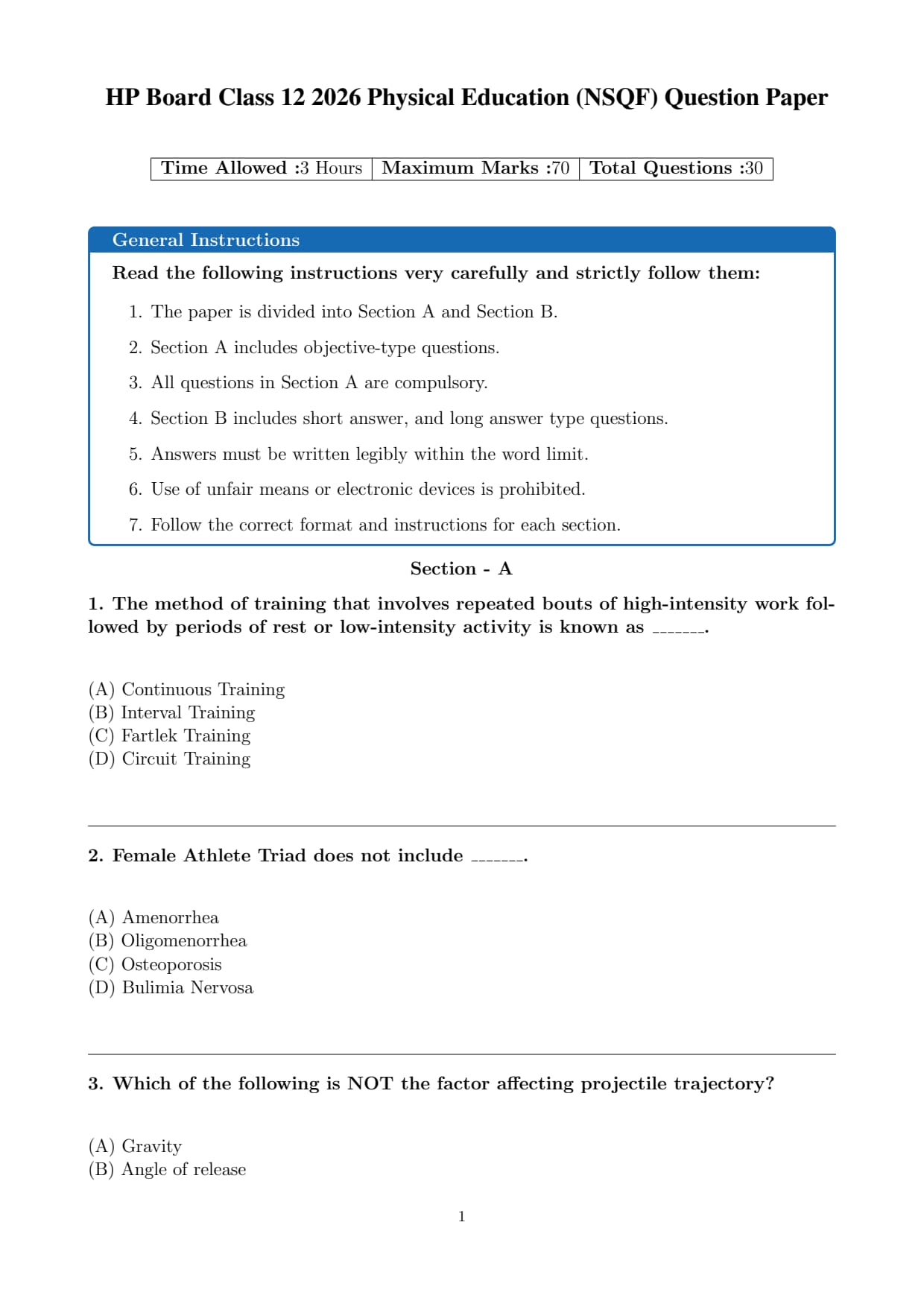
The method of training that involves repeated bouts of high-intensity work followed by periods of rest or low-intensity activity is known as ______ .
Female Athlete Triad does not include _____ .
Which of the following is NOT the factor affecting projectile trajectory?
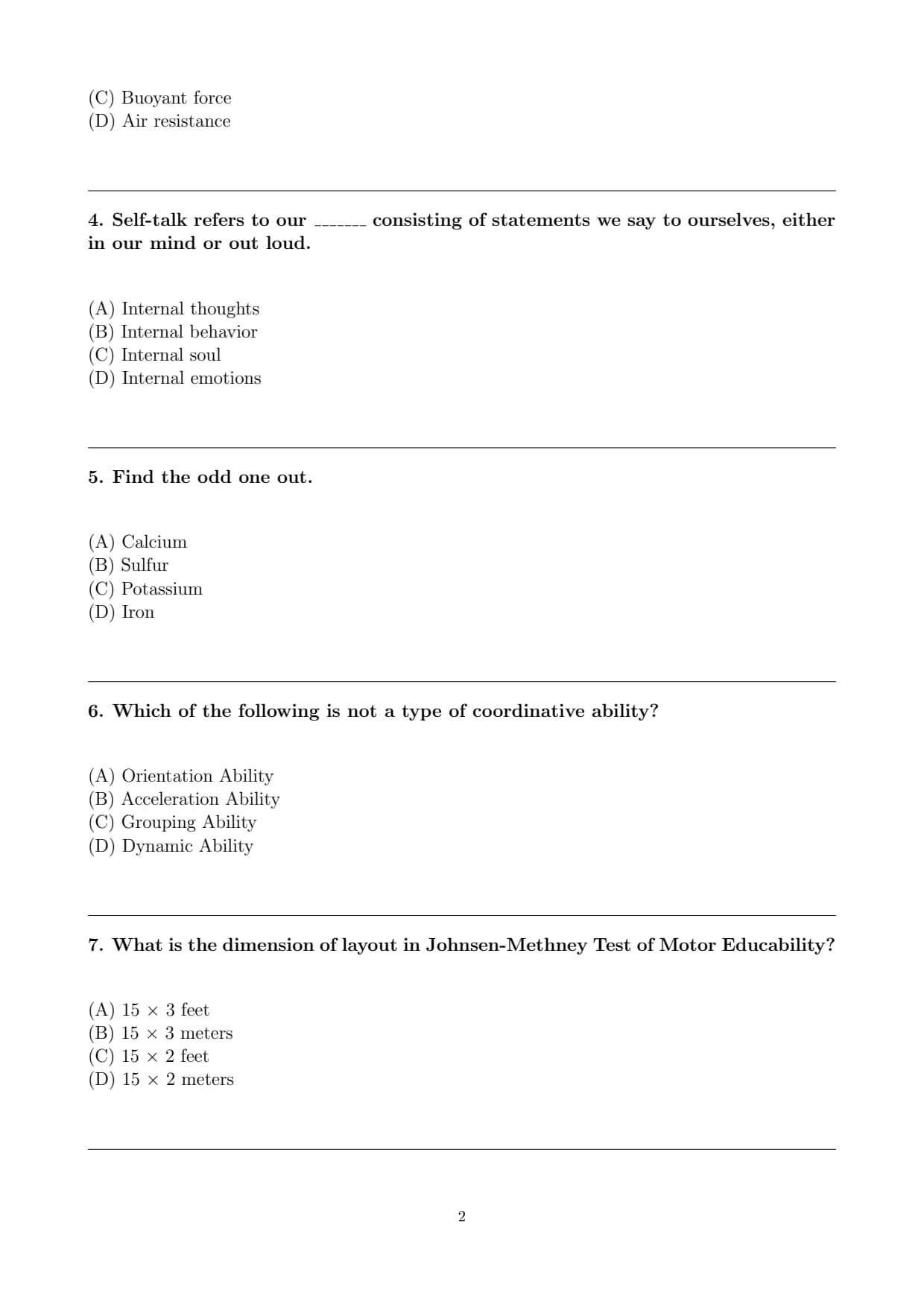
Self-talk refers to our _____ consisting of statements we say to ourselves, either in our mind or out loud.
Find the odd one out.
Which of the following is not a type of coordinative ability?
What is the dimension of layout in Johnsen-Methney Test of Motor Educability?
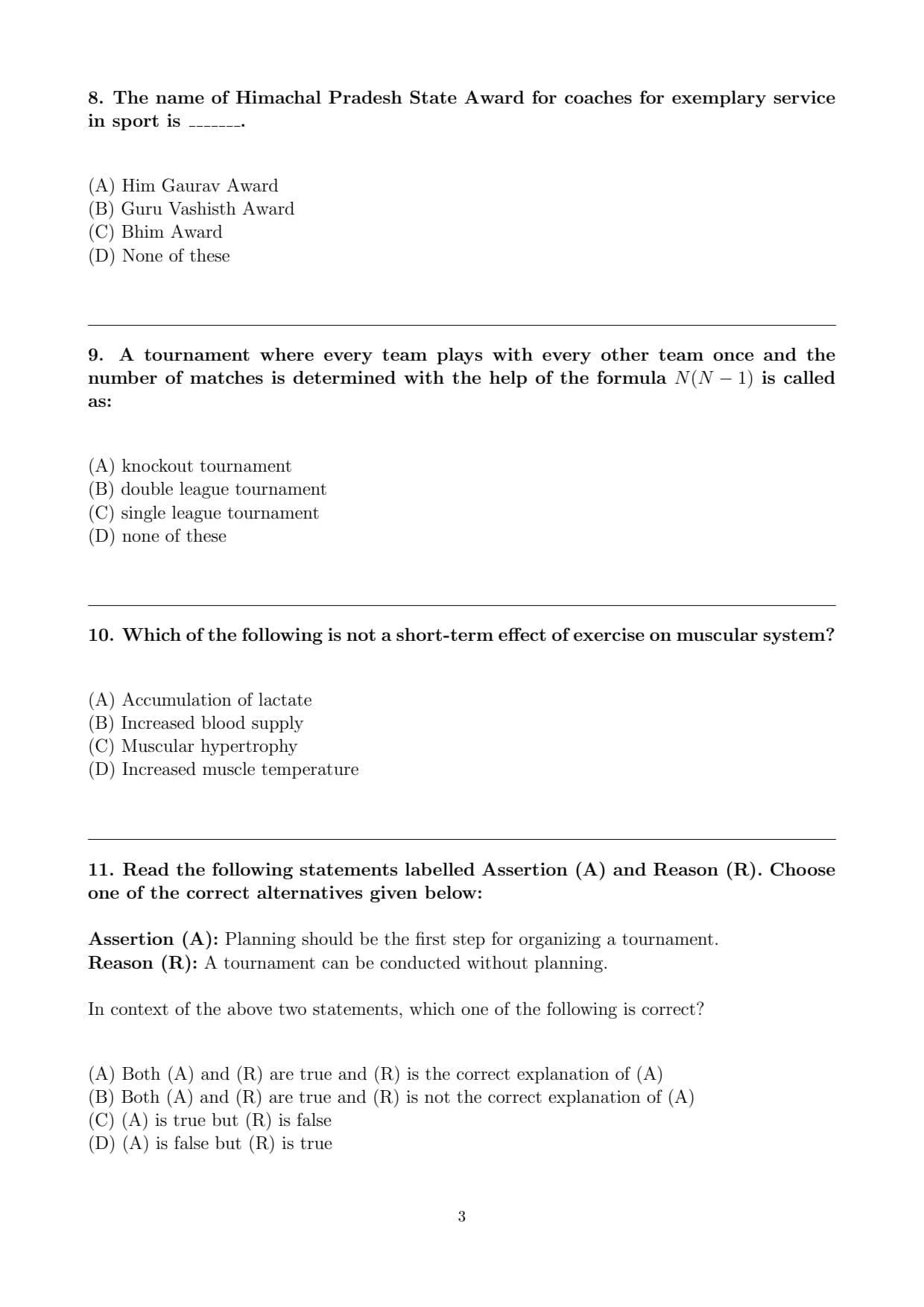
The name of Himachal Pradesh State Award for coaches for exemplary service in sport is _______.
A tournament where every team plays with every other team once and the number of matches is determined with the help of the formula \(N(N-1)\) is called as:
Which of the following is not a short-term effect of exercise on muscular system?
Read the following statements labelled Assertion (A) and Reason (R). Choose one of the correct alternatives given below:
Assertion (A): Planning should be the first step for organizing a tournament.
Reason (R): A tournament can be conducted without planning.
In context of the above two statements, which one of the following is correct?
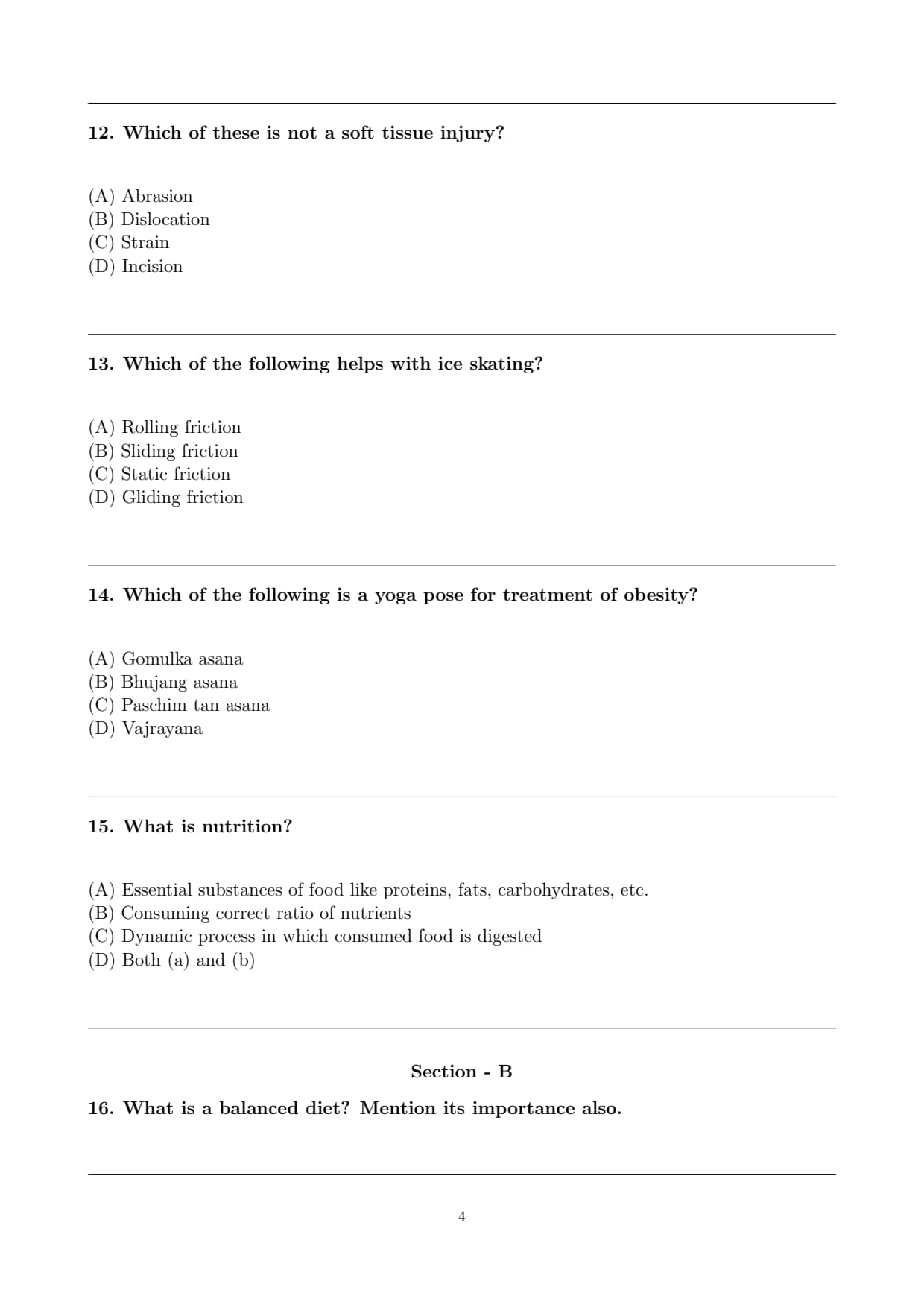
Which of these is not a soft tissue injury?
Which of the following helps with ice skating?
Which of the following is a yoga pose for treatment of obesity?
What is nutrition?
What is a balanced diet? Mention its importance also.
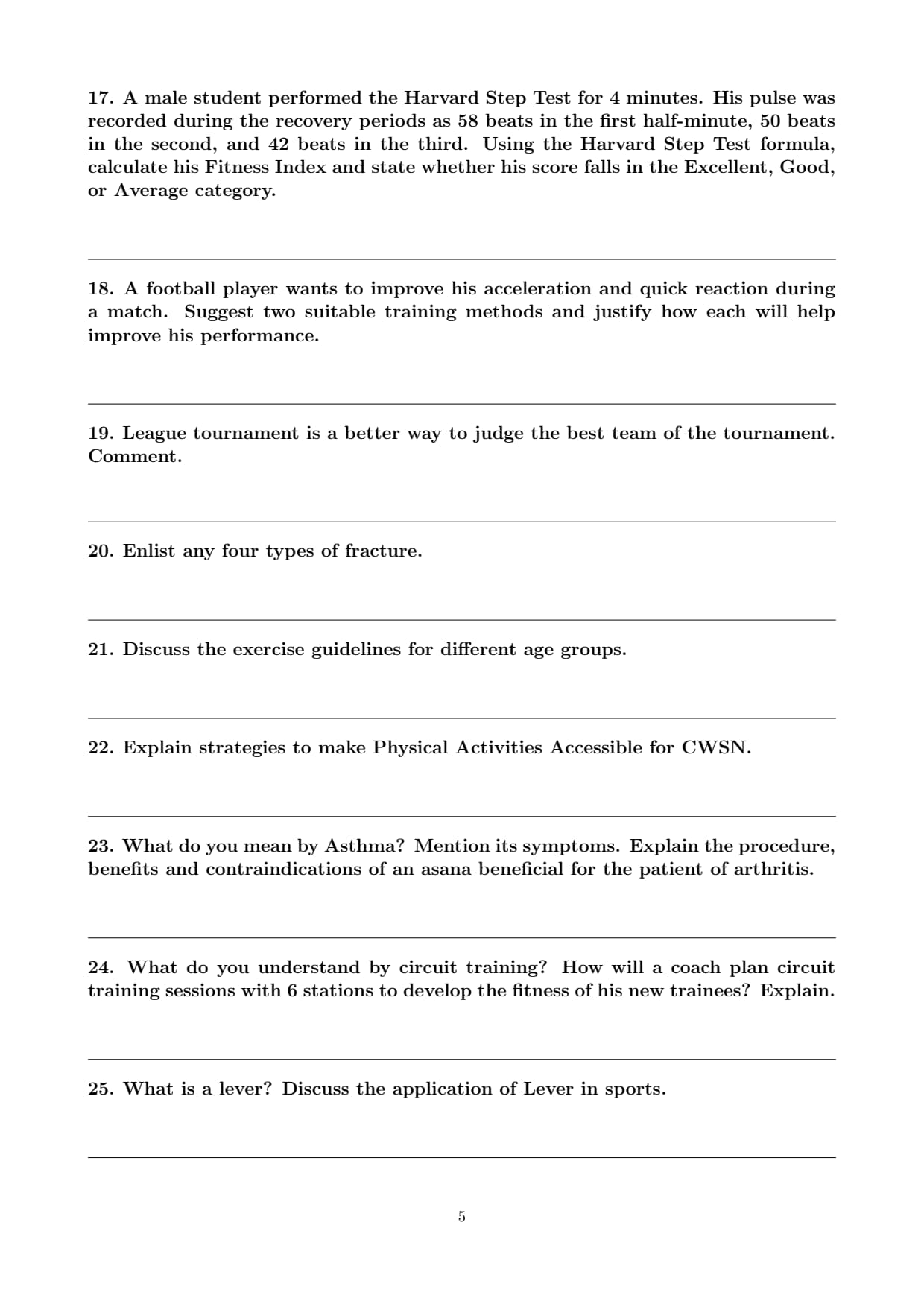
A male student performed the Harvard Step Test for 4 minutes. His pulse was recorded during the recovery periods as 58 beats in the first half-minute, 50 beats in the second, and 42 beats in the third. Using the Harvard Step Test formula, calculate his Fitness Index and state whether his score falls in the Excellent, Good, or Average category.
A football player wants to improve his acceleration and quick reaction during a match. Suggest two suitable training methods and justify how each will help improve his performance.
League tournament is a better way to judge the best team of the tournament. Comment.
Enlist any four types of fracture.
Discuss the exercise guidelines for different age groups.
Explain strategies to make Physical Activities Accessible for CWSN.
What do you mean by Asthma? Mention its symptoms. Explain the procedure, benefits and contraindications of an asana beneficial for the patient of arthritis.
What do you understand by circuit training? How will a coach plan circuit training sessions with 6 stations to develop the fitness of his new trainees? Explain.
What is a lever? Discuss the application of Lever in sports.
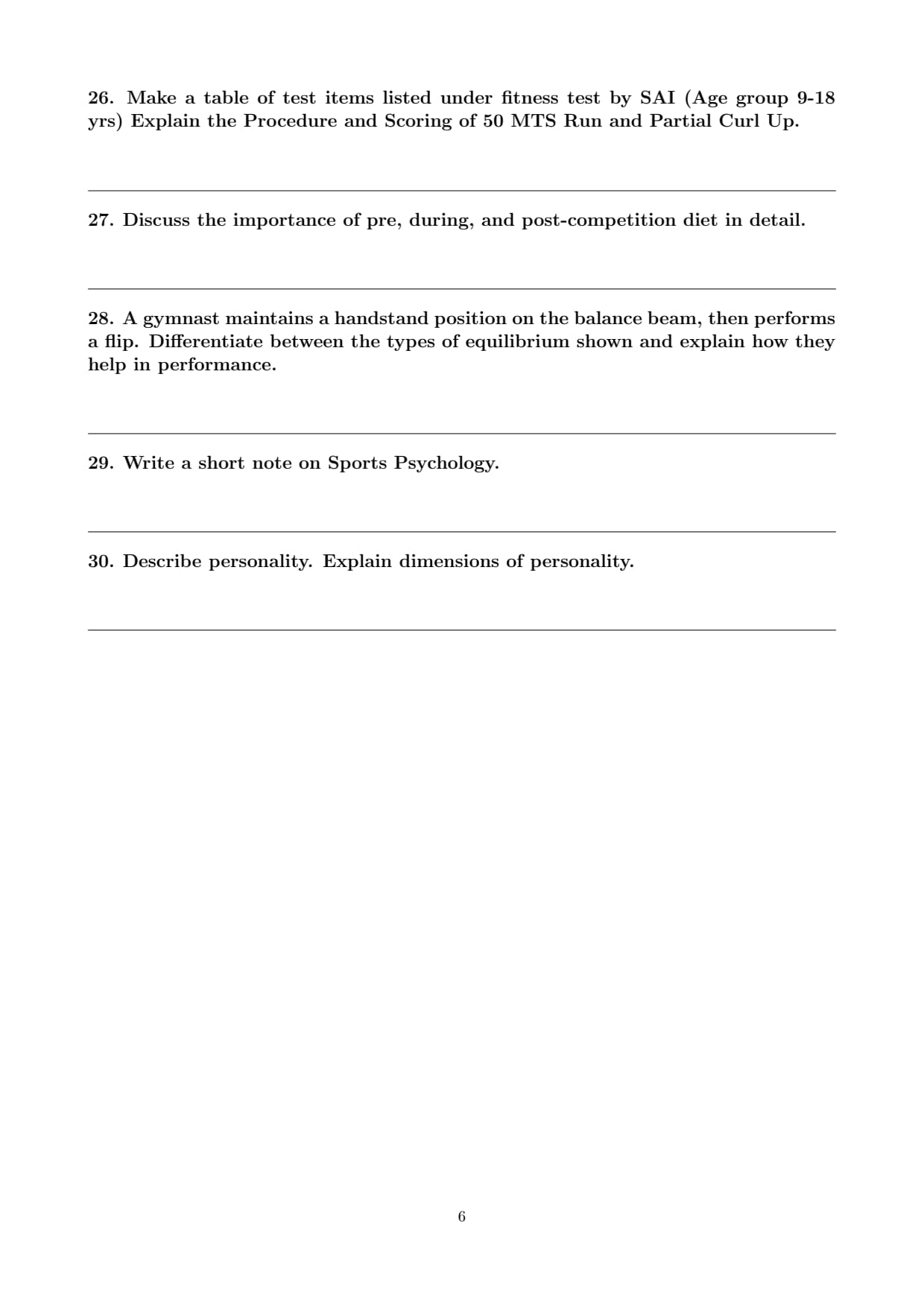
Make a table of test items listed under fitness test by SAI (Age group 9-18 yrs) Explain the Procedure and Scoring of 50 MTS Run and Partial Curl Up.
Discuss the importance of pre, during, and post-competition diet in detail.
A gymnast maintains a handstand position on the balance beam, then performs a flip. Differentiate between the types of equilibrium shown and explain how they help in performance.
Write a short note on Sports Psychology.
Describe personality. Explain dimensions of personality.



Comments