


An electric dipole of dipole moment p is lying along uniform electric field E. Calculate the work done in rotating the dipole by 90 degrees.

Jasmine Grover logo

Jasmine Grover

Education Journalist | Study Abroad Strategy Lead

Ques: An electric dipole of dipole moment p is lying along uniform electric field E. Calculate the work done in rotating the dipole by 90 degrees.

Ans: The work done in rotating the dipole by 90 degrees when dipole moment is lying along uniform electric field is “pE”. 

Explanation: The potential energy of an electric dipole in a uniform electric field is given by an expression: U = -pEcosθ.

Initially, the dipole moment is aligned with the electric field, so θ = 0, and the potential energy is:

U1 = -pEcos0 = -pE

When the dipole is rotated by 90 degrees, the angle between the dipole moment and the electric field becomes θ = 90 degrees, and the potential energy becomes:

U2 = -pEcos90 = 0

The change in potential energy is then equal to the work done

Work Done = ΔU = U2 - U1 = 0 - (-pE) = pE
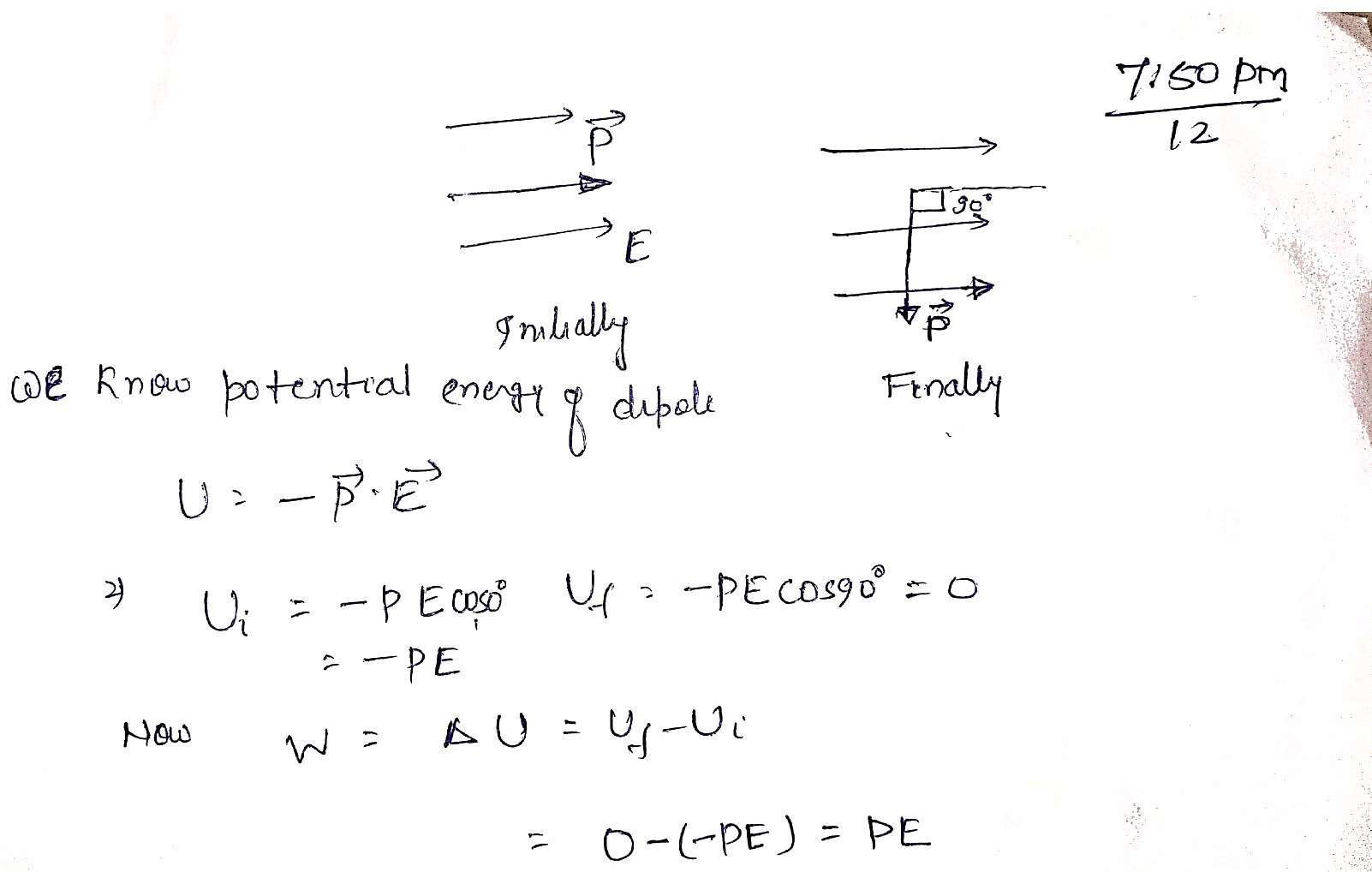
electric dipole of dipole moment p is lying along uniform electric field E

Therefore, the potential energy of the dipole in rotating it by 90 degrees is pE.

CBSE CLASS XII Related Questions

  • 1.
    Consider a cylindrical conductor of length \( l \) and area of cross-section \( A \). Current \( I \) is maintained in the conductor and electrons drift with velocity \( \vec{v}_d \, (|\vec{v}_d| = \frac{eE}{m} \tau) \), where symbols have their usual meanings. Show that the conductivity of the material of the conductor is given by \[ \sigma = \frac{n e^2 \tau}{m}. \]


      • 2.
        In a Young's double-slit experiment, two waves each of intensity I superpose each other and produce an interference pattern. Prove that the resultant intensities at maxima and minima are 4I and zero respectively.


          • 3.

            The electric potential (V ) and electric field (⃗ E) are closely related concepts in electrostatics. The electric field is a vector quantity that represents the

              • Production of AC is economical.
              • AC can be easily and efficiently converted from one voltage to another.
              • AC can be transmitted economically over long distances.
              • AC is less dangerous.

            • 4.
              The figure represents the variation of the electric potential \( V \) at a point in a region of space as a function of its position along the x-axis. A charged particle will experience the maximum force at:

                • P
                • Q
                • R
                • S

              • 5.
                Two small identical metallic balls having charges \( q \) and \( -2q \) are kept far at a separation \( r \). They are brought in contact and then separated at distance \( \frac{r}{2} \). Compared to the initial force \( F \), they will now:

                  • attract with a force \( \frac{F}{2} \)
                  • repel with a force \( \frac{F}{2} \)
                  • repel with a force \( F \)
                  • attract with a force \( F \)

                • 6.
                  A circular coil of 100 turns and radius \( \left(\frac{10}{\sqrt{\pi}}\right) \, \text{cm}\) carrying current of \( 5.0 \, \text{A} \) is suspended vertically in a uniform horizontal magnetic field of \( 2.0 \, \text{T} \). The field makes an angle \( 30^\circ \) with the normal to the coil. Calculate:
                  the magnetic dipole moment of the coil, and
                  the magnitude of the counter torque that must be applied to prevent the coil from turning.

                    CBSE CLASS XII Previous Year Papers

                    Comments


                    No Comments To Show

