


An electric dipole of dipole moment vec p is placed in a uniform electric field vec E. Find the maximum torque experienced by the dipole.

Collegedunia Team logo

Collegedunia Team

Content Curator

When an electric dipole of dipole moment vector p is placed in a uniform electric field vector E, it experiences a torque given by the formula:

τ = p × E

where τ is the torque vector, p is the dipole moment vector, and E is the electric field vector.

The magnitude of the torque is given by:

|τ| = p E sin θ

where θ is the angle between the dipole moment vector and the electric field vector.

The maximum torque occurs when the dipole moment vector is perpendicular to the electric field vector, i.e., when θ = 90 degrees. In this case, sin θ = 1, and the magnitude of the torque is:

|τ|max = p E

Therefore, the maximum torque experienced by the dipole is equal to the product of the dipole moment and the electric field strength.
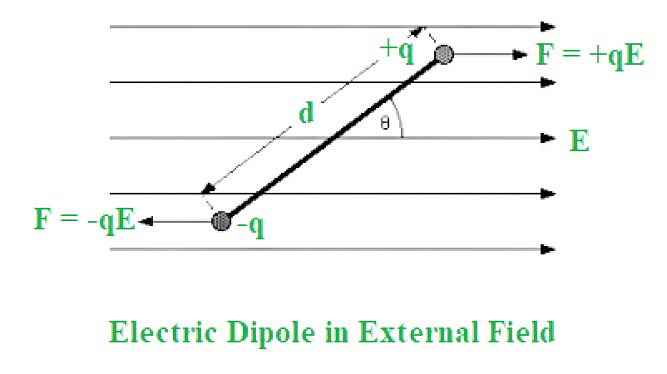
Electric Dipole in External Field

Electric Dipole in External Field

Also check:

CBSE CLASS XII Related Questions

  • 1.

    The electric potential (V ) and electric field (⃗ E) are closely related concepts in electrostatics. The electric field is a vector quantity that represents the

      • Production of AC is economical.
      • AC can be easily and efficiently converted from one voltage to another.
      • AC can be transmitted economically over long distances.
      • AC is less dangerous.

    • 2.
      A square loop of side 0.50 m is placed in a uniform magnetic field of 0.4 T perpendicular to the plane of the loop. The loop is rotated through an angle of 60° in 0.2 s. The value of emf induced in the loop will be:

        • 5 V
        • 3.5 V
        • 2.5 V
        • Zero V

      • 3.
        Assertion : Induced emf produced in a coil will be more when the magnetic flux linked with the coil is more. Reason (R): Induced emf produced is directly proportional to the magnetic flux.

          • Both Assertion (A) and Reason (R) are true and Reason (R) is the correct explanation of the Assertion (A).
          • Both Assertion (A) and Reason (R) are true, but Reason (R) is not the correct explanation of the Assertion (A).
          • Assertion (A) is true, but Reason (R) is false.
          • Both Assertion (A) and Reason (R) are false.

        • 4.
          The figure represents the variation of the electric potential \( V \) at a point in a region of space as a function of its position along the x-axis. A charged particle will experience the maximum force at:

            • P
            • Q
            • R
            • S

          • 5.
            Two small identical metallic balls having charges \( q \) and \( -2q \) are kept far at a separation \( r \). They are brought in contact and then separated at distance \( \frac{r}{2} \). Compared to the initial force \( F \), they will now:

              • attract with a force \( \frac{F}{2} \)
              • repel with a force \( \frac{F}{2} \)
              • repel with a force \( F \)
              • attract with a force \( F \)

            • 6.
              Four long straight thin wires are held vertically at the corners A, B, C and D of a square of side \( a \), kept on a table and carry equal current \( I \). The wire at A carries current in upward direction whereas the current in the remaining wires flows in downward direction. The net magnetic field at the centre of the square will have the magnitude:

                • \( \dfrac{\mu_0 I}{\pi a} \) and directed along OC
                • \( \dfrac{\mu_0 I}{\pi a \sqrt{2}} \) and directed along OD
                • \( \dfrac{\mu_0 I \sqrt{2}}{\pi a} \) and directed along OB
                • \( \dfrac{2\mu_0 I}{\pi a} \) and directed along OA
              CBSE CLASS XII Previous Year Papers

              Comments


              No Comments To Show

