


When an electric dipole is placed in a non uniform electric field what does the dipole experience?

Collegedunia Team logo

Collegedunia Team

Content Curator

When an electric dipole is placed in a non-uniform electric field, it experiences a net force and a net torque.

  • The electric field exerts a force on the charges of the dipole, with the positive charge experiencing a force in the direction of the electric field. 
  • The negative charge experiencing a force in the opposite direction. As a result, the dipole experiences a net force that tends to align it with the direction of the electric field.
  • At the same time, the non-uniform electric field produces a torque on the dipole, causing it to rotate.
  • The torque is given by the cross product of the dipole moment vector and the electric field vector.
  • The magnitude of the torque is maximum when the dipole is oriented perpendicular to the electric field, and zero when the dipole is aligned parallel to the electric field.

The net effect of the force and torque is to cause the dipole to rotate and align with the direction of the electric field. This process is known as dielectric polarization, and is important in many applications, such as in the functioning of capacitors, where it helps to store electrical energy.
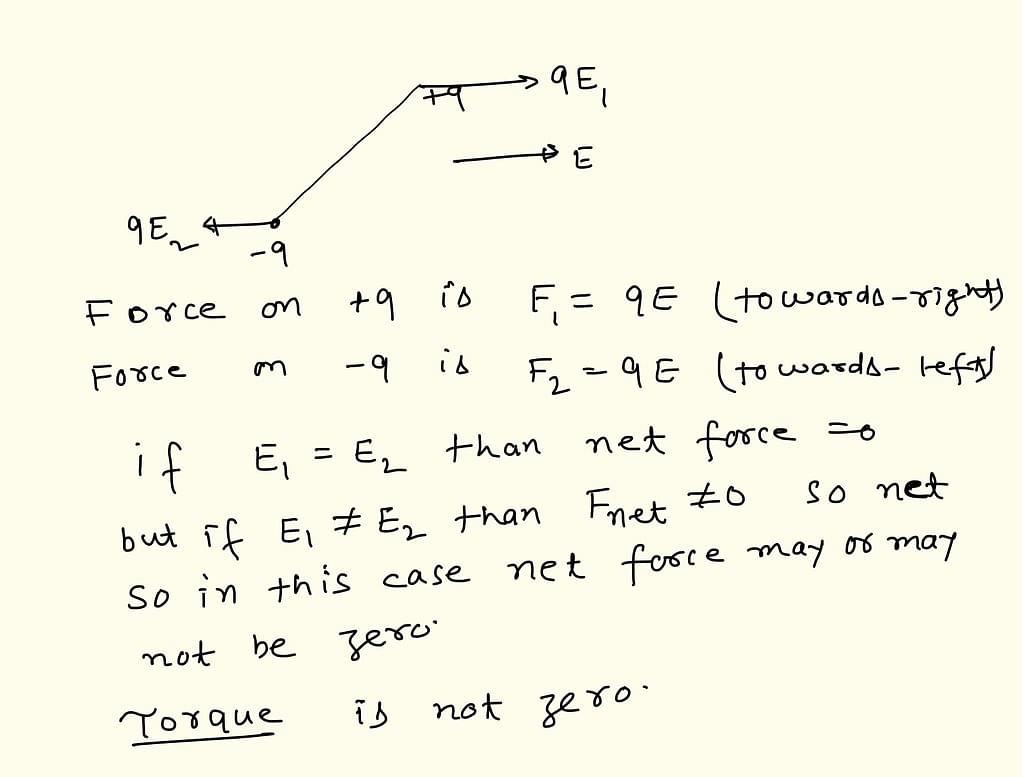
Electric Dipole in Non-uniform Electric Field

Electric Dipole in Non-uniform Electric Field

Check out:

CBSE CLASS XII Related Questions

  • 1.
    A circular coil of 100 turns and radius \( \left(\frac{10}{\sqrt{\pi}}\right) \, \text{cm}\) carrying current of \( 5.0 \, \text{A} \) is suspended vertically in a uniform horizontal magnetic field of \( 2.0 \, \text{T} \). The field makes an angle \( 30^\circ \) with the normal to the coil. Calculate:
    the magnetic dipole moment of the coil, and
    the magnitude of the counter torque that must be applied to prevent the coil from turning.


      • 2.
        A square loop of side 0.50 m is placed in a uniform magnetic field of 0.4 T perpendicular to the plane of the loop. The loop is rotated through an angle of 60° in 0.2 s. The value of emf induced in the loop will be:

          • 5 V
          • 3.5 V
          • 2.5 V
          • Zero V

        • 3.
          In a Young's double-slit experiment, two waves each of intensity I superpose each other and produce an interference pattern. Prove that the resultant intensities at maxima and minima are 4I and zero respectively.


            • 4.
              The magnetic field in a plane electromagnetic wave travelling in glass (\( n = 1.5 \)) is given by \[ B_y = (2 \times 10^{-7} \text{ T}) \sin(\alpha x + 1.5 \times 10^{11} t) \] where \( x \) is in metres and \( t \) is in seconds. The value of \( \alpha \) is:

                • \( 0.5 \times 10^3 \, \text{m}^{-1} \)
                • \( 6.0 \times 10^2 \, \text{m}^{-1} \)
                • \( 7.5 \times 10^2 \, \text{m}^{-1} \)
                • \( 1.5 \times 10^3 \, \text{m}^{-1} \)

              • 5.
                Consider a cylindrical conductor of length \( l \) and area of cross-section \( A \). Current \( I \) is maintained in the conductor and electrons drift with velocity \( \vec{v}_d \, (|\vec{v}_d| = \frac{eE}{m} \tau) \), where symbols have their usual meanings. Show that the conductivity of the material of the conductor is given by \[ \sigma = \frac{n e^2 \tau}{m}. \]


                  • 6.
                    The figure represents the variation of the electric potential \( V \) at a point in a region of space as a function of its position along the x-axis. A charged particle will experience the maximum force at:

                      • P
                      • Q
                      • R
                      • S
                    CBSE CLASS XII Previous Year Papers

                    Comments


                    No Comments To Show

