



Education Content Expert
Factors of 105 are the numbers that can be evenly divided into 105. The numbers that divide 105 completely without leaving any remainder are called the factors of 105. There are eight factors of 105 which are 1, 3, 5, 7, 15, 21, 35, and 105. 1 is the smallest factor of 105 while 105 is its own largest factor. The sum of all the factors of 15 is 192. The prime factorization of 105 is 3 × 5 × 7. Pair factors of 105 are the set of two numbers that when multiplied together gives the number 105 as the product. Thus, the factors of 105 in pairs are (1, 105), (3, 35), (5, 21), and (7, 15).
| Table of Content |
Key Terms: Factors of 105, Factors Pairs, Prime Factorization, Prime Factors, Composite Number, Remainder, Division, Multiplication
What are Factors of 105?
[Click Here for Sample Questions]
Factors of 105 are those numbers that divide 105 perfectly leaving zero as the remainder at the end of the division process. In other words, the numbers that give the product as 105 on multiplication with each other are referred to as the factors of 105. Thus, the factors of 105 are 1, 3, 5, 7, 15, 21, 35, and 105.
Factors of 105 = 1, 3, 5, 7, 15, 21, 35, 105
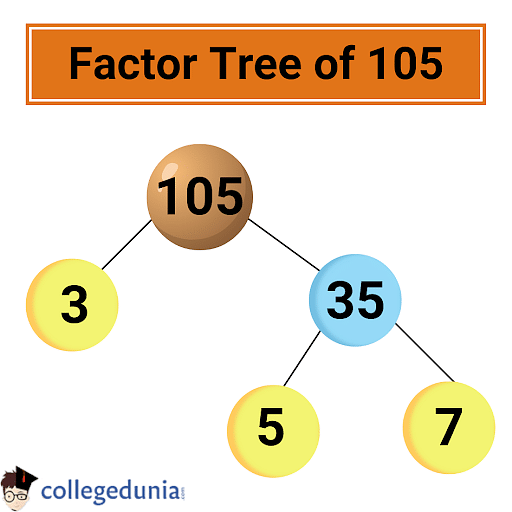
Factors of 105
Read More:
| Relevant Concepts | ||
|---|---|---|
| Factors of 15 | Factors of 28 | Factors of 16 |
| Factors of 72 | Factors of 12 | Factors of 48 |
| Factors of 18 | Factors of 25 | Factors of 21 |
Factors of 105 in Pairs
[Click Here for Sample Questions]
Pair factors of 105 are the pair of numbers, that on multiplication, give the original number 105 as the product. It must be noted that the pair factors of 105 can be positive as well as negative. The pair factors can be negative as they would result in the positive value of 105 only as the product of two negative numbers is always positive. The positive and negative pair factors of 105 are as follows:
Positive Pair Factors of 105
The positive pair factors of 105 are (1, 105), (3, 35), (5, 21), and (7, 15), which can be explained as follows:
| Positive Factors of 105 | Positive Pair Factors of 105 |
|---|---|
| 1 × 10⁵ | (1, 105) |
| 3 × 35 | (3, 35) |
| 5 × 21 | (5, 21) |
| 7 × 15 | (7, 15) |

Factors of 105 in Pairs
Negative Pair Factors of 105
The negative pair factors of 105 are (-1, -105), (-3, -35), (-5, -21), and (-7, -15), which can be explained as follows:
| Negative Factors of 105 | Negative Pair Factors of 105 |
|---|---|
| -1 × -105 | (-1, -105) |
| -3 × -35 | (-3, -35) |
| -5 × -21 | (-5, -21) |
| -7 × -15 | (-7, -15) |
Read More: Twin Primes
Factors of 105 by Division Method
[Click Here for Sample Questions]
Factors of 105 are found by dividing the number 105 by various consecutive integers. In the division method, if an integer divides 105 exactly leaving a remainder of 0, then those integers are the factors of 105. We will begin with the number 1 and continue till 105.
- 105 ÷ 1 = 105 (Factor is 1; Remainder is 0)
- 105 ÷ 3 = 35 (Factor is 3; Remainder is 0)
- 105 ÷ 5 = 21 (Factor is 5; Remainder is 0)
- 105 ÷ 7 = 15 (Factor is 7; Remainder is 0)
- 105 ÷ 15 = 7 (Factor is 15; Remainder is 0)
- 105 ÷ 21 = 5 (Factor is 21; Remainder is 0)
- 105 ÷ 35 = 3 (Factor is 35; Remainder is 0)
- 105 ÷ 105 = 1 (Factor is 105; Remainder is 0)
Thus, if we divide 105 by any other number than 1, 3, 5, 7, 15, 21, 35 and 105, it will leave a remainder of some value. Therefore, the factors of 105 are 1, 3, 5, 7, 15, 21, 35, and 105.
Read More: Greatest Common Divisor
Prime Factorization of 105
[Click Here for Sample Questions]
Prime factorization of 105 refers to the process of writing the number 105 as the product of its prime factors.
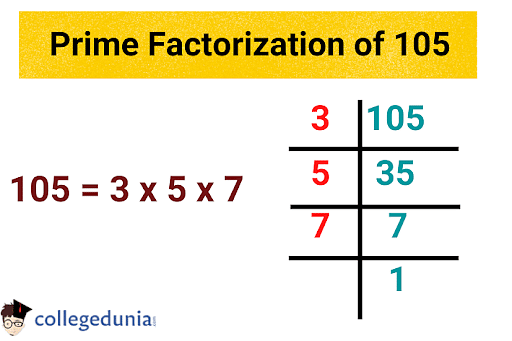
Prime Factorization of 105
Here are the steps to find the prime factors of 105:
- Consider a pair factor of 105, say (1, 105).
- 1 is neither a prime nor composite number, thus, it cannot be factorized further.
- Take the other factor 105, which is a composite number, which can be factored further into its prime factors.
- 105 can be written as the product of 3 and 35, 105 = 3 x 35.
- Now, here 3 is a prime number and 35 is a composite number.
- 35 is written as the product of 5 and 7, and now we can see that both 5 and 7 are prime numbers.
- At last, write all the numbers in the form of a product of its prime factors.
- 105 is written as 3 × 5 × 7 in form of its prime factors.
- Thus, the prime factorization of 105 is 3 × 5 × 7.
Read More: Co Prime Numbers
Solved Examples on Factors of 105
[Click Here for Sample Questions]
Example 1: 105 chocolates are to be divided into groups in such a manner that there are an equal number of chocolates in each group. Find out in how many ways can they be grouped.
Solution: Here, we will use the concept of factor pairing to divide 105 chocolates into groups.
We know that (35, 3), (5, 21), and (7, 15) are the factor pairs of 105.
Thus, the chocolates can be grouped in three different ways.
Example 2: What are the common factors of 105 and 106?
Solution: The factors of 105 and 106 are:
- Factors of 105: 1, 3, 5, 7, 15, 21, 35, and 105.
- Factors of 106: 1, 2, 53, and 106.
Thus, there is only one common factor of 105, and 106 which is 1.
Read More:
| Related Topics | ||
|---|---|---|
| LCM Formula | Relation Between HCF and LCM | Properties of LCM and HCF |
| LCM of Two Numbers | Fundamental Theorem Of Arithmetic | Prime Number Formula |
Things to Remember
- Factors of 105 are the natural numbers that divide 105 completely with no remainder.
- The number 105 has eight factors in total.
- The factors of 105 are 1, 3, 5, 7, 15, 21, 35, and 105.
- The prime factorization of 105 is 3 × 5 × 7, where 3, 5, and 7 are the prime factors of 105.
- The factors of 105 in pairs are (1, 105), (3, 35), (5, 21), and (7, 15).
- The sum of the factors of 105 is 192.
Sample Questions
Ques. What are the common factors of 105 and 104? (2 Marks)
Ans. The factors of 105 and 104 are given as
- Factors of 105: 1, 3, 5, 7, 15, 21, 35, and 105.
- Factors of 104: 1, 2, 4, 8, 13, 26, 52, and 104.
Therefore, the common factor of 105 and 104 is 1.
Ques. Shanaya has a toffee packet with 105 toffees in it. She distributed the toffees among her classmates. Find the total number of students if she gave 5 toffees to each one of them. (2 Marks)
Ans. It is given that,
- Total number of chocolates: 105
- Chocolates given to each student: 5
Number of students in the class=105 ÷ 5 = 21
Thus, there are 21 students in the class. Here we can see that (5,21) is a pair factor of 105.
Ques. What are the common factors of 105 and 103? (2 Marks)
Ans. Listing all the factors of 105 and 103:
- Factors of 105: 1, 3, 5, 7, 15, 21, 35, and 105.
- Factors of 103: 1 and 103.
There is only one common factor of 105 and 103, i.e. 1.
Ques. Can we divide 105 geometry boxes equally among 50 kids? (1 Mark)
Ans. No, we can not distribute 105 geometry boxes among 50 kids equally as 50 is not a factor of 105 and leaves a remainder, so some boxes will be left at the end.
Ques. How many factors of 105 are common to the factors of 3? (2 Marks)
Ans. We know that,
- Factors of 105: 1, 3, 5, 7, 15, 21, 35, 105
- Factors of 3: 1, 3.
Thus, 1, and 3 are the common factors of 105 and 3.
Ques. Find the sum of all the factors of 105. (2 Marks)
Ans. The factors of 105 are given as 1, 3, 5, 7, 15, 21, 35, and 105.
On adding all these factors, we get
1 + 3 + 5 + 7 + 15 + 21 + 35 + 105 = 192
Thus, the sum of the factors of 105 is 192.
Ques. State the prime factorization of 105. (1 Mark)
Ans. The prime factorization of 105 is written as 3 × 5 × 7.
Ques. What are the positive and negative pair factors of 105? (2 Marks)
Ans. The positive and negative pair factors of 105 are as follows:
- Positive pair factors of 105: (1, 105), (3, 35), (5, 21), and (7, 15).
- Negative pair factors of 105: (-1, -105), (-3, -35), (-5, -21), and (-7, -15).
Ques. Is 21 a factor of the number 105? (2 Marks)
Ans. Yes, 21 is a factor of the number 105, as it divides 105 exactly without leaving a remainder.
105 ÷ 21 = 5
There is zero as the remainder, thus, 21 is a factor of 105.
Ques. Name the Greatest Common Factor of 105 and 97. (2 Marks)
Ans. We know that the factors of 105 are 1, 3, 5, 7, 15, 21, 35, 105 and the factors of 97 are 1, 97. Thus, 105 and 97 have only one common factor which is 1 which implies that 105 and 97 are co-prime numbers. Therefore, the Greatest Common Factor (GCF) of 105 and 97 is 1.
Check-Out:




Comments