



Content Curator
Is 101 a Prime Number? The question can be confusing. A Prime number needs to have two factors in order to be categorized as a prime number.
Finding 101's components is essential to know if it is a prime or composite number. A whole number with just the number itself and one other element is said to be a prime number.
For instance, 11 is a prime number because it can only be divided by the digits 1 and 11. However, 8 is a composite number since it has additional factors: 8 = 2 x 4, 1 x 8, etc. The reasoning behind "Is 101 a prime number or a composite number?" is based on the same idea.
Also Check: Square Root
| Table of Content |
Key Terms: Prime number, Composite number, Factors, Whole Number, Integer, Non-Prime Numbers
What is Prime Number?
[Click Here for Sample Questions]
A positive integer with exactly two elements, namely 1 and the number itself, is referred to as a prime number.
- If p is a prime, then 1 and p by itself are required to be its only factors.
- Composite numbers do not fall into this category and may be factored into other positive integers.
- A prime number is an integer or positive number that is not the sum of any other two positive integers save 1 and the number itself.
Read Also:
| Topic Related Concepts | ||
|---|---|---|
| Co-Prime Numbers | Prime Number Formula | Twin Primes |
| Is '1' a Prime Number? | Digits | Types of Numbers |
Prime Numbers up to 1,000
[Click Here for Sample Questions]
Let's look at the list of prime numbers starting from 1 to 1000. One thing to keep in mind is that since 1 has only one element, it is not a prime number. Hence, the prime numbers begin with 2.
| Numbers | Number of Prime Numbers | List of Prime Numbers |
|---|---|---|
| 1 to 100 | 21 prime numbers | 2, 3, 5, 7, 11, 13, 17, 19, 23, 29, 31, 37, 41, 43, 47, 53, 59, 61, 67, 71, 73, 79, 83, 89, 97 |
| 101-200 | 21 prime numbers | 101, 103, 107, 109, 113, 127, 131, 137, 139, 149, 151, 157, 163, 167, 173, 179, 181, 191, 193, 197, 199 |
| 201-300 | 16 prime numbers | 211, 223, 227, 229, 233, 239, 241, 251, 257, 263, 269, 271, 277, 281, 283, 293 |
| 301-400 | 16 prime numbers | 307, 311, 313, 317, 331, 337, 347, 349, 353, 359, 367, 373, 379, 383, 389, 397 |
| 401-500 | 17 prime numbers | 401, 409, 419, 421, 431, 433, 439, 443, 449, 457, 461, 463, 467, 479, 487, 491, 499 |
| 501-600 | 14 prime numbers | 503, 509, 521, 523, 541, 547, 557, 563, 569, 571, 577, 587, 593, 599 |
| 601-700 | 16 prime numbers | 601, 607, 613, 617, 619, 631, 641, 643, 647, 653, 659, 661, 673, 677, 683, 691 |
| 701-800 | 14 prime numbers | 701, 709, 719, 727, 733, 739, 743, 751, 757, 761, 769, 773, 787, 797 |
| 801-900 | 15 prime numbers | 809, 811, 821, 823, 827, 829, 839, 853, 857, 859, 863, 877, 881, 883, 887 |
| 901-1000 | 14 prime numbers | 907, 911, 919, 929, 937, 941, 947, 953, 967, 971, 977, 983, 991, 997 |
Read Also: NCERT Solutions for Class 6 Maths Playing With Numbers
Is 101 a Prime Number?
[Click Here for Sample Questions]
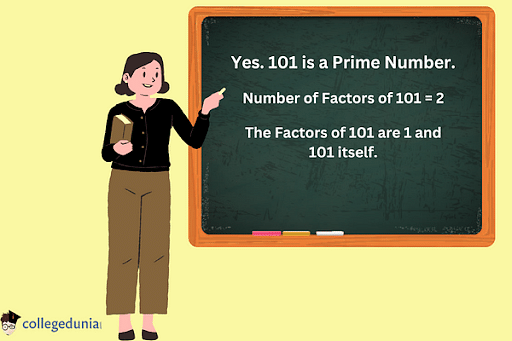
101 is a prime number since it only contains two factors, one and 101. It meets the criteria for prime numbers because it has exactly two factors.
- A positive whole number with two factors, or divisors, is considered to be a prime number.
- The number with factors of 1 and the number itself is a prime number.
- When a whole number cannot be divided by another whole number to get a whole number quotient, it is said to be a prime number (excluding 1).
- However, 102 is a composite number because it can be divided by another whole number to produce a whole number quotient.
- 101 can only be divided by one other whole number to get a whole number quotient. (i.e., 1 is not included, decimals do not count, and must be a positive integer).
- Finding the factors of the number 101 is the first step in determining whether it is a prime number.
Is 101 a Prime number?
Ways to Confirm if 101 is a Prime Number
The process below can help determine whether 101 is a prime number.
- Step 1: Verify that the unit digit is not one of the following: 0, 2, 4, 6, or 8. It isn't in this instance.
- Step 2: Determine whether the total of the numbers in 101 is divisible by 3. Here, the number 1+0+1=2 is not divisible by 3.
- Step 3: Calculate 101's square root, which is 101 = 10.04.
- Step 4: Determine whether 101 can be divided into smaller numbers than 10.
Thus, 101 can be categorized as a prime number because no number below 10 can divide it exactly.
Note: 101 is not a perfect square. 1 and 101 are the 101's factors. 101's prime factors are: (since, 101 is the only one prime number which is the factor of 101.)
Read Also: Remainder Theorem
Things to Remember
- A positive integer which has two factors, 1 and the number itself, is termed as a prime number.
- A prime number needs to have two factors in order to be categorized as a prime number.
- 101 is a prime number because it has two factors, 1 and 101 itself.
Read Also:
Sample Questions
Ques: List every prime number from 1 to 30. (1 mark)
Ans: 2, 3, 5, 7, 11, 13, 17, 19, 23, and 29 are among the prime numbers between 1 and 30.
Ques: Without a prime number in between, write seven consecutive composite numbers under 100. (1 mark)
Ans: The seven composite numbers that must be consecutive are 90, 91, 92, 93, 94, 95, and 96.
Ques: Write prime numbers between- (3 marks)
(a) 10 and 50
(b) 70 and 90
(c) 40 and 85
(d) 60 and 100
Ans: a. The prime numbers between 10 and 50 are 11, 13, 17, 19, 23, 29, 31, 37, 41, 43 and 47.
- Between 70 and 90, there are five prime numbers: 71, 73, 79, 83, and 89.
- Between 40 and 85, the prime numbers are 41, 43, 47, 53, 59, 61, 67, 71, 73, 79, and 83.
- 61, 67, 71, 73, 79, 83, 89, and 97 are the prime numbers between 60 and 100.
Ques: What prime number is the smallest? Is the number even? (2 marks)
Ans: The lowest prime number is 2, which is also its own.
The number is an even prime. All even numbers other than 2 are composite numbers.
Ques: Which odd prime is the smallest? Do all odd numbers have prime factors? Give an instance of an odd integer that is not prime, if not. (2 marks)
Ans: Three is the smallest odd prime number.
No, not all odd numbers are prime numbers. For instance, despite being an odd number, the number 9 has three factors: 1, 3, and 9, hence it is not a prime number.
Ques: How do composite numbers work? An odd composite number is possible. Write the smallest odd composite number if the answer is yes. (2 marks)
Ans: A composite number is one that contains more than two factors.
For instance, the composite numbers 4, 6, 8, 9, 10, and 15 are.
An odd number can indeed be a composite number. Nine is the lowest composite odd number.
Ques: What digit might possibly replace the unit to determine whether a number bigger than 10 is prime? (2 marks)
Ans: A number higher than 10 must be a prime number for the unit digit to be one of the digits 1, 3, 7, or 9.
Example: The prime numbers 11, 13, and 19 are all higher than 10.
Ques: Is 63 a prime number? (2 marks)
Ans: No, the number 63 is not a prime. A multiple of 1, 3, 7, 9, and 21 is 63. It is therefore not a prime number because it has more than two multiples, namely 1 and 63.
Ques: What do twin-primes mean? List all twin-prime pairs between 50 and 100. (2 marks)
Ans: Twin primes are two prime numbers that have just one composite number in common.
Twin primes include, for instance, (3, 5), and (5, 7).
Between 50 and 100, the twin primes (59, 61) and (71, 73).
Ques: How do co-primes work? Five co-prime instances should be given. Co-primes never fail to be prime. If not, give an example to support your response. (3 marks)
Ans: When there is only one other component they share in common, two numbers are said to be co-primes.
Examples of co-primes include (2, 3), (3, 4), (4, 5), (5, 7), and (13, 17).
For instance, co-prime numbers (3, 4), (6, 7) and 8 do not have to be prime numbers (4, 13).
Check-Out:





Comments