



Education Journalist | Study Abroad Strategy Lead
Mechanism of Evolution has been explained with theories like the Big Bang Theory, Theory of Darwin and the Hardy-Weinberg Equilibrium. Evolution is the process of natural selection that causes changes in the traits of species over multiple generations. The creatures undergo genetic changes as a result of mutations and other relevant factors, and they evolve through generations. The evolution of life on Earth has not been easy. The evolutionary theory seeks to convey the narrative of the earth's beginning and how life arose on the planet.
| Table of Content |
Keyterms: Evolution, Natural selection, Mutation, Life, Gene, Hypothesis, Origin of life, Planet, Relevant factors, Traits
Read More: Medulla Oblongata
The Big Bang Theory
[Click Here for Sample Questions]
The Big Bang Theory is the most widely accepted theory for the origin of life on Earth and its various forms. According to the hypothesis, the universe was created 20 billion years ago as a result of a massive explosion. The earth's formation took another 10 billion years.
Read More: Emphysema
When the earth was created, it grew, and the living circumstances, such as temperature and atmosphere, became more stable. The first life form on Earth is thought to have appeared roughly 2000 million years ago (mya).
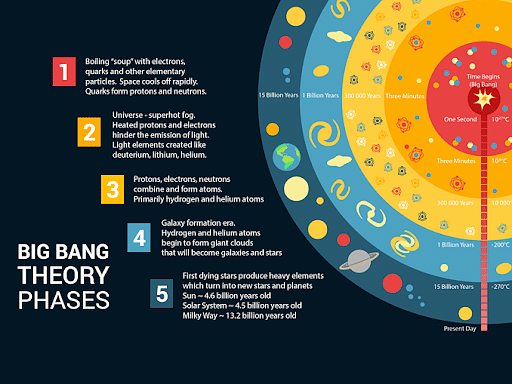
Fig. Big Bang Theory Phases
Despite the lack of a precise description of the first living cell's evolution, it is considered that the first cell evolved from non-cellular molecules. This cell split into two, resulting in the formation of more of them. The developing cells possessed a few distinguishing characteristics that aided their survival. These characteristics include the cells' ability to trap light energy and derive energy from it, as well as their oxygen-releasing capacity. Finally, single-celled organisms developed into multicellular organisms that are far more complicated.
Evolution proceeded at a significantly higher rate once multicellular organisms were evolved. Within a time span of 500-300 million years ago, new species such as invertebrates, plants, and animals such as reptiles, fish, amphibians, and mammals began to develop and evolve (mya). Later on, these species began to evolve independently. The branching of lineages began as a result of this. Climate change, limited resources, predators, and other environmental factors all had a significant influence in this. One life form dominated over the other at each stage of evolution. Nature chose one above the other, and that one was dubbed "the fittest of all."
Also Read:
| Related Articles | ||
|---|---|---|
| Sexual Reproduction | Spore Formation | Regeneration |
| Sex Determination | Oogenesis | Chromosomes and Genes |
Hardy-Weinberg Equilibrium
[Click Here for Sample Questions]
The incidence and consistency of gene frequency for a certain gene are quantitatively explained by the principle. According to the idea, allelic frequency and gene pool remain stable throughout generations. Genetic equilibrium is the term for this process. Furthermore, the allelic frequencies add up to 1.
Assume that the allele X frequency in a population is a and that the allele X frequency is b.
As a result, XX has a2 frequency, xx has b2 frequency, and Xx has 2ab frequency. As a result, the equation can be written as a2 + b2 + 2ab = 1 or (a + b)2 = 1.
Factors that influence the Hardy-Weinberg principle include:
- Mutation
- Genetic drift
- Natural selection
- Genetic recombination
- Gene flow
Read More: Corpora Quadrigemina
Theory of Darwin
[Click Here for Sample Questions]
Charles Darwin is renowned as the "Father of Evolution" because of his role in the development of evolutionary theory. Darwin's natural selection hypothesis provided a more reasonable explanation for the emergence of new species. Natural selection led to the evolution of multiple species from a single species as a result of adaptation to changing environmental conditions.
According to Darwin, as the environment changes, an organism's requirements change as well, and the organism adapts to the new environment. Adaptation refers to the process of changing over time in response to natural requirements.
Only the superior alterations are naturally selected, according to Darwin's hypothesis, while the poor ones are removed. As a result, not all adaptations aid in the progression of evolution. All organisms, according to Darwin, shared a common ancestor at some point in the past and have been diverging ever since. With examples, his evolutionary ideas support both the convergent and divergent theories of evolution.
Evolution, according to Charles Darwin, is a slow and protracted process. He came to the conclusion that evolution occurred over a very long length of time. When we talk about the length of time that evolution has taken, we normally refer to billions of years. It takes a long time for a species to develop from another.
Natural selection is carried out in four different ways:
- Variation- An organism's modifications throughout time usually result in the emergence of a new species.
- Inheritance- Inheritance is the process of passing on differences from generation to generation, which eventually leads to speciation.
- A high rate of population expansion- This result in a species reproducing more creatures than the environment can support.
- Differential survival and reproduction- Superior differences result in an organism's survival, whilst inferior or negative changes result in extinction. The superior variations are those that are passed down over generations.
Read More: Law of Limiting Factor
Mechanism of Evolution
[Click Here for Sample Questions]
Changes in the gene pool—the collection of genes—cause evolution to take place. A population is caused by four main mechanisms- Mutation, Gene Flow, Genetic Drift, and Natural Selection.
- Mutation: Changes in a living organism's DNA sequence are referred to as mutations. Only mutations in germ cells, such as the egg or sperm cells, are passed down to subsequent generations. These mutations are passed down from one generation to the next and can be found in every cell of a person's body. The mutations that lead to evolution are these. Acquired mutations occur throughout a person's life and are only found in a small number of cells. These are caused by environmental causes like ultraviolet light and are not passed down to future generations. They are not a component of the evolutionary process.
- Genetic Drift: It refers to a population's allele frequency changing as a result of chance. It's a random occurrence with a higher effect in smaller populations and a lower effect in larger groups. The bottleneck effect and the founder effect are two examples of genetic drift.

Fig. Genetic Drift
- Gene Flow: Gene flow is the transfer of genes from one group to another. Pollen migrates from one location to another because of the movement of the wind, or people relocating to new cities or nations, to name a few examples. Horizontal gene transfer, or the asexual movement of genetic material from one group to another, is possible. This is a common occurrence in prokaryotes.

Fig. Gene Flow
- Natural Selection: Some people with certain characteristics have a higher rate of survival and reproduction than others. They pass on these genetic characteristics to their offspring, resulting in an evolutionary shift in subsequent generations. Natural selection is the process of selecting genetic traits that are helpful to future generations' survival.
Also Read:
| Related Articles | ||
|---|---|---|
| Animal Cell | Discovery of Cells | Productivity in Ecosystem |
| Regions of Roots | Tissue | Blastocyst |
Things to Remember
- Evolution is the process of natural selection that causes changes in the traits of species over multiple generations. The creatures undergo genetic changes as a result of mutations and other relevant factors, and they evolve through generations.
- According to the hypothesis, the universe was created 20 billion years ago as a result of a massive explosion. The earth's formation took another 10 billion years. When the earth was created, it grew, and the living circumstances, such as temperature and atmosphere, became more stable.
- Hardy Weinberg Equilibrium- According to the idea, allelic frequency and gene pool remain stable throughout generations. Genetic equilibrium is the term for this process. Furthermore, the allelic frequencies add up to 1.
- According to Darwin, as the environment changes, an organism's requirements change as well, and the organism adapts to the new environment. Adaptation refers to the process of changing over time in response to natural requirements.
- Natural selection is carried out in four different ways: Variation, Inheritance, A high rate of population expansion and Differential survival and reproduction.
Also Read:
Sample Questions
Ques. Describe "survival of the fittest". (2 Marks)
Ans. Darwin invented the phrase "survival of the fittest" to promote his theory of natural selection. Natural selection favours organisms that adapt to changing environmental conditions and overcome competition for food and space. In simple words, creatures that are physically fit and healthy are referred to as "fit." Those that aren't are weeded out. "Survival of the fittest" is the term used to describe this phenomenon.
Ques. In what ways can genetic variation help evolution? (2 Marks)
Ans. Natural selection can employ genetic variation to raise or decrease the frequency of alleles already present in the population, which is crucial in evolution. These differences allow select individuals to adapt to their surroundings.
Ques. Which law states that in a population, the sum of allelic frequencies is constant? Make a list of the five elements that have an impact on the law. (4 Marks)
Ans. Hardy-Weinberg equilibrium is the law. The following are the five variables that influence the law:
Genetic drift: Random sampling of organisms causes genetic drift, which is the change in the frequency of an existing gene variant in a population. The offspring's alleles are a sampling of the parents', and chance plays a part in determining whether or not a specific individual lives and reproduces.
Mutation: A mutation is a change in the nucleotide sequence of an organism's genome, virus genome, or extra chromosomal DNA. DNA or RNA can be found in viral genomes.
Gene flow: Gene flow is the transfer of genetic material from one population to another in population genetics. Two populations with equivalent allele frequencies can be regarded a single effective population if the rate of gene flow is high enough.
Genetic Recombination: Genetic recombination is the exchange of genetic material between organisms that results in the development of children with features that are distinct from those of either parent.
Natural Selection: Natural selection is the process through which individuals with various phenotypes survive and reproduce differently. The change in the heritable features characteristic of a population over generations is a major evolutionary mechanism.
Ques. Explain the differences between convergent and coevolutionary evolution. (4 Marks)
Ans. Convergent evolution occurs when similar traits evolve independently in organisms from distinct periods or epochs in time. Convergent evolution produces homologous structures that have a similar form or function but were not present in the groups' last common ancestor. The link between bat and bug wings, shark and dolphin bodies, and vertebrate and cephalopod eyes are all examples of convergent evolution. Convergent evolution produces analogous structures, while homologous structures do not.
Coevolution occurs when the evolution of two or more species is influenced by natural selection in a reciprocal manner. Gene-culture coevolution is another word for two features in the same species that influence each other's evolution. The association between some bird species and butterflies is a good example. One of the fundamental strategies by which biological communities are formed is through coevolution.
Ques. Explain the concept of adaptive radiation. Give specific instances to back up your answer. (2 Marks)
Ans. The process by which a living thing evolves from a single progenitor into several distinct forms is known as adaptive radiation. This is primarily due to environmental changes. Adaptive radiation is exemplified by Darwin's Finches. Finches on the Galapagos Islands have a wide range of beaks, depending on the sort of food they eat. Over time, a single species adapted to climatic and nutritional conditions and produced distinct beak forms.
Ques. What do the different stages of evolution entail? (2 Marks)
Ans. Human evolution is divided into seven stages:
- Dryopithecus
- Ramapithecus
- Australopithecus
- Homo Erectus
- Homo Sapiens Neanderthalensis
- Homo Sapiens
Ques. What exactly do the terms "bottleneck effect" and "founder effect" mean? (3 Marks)
Ans. The bottleneck effect: It happens when the population drops suddenly owing to environmental variables such as earthquakes, tsunamis, epidemics, and so on. Some genes are depleted from the population as a result of this event. The genetic diversity of the original gene pool is drastically reduced as a result of this. As a result, the genetic makeup of the surviving population diverges from that of the original population.
The founder effect: There is a loss of genetic diversity when a small group of individuals isolated from a larger population form a new population. They lack the genetic variety that existed in the earlier population. As a result, some genetic features become more common than others, leading to the emergence of hereditary illnesses in future generations.
For Latest Updates on Upcoming Board Exams, Click Here: https://t.me/class_10_12_board_updates
Check-Out:




Comments