NCERT Solutions For Class 12 Biology Chapter 7: Evolution

Collegedunia Team logo

Collegedunia Team

Content Curator

NCERT Solutions for Class 12 Biology Chapter 7 Evolution are provided in this article. It covers all the important definitions, concepts, and methodologies that will be really beneficial for the students appearing for CBSE Class 12 Exam 2022-23. The important topics that are included in this chapter are:

Expected no. of Questions: 3-4 questions of around 6 marks.

Download PDF: NCERT Solutions for Class 12 Biology Chapter 7 Evolution


NCERT Solutions for Class 12 Biology Chapter 7
NCERT Solutions NCERT Solutions NCERT Solutions NCERT Solutions NCERT Solutions NCERT Solutions NCERT Solutions NCERT Solutions NCERT Solutions

Class 12 Biology Chapter 7 Evolution: Important Topics

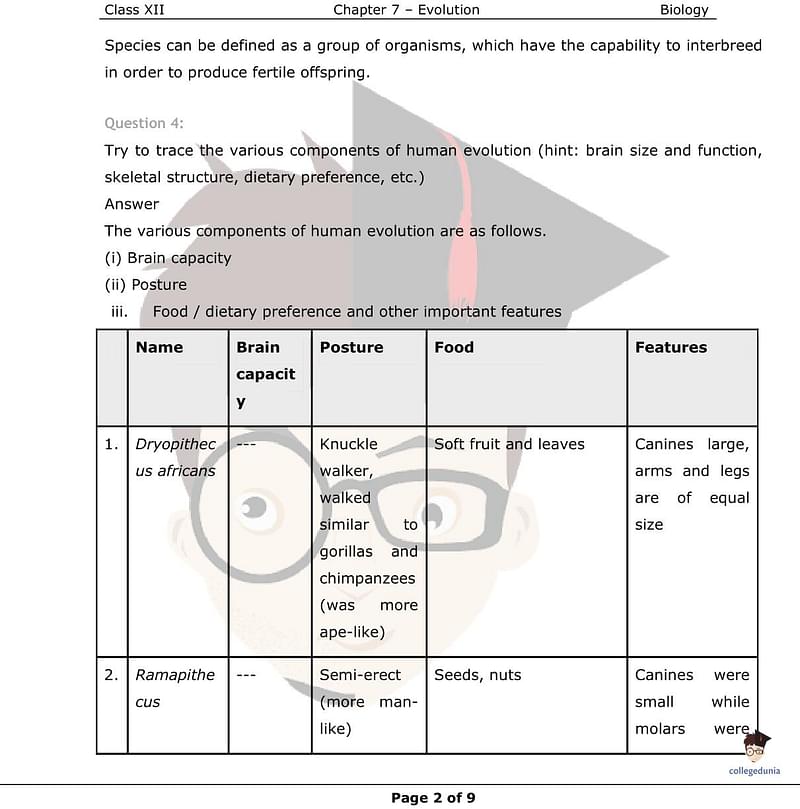
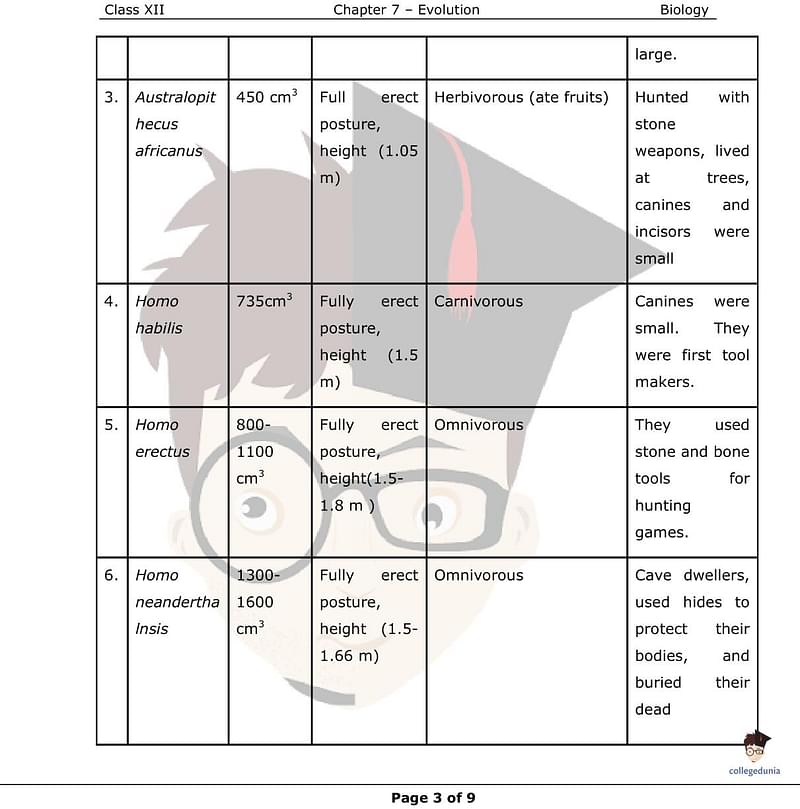
Evolution refers to a theory describing the growth and the change in the characteristics of a species as it moves from generation to generation. The growth of the species depends on the natural selection process of organisms. The important topics that are covered in this chapter are:

  • Origin of Life

The origin of life begins with the origin of the universe. The universe, an old vast, and empty space comprising galaxies originated around 20 billion years ago. According to some experts, life came from outer space as spores while another set of experts explained that life came from a non-cellular component such as decaying matters like mud. The latter theory came to be considered as the theory of spontaneous generation, which was discarded later.

  • Biological Evolution

Evolutionary biology is considered to be a branch of biology that deals with the processes that are responsible for the evolution and diversity of life on earth. It includes from the very first ancestor to all life on earth to the very first modern human ancestor.

  • Darwin’s Contribution

Carles Darwin, the father of evolution, has a large contribution to the establishment of the theory of evolution. His theory helped in removing all the conventional old beliefs which said that the formation of various species was a supernatural phenomenon or act of the Almighty.


Also Read:

Check-Out: 

CBSE CLASS XII Related Questions

  • 1.
    Assertion (A) : The milk produced by transgenic cow 'Rosie' was nutritionally more balanced product for human babies than natural cow milk.
    Reason (R) : It was human protein enriched milk containing human alpha lactalbumin.

      • Both Assertion (A) and Reason (R) are true and Reason (R) is the correct explanation of the Assertion (A).
      • Both Assertion (A) and Reason (R) are true, but Reason (R) is not the correct explanation of the Assertion (A).
      • Assertion (A) is true, but Reason (R) is false.
      • Assertion (A) is false, but Reason (R) is true.

    • 2.

      In an ecosystem, different species occupy different levels and vertical distribution of species is found. This is called ______. 
       

        • Stratification
        • Layering
        • Fragmentation
        • Population

      • 3.
        Which of the following statements about plasmids is incorrect?

          • Plasmids have the ability to replicate within the bacterial cell.
          • Their replication is controlled by chromosomal DNA.
          • They are autonomously replicating circular extra-chromosomal DNA.
          • They often carry antibiotic resistant genes.

        • 4.
          In the following figure, two ways of pairing of two homologous pairs of chromosomes are shown. Which of the following phenomena is expressed?

            • Linkage of genes
            • Independent assortment of genes
            • Multiple alleles
            • Incomplete dominance

          • 5.
            The idea of use and disuse of organs for evolution of organism was proposed by

              • Charles Darwin
              • Thomas Malthus
              • Hugo De Vries
              • Lamarck

            • 6.
              Assertion (A): The embryo with 8 to 16 blastomeres is called a morula.
              Reason (R): The morula continues to divide and transform into trophoblast.

                • Both Assertion (A) and Reason (R) are true and Reason (R) is the correct explanation of the Assertion (A).
                • Both Assertion (A) and Reason (R) are true, but Reason (R) is not the correct explanation of the Assertion (A).
                • Assertion (A) is true, but Reason (R) is false.
                • Assertion (A) is false, but Reason (R) is true.
              CBSE CLASS XII Previous Year Papers

              Comments


              No Comments To Show