



Education Journalist | Study Abroad Strategy Lead
NCERT Solutions for Class 10 Maths Chapter 1 – Real Numbers are provided in this article. Real numbers in the number system are the set of rational and irrational numbers. Real numbers can be expressed in the number line and arithmetic operations can also be operated on them. The average number of questions that are asked from this chapter is usually 3.
Class 10 Maths Chapter 1 Real numbers belong to Unit 1 Number Systems which has a weightage of 10 marks in the Class 10 Maths Examination. NCERT Solutions for Class 10 Maths for Chapter 1 covers two important properties of positive integers which are Euclid's Division Lemma algorithm and the Fundamental Theorem Of Arithmetic.
Download PDF: NCERT Solutions for Class 10 Maths Real Numbers
NCERT Solutions for Class 10 Maths Chapter 1
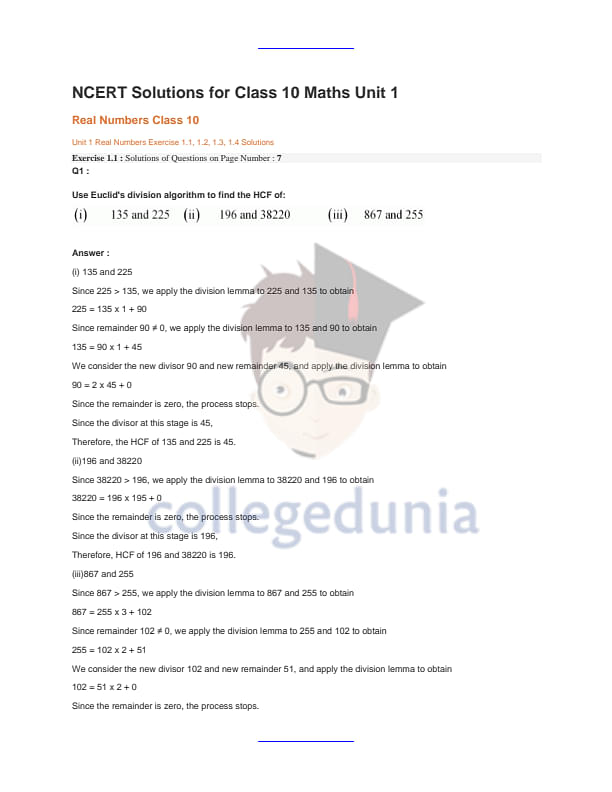
The Chapter 1 Class 10 Maths are given below –


Important Topics in Class 10 Maths Chapter 1 Real Numbers
Real Numbers is an important chapter of Class 10 Maths. The main topics of the chapter include –
- Euclid’s Division Lemma states that for any two integers a and b, there exists a unique pair of integers q and r such that a = b × q + r and 0 ≤ r < b.
| This lemma is equivalent to: Dividend = Divisor × Quotient + Remainder In other words, for a pair of dividend and divisor, the remainder and the quotient obtained are unique. |
- Prime Factorisation is the method of expressing a natural number as a product of different prime numbers.
| For example: 36 = 2 × 2 × 3 × 3 is the prime factorisation of 36. |
- Fundamental Theorem of Arithmetic states that the prime factorisation for a given number is unique if the arrangement of the prime factors is ignored.
| For example: 36 = 2 × 2 × 3 × 3 or, 36 = 2 × 3 × 2 × 3 |
- For any 2 positive integers a and b, a × b = H.C.F × L.C.M.
| For example, For 36 and 56, the HCF is 4 and the LCM is 504 36 × 56 = 2016 4 × 504 = 2016 Therefore, 36 × 56 = 4 × 504 |
- Rational numbers are the numbers that can be written in the p/q form, where p and q are integers and q ≠ 0.
| For example – 1/2, 4/5, 3/4, etc. |
NCERT Solutions For Class 10 Maths Chapter 1 Exercises:
The detailed solutions for all the NCERT Solutions for Real Numbers under different exercises are as follows:
Real Numbers – Related Topics:
CBSE Class 10 Mathematics Study Guides:




Comments