NCERT Solutions for Class 10 Maths Chapter 1 Real Numbers Exercise 1.2

Jasmine Grover logo

Jasmine Grover

Education Journalist | Study Abroad Strategy Lead

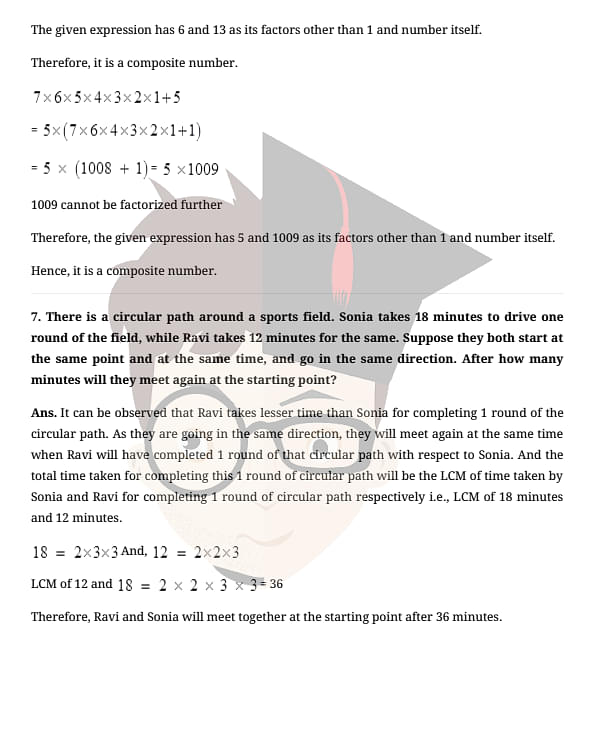
NCERT Solutions for Class 10 Maths Chapter 1 Real Numbers Exercise 1.2 is covered in this article with a detailed explanation. Chapter 1 Real Numbers Exercise 1.2 deals with the fundamental theorem of arithmetic. The 7 questions of the exercise cover the concept of factorization of composite numbers.

Download PDF NCERT Solutions for Class 10 Maths Chapter 1 Exercise 1.2

Check out the solutions of Class 10 Maths NCERT Solutions for Chapter 1 Real Numbers Exercise 1.2

Read More: NCERT Solutions For Class 10 Maths Real Numbers

Check out other exercise solutions of Class 10 Maths Chapter 1 Real Numbers

Also Read:

Also Read:

CBSE X Related Questions

  • 1.
    Prove that \(2 + 3\sqrt{5}\) is an irrational number given that \(\sqrt{5}\) is an irrational number.


      • 2.
        Three tennis balls are just packed in a cylindrical jar. If radius of each ball is \(r\), volume of air inside the jar is

          • \(2\pi r^3\)
          • \(3\pi r^3\)
          • \(5\pi r^3\)
          • \(4\pi r^3\)

        • 3.
          Prove that: \(\frac{\sec^3 \theta}{\sec^2 \theta - 1} + \frac{\csc^3 \theta}{\csc^2 \theta - 1} = \sec \theta \cdot \csc \theta (\sec \theta + \csc \theta)\)


            • 4.
              A conical cavity of maximum volume is carved out from a wooden solid hemisphere of radius 10 cm. Curved surface area of the cavity carved out is (use \(\pi = 3.14\))

                • \(314 \sqrt{2}\) \(\text{cm}^{2}\)
                • \(314\) \(\text{cm}^{2}\)
                • \(\frac{3140}{3}\) \(\text{cm}^{2}\)
                • \(3140 \sqrt{2}\) \(\text{cm}^{2}\)

              • 5.
                For any natural number n, \( 5^n \) ends with the digit :

                  • 0
                  • 5
                  • 3
                  • 2

                • 6.
                  PQ is tangent to a circle with centre O. If \(OQ = a\), \(OP = a + 2\) and \(PQ = 2b\), then relation between \(a\) and \(b\) is

                    • \(a^2 + (a + 2)^2 = (2b)^2\)
                    • \(b^2 = a + 4\)
                    • \(2a^2 + 1 = b^2\)
                    • \(b^2 = a + 1\)

                  Comments


                  No Comments To Show