


NCERT Solutions for Class 10 Maths Chapter 1 Real Numbers Exercise 1.3

Jasmine Grover logo

Jasmine Grover

Education Journalist | Study Abroad Strategy Lead

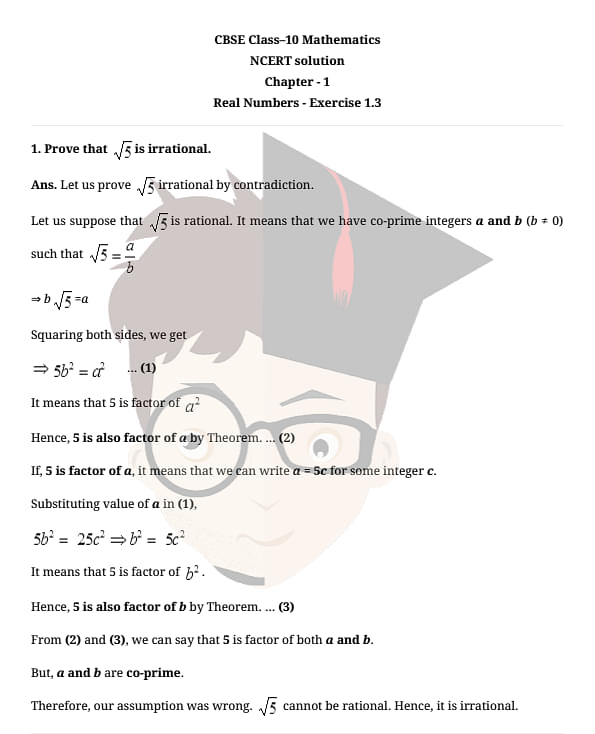
NCERT Solutions for Class 10 Maths Chapter 1 Real Numbers Exercise 1.3 is covered in this article with a detailed explanation. Chapter 1 Real Numbers Exercise 1.3 deals with proving that root p is irrational. The 3 questions of the exercise cover the concept of irrational numbers

Download PDF NCERT Solutions for Class 10 Maths Chapter 1 Exercise 1.3

Check out the solutions of Class 10 Maths NCERT solutions chapter 1 Real Numbers Exercise 1.3
Read More: NCERT Solutions For Class 10 Maths Real Numbers

Check out other exercise solutions of Class 10 Maths Chapter 1 Real Numbers

Also Read:

Also Read:

CBSE X Related Questions

  • 1.
    Prove that \(2 + 3\sqrt{5}\) is an irrational number given that \(\sqrt{5}\) is an irrational number.


      • 2.
        An ice-cream cone of radius \(r\) and height \(h\) is completely filled by two spherical scoops of ice-cream. If radius of each spherical scoop is \(\frac{r}{2}\), then \(h : 2r\) equals

          • \(1 : 8\)
          • \(1 : 2\)
          • \(1 : 1\)
          • \(2 : 1\)

        • 3.
          Assertion (A) : \((\sqrt{3} + \sqrt{5})\) is an irrational number.
          Reason (R) : Sum of the any two irrational numbers is always irrational.

            • Both Assertion (A) and Reason (R) are true and Reason (R) is the correct explanation of the Assertion (A).
            • Both Assertion (A) and Reason (R) are true, but Reason (R) is not the correct explanation of Assertion (A).
            • Assertion (A) is true, but Reason (R) is false.
            • Assertion (A) is false, but Reason (R) is true.

          • 4.
            Solve the linear equations \(3x + y = 14\) and \(y = 2\) graphically.


              • 5.
                For any natural number n, \( 5^n \) ends with the digit :

                  • 0
                  • 5
                  • 3
                  • 2

                • 6.
                  A conical cavity of maximum volume is carved out from a wooden solid hemisphere of radius 10 cm. Curved surface area of the cavity carved out is (use \(\pi = 3.14\))

                    • \(314 \sqrt{2}\) \(\text{cm}^{2}\)
                    • \(314\) \(\text{cm}^{2}\)
                    • \(\frac{3140}{3}\) \(\text{cm}^{2}\)
                    • \(3140 \sqrt{2}\) \(\text{cm}^{2}\)

                  Comments


                  No Comments To Show


