NCERT Solutions for Class 9 Maths Chapter 7 Triangles Exercise 7.5 Solutions

Collegedunia Team logo

Collegedunia Team

Content Curator

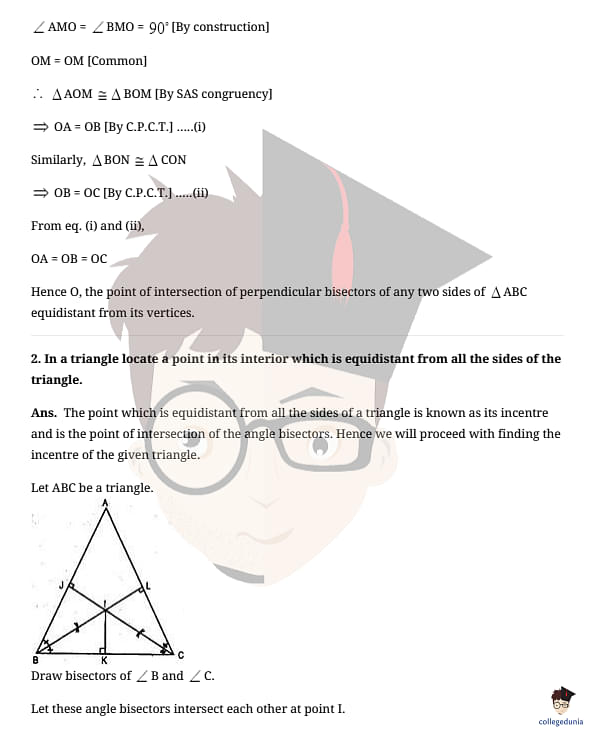
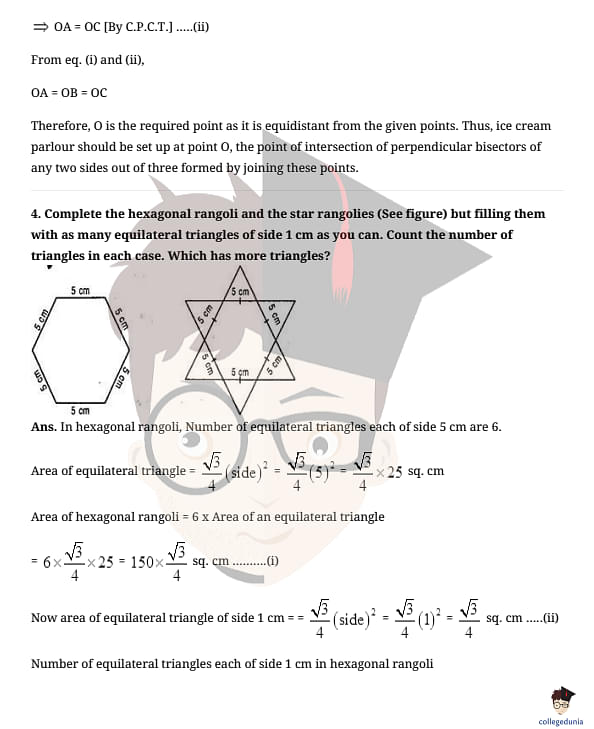
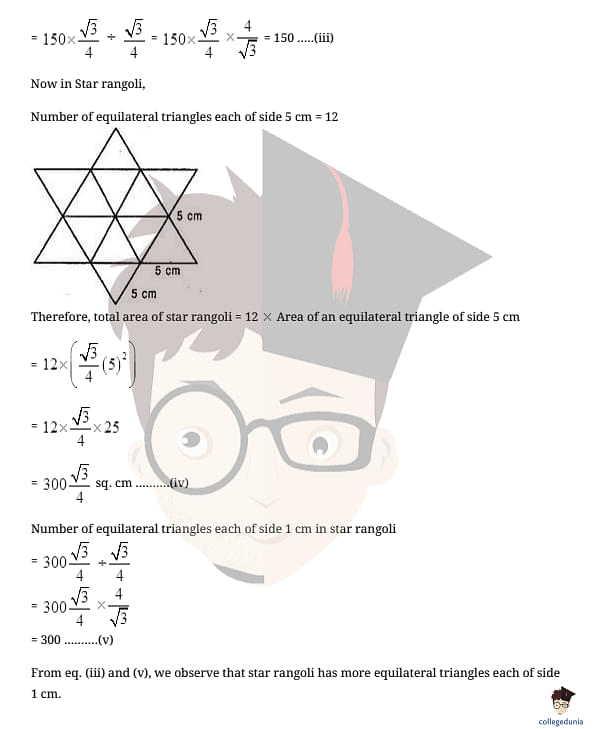
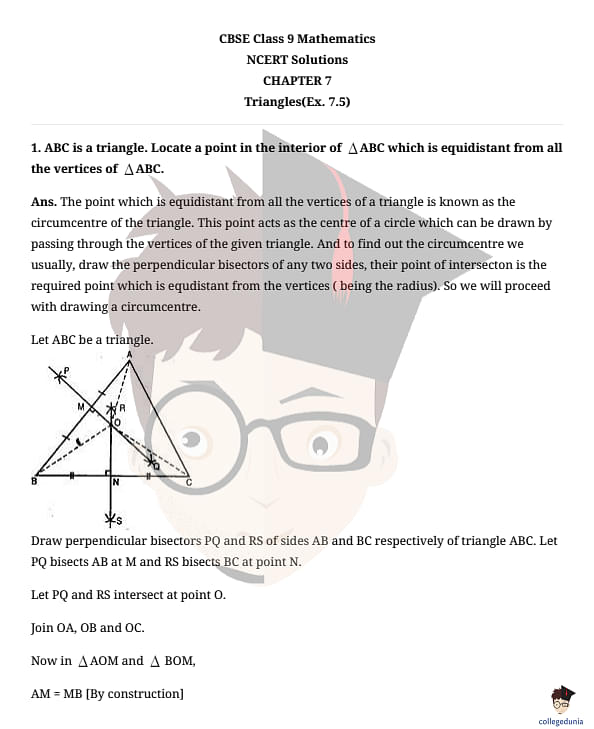
NCERT Solutions for Class 9 Maths Chapter 7 Triangles Exercise 7.5 Solutions are based on the summary of previous exercises, like SAS Congruence Rule, ASA Congruence Rule, AAS Congruence Rule, SSS Congruence Rule, RHS Congruence Rule and Properties of Triangle.

Download PDF: NCERT Solutions for Class 9 Maths Chapter 7 Exercise 7.5 Solutions

Check out NCERT Solutions for Class 9 Maths Chapter 7 Exercise 7.5 Solutions
Read More: NCERT Solutions For Class 9 Maths Chapter 7 Triangles

Exercise Solutions of Class 9 Maths Chapter 7 Triangles 

Also check other Exercise Solutions of Class 9 Maths Chapter 7 Triangles

Also Check:

Also check:

CBSE X Related Questions

  • 1.
    Assertion (A) : \((\sqrt{3} + \sqrt{5})\) is an irrational number.
    Reason (R) : Sum of the any two irrational numbers is always irrational.

      • Both Assertion (A) and Reason (R) are true and Reason (R) is the correct explanation of the Assertion (A).
      • Both Assertion (A) and Reason (R) are true, but Reason (R) is not the correct explanation of Assertion (A).
      • Assertion (A) is true, but Reason (R) is false.
      • Assertion (A) is false, but Reason (R) is true.

    • 2.
      The dimensions of a window are 156 cm \(\times\) 216 cm. Arjun wants to put grill on the window creating complete squares of maximum size. Determine the side length of the square and hence find the number of squares formed.


        • 3.
          Prove that \(2 + 3\sqrt{5}\) is an irrational number given that \(\sqrt{5}\) is an irrational number.


            • 4.
              PQ is tangent to a circle with centre O. If \(OQ = a\), \(OP = a + 2\) and \(PQ = 2b\), then relation between \(a\) and \(b\) is

                • \(a^2 + (a + 2)^2 = (2b)^2\)
                • \(b^2 = a + 4\)
                • \(2a^2 + 1 = b^2\)
                • \(b^2 = a + 1\)

              • 5.
                Prove that: \(\frac{\sec^3 \theta}{\sec^2 \theta - 1} + \frac{\csc^3 \theta}{\csc^2 \theta - 1} = \sec \theta \cdot \csc \theta (\sec \theta + \csc \theta)\)


                  • 6.
                    A conical cavity of maximum volume is carved out from a wooden solid hemisphere of radius 10 cm. Curved surface area of the cavity carved out is (use \(\pi = 3.14\))

                      • \(314 \sqrt{2}\) \(\text{cm}^{2}\)
                      • \(314\) \(\text{cm}^{2}\)
                      • \(\frac{3140}{3}\) \(\text{cm}^{2}\)
                      • \(3140 \sqrt{2}\) \(\text{cm}^{2}\)

                    Comments


                    No Comments To Show