



Content Curator
Rational and irrational numbers are both real numbers but different in terms of their properties. The rational number is the one that can be represented as P / Q where P and Q are integers and Q ≠ 0. Irrational numbers, on the other hand, are those numbers which can not be represented in the form of fractions. \( 2\over3\) is an example of rational numbers while √2 is an irrational number. Real numbers include a whole list of rational and irrational numbers.
Check out: Maths Study Material
| Table of Content |
Key Takeaways: Rational Numbers, Irrational Numbers, Whole Numbers, Real Numbers, Coprime, Integers
What is a Rational Number?
[Click Here for Sample Questions]
Rational numbers are the most common type of number we often read after whole numbers. These numbers are in the form of p/q, where p and q can be any integers and q ≠ 0. People often find it difficult to distinguish between fractions and rational numbers because of the basic numerical structure, i.e. p/q form. Fractions are made up of whole numbers while rational numbers are made up of integers with a non-zero denominator.
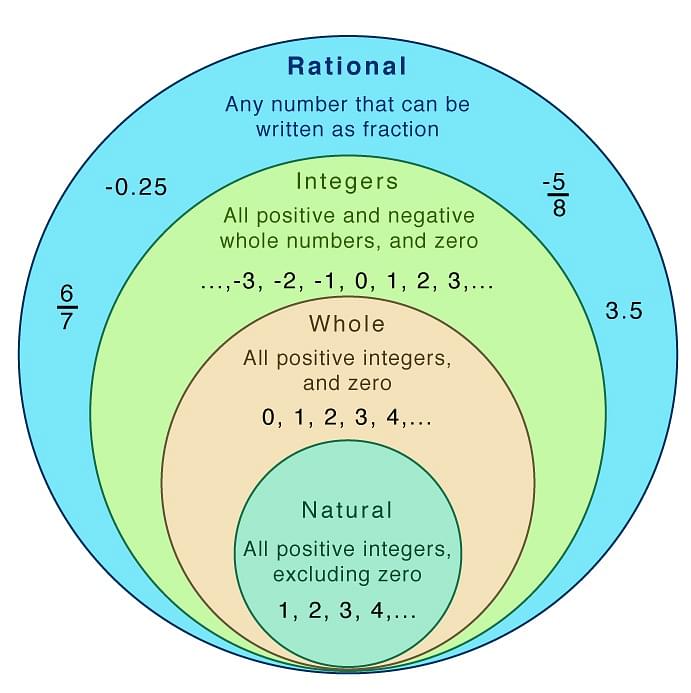
Rational Numbers
What is an Irrational Number?
[Click Here for Sample Questions]
An irrational number is a number that can not be expressed as a p/q fraction of any integers p and q. Irrational numbers have a decimal extension that is continuous or intermittent. Every transcendental number is irrational. Irrational numbers are those real numbers that can be represented in a standard way. In other words, those real numbers that are not rational numbers are known as irrational numbers. For example, \(?2\) and π is an irrational number, where the value of π = 3.14.
Also Read:
Difference Between Rational and Irrational Numbers
[Click Here for Sample Questions]
The key differences between rational and irrational numbers are given below:
| Rational Numbers | Irrational Numbers |
|---|---|
| Rational numbers are expressed in the form of ratios, where numerator and denominator are the integers. | Irrational numbers cannot be expressed in the form of the ratio of two integers or fractions. |
| It consists of perfect squares. | Irrational numbers include surds. |
| In rational numbers, decimals are finite. | In irrational numbers, decimals are non-terminating and non-repeating. |
Properties of Rational and Irrational Numbers
[Click Here for Sample Questions]
There are some basic rules for rational and irrational numbers, these rules are as follows:
Rule 1: The sum of two rational numbers will always be a rational number.
For example, ½ + 3/2 = 4/2 = 2
Rule 2: The product of two rational numbers will be a rational number too.
For example,\(2\over3\)× ½ = 2/6
Rule 3: The sum of two irrational numbers will not be necessarily an irrational number.
For example,
(i) √2 + √2 = 2√2 , which is an irrational number.
(ii) 2 + 2√5 + (-2√5) = 2, which is a rational number.
Rule 4: The product of two irrational numbers is not always necessarily an irrational number.
For example,
(i) √2 × √3 = √6, is an irrational number.
(ii) √2 × √2 = √4 = 2, is a rational number.
Things to Remember
[Click Here for Sample Questions]
- Rational numbers can also be presented in the form of decimals.
- Natural numbers, whole numbers, integers, fractions, and decimals are all rational numbers.
- Non-terminating decimals with repetitive patterns are also rational numbers.
- In addition, subtraction, multiplication, and division of two irrational numbers, result may or may not be a rational number.
- In any of the two irrational numbers, their odd multiplication (LCM) may or may not be present.
Also Read:
Sample Questions
Ques. Give two examples of irrational numbers. (3 Marks)
Ans. i. \(\pi\)(pi) is an irrational number. π = 3⋅14159265… The decimal value here never stops. Since the value ? is closer to 22/7, we take the value of pi as 22/7 or 3.14 (Note: 22/7 is a rational number.)
- √2 is an irrational number. Consider an isosceles triangle with right angles, with two equal sides AB and BC of 1 unit length. In Pythagoras' theory, the hypotenuse AC will be √2. So, √2 = 1⋅414213….
Ques. Find a rational number between ½ and ?. (3 Marks)
Ans. First, we need to take the average of these two rational numbers -
½ + \( 2\over 3\) / 2
= 3/6 + 4/6 / 2
= 7/6 / 2
= 7/6 × ½
= 7/12
So, 7/12 is a rational number between ½ and \(2\over3 \).
Ques. Is 3.14 a rational number? (2 Marks)
Ans. Yes, 3.14 is a rational number as it is a terminating decimal point. But note that π is NOT a rational number because the exact π is not 22/7. Its value is 3.141592653589793238… with decimal but it has no recurring decimal patterns.
Ques. Name the properties of rational numbers. (2 Marks)
Ans. There are six properties of rational numbers -
- Closure property
- Commutative property
- Associative property
- Distributive property
- Multiplicative property
- Additive property
Ques. How to identify an irrational number? (3 Marks)
Ans. We know that irrational numbers are the real numbers that can not be expressed in terms of p/q. For example, √5 and √3, etc. are irrational numbers. On the other hand, numbers that can be represented by p/q, where p and q are integers and q ≠ 0, the numbers are rational.
Ques. Write 3 uses of irrational numbers. (3 Marks)
Ans. The three uses of irrational numbers are -
- The infinite number ‘pi’ is used to calculate the location of different geometric shapes in real life, to predict the correct distances, and many other uses available.
- Euler’s ‘e’ number is used in the adoption of multiple physics formulas to prove more evidence.
- Irrational numbers cannot be expressed in the form of hexadecimal, decimal, binary, or any other format.
Ques. Give any two irrational numbers between √11 and √15. (3 Marks)
Ans. First, we need to find out the square roots of √11 and √15
Square roots-
√11 = 11
√15 = 15
So there are 12, 13, and 14 between 11 and 15.
Picking any two results,
So, the two irrational numbers between √11 and √15 are √12 and √13.
Ques. Is 6 a fraction or a rational number? (2 Marks)
Ans. 6 is both a fraction and a rational number.
As the fractional representation of 6 = 12/2, which is a positive number ratio. So it is a fraction.
Also, 6 is a rational number too.
For Latest Updates on Upcoming Board Exams, Click Here: https://t.me/class_10_12_board_updates
Check-Out:



Comments