



Content Curator
The NCERT Solutions for class 9 Maths Chapter 1 Number Systems are provided in the article.
Class 9 Maths Chapter 1 Number Systems belong to Unit 1 Number Systems which has a weightage of 10 marks in the Class 9 Maths Examination. NCERT Solutions for Class 9 Maths for Chapter 1 cover the following important concepts:
- Rationalize the denominator
- Irrational Numbers
- Addition And Subtraction Of Integers
- Relation between HCF and LCM
- Decimal expansion of rational numbers
Download: NCERT Solutions for Class 9 Mathematics Chapter 1 pdf
NCERT Solutions for Class 9 Maths Chapter 1
The Chapter 1 Class 9 Maths are given below:

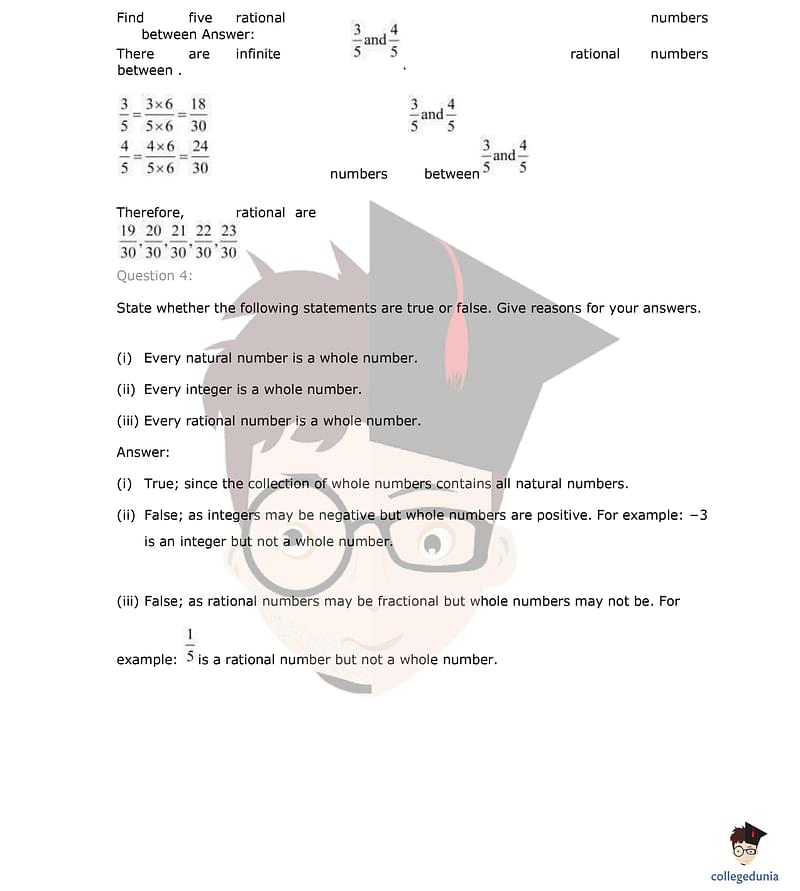

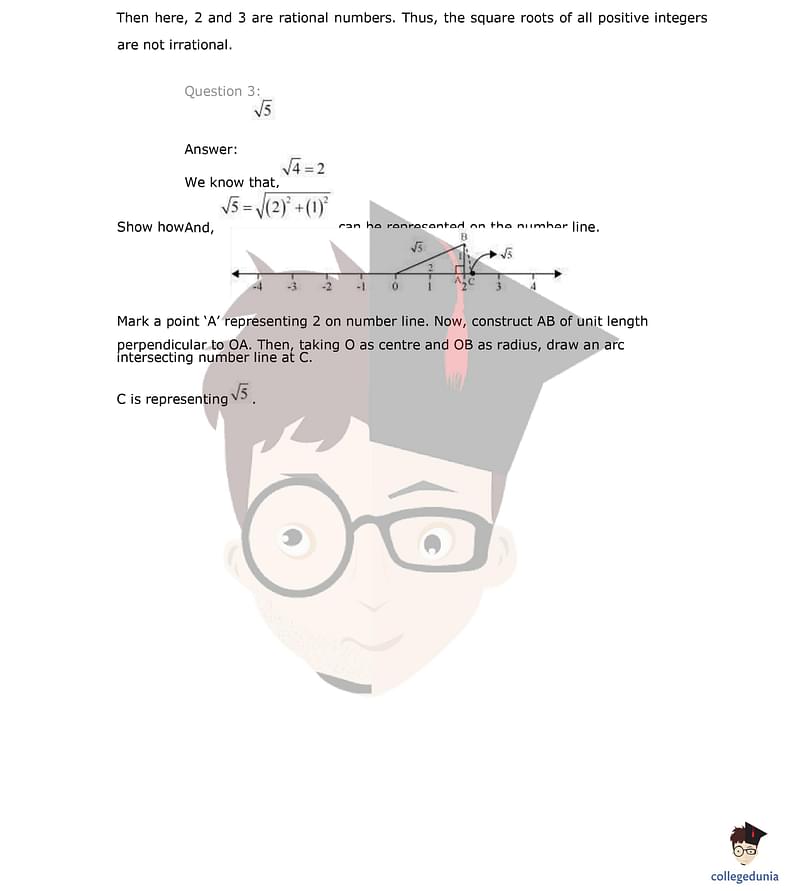


Important Topics in Class 9 Maths Chapter 1 Number Systems
Important Topics in Class 9 Maths Chapter 1 Number Systems are elaborated below:
Polynomial in One Variable
Polynomials in one variable are algebraic expressions. These are in the form of axn where n is a non-negative (i.e. positive or zero) integer and a is a real number, called the coefficient of the term.
| Examples of polynomials in one variable:
|
Degree of a Polynomial
The degree of a polynomial in one variable is the largest exponent in the polynomial.
| Example: Determine the leading coefficient and the degree of the polynomial of the following expression 5x2 - 20x - 20. Solution: Given a polynomial expression, 5x2 - 20x - 20. Highest exponent of the variable x is 2; thus, degree of expression is 2. Coefficient with the highest exponent will be the leading coefficient of the expression; thus, the leading coefficient is 5. Therefore, Degree = 2 and Leading Coefficient = 5 |
Monomials, Binomials, Trinomials
- Monomial: A polynomial with exactly one term.
- Binomial: A polynomial with exactly two terms.
- Trinomial: A polynomial with exactly three terms.
| Examples:
|
Zeros of a Polynomial
Zeros of polynomial are values of the variable so that the polynomial equals 0 at that point.
| Example: Sam knows that the zeros of a quadratic polynomial are -3 and 5. How can we help to find the equation of the polynomial? Solution: Zeros of the quadratic polynomial are -3 and 5. Let α = -3, and β = 5 Then, we have the sum of the roots = α + β = 2 Product of the roots = α.β = -15 The required quadratic equation is x2 - (α + β)x + α.β = 0 x2 - 2(x) + (-15) = 0 x2 - 2x - 15 = 0 Therefore, equation of the quadratic polynomial is x2 - 2x - 15 = 0 |
NCERT Solutions for Class 9 Maths Chapter 1 Exercises:
The detailed solutions for all the NCERT Solutions for Number Systems under different exercises are:
- NCERT Solutions for Class 9 Maths Chapter 1 Number Systems Exercise 1.1 Solutions
- NCERT Solutions for Class 9 Maths Chapter 1 Number Systems Exercise 1.2 Solutions
- NCERT Solutions for Class 9 Maths Chapter 1 Number Systems Exercise 1.3 Solutions
- NCERT Solutions for Class 9 Maths Chapter 1 Number Systems Exercise 1.4 Solutions
- NCERT Solutions for Class 9 Maths Chapter 1 Number Systems Exercise 1.5 Solutions
- NCERT Solutions for Class 9 Maths Chapter 1 Number Systems Exercise 1.6 Solutions
Also check:
Check out:



Comments