



Education Journalist | Study Abroad Strategy Lead
Number system is the system of representing numbers using digits or other symbols such as alphabets. A number is a mathematical value that helps in counting or measuring objects. The value of any digit in a number system is determined by the digit itself, its position in the number, and the base value of the number system. The numbers are represented in a unique manner and help in performing different arithmetic operations like addition, subtraction, and division. There are different types of number systems in Maths such as binary number systems, decimal number systems, octal number systems, and hexadecimal number systems.
Related Links
- Appearing for JEE Main, Download JEE Mains PYQ for all sabjects
- Appearing for CUET, Download CUET PYQ for all subjects
Key takeaways: Number system; Rational numbers; Irrational numbers; Decimal system; Conversion rules, binary number system
What are Number Systems?
[Click Here for Sample Questions]
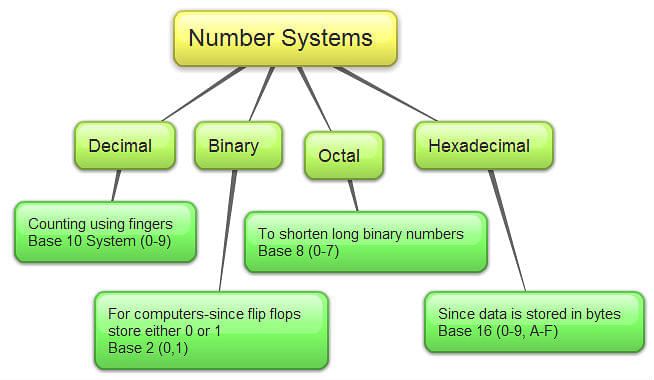
Number system is a system of expressing numbers of a given set using digits or symbols. The numbers are used as digits with 0 and 1 being the most common ones that are used to represent binary numbers. The remaining digits from 0 to 9 are used to represent various other types of number systems.
Read More:
Types Of Number System
[Click Here for Sample Questions]
Number System is of four types which are:
Decimal Number System
Number system with a base value of ten is termed the Decimal number system.
- It uses the 10 digits: 0-9.
- Each digit is at a place in the number with a place value of a product of different powers of 10.
- The place value is determined from right to left in the number as the first place value called units, the second as tens, and so on.
- The decimal number system is the most commonly used number system in day-to-day life.
- If any number is represented without a base, its base can be taken as 10.
Place value: Units -100, tens-101, hundreds-102, thousands-103, and so on.

Place Value of Decimal Number System
Example of Decimal Number System10286 has place values as (1 × 10⁴) + (0 × 103) + (2 × 10²) + (8 × 101) + (6 × 100) 1 × 10000 + 0 × 1000 + 2 × 100 + 8 × 10 + 6 × 1 10000 + 0 + 200 + 80 + 6 10286 |
Also Read: Trigonometric Functions
Binary Number System
Number System that uses base value 2 (two) is termed a Binary number system.
- The binary number system uses 2 digits: 0 and 1 for the creation of numbers.
- The numbers formed using 0 and 1 are binary numbers.
- The binary number system is used in electronic devices and computer systems.
- Digits 0 and 1 are known as bits while 8 bits together form a byte.
Decimal Numbers 0-9 are represented in the binary system as: 0, 1, 10, 11, 100, 101, 110, 111, 1000, and 1001, respectively.
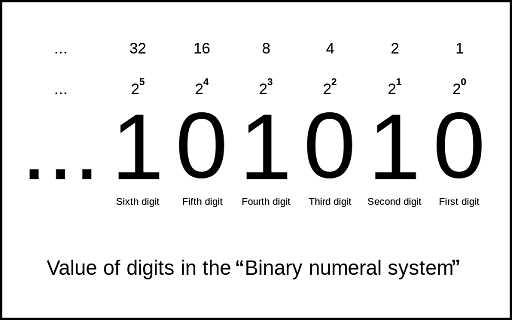
Binary Number System
Example of Binary Number SystemWrite (14)10 as a binary number. Solution:
Therefore, we get (14)10 = 11102. |

Read More: Binary Addition
Octal Number System
In the octal number system, the base value 8 (eight) is used.
- The Octal number system uses 8 digits: 0-7 for the creation of Octal Numbers.
- The conversion of octal numbers to decimal values is done by multiplying each digit in the number with the place value and then adding the result.
- The place values are 80, 81, 82, etc.
- This number system has lesser digits as compared to other systems, therefore it has fewer computational errors.
- Digits such as 8 and 9 are not included in the octal number system.
- It is used in minicomputers with digits from 0 to 7
Octal Number System – Solved ExampleExample: Convert 2158 into decimal. Solution: 2158 = 2 × 82 + 1 × 81 + 5 × 80 = 2 × 64 + 1 × 8 + 5 × 1 = 128 + 8 + 5 = 14110 |
Also Read:
Hexadecimal Number System
Hexadecimal Number System has a base value of 16. It uses 16 digits: 0-16 for the creation of its numbers.
- Digits 0,1,2,3,4,5,6,7,8,9 are taken as digits in the decimal number system but the digits from 10-15 are represented by the alphabet A-F.
- 10 is represented as A, 11 as B, 12 as C, 13, and so on.
| The numbers in the hexadecimal number system can be represented as –
|
Read More: Decimal to Hex Conversion
Number System Conversion Rules
[Click Here for Sample Questions]
Conversion rules to be followed while conversion of the number system is as follows –
Decimal number system to Other Base System
- Step 1: Divide the decimal number by the new base value.
- Step 2: Remainder from Step 1 is taken as the rightmost digit (least significant digit) of the new base number.
- Step 3: The quotient of the previous division is again divided by the new base.
- Step 4: Remainder from Step 3 is taken as the next digit of the new base number.
Steps 3 and 4 are repeated until the quotient becomes zero in Step 3.
The last remainder is the Most Significant Digit of the new base number.
Example: Decimal Number: 2910
Calculating Binary Equivalent −
| Step | Operation | Result | Remainder |
|---|---|---|---|
| Step 1 | 29/ 2 | 14 | 1 |
| Step 2 | 14/ 2 | 7 | 0 |
| Step 3 | 7/ 2 | 3 | 1 |
| Step 4 | 3/ 2 | 1 | 1 |
| Step 5 | 1/ 2 | 0 | 1 |
In steps 2 and 4, the remainders are arranged in reverse order. Thus, the first remainder is the Least Significant Digit and the last remainder is the Most Significant Digit.
Decimal Number: 2910 = Binary Number: 111012
Read More: Number System Important Questions
Other Base System to Decimal System
The conversion process from another base system to a decimal number system is as follows –
- Step 1: The positional value of each digit is determined.
- Step 2: The obtained positional values (in Step 1) are multiplied by the digits in the corresponding position.
- Step 3: The products calculated in Step 2 are added. The total is the equivalent value in the decimal system.
Example: Binary Number: 111012
Calculating Decimal Equivalent
| Steps | Binary Number | Decimal Number |
|---|---|---|
| Step 1 | 111012 | [(1 × 24) + (1 × 23) + (1 × 22) + (0 × 21) + (1 × 20)]10 |
| Step 2 | 111012 | (16 + 8 + 4 + 0 + 1)10 |
| Step 3 | 111012 | 2910 |
Binary Number: 111012 = Decimal Number: 2910
Also Read: Binary to Octal Conversion
Other Base System to Non-Decimal Number System
- Step 1: Original number is converted to a decimal number
- Step 2: The decimal number is converted to the new base number.
Example: Octal Number - 258
Calculating Binary Equivalent:
Step 1- Convert to Decimal
| Step | Octal Number | Decimal Number |
|---|---|---|
| Step 1 | 258 | [(2 × 81) + (5 × 80)]10 |
| Step 2 | 258 | (16 + 5 )10 |
| Step 3 | 258 | 2110 |
Octal Number: 258 = Decimal Number: 2110
Step 2- Convert Decimal to Binary
| Step | Operation | Result | Remainder |
|---|---|---|---|
| Step 1 | 21 / 2 | 10 | 1 |
| Step 2 | 10 / 2 | 5 | 0 |
| Step 3 | 5 / 2 | 2 | 1 |
| Step 4 | 2 / 2 | 1 | 0 |
| Step 5 | 1 / 2 | 0 | 1 |
Decimal Number- 2110 = Binary Number → 101012
Octal Number- 258 = Binary Number → 101012
Also Read:
Different Numbers in Number Systems
The various types of numbers used in the number system are as follows:
Natural numbers: Numbers from 1 to infinity are known as Natural numbers. They are denoted by ‘N’.
N = {1, 2, 3, 4......}
Whole Numbers: Numbers from 0 (zero) to infinity are known as Whole numbers. They are denoted by ‘W’.
W = {0, 1, 2, 3, 4,5 ......}

Number System
Integers: The collection of all the natural numbers, negative of natural numbers, and zero are called Integers. Integers are denoted by ‘Z’ or ‘I’.
Z or I = {...... -5, -4, –3, –2, –1,0,1,2,3,4,5 ......}
Rational Number: A number that can be expressed in fraction as p/q where q ≠ 0. A Rational number is denoted by ‘Q’.
Q = {1/3, 1/5, 1/8,.....}
Irrational Number: A number that can’t be expressed in the form of fraction p/q and its decimal form is non-terminating and non-repeating is known as an irrational number.
Example: √3, π, 1.732, and √2 is an irrational number
Things to Remember
- All-natural numbers are whole numbers but vice versa is not true.
- Natural numbers are a subset of integers.
- The addition, subtraction, and multiplication of two rational numbers always result in a rational number.
- Numbers in the computer system are represented in the number system.
- Decimal numbers are those with the base or radix of 10.
- Binary numbers are represented in 0 and 1.
- Octal Numbers have a base value of 8.
- Hexadecimal numbers have a base value of 16.
Sample Questions
Ques: Find decimal number: (101101)2 (2 marks)
Ans: (1101)2
Following the steps mentioned above,
1 x 23 + 1 x 22 + 0 x 21 + 1 x 20
= 1 x 8 + 1 x 4 + 0 x 2 + 1 x 1
= 8 + 4 + 1
= (13)10
Ques: (24)8 in decimal. (2 marks)
Ans: (24)8
=2×81+4×80
= (20)10
Ques: Convert 2116 to decimal number. (2 marks)
Ans: 2116 to decimal number.
Following steps mentioned above
2 x 161 + 1 x 160
= 2 x 16 + 1 x 1
= 3310
Therefore, 12116 = 3310
Ques: Convert (89)16 into a binary number (2 marks)
Ans: As we know, 8 = 1000 and 9 = 1001 in binary system.
Therefore, (89)16 = (10001001)2
Ques: Convert 1310 to binary (2 marks)
Ans: Divide 13 by 2 13/2 = 6 and remainder 1
6/2 = 3 and remainder is 0
3/2 = 1 and remainder is 1
1/2 = 0 and remainder is 1.
So, remainders in the order: 1011
So, the binary number is (1011)2
Ques: Express 0.66666…… in the form p/q, where p and q are integers and q ≠ 0. (2 marks)
Ans: 0.66666……
Let, x = 0.66666……
10x = 6.666….
10x – x = (6.6666…..) – (0.66666……..)
9x = 6
x = 6/9
x = 2/3
Thus, 0.6666… is 2/3 in p/q form.
Ques: Represented √5 on the number line. (2 marks)
Ans: We know that, √4 = 2
\(\sqrt{5} = \sqrt{(2)^2 + (1)^2}\)

Point ‘A’ represents 2 on the number line. AB of unit length perpendicular to OA constructed. Taking O as centre and OB as radius, an arc intersecting number line at C is drawn, representing √5.
Ques. Is zero a rational number? Can you write it in the form p/ q , where p and q are integers and q ≠0? (2 marks)
Ans. Yes, zero is a rational number; it can be written in the form p/ q.
0 = 0/1 = 0/ 2 = 0/ 3 etc.
Denominator q can also be taken as a negative integer.
Ques. Represent √9.3 on the number line. (2 marks)
Ans. Draw a line segment AB = 9.3 units and extend it to C such that BC = 1 unit.
Find the midpoint of AC and mark it as O.
Draw a semicircle taking O as centre and AO as radius. Draw BD ⊥ AC.
Draw an arc taking B as centre and BD as radius meeting AC produced at E such that BE = BD = √9.3 units.

Ques. π is defined as the ratio of the circumference (say c) of a circle to its diameter (say d). That is π = c/ d. This seems to contradict the fact that n is irrational. How will you resolve this contradiction? (2 marks)
Ans. When we measure the length of a line with a scale or with any other device, we only get an approximate rational value, i.e. c and d both are irrational.
∴ c/ d is irrational and hence π is irrational.
Thus, there is no contradiction in saying that it is irrational.
Also Read:





Comments