



Content Curator
Scientific name of the Grasshopper is Caelifera, though there are various kinds of grasshoppers with different scientific names. Grasshoppers are mostly green and brown colored insects with a weight around 300mg. Normally, the female grasshoppers are bigger than the male ones. Grasshoppers can be considered as one of the oldest insects, as per evidence found, there were grasshoppers 250 million years ago. To fight with the predators, the grasshoppers have strong hind long legs.
| Table of Contents |
Key Terms: Grasshoppers, Locust, Scientific names, American grasshoppers, Desert Locust, leaf grasshoppers.
Taxonomy of Grasshoppers
[Click Here for Sample Questions]
As hemimetabolous insects, they do not undergo complete metamorphosis; they hatch from an egg into a nymph or "hopper" which undergoes five molts, becoming more similar to the adult insect at each developmental stage. Here are the taxonomic details of grasshoppers-
| Kingdom | Animalia |
| Phylum | Arthropoda |
| Class | Insecta |
| Order | Orthoptera |
| Suborder | Caelifera |
| Infraorder | Acrididae |
| Informal group | Acridomorpha |
Characteristics of Grasshoppers
[Click Here for Sample Questions]
Here are the most prominent characteristics of grasshoppers-
- There are a total 11 parts in the grasshopper’s abdomen.
- The grasshoppers have- head, body, thorax and abdomen along with a pair of strong legs, wings and antennas.
- They also have a pair of compound eyes.
- Grasshoppers can be a variety in colors that includes- green to olive, or brown and golden.
- The grasshoppers have sense organs all around their body, hence, they are very sensitive to touch.
Also Read:
Types of Grasshoppers
[Click Here for Sample Questions]
The grasshoppers can be classified in two ways- the general classifications and the scientific classifications.
General Classification
Generally, the grasshoppers can be divided into two categories-
- Long Horned Grasshoppers
- Short Horned Grasshoppers
-
Long Horned Grasshoppers:
Here are the characteristics of the Long-Horned Grasshoppers-
- This type of grasshopper has long antenna-like horns.
- They belong to the Tettigoniidae family.
- These grasshoppers are mostly green in color and have pretty long wings.
- Usually lives in grass and bushes.

Long-Horned Grasshopper
-
Short Horned Grasshoppers:
Here are the characteristics of the Short-Horned Grasshoppers-
- This type of grasshopper belongs to the Acrididae family.
- Have short and heavy antenna-like horns.
- They are herbivorous, and more destructive than the Locust.
- They are mostly green and straw-colored which helps them blend with the surroundings.

Short-Horned Grasshopper
Scientific Classification
The four most important scientific classification of the grasshoppers are-
- American Grasshopper
- Horsehead Grasshopper
- Leaf Grasshopper
- Desert Locust
- American Grasshopper:
Here are the characteristics of the American Grasshoppers-
- The scientific name of the American Grasshopper is- Schistocerca Americana
- They are occasionally destructive.
- This type of grasshoppers are yellowish brown to reddish brown in color.
- Mostly seen in Florida, Mexico and the Bahamas.

American Grasshopper
- Horsehead Grasshopper:
Here are the characteristics of the Horsehead Grasshoppers-
- The scientific name of the Horsehead Grasshopper is Pseudo Proscopia scabra.
- Mostly found in South America in Brazil, French Guiana, Venezuela and Peru.
- They feed on leaves and look like a normal stick.
- They are called the Horsehead Grasshopper due to their heads that are similar to the head of a horse.

Horsehead Grasshopper
- Leaf Grasshopper:
Here are the characteristics of the Leaf Grasshoppers-
- Scientific name of the Leaf Grasshopper is Phyllochoreia ramakrishnai.
- This type of grasshopper is also called wingless cricket.
- Leaf grasshoppers are almost wingless, and have long cerci and antennas.
- It does not have any sound-producing or hearing organs.
- They are mostly active at night.

Leaf Grasshopper
- Desert Locust:
Here are the characteristics of the Desert Locust-
- The scientific name of desert locust is Schistocerca gregaria
- This is a species of locust that belongs to the Acrididae family.
- The most aggressive and dangerous type of grasshoppers.
- These are the most damaging to the corps.

Desert Locust
Life-Cycle of the Grasshoppers
[Click Here for Sample Questions]
The life-cycle of the grasshoppers are completed in the three basic steps-
- Egg Stage: The female grasshoppers generally lay eggs under the soil or leaf litter and sprays a kind of sticky substance around them for protection. These eggs remain under the litter for autumn and winter seasons and the nymphs come out when the weather is warmer.
- Nymph Stage: In the nymph stage, the grasshoppers almost look like the grown up grasshoppers, only their reproductive systems and wings are yet to be matured. This stage lasts for six weeks. The grasshoppers undergo six molts during this phase.
- Adult Stage: Within 15 days of the adulthood stage the reproductive system of the grasshopper matures. And within 25 to 30 days of the adult phase their wings grow up. The life-span of the grasshoppers is only twelve months. In the adult phase they learn to hunt and fight against the predators.
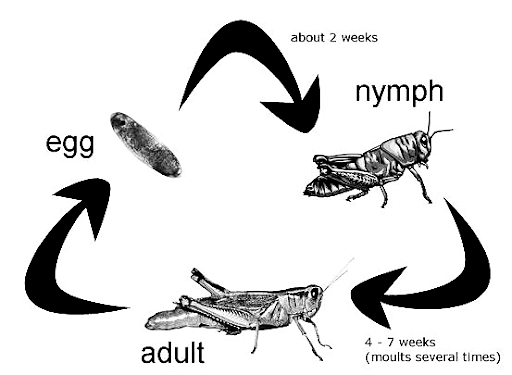
Life-cycle of the Grasshopper
Usefulness of the Grasshoppers
[Click Here for Sample Questions]
Here are the usefulness of the grasshoppers-
- Grasshoppers are important for balancing the ecosystem by preventing outgrowth of the plant biomass.
- In some countries like China, grasshoppers are used as food.
- They help in decomposition and regrowth of the plants.
- Dead grasshoppers are used as fertilizers.
- In some ancient cultures the grasshoppers are a representation of freedom, and spiritual enlightenments.
Also Check:
Differences Between Grasshoppers and Locusts
[Click Here for Sample Questions]
Though grasshoppers and the locusts belong to the same category, there are some basic differences between them.
| Grasshopper | Locust |
|---|---|
| Grasshoppers are normally solitary insects. | Whereas, the locusts are aggressive. |
| Grasshoppers are larger in size. | Locusts are smaller in size. |
| The front wings of the grasshoppers are hard and thin. | The wings of the locusts are flexible and appropriate for long-distance flights. |
| Grasshoppers normally live by themselves. | Whereas, the locusts live in groups. |
| Grasshoppers can hop mostly. | The Locust can fly. |
Things to Remember
[Click Here for Sample Questions]
- Scientific name of the Grasshopper is Caelifera.
- The scientific names of various scientific categories of grasshoppers are- American Grasshopper – Schistocerca Americana
- Horsehead Grasshopper – Pseudo Proscopia scabra
- Leaf Grasshopper – Phyllochroa ramakrishnai
- Desert Locust – Schistocerca gregaria
- Grasshoppers are important for balancing the ecosystem by preventing outgrowth of the plant biomass.
- There are a total 11 parts in the grasshopper’s abdomen.
- Though grasshoppers and the locusts belong to the same category, there are some basic differences between them.
- There are three steps of the life-cycle for the grasshoppers- Egg stage, Nymph stage, and Adult stage.
Important PYQs Related to The Scientific Names
- The scientist widely regarded as the triple crown of biology…. (AMUEEE 2015)
- The correct sequence of taxonomic hierarchy is…. (KCET 2018)
- Phenetic classification is based, ….(MU OET 2012)
- The first phylogenetic system of plant classification was…. (JIPMER 2004)
- Evolutionary history of an organism is known as…(NEET 2006)
- Reason of diversity in living beings is… (NEET 2001)
- The living organisms can be unexceptionally distinguished from… (NEET 1998)
- Rauwolfia - serpentina belongs to… (KCET 2007)
- Edaphology is… (KCET 2007)
- Read the statements given below and identify the incorrect statement… (KCET 2012)
- Which of the following taxonomic categories of housefly is… (KEAM)
- Bladderworm/cysticercus is the larval stage of… (NEET 1991)
- Which one of the following is oviparous?... (NEET 2015)
- Which one of the following statements about certain given animals is correct?... (NEET 2010)
- Which of the following organisms possesses characteristics of a plant and an animal? (NEET 1995)
Sample Questions
Ques. What is the Scientific name of Grasshopper? (1 Mark)
Ans. Scientific name of the Grasshopper is Caelifera
Ques. What are the basic characteristics of the grasshoppers? (3 Marks)
Ans. Grasshoppers are mostly green and brown colored insects. Here are the most prominent characteristics of grasshoppers-
- There are a total 11 parts in the grasshopper’s abdomen. They also have a pair of compound eyes.
- Grasshoppers can be a variety in colors that includes- green to olive, or brown and golden.
- The grasshoppers have sense organs all around their body, hence, they are very sensitive to touch.
Ques. Explain the types of the Grasshoppers? (2 Marks)
Ans. The grasshoppers can be categorized in two ways- the general ways, and the scientific ways.
Generally, the grasshoppers are divided into two categories- 1. Long-headed grasshoppers, and 2. Short-headed grasshoppers.
Scientifically there are four main categories of the grasshoppers-
- American Grasshopper
- Horsehead Grasshopper
- Leaf Grasshopper
- Desert Locust
Ques. What are the basic differences between the grasshoppers and the locusts. (4 Marks)
Ans. Though locusts are included in the grasshopper categories, there are some basic differences between them-
| Grasshopper | Locust |
|---|---|
| Grasshoppers are normally solitary insects. | Whereas, the locusts are aggressive. |
| Grasshoppers are larger in size. | Locusts are smaller in size. |
| The front wings of the grasshoppers are hard and thin. | The wings of the locusts are flexible and appropriate for long-distance flights. |
| Grasshoppers normally live by themselves. | Whereas, the locusts live in groups. |
| Grasshoppers can hop mostly. | The Locust can fly. |
Ques. Mention the scientific names of the scientific categories of grasshoppers. (4 Marks)
Ans. Scientifically the grasshoppers are divided into four main types-
- American Grasshopper- Schistocerca Americana
- Horsehead Grasshopper- Pseudo Proscopia scabra
- Leaf Grasshopper- Phyllochroa ramakrishnai
- Desert Locust- Schistocerca gregaria
Ques. Describe the life-cycle of the grasshoppers. (4 Marks)
Ans. There are three fundamental steps in the life cycle of the grasshopper-
- Egg Stage: Female grasshoppers typically lay their eggs under soil or leaf litter and cover them with a kind of sticky substance to protect them. The nymphs emerge when the temperature is warmer, and the eggs stay under the litter throughout the fall and winter.
- Nymph Stage: In the nymph stage, the grasshoppers almost look like the grown up grasshoppers, only their reproductive systems and wings are yet to be matured. This stage lasts for six weeks. The grasshoppers undergo six molts during this phase.
- Adult Stage: The grasshopper's reproductive system reaches maturity 15 days after entering the adult stage. And during the adult phase, their wings develop fully in 25 to 30 days. The grasshoppers only have a one-year lifespan. When they reach adulthood, they learn how to hunt and defend themselves from predators.
Ques. State the taxonomic details of grasshoppers. (4 Marks)
Ans. Taxonomy can be explained as the science of naming, describing, and classifying all the species of living organisms, like- plants, animals, microorganisms etc. Here are the taxonomic details of the grasshoppers-
Kingdom- Animalia
Phylum- Arthropoda
Class- Insecta
Order- Orthoptera
Suborder- Caelifera
Infraorder- Acrididae
Informal group- Acridomorpha
Also check:





Comments