



Scientific name of Leopard is Panthera pardus. Leopard belongs to the Felidae family. This creature shows similarities with cats and tigers. Etymologically the word - Leopard, came from the Latin language ‘leopardus’, which is derived from old French word- ‘leupart’ that refers to the species like Cheetah. This species is widely found in Africa. Leopards are very strong with the ability to climb trees and run quickly.
Key Terms: Leopard, scientific name, carnivora, predator, snow leopard, black panther.
Taxonomy of Leopard
[Click Here for Sample Questions]
There are a number of recognised varieties of leopards. They all have different scientific names. Though Panthera pardus is the most common one. Here are the taxonomic details of leopard-
| Scientific Classification of Leopard | |
|---|---|
| Kingdom | Animalia |
| Phylum | Chordata |
| Class | Mammalia |
| Order | Carnivora |
| Suborder | Feliformia |
| Family | Felidae |
| Subfamily | Pantherinae |
| Genus | Panthera |
| Species | P. pardus |
Characteristics of Leopard
[Click Here for Sample Questions]
Here are the basic characteristics of Leopard:
- The leopards weigh around 30 to 90 kg.
- The male leopards are heavier than the females.
- They have long furry tails with yellow-green eyes.
- The leopards are usually 3-6.5 feet long.
- Leopards belong to the cat and tiger categories.
- The body color of the leopard varies depending upon their categories.
- They have large strong limbs with powerful muscles.
- Leopards are carnivorous.
- They are four-footed animals with sharp claws.
- Leopards can easily climb trees and they are fast runners.
- Leopard and Jaguar differes from each other in the pattern of spots they have on body.
- Jaguars are heavier than leopards and have blockiness on their heads.
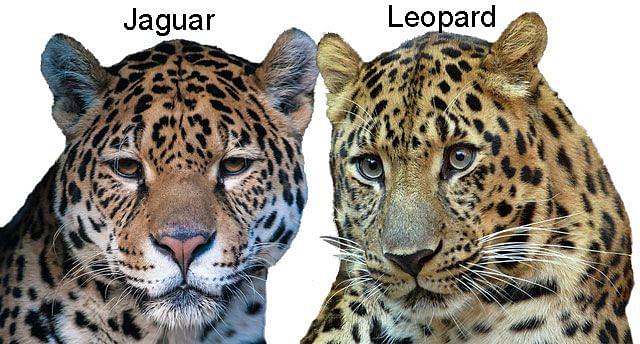
Leopard and Jaguar
Learn More About:
Life Cycle of Leopard
[Click Here for Sample Questions]
The normal lifespan of a leopard is 12-18 years. They usually mate throughout the year.
- The Estrous Cycle takes around 45-46 days.
- Whereas, the Gestation Period takes 90-100 days to complete the development.
- The baby leopards are generally called ‘cubs’.
- These cubs take 12-18 months to mature.
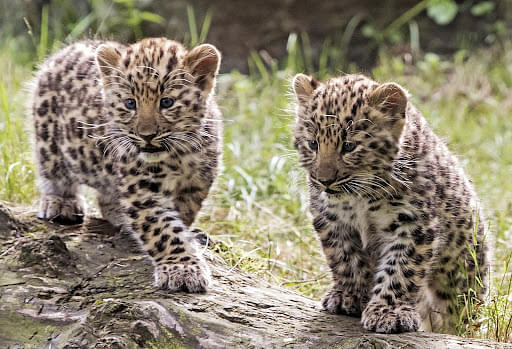
Leopard Cubs
Types of Leopards
[Click Here for Sample Questions]
Leopards can be categorized in two ways- as per their physical characteristics, and as per the scientific categories.
Types of Leopards As Per Physical Characteristics:-
Leopards can be divided into 4 main categories as per their physical characteristics.
Snow Leopard
These leopards are basically wild cats who are grayish-white in color. They originated in Himalayan high altitudes. The snow leopard can be seen in Kibber Wildlife Sanctuary in Himachal Pradesh, India.
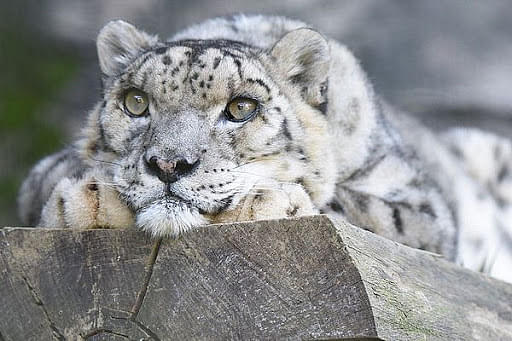
Snow Leopard
Black Leopard
Black leopards are mostly found in India, and they are also known as the black panthers. Black panthers are found in Nagarhole National Park, Tadoba National Park, and Kabini Wildlife Sanctuary in India.
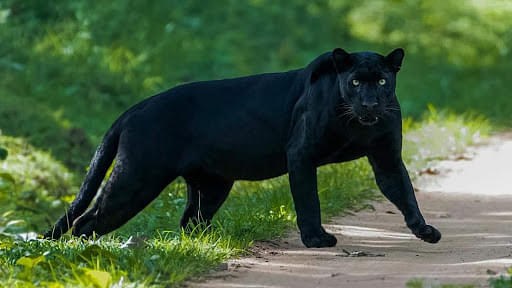
Black Panther
Clouded Leopard
This type of leopard is smaller in size, almost like a big sized cat. They are less aggressive and mostly found in Himalayan foothills.

Clouded Leopard
Cat Leopard
Cat leopards are most common in the subcontinent. Though they are carnivorous and mostly solitary animals without much aggression.

Cat Leopard
Types of Leopard As Per Scientific Categories:-
In this case, the leopards can be categorized in 5 types
African Leopard
Originated in African continents, these leopards are sexually dimorphic. The scientific name of African leopard is Panthera pardus pardus.
Amur Leopard
Originated in Russia and China, these are endangered species. Their scientific name is Panthera pardus orientalis.
Anatolian Leopard
These are Purssian Leopards, originated in Afghanistan, Iran and Turkey. Scientific name of Anatolian leopard is Panthera pardus tulliana.
Arabian Leopard
Originated in the Arabian Peninsula, these are also endangered species. The scientific name of this species is Panthera pardus nimr.
Sri Lankan Leopard
Originated in Sri Lanka. Scientific name of Sri Lankan leopard is Panthera pardus kotiya
Also Check:
Things to Remember
- Scientific name of Leopard is Panthera pardus.
- This creature shows similarities with cats.
- The lifespan of a leopard is 12-18 years.
- Leopards have long furry tails with yellow-green eyes.
- They are fast runners and can climb trees easily.
- Based on their physical characteristics, leopards are of 4 types.
- These 4 types include snow leopard, black panther, clouded leopard and cat leopard.
- Based on their habitat, there are 5 types of leopard- Shri Lankan, Arabian, Amur, Afrcan and Anatolian leopards.
Important PYQs Related To This Chapter
- The scientist widely regarded as the triple crown of biology…. (AMUEEE 2015)
- The correct sequence of taxonomic hierarchy is…. (KCET 2018)
- Phenetic classification is based, ….(MU OET 2012)
- The first phylogenetic system of plant classification was…. (JIPMER 2004)
- Evolutionary history of an organism is known as…(NEET 2006)
- Reason of diversity in living beings is… (NEET 2001)
- The living organisms can be unexceptionally distinguished from… (NEET 1998)
- Rauwolfia - serpentina belongs to… (KCET 2007)
- Edaphology is… (KCET 2007)
- Read the statements given below and identify the incorrect statement… (KCET 2012)
- Which of the following taxonomic categories of housefly is… (KEAM)
- Bladderworm/cysticercus is the larval stage of… (NEET 1991)
- Which one of the following is oviparous?... (NEET 2015)
- Which one of the following statements about certain given animals is correct?... (NEET 2010)
- Which of the following organisms possesses characteristics of a plant and an animal? (NEET 1995)
Sample Questions
Ques. What is the scientific name of Leopard? (1 Mark)
Ans. Scientific name of Leopard is Panthera pardus.
Ques. Write down the scientific names of the following leopards- Anatolian Leopard, Sri Lankan Leopard, African Leopard, and Indian Leopard. (4 Marks)
Ans. Here are the scientific names-
- Anatolian leopard- Panthera pardus tulliana
- Sri Lankan leopard- Panthera pardus kotiya
- African Leopard- Panthera pardus pardus
- Indian Leopard- Panthera pardus fusca
Ques. Write down the taxonomic details of Leopard. (3 Marks)
Ans. The word - Leopard, came from the Latin language ‘leopardus’, which is derived from old French word- ‘leupart’ that refers to the species like Cheetah. Leopards are very similar to cats and tigers. The taxanomic classification is as follows.
- Kingdom- Animalia
- Phylum- Chordata
- Class- Mammalia
- Order- Carnivora
- Suborder- Feliformia
- Family- Felidae
- Subfamily- Pantherinae
- Genus- Panthera
- Species- P. pardus
Ques. What are the main types of leopards that are found in India? (4 Marks)
Ans. There are mostly 4 types of leopards that can be found in India. Those are-
- Snow Leopard: They are basically wild cats with grayish white color. They originated in Himalayan high altitudes. This snow leopard also found in Kibber Wildlife Sanctuary in Himachal, India.
- Cat Leopard: Cat leopards are most common in the subcontinent. Though they are carnivorous, they are mostly solitary animals without much aggression.
- Black Leopard: Black leopards are mostly found in India, and they are also known as the black panthers. We can see black panthers in Nagarhole National Park, Tadoba National Park, and Kabini Wildlife Sanctuary in India.
- Clouded Leopard: This type of leopard is smaller in size, almost like a big sized cat. They are less aggressive and mostly found in Himalayan foothills.
Ques. What are the main characteristics of leopards? (3 Marks)
Ans. There are a number of recognised varieties of leopards. Few are listed below.
- Leopards belong to the cat and tiger categories.
- They have long furry tails and yellow-green eyes.
- The leopards weigh around 30 to 90 kg.
- The leopards are usually 3-6.5 feet long in size.
- They have large strong limbs with powerful muscles that help them to run fast and climb the trees.
- Leopards are carnivorous.
- They have four feets with sharp claws.
Ques. Explain the life cycle of the leopard in short. (1 Mark)
Ans. The normal lifespan of a leopard is 12-18 years. They usually mate throughout the year. The Estrous Cycle takes around 45-46 days. Whereas, the Gestation Period takes 90-100 days to complete. The baby leopards are generally called ‘cubs’.These cubs take 12-18 months to mature.
Ques. Name two endangered species of leopard. (1 Mark)
Ans. Two endangered species of leopards are- Amur Leopard and Arabian Leopard.
Ques. Why are Leopards considered to be Carnivorous? (2 Marks)
Ans. Carnivores or carnivorous animals can be defined as those animals that feed on other animals.
The leopards are considered to be Carnivorous as they are born predators who survive on other animals.
Also check:




Comments