



Content Curator
The New Education Policy (NEP) has led to a number of changes in the Board of Class 10 and Class 12 examinations. Read the article to find out all the key highlights.

The National Education Policy (NEP), reformed after 34 years, envisages some major changes in the education sector.
On July 29, 2020, the Union Cabinet approved a new policy on education and also changed the name of the Ministry of Human Resources Development to the Ministry of Education.
From the changes in the Board's exam patterns, the flexibility of subjects to no rigid separation between the Arts and Science streams, the NEP has brought about some major reforms for students in classes 10 and 12.
This is the first education policy of the 21st century to replace the 34-year-old National Education Policy, which was drafted in 1986.
Following a 5 + 3 + 3 + 4 pattern, the NEP suggests scrapping the school's 10 + 2 structure.
The new structure would follow 3-8 years of primary schooling, 8-11 years of preparatory schooling, 11-14 years of secondary schooling, while the last stage would be 14-18 years of secondary schooling.
This stage consists of two sub-stages: classes 9 and 10 in the first phase, and classes 11 and 12 in the second phase.
This stage will consist of four years of multidisciplinary study, with critical thinking, attention to the aspirations of life, greater flexibility and student choice.
The policies that will come into effect by 2030 have been welcomed by Prime Minister Narendra Modi, Union ministers, academics, industry experts, teachers and students.
How will the NEP affect Board exams?
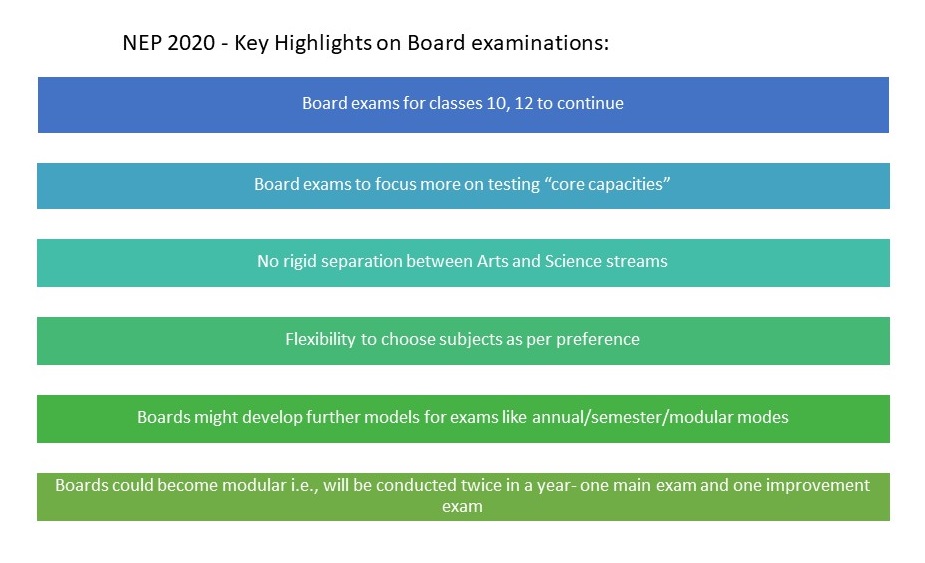
Although the Board examinations for classes 10 and 12 will continue, the existing system of the board and entrance examinations will be changed in order to eliminate the need for undertaking coaching classes.
Board examinations shall be redesigned to encourage "holistic development." The new policy aims to make the Board's examinations "easier" by testing only the "core capacity" of students.
The changes introduced by the NEP will change the overall syllabus and pattern for students in classes 10 and 12.
With the amalgamation of subjects and the crossover between streams, students will now be able to study subjects according to their preferences and pursue higher studies accordingly.
They will have the option to choose subjects such as the arts and crafts, as well as the traditional ones. For example, a science student will be able to choose an arts subject and study both at the same time.
Boards may also develop additional test models, such as Annual / Semester / Modular Board Exams.
All subjects starting with mathematics may be offered at two levels — two parts or objective type and descriptive type notes the NEP.
Board examinations could also become modular, i.e. they can be carried out more than once a year — one main examination and one for improvement, if desired.
Each subject offered in the board examination will have an objective as well as a description examination.
The policy also points out that school assessments will be carried out by means of a "multidimensional report" of students attending the board of directors' examinations.
In addition to the assessment provided by the teachers, the Progress Card will include both self-assessment and peer assessment.
Policy states that there will be no hard separation between 'curricular,' 'extracurricular' or 'co-curricular' or between 'vocational' and 'academic' streams, which suggests that extracurricular activities such as sketching, painting, etc. may be part of the student progress report.
NEP 2020: Changes in Open Schools
NIOS and State Open Schools will offer grades A, B and C equivalent to grades 3, 5 and 8 of the formal school system.
They will also offer secondary education programs equivalent to Grades 10 and 12; vocational training courses/programs. They will also be enhanced to provide adult literacy and life-enrichment programs.
NEP 2020: Changes in Higher Education
Many changes in higher education have also been mentioned in the policy. MPhil 's policy has been phased out.
Students could apply directly to doctoral programs after their master's degree. As per UGC Chairman VS Chauhan, MPhil degrees have slowly been phased out in favour of a direct PhD programme.
The four-year college undergraduate program has also made a comeback. In its new form, the four-year program is more structured.
The NEP offers multiple exit options for students — if students complete one year, they will be awarded a certificate, two years of graduation, three years of graduation, and if they pursue a four-year research program, they will be eligible for direct doctoral admissions.
In addition, multiple regulators, such as the University Grants Commission ( UGC), All India Technical Education Council (AICTE) and the National Teacher Education Council (NCTE).
All of these will now be replaced by a single regulator.
Also Read: Academicians from North East skeptical about the Implementation of NEP
.jpeg?h=127&w=254&mode=stretch)
.jpeg?h=127&w=254&mode=stretch)


.jpeg?h=127&w=254&mode=stretch)
.jpeg?h=127&w=254&mode=stretch)
.jpeg?h=127&w=254&mode=stretch)
.jpeg?h=127&w=254&mode=stretch)



%20(26).jpeg?h=40&w=40&mode=stretch)
%20(25).jpeg?h=40&w=40&mode=stretch)


%20(27).jpeg?h=40&w=40&mode=stretch)
%20(27).jpeg?h=40&w=40&mode=stretch)
.png?h=40&w=40&mode=stretch)
%20(24).jpeg?h=40&w=40&mode=stretch)

%20(21).jpeg?h=40&w=40&mode=stretch)



Comments