



Education Journalist | Study Abroad Strategy Lead | Updated On - Apr 18, 2026
Neither is universally better. The right choice depends on your field, your budget, your risk tolerance around visa uncertainty and what you want your life to look like five years after graduation.
This guide compares MS in Germany vs MS in USA across every dimension that matters for Indian students in 2026: cost, admission requirements, top universities, post-study work, salary, PR timeline and visa risk.
All conversions these exchange rates: 1 USD = Rs. 92.66 and 1 EUR = Rs. 109.00
Read More: Top 5 Countries to Study MS Abroad: Universities, Fees and Outcomes
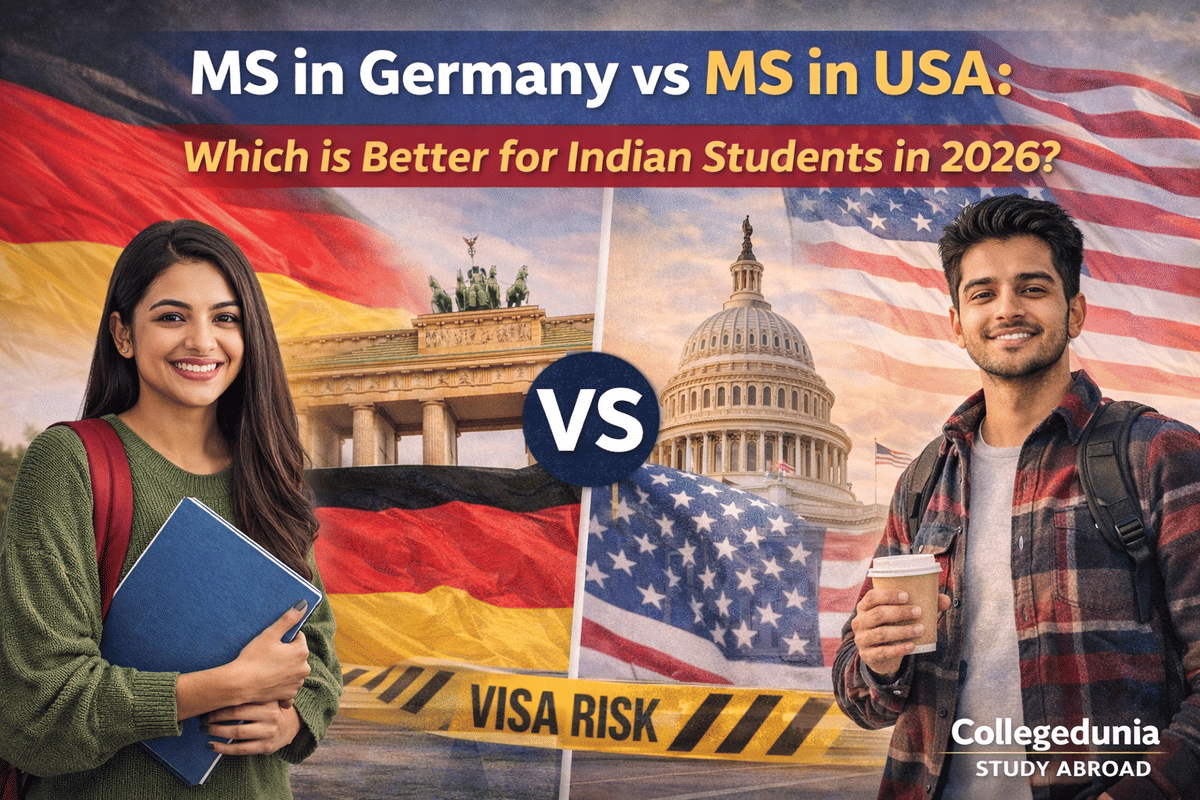
- MS in Germany vs MS in USA: Quick Comparison
- Cost Comparison: Total Investment for Indian Students
- Top Universities: Germany vs USA for MS
- Admission Requirements: What You Need to Get In
- Post-Study Work and Visa: The Most Critical Difference in 2026
- Salary After MS: Germany vs USA
- PR and Long-Term Settlement: Which is Easier for Indians
- Field-Wise Verdict: Which Country is Better for Your Specialisation
- Who Should Choose Germany and Who Should Choose USA
- FAQs
MS in Germany vs MS in USA: Quick Comparison
Here is the complete side-by-side comparison before we go into detail on each factor.
| Factor | MS in Germany | MS in USA |
|---|---|---|
| Tuition (public universities) | Zero (semester fee €100 to €400) | USD 20,000 to USD 60,000 per year |
| Total 2-year cost (INR) | Rs. 20L to Rs. 30L | Rs. 70L to Rs. 1.55Cr |
| Program duration | 2 years (standard) | 1.5 to 2 years |
| GRE required | Not required at most universities | Required at most top universities |
| Language requirement | IELTS 6.5 for English programs | IELTS 6.5 to 7.0 or TOEFL 90 to 100 |
| Post-study work | 18-month job seeker visa (no employer needed) | 12-month OPT (36 months STEM) — under active threat in 2026 |
| Starting salary (CS/Engineering) | €45,000 to €65,000 (Rs. 49.1L to Rs. 70.9L) | USD 90,000 to USD 130,000 (Rs. 83.4L to Rs. 1.20Cr) |
| PR timeline | 21 months via EU Blue Card | 50 to 100+ years for Indians in EB-2 and EB-3 categories |
| Visa risk in 2026 | Low. Student visa processing in as few as 6 days | High. F-1 issuances down 44% in 2025. OPT under threat |
| Brand recognition in India | Moderate. TU9 universities well known in engineering | Very high. MIT, Stanford, CMU globally recognised |
| English language environment | English programs available but daily life in German | Fully English |
| Education loan required | Rarely. Blocked account of €11,904 (Rs. 1.30L) is own money | Almost always. Rs. 40L to Rs. 1Cr+ loans common |
Cost Comparison: Total Investment for Indian Students
Germany costs 3 to 6 times less than the USA for an MS degree. The difference is not marginal. It is the single most important financial decision most Indian families will make.
The cost comparison below uses realistic figures for a 2-year MS program at a mid-tier to good university in each country. Top US universities such as MIT, Stanford and CMU cost significantly more than the figures below.
Annual Cost Breakdown: Germany vs USA
| Cost Component | Germany (Annual) | Germany (INR) | USA (Annual) | USA (INR) |
|---|---|---|---|---|
| Tuition | €0 to €800 (semester fee only) | Rs. 0 to Rs. 87,200 | USD 20,000 to USD 60,000 | Rs. 18.5L to Rs. 55.6L |
| Accommodation | €300 to €600 per month | Rs. 3.9L to Rs. 7.9L | USD 800 to USD 1,800 per month | Rs. 8.9L to Rs. 20.0L |
| Food and groceries | €180 to €220 per month | Rs. 2.4L to Rs. 2.9L | USD 300 to USD 500 per month | Rs. 3.3L to Rs. 5.6L |
| Health insurance | €130 to €150 per month | Rs. 1.7L to Rs. 2.0L | USD 150 to USD 300 per month | Rs. 1.7L to Rs. 3.3L |
| Transport | €63 per month (semester ticket) | Rs. 82,400 | USD 50 to USD 150 per month | Rs. 55,600 to Rs. 1.7L |
| Miscellaneous | €100 to €150 per month | Rs. 1.3L to Rs. 2.0L | USD 200 to USD 400 per month | Rs. 2.2L to Rs. 4.4L |
| Total Annual Cost | €9,300 to €14,700 | Rs. 10.1L to Rs. 16.0L | USD 38,000 to USD 85,000 | Rs. 35.2L to Rs. 78.8L |
Total 2-Year Investment Comparison
| Scenario | Germany (2 Years) | USA (2 Years) | Germany Saves |
|---|---|---|---|
| Budget (affordable city) | Rs. 20L to Rs. 25L | Rs. 70L to Rs. 88L | Rs. 50L to Rs. 63L |
| Mid-range (average city) | Rs. 25L to Rs. 30L | Rs. 99L to Rs. 1.20Cr | Rs. 74L to Rs. 90L |
| Top university (Munich or NYC) | Rs. 30L to Rs. 38L | Rs. 1.30Cr to Rs. 1.55Cr | Rs. 1.0Cr to Rs. 1.17Cr |
The blocked account deposit of €11,904 (Rs. 1.30L) required for the German student visa is your own money. It is returned to you at €992 per month after arrival in Germany. It is not an additional cost.
Also Check: MS in Germany: Top Universities, Fees and Job Outcomes
Top Universities: Germany vs USA for MS
The USA has more universities in the global top 20. Germany has more universities offering free high-quality MS programs in engineering and STEM. The right comparison is not which country has better universities overall but which universities are realistic targets for your profile.
Top MS Universities in Germany for Indian Students
| University | QS Rank 2026 | Tuition (Non-EU) | Strengths |
|---|---|---|---|
| LMU Munich | 58 | Free (€157 semester fee) | Sciences, data science, medicine |
| TU Munich (TUM) | 37 | €4,000 to €6,000 per semester (non-EU) | Engineering, CS, robotics, AI |
| RWTH Aachen | 99 | Free (€300 semester fee) | Mechanical engineering, CS, manufacturing |
| TU Berlin | 154 | Free (€307 semester fee) | Engineering, CS, architecture |
| Karlsruhe Institute of Technology (KIT) | 119 | €1,500 per semester (Baden-Wurttemberg) | Engineering, physics, computer science |
| TU Dresden | 237 | Free (€258 semester fee) | Engineering, IT, natural sciences |
| University of Stuttgart | 301 to 350 | €1,500 per semester (Baden-Wurttemberg) | Aerospace, mechanical engineering, automotive |
Top MS Universities in USA for Indian Students
| University | QS Rank 2026 | Annual Tuition (USD) | Annual Tuition (INR) | Strengths |
|---|---|---|---|---|
| MIT | 1 | USD 59,750 | Rs. 55.4L | Engineering, CS, AI, robotics |
| Stanford University | 5 | USD 62,484 | Rs. 57.9L | CS, AI, data science, entrepreneurship |
| Carnegie Mellon University | 52 | USD 55,816 | Rs. 51.7L | CS, ML, software engineering, robotics |
| UC Berkeley | 12 | USD 29,000 to USD 45,000 | Rs. 26.9L to Rs. 41.7L | EECS, data science, engineering |
| Georgia Tech | 137 | USD 14,000 to USD 32,000 | Rs. 13.0L to Rs. 29.7L | CS, engineering, analytics |
| University of Texas Austin | 197 | USD 18,000 to USD 35,000 | Rs. 16.7L to Rs. 32.4L | CS, engineering, data science |
| Purdue University | 109 | USD 28,000 to USD 32,000 | Rs. 25.9L to Rs. 29.7L | Engineering, CS, aeronautics |
Also Check: MS in USA: Top Universities, Fees and Eligibility 2026
Admission Requirements: What You Need to Get In
Germany does not require GRE for most programs. The USA requires GRE at most top universities. Germany requires an APS certificate for all Indian students. The USA requires a strong SOP and LOR package.
| Requirement | MS in Germany | MS in USA |
|---|---|---|
| Minimum GPA (Indian equivalent) | 65% to 75% (7.0 to 7.5 CGPA) for most programs. 75%+ for top universities | 3.0 GPA (4.0 scale) or 75%+ for good programs. 3.5+ for top universities |
| GRE | Not required at most German universities | Required at most top universities. 310 to 325 for competitive programs |
| IELTS | 6.5 minimum for English-taught programs. No band below 6.0 | 6.5 to 7.0 depending on university |
| TOEFL | 80 to 100 for English-taught programs | 90 to 105 for most programs |
| APS Certificate | Mandatory for all Indian students. Rs. 18,000. 3 to 6 weeks processing | Not required |
| Statement of Purpose | Required. Research-focused. Explain academic motivation | Required. Career-focused. Explain goals and fit with program |
| Letters of Recommendation | 2 to 3 academic references | 3 academic or professional references |
| Application fee | €75 via Uni-Assist (first university) + €30 each additional | USD 75 to USD 150 per university |
| Application deadline | Winter: July 15. Summer: January 15 (apply 6 to 8 weeks earlier) | December 1 to January 15 for Fall intake |
The practical implication: Germany is more accessible for Indian students with a strong academic record but no GRE score. The USA requires more standardised test preparation but offers more flexibility in program selection and specialisation. Indian students applying to Germany must also factor in the APS certificate, which takes 3 to 6 weeks and costs Rs. 18,000 and must be obtained before the visa stage.
Post-Study Work and Visa: The Most Critical Difference in 2026
This is where Germany and the USA diverge most sharply in 2026. Germany offers a statutory 18-month job seeker visa with no employer required. The USA offers OPT which is currently under active threat of elimination by the Trump administration.
For Indian students making a decision today about where to study for a degree they will complete in 2027 or 2028, the post-study work pathway is the most important factor after cost.
| Factor | Germany Post-Study | USA Post-Study |
|---|---|---|
| Post-study work permit | 18-month job seeker visa (Aufenthaltserlaubnis zur Arbeitssuche) | OPT: 12 months standard, 36 months STEM |
| Employer required at application | No. You search for a job during the 18 months | Yes. OPT requires employment in field of study within 90 days |
| Legal basis | German Residence Act Section 20 (statutory) | Executive regulation (can be eliminated without Congress) |
| Risk of elimination in 2026 | Very low | Active. DHS rulemaking in progress. USCIS director stated intent to end OPT |
| Path after post-study work | EU Blue Card. No lottery. Employer-sponsored | H-1B lottery. Annual cap. 15% selection rate for entry-level roles in FY2027 |
The H-1B lottery context is critical for Indian students. In FY2027, entry-level roles carried only a 15% selection chance under the new wage-weighted lottery system, down from 30% under the previous equal-odds system. Even if OPT survives, the H-1B pathway has become significantly harder for Indian graduates in entry-level positions.
Read More: OPT for F-1 Students: Complete Guide to Rules and Application
Salary After MS: Germany vs USA
US salaries are higher in absolute terms. German salaries are lower but so are costs. German income tax rates of 19% to 42% and US cost of living in tech hubs that runs 40% to 60% higher than major German cities means the real purchasing power difference is smaller than the gross salary gap suggests.
| Field | Germany Starting Salary | Germany (INR) | USA Starting Salary | USA (INR) |
|---|---|---|---|---|
| Computer Science / Software Engineering | €50,000 to €65,000 | Rs. 54.5L to Rs. 70.9L | USD 100,000 to USD 140,000 | Rs. 92.7L to Rs. 1.30Cr |
| Data Science / AI / ML | €55,000 to €70,000 | Rs. 59.9L to Rs. 76.3L | USD 110,000 to USD 150,000 | Rs. 1.02Cr to Rs. 1.39Cr |
| Mechanical Engineering | €45,000 to €60,000 | Rs. 49.1L to Rs. 65.4L | USD 75,000 to USD 100,000 | Rs. 69.5L to Rs. 92.7L |
| Electrical Engineering | €48,000 to €62,000 | Rs. 52.3L to Rs. 67.6L | USD 85,000 to USD 110,000 | Rs. 78.8L to Rs. 1.02Cr |
| Business Analytics / Finance | €45,000 to €58,000 | Rs. 49.1L to Rs. 63.2L | USD 90,000 to USD 120,000 | Rs. 83.4L to Rs. 1.11Cr |
5-Year Net Wealth Comparison (CS Graduate)
| Metric | Germany Path | USA Path |
|---|---|---|
| Total degree cost | Rs. 25L | Rs. 99L |
| Year 1 gross salary | Rs. 60.0L (€55,000) | Rs. 1.16Cr (USD 125,000) |
| Year 1 take-home (after tax) | Rs. 38L to Rs. 42L | Rs. 78L to Rs. 86L |
| Loan repayment burden | Minimal to none | Rs. 6L to Rs. 10L per year for 10 years |
| Visa uncertainty risk | Low | High (OPT threat, H-1B lottery) |
| Break-even vs India salary | Year 1 to 2 | Year 2 to 3 (after loan repayment) |
PR and Long-Term Settlement: Which is Easier for Indians
Germany offers one of the fastest PR pathways in the world for Indian STEM graduates. The USA has one of the longest green card queues for Indian nationals with wait times of 50 to 100 years for employment-based categories.
| Factor | Germany PR Path | USA Green Card Path |
|---|---|---|
| Primary pathway | EU Blue Card to Permanent Settlement (Niederlassungserlaubnis) | H-1B to EB-2 or EB-3 employment-based green card |
| Minimum timeline | 21 months with EU Blue Card (with B1 German) | 50 to 100+ years for Indian nationals in EB-2 and EB-3 categories |
| Lottery required | No | Yes. H-1B annual lottery. 15% selection rate for entry-level in FY2027 |
| Language requirement for PR | B1 German for 21-month path. A1 German for 33-month path | No language requirement |
| EU mobility after PR | Yes. Long-term EU resident status allows work across EU | Not applicable |
The green card backlog for Indian nationals is the most underappreciated risk in the US MS decision. Indian nationals in the EB-2 category face a priority date backlog that immigration attorneys estimate at 50 to 100 years based on current processing rates. Most Indian students who go to the US for an MS and get an H-1B will spend their entire working career without permanent residency, dependent on employer-sponsored H-1B renewal every 3 years.
Read More: UK vs Germany for Indian Students 2026: Which is Better?
Field-Wise Verdict: Which Country is Better for Your Specialisation
The right country depends heavily on what you are studying. Germany dominates in engineering and automotive. The USA dominates in CS, AI and finance. Here is the field-by-field breakdown.
| Field | Better Country | Reason |
|---|---|---|
| Computer Science (top tier) | USA | MIT, Stanford, CMU are globally unmatched. Silicon Valley job market. USD 120K+ starting salaries |
| Computer Science (value for money) | Germany | TU Berlin, RWTH Aachen, TU Munich offer strong CS programs at zero tuition. EU tech market growing |
| Mechanical Engineering | Germany | RWTH Aachen, TU Munich, KIT are world leaders. BMW, Bosch, Siemens and Mercedes recruit directly from campus |
| Electrical Engineering | Germany | Strong industry ties with Siemens, Infineon and Bosch. TU Munich and KIT are top programs |
| Data Science and AI | USA (top tier) / Germany (value) | USA offers higher salaries and more AI-focused roles. Germany offers free tuition and a growing AI ecosystem in Berlin and Munich |
| Automotive Engineering | Germany | No comparison. Germany is the global automotive capital. Stuttgart, Munich and Wolfsburg are the industry hubs |
| Finance and Business Analytics | USA | Wall Street, Chicago and San Francisco finance markets. Higher salaries. Better MS Finance brand recognition |
| Biotechnology and Life Sciences | Germany | Heidelberg, LMU Munich and TU Munich are world-class. BioNTech, Bayer and BASF recruit from German universities |
| Aerospace Engineering | Germany | University of Stuttgart and TU Munich are top programs. Airbus, DLR and MTU recruit directly |
| Architecture and Urban Planning | Germany | TU Berlin and TU Munich are globally ranked. Lower cost. Strong European design market |
Who Should Choose Germany and Who Should Choose USA
There is no single right answer. The decision depends on your profile, your field, your financial situation and your long-term goals. Here is the honest breakdown.
Choose MS in Germany If:
- Your family cannot take on Rs. 50L to Rs. 1Cr in education debt. Germany eliminates tuition entirely at public universities. The total investment of Rs. 20L to Rs. 30L is mostly living costs you would incur anywhere
- You are in engineering, automotive, aerospace or life sciences. German universities and industry connections in these fields are world-class and often better than US alternatives at a fraction of the cost
- You want a clear fast PR pathway. EU Blue Card to permanent residency in 21 months is one of the fastest structured pathways available to Indian nationals anywhere in the world
- You are concerned about US visa uncertainty. The F-1 visa issuance rate for Indians dropped 44% in 2025. OPT is under active threat. The German student visa is processing in as few as 6 days at Indian consulates in 2026
- You do not have a GRE score and do not want to prepare for one. Most German universities do not require GRE for MS admission
- You are willing to learn basic German. B1 German unlocks the fastest PR pathway and significantly expands your job market access beyond English-only roles
Choose MS in USA If:
- You are targeting top CS, AI or ML roles at FAANG or top tech companies. MIT, Stanford and CMU carry brand weight that German universities cannot match for Silicon Valley recruitment. Starting salaries of USD 120K to USD 180K (Rs. 1.11Cr to Rs. 1.67Cr) are realistic for top graduates
- You have a strong GRE score (320+) and competitive profile. A strong GRE opens doors to funded MS programs and research assistantships that can significantly reduce the cost
- You have a clear H-1B sponsorship plan. If you are targeting large tech companies with strong H-1B sponsorship track records such as Google, Microsoft, Amazon and Meta, the OPT to H-1B pathway is more viable than for students targeting smaller employers
- You want access to the US startup and venture capital ecosystem. No other country comes close to the US for early-stage startup opportunities especially in tech and biotech
- Your family can fund the degree without financial distress. If the Rs. 90L to Rs. 1.2Cr total cost does not create hardship, the US brand premium and salary premium may justify the investment
FAQs
Ques. Is MS in Germany really free for Indian students?
Ans. Yes, at public universities in most German states. You pay only a semester administrative fee of €100 to €400 (Rs. 10,900 to Rs. 43,600) per semester. There is no tuition fee. The exceptions are Baden-Wurttemberg (€1,500 per semester for non-EU students) and TU Munich in Bavaria (€4,000 to €6,000 per semester for non-EU Master's students). All other public universities in Germany are free for Indian students.
Ques. Which is better for CS: Germany or USA?
Ans. It depends on your target outcome. If you are targeting top-tier roles at FAANG companies with USD 120K to USD 180K (Rs. 1.11Cr to Rs. 1.67Cr) starting salaries, the USA (MIT, Stanford, CMU) is better. If you want a strong CS degree at zero tuition with a clear PR pathway and are open to a European tech career, Germany (TU Berlin, RWTH Aachen, TU Munich) is the better value. The US salary premium is real but so is the cost premium, visa risk and green card backlog.
Ques. What is the total cost of MS in Germany vs MS in USA for Indian students?
Ans. A 2-year MS in Germany at a free public university costs Rs. 20L to Rs. 30L in total including living expenses, health insurance and semester fees. The same duration at a US university costs Rs. 70L to Rs. 1.55Cr depending on the university and city. Germany is 3 to 6 times cheaper. The blocked account deposit of €11,904 (Rs. 1.30L) required for the German student visa is your own money returned to you monthly after arrival.
Ques. Is GRE required for MS in Germany?
Ans. No. Most German public universities do not require GRE for MS admission. The primary requirements are a Bachelor's degree in a relevant field, a minimum CGPA of 7.0 to 7.5 out of 10, IELTS 6.5 or TOEFL 80 to 100 for English-taught programs, an APS certificate (mandatory for Indian students) and a Statement of Purpose. Some private universities and specific programs may require GRE but it is not standard practice.
Ques. How does post-study work compare between Germany and USA in 2026?
Ans. Germany offers an 18-month job seeker visa after graduation with no employer required at the time of application. It is written into the German Residence Act and cannot be eliminated by a single executive decision. The USA offers OPT (12 months standard, 36 months STEM) which is currently under active threat from the Trump administration. A DHS rulemaking is in progress and the USCIS director has publicly stated his intent to end OPT. For students graduating in 2027 or 2028, Germany's post-study work pathway carries significantly lower risk.
Ques. Which country is easier for PR: Germany or USA?
Ans. Germany is dramatically easier. EU Blue Card holders can apply for permanent settlement in 21 months with B1 German language skills. Indian nationals in the US EB-2 employment-based green card category face a backlog estimated at 50 to 100 years based on current processing rates. Most Indian students who go to the US for an MS will spend their entire working career without permanent residency, dependent on employer-sponsored H-1B renewal every 3 years.
Ques. What is the salary difference between Germany and USA after MS?
Ans. A CS graduate in the US starts at USD 100,000 to USD 140,000 (Rs. 92.7L to Rs. 1.30Cr) per year. In Germany the same profile starts at €50,000 to €65,000 (Rs. 54.5L to Rs. 70.9L). However German income tax is higher (19% to 42%) and US cost of living in tech hubs is 40% to 60% higher than German cities. After tax and cost of living adjustments the real purchasing power difference is smaller than the gross salary gap suggests. The US degree also costs Rs. 70L to Rs. 90L more which must be factored into the ROI calculation.
Ques. Do I need to know German to study MS in Germany?
Ans. Not for most Master's programs. Over 1,800 Master's programs in Germany are fully taught in English. IELTS 6.5 is the standard requirement. You can complete your entire degree without speaking German. However learning German to at least B1 level is strongly recommended for job market access and for the fastest PR pathway of 21 months via EU Blue Card. Most German engineering and manufacturing companies require B1 to B2 German for day-to-day work.


1720429164.png?tr=w-305,h-145,c-force?h=40&w=40&mode=stretch)
1720436069.jpg?tr=w-305,h-145,c-force?h=40&w=40&mode=stretch)








Comments