



Education Journalist | Study Abroad Strategy Lead | Updated On - Apr 16, 2026
Choosing between the UK and Germany for your Master's degree is one of the most consequential decisions you will make as an Indian student. Both countries offer world-class universities, strong job markets and clear post-study pathways. But they are built for very different student profiles.
Germany is nearly free to study in. The UK costs Rs. 15 to 40 lakh per year in tuition alone. Yet a large number of Indian students still choose the UK every year. The reason is not irrational. It comes down to language comfort, brand recognition and program speed. But whether that trade-off makes sense for you depends entirely on your goals.
If you want a one-year Master's, English-language comfort and a globally recognised brand name, the UK is the better fit. If you want low-cost education, strong STEM career prospects and a faster route to permanent residency in Europe, Germany wins clearly in 2026.
Exchange rates used in this article: 1 GBP = Rs. 126.63 | 1 EUR = Rs. 110.33
Check Out: Top Universities Abroad for Indian Students
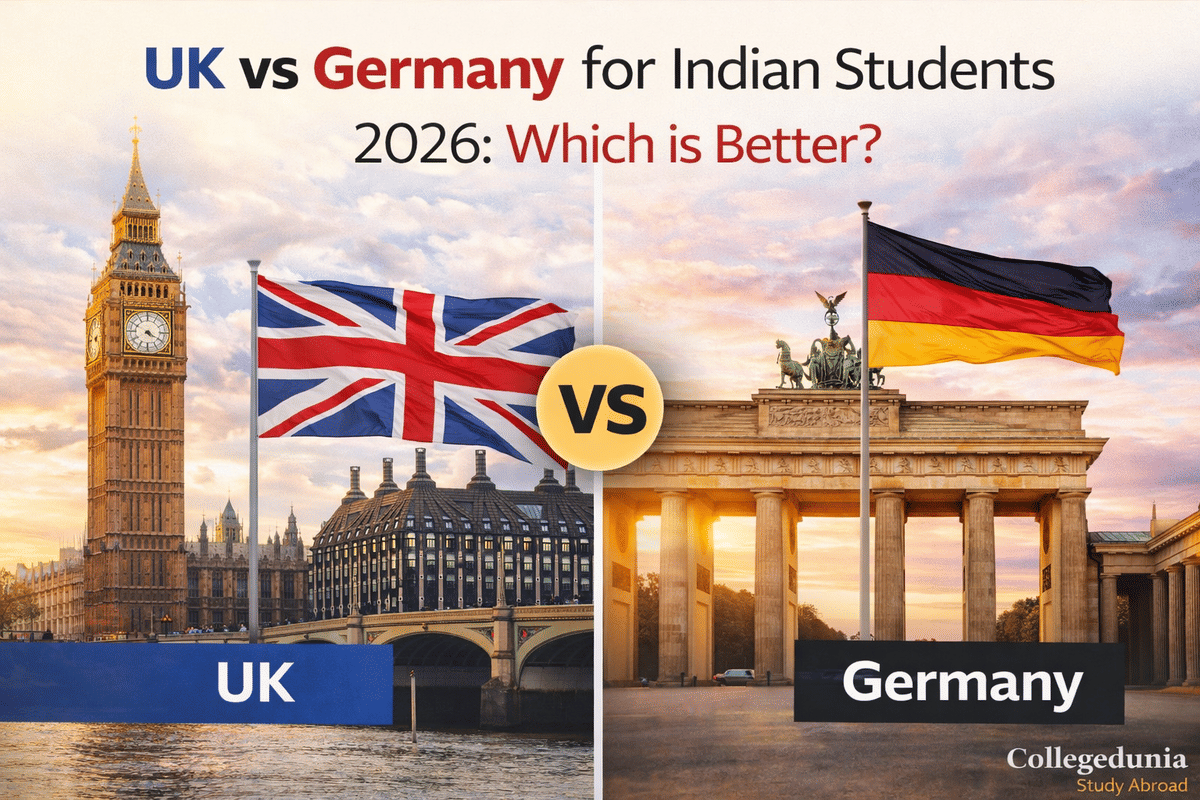
- UK vs Germany for Indian Students: Quick Comparison 2026
- Education System: Speed vs Depth
- Top Universities in UK and Germany for Indian Students (QS 2026)
- Tuition Fees: UK vs Germany for Indian Students
- Cost of Living: UK vs Germany
- Student Visa Requirements: UK vs Germany
- Post-Study Work Visa: UK vs Germany
- PR Pathway: Which Country is Faster?
- Job Market and Salaries: UK vs Germany
- Language Barrier: The Real Career Risk
- STEM vs Non-STEM: Which Country Fits Your Field?
- Scholarships for Indian Students: UK vs Germany
- Which Should You Choose? A Decision Framework for Indian Students
- Frequently Asked Questions
UK vs Germany for Indian Students: Quick Comparison 2026
At a glance, Germany wins on cost and PR speed. The UK wins on language ease and program duration.
The table below covers the most critical decision factors side by side.
| Parameter | United Kingdom | Germany |
|---|---|---|
| Language of Instruction | English | English (Master's) but German needed for jobs |
| Tuition Fees (Public Universities) | Rs. 15L to Rs. 41L per year | Rs. 0 to Rs. 2.7L per year |
| Master's Duration | 1 year | 2 years |
| Monthly Living Cost | Rs. 1.1L to Rs. 1.6L | Rs. 80,000 to Rs. 95,000 |
| Post-Study Work Visa | 2 years (Graduate Route) | 18 months (Job Seeker Visa) |
| Starting Salary (STEM) | Rs. 37L per year (approx. £35,000) | Rs. 47L per year (approx. €52,000) |
| PR Timeline | 5 to 8 years | 2 to 4 years (EU Blue Card) |
| Visa Acceptance Rate | ~99% | ~90% |
Note: German Public universities in most states charge no tuition fees. Bavaria (home to TU Munich) now charges fees for non-EU students. Always verify with the specific university before applying.
The UK's shorter program duration means you enter the workforce a full year earlier. Germany's lower total cost and faster PR pathway make it a stronger long-term investment for most STEM students.
Read More: Complete guide to studying in the UK for Indian students
Education System: Speed vs Depth
The UK offers a fast, intensive one-year Master's. Germany offers a two-year program with deeper industry integration.
These are not just structural differences. They shape your entire experience and career trajectory.
UK: One Year, High Intensity
A UK Master's is completed in 12 months.
- This suits students who want to re-enter the workforce quickly or those mid-career who cannot afford a two-year break.
- The pace is demanding.
- There is limited time for internships during the program itself.
Universities like Imperial College London (QS #2), Oxford (QS #4) and Cambridge (QS #6) carry enormous brand weight globally. An Oxford or LSE degree opens doors in Indian consulting firms, global banks and multinational corporations in a way that few other credentials can match.
Check Out: 1 year Masters in UK
Germany: Two Years with the Werkstudent Advantage
Germany's two-year model is built around depth.
- Students have time for research projects, thesis work and the Werkstudent system.
- This allows students to work up to 20 hours per week in field-related roles at companies like SAP, BMW, Siemens and Bosch.
German employers often value Werkstudent experience more than grades. By the time you graduate, you already have 12 to 18 months of relevant industry experience on your CV. This is a significant competitive advantage in the German job market.
Top Universities in UK and Germany for Indian Students (QS 2026)
Both countries host globally ranked universities. The UK leads in overall rankings. Germany leads in engineering and technology.
Top UK Universities (QS World Rankings 2026)
| University | QS Rank 2026 | Annual Tuition (Approx.) | Annual Tuition (INR Approx.) |
|---|---|---|---|
| Imperial College London | 2 | £21,000 to £45,000 | Rs. 26.6L to Rs. 57L |
| University of Oxford | 4 | £33,050 to £48,620 | Rs. 41.8L to Rs. 61.5L |
| University of Cambridge | 6 | £29,000 to £42,000 | Rs. 36.7L to Rs. 53.2L |
| UCL | 9 | £19,400 to £52,900 | Rs. 24.6L to Rs. 67L |
| University of Edinburgh | 27 | £27,000 to £40,000 | Rs. 34.2L to Rs. 50.7L |
Tuition figures are estimates for the 2026-27 academic year. Verify on official university websites before applying.
The UK's top universities are particularly strong in business, finance, law, humanities and social sciences. For these fields, the brand premium is real and measurable in starting salaries.
Top German Universities (QS World Rankings 2026)
| University | QS Rank 2026 | Tuition Per Semester | Annual Tuition (INR Approx.) |
|---|---|---|---|
| Technical University of Munich (TUM) | 22 | €4,000 to €6,000 (non-EU) | Rs. 8.8L to Rs. 13.2L per year |
| LMU Munich | 58 | No tuition fee | Rs. 0 (semester fee only) |
| Heidelberg University | 80 | €1,500 per semester | Rs. 3.3L per year |
| Freie Universitat Berlin | 88 | €1,400 per semester | Rs. 3.1L per year |
| RWTH Aachen University | 99 | No tuition fee | Rs. 0 (semester fee only) |
TUM now charges non-EU students tuition fees following Bavaria's 2024 policy change. All other public universities listed charge only a semester administrative fee of €150 to €400.
Germany's top universities are particularly strong in engineering, computer science, automotive technology, data science and renewable energy. For STEM students, TUM and RWTH Aachen are globally respected names.
Tuition Fees: UK vs Germany for Indian Students
Germany is dramatically cheaper. Most public German universities charge zero tuition. UK universities charge Rs. 15 to 41 lakh per year.
UK Tuition Fees
UK universities charge international students between £14,000 and £38,000 per year for most Master's programs. Specialist programs in medicine, MBA and law can exceed £60,000 per year.
| Program Level | Annual Tuition (GBP) | Annual Tuition (INR) |
|---|---|---|
| Undergraduate | £11,400 to £38,000 | Rs. 14.4L to Rs. 48.1L |
| Postgraduate (Master's) | £14,000 to £38,000 | Rs. 17.7L to Rs. 48.1L |
| MBA | £30,000 to £60,000 | Rs. 38L to Rs. 76L |
Germany Tuition Fees
Public universities in Germany charge no tuition fees for most programs. Students pay only a semester contribution covering administrative costs and a public transport pass.
| Program Level | Tuition (Public Universities) | Semester Fee | Annual Cost (INR) |
|---|---|---|---|
| Undergraduate | Free | €150 to €400 | Rs. 33,000 to Rs. 88,000 |
| Postgraduate (Master's) | Free | €150 to €400 | Rs. 33,000 to Rs. 88,000 |
| TUM (non-EU students) | €4,000 to €6,000 per semester | Included | Rs. 8.8L to Rs. 13.2L |
| Private Universities | €10,000 to €30,000 per year | Varies | Rs. 11L to Rs. 33L |
The cost difference over a full program is stark. A two-year Master's in Germany at a public university costs Rs. 66,000 to Rs. 1.76L in fees. The same duration at a UK university would cost Rs. 35L to Rs. 96L in tuition alone.
Cost of Living: UK vs Germany
Germany is 30 to 40% cheaper to live in than the UK. London adds a significant premium on top of already high UK costs.
Monthly living costs are a major factor in total program ROI. Here is a detailed breakdown.
| Expense | UK (Monthly) | UK (INR) | Germany (Monthly) | Germany (INR) |
|---|---|---|---|---|
| Accommodation (shared) | £400 to £750 | Rs. 50,700 to Rs. 95,000 | €300 to €600 | Rs. 33,100 to Rs. 66,200 |
| Food | £160 to £200 | Rs. 20,300 to Rs. 25,300 | €180 to €220 | Rs. 19,900 to Rs. 24,300 |
| Transport (monthly pass) | £32 to £80 | Rs. 4,100 to Rs. 10,100 | €49 to €90 | Rs. 5,400 to Rs. 9,900 |
| Health Insurance | £65 per month (IHS) | Rs. 8,200 | €80 to €110 | Rs. 8,800 to Rs. 12,100 |
| Miscellaneous | £100 to £150 | Rs. 12,700 to Rs. 19,000 | €80 to €120 | Rs. 8,800 to Rs. 13,200 |
| Total Monthly | £757 to £1,180 | Rs. 95,900 to Rs. 1.49L | €689 to €1,140 | Rs. 76,000 to Rs. 1.26L |
Note: London costs are significantly higher. The UK Home Office requires Indian students to show Rs. 1.94L per month (£1,529) for London and Rs. 1.48L per month (£1,171) for other UK cities as financial proof for the student visa.
Read More:
Total Program Cost Comparison
This is the number most comparison articles skip. Here is the full picture.
| Parameter | UK (1-Year Master's) | Germany (2-Year Master's) |
|---|---|---|
| Tuition | Rs. 17.7L to Rs. 48.1L | Rs. 0 to Rs. 2.6L |
| Living Costs | Rs. 11.5L to Rs. 17.9L | Rs. 18.2L to Rs. 30.2L |
| Visa and Health Fees | Rs. 1.6L | Rs. 0.9L |
| Total Estimated Cost | Rs. 30.8L to Rs. 67.6L | Rs. 19.1L to Rs. 33.7L |
Even accounting for Germany's extra year of living costs, the total program cost is significantly lower. For budget-conscious students, this difference can mean the gap between taking an education loan and studying debt-free.
Student Visa Requirements: UK vs Germany
The UK visa is faster to process but more expensive. Germany's visa takes longer and requires a blocked account of Rs. 13.1L.
UK Student Visa 2026
The UK student visa has a ~99% acceptance rate for Indian students. Key requirements and costs are as follows.
| Requirement | Details |
|---|---|
| Application Fee | £490 (Rs. 62,000) |
| Immigration Health Surcharge | £776 per year (Rs. 98,300) |
| Financial Proof (London) | £1,529 per month (Rs. 1.94L) |
| Financial Proof (Outside London) | £1,171 per month (Rs. 1.48L) |
| English Requirement | IELTS 6.5 or equivalent (B2 level from Jan 2026) |
| Processing Time | 3 weeks |
| Work Allowance | 20 hours per week during term |
From January 2026, the UK requires a B2-level English proficiency test from a Home Office-approved SELT provider. Medium of Instruction (MOI) letters are no longer accepted for the student visa.
Germany Student Visa 2026
Germany's visa process is more involved but significantly cheaper. The APS certificate is mandatory for Indian students.
| Requirement | Details |
|---|---|
| Application Fee | €75 (Rs. 8,300) |
| Blocked Account (Sperrkonto) | €11,904 for one year (Rs. 13.1L) |
| APS Certificate | Mandatory for Indian students (4 to 8 weeks processing) |
| English Requirement | IELTS 6.0 to 6.5 for English-taught programs |
| German Language | DSH-2 or TestDaF Level 4 for German-taught programs |
| Processing Time | 4 to 12 weeks |
| Work Allowance | 140 full days or 280 half-days per year |
The blocked account amount is not a fee. It is your own money held in a German bank account and released monthly (approximately €992 per month) once you arrive. You get it back. But you need to arrange Rs. 13.1L upfront before your visa is approved.
Post-Study Work Visa: UK vs Germany
Both countries offer 18 months of post-study work. The UK previously offered 2 years but this is being reduced from January 2027.
UK Graduate Route Visa
The UK Graduate Route currently allows 2 years of post-study work for Bachelor's and Master's graduates and 3 years for PhD holders. From January 1, 2027, this will be reduced to 18 months for Bachelor's and Master's graduates.
| Feature | Details |
|---|---|
| Duration | 2 years (reducing to 18 months from Jan 2027) |
| Application Fee | £822 (Rs. 1.04L) |
| Healthcare Surcharge | £1,035 per year (Rs. 1.31L) |
| Work Restrictions | None. Any job, any salary |
| Next Step | Skilled Worker Visa (requires employer sponsorship and minimum salary of £38,700) |
The Graduate Route is flexible but the transition to a Skilled Worker Visa is the real challenge. Employers must be licensed sponsors and the salary threshold is high. Many Indian graduates find this step difficult, particularly in non-STEM fields.
Germany Job Seeker Visa
Germany offers an 18-month post-study visa to find employment. During this period, graduates can work any job without restriction.
| Feature | Details |
|---|---|
| Duration | 18 months |
| Application Fee | €75 (Rs. 8,300) |
| Work Restrictions | None during the 18 months |
| Next Step | EU Blue Card or standard work permit (no employer sponsorship fee) |
The key advantage of Germany's system is that there is no employer sponsorship requirement for the Blue Card. If you earn above the threshold (€43,759 per year for shortage occupations including IT and engineering), you can apply directly. This makes the transition from student to permanent resident significantly smoother.
PR Pathway: Which Country is Faster?
Germany offers PR in 2 to 4 years via the EU Blue Card. The UK requires 5 years of continuous work before you can apply for Indefinite Leave to Remain.
This is the single biggest differentiator for Indian students planning long-term settlement abroad.
| Factor | UK (ILR) | Germany (Niederlassungserlaubnis) |
|---|---|---|
| Minimum Time to PR | 5 years of continuous work | 33 months (21 months with B1 German) |
| Salary Threshold | £38,700 per year | €43,759 per year (shortage occupations) |
| Employer Sponsorship | Required throughout | Not required for Blue Card |
| Language Requirement | English (no formal test) | B1 German for faster PR |
| Citizenship Timeline | 6 years after ILR | 5 to 6 years from arrival |
| EU Mobility | No | Yes. Blue Card valid across EU countries |
Germany's EU Blue Card is a powerful instrument. Once you hold it, you can also explore job opportunities in Austria, the Netherlands, France and other EU nations. The UK offers no equivalent mobility post-Brexit.
For Indian students who want to settle in Europe long-term, Germany's PR pathway is objectively faster and more accessible.
Job Market and Salaries: UK vs Germany
Both countries have strong job markets. The UK leads in finance and consulting. Germany leads in engineering, IT and manufacturing.
In-Demand Roles and Salaries in the UK
| Job Role | Average Annual Salary (GBP) | Average Annual Salary (INR) |
|---|---|---|
| Software Engineer | £45,000 to £75,000 | Rs. 57L to Rs. 95L |
| Data Analyst | £35,000 to £55,000 | Rs. 44.3L to Rs. 69.7L |
| Financial Analyst | £40,000 to £65,000 | Rs. 50.7L to Rs. 82.3L |
| Marketing Manager | £40,000 to £60,000 | Rs. 50.7L to Rs. 76L |
| Civil Engineer | £31,000 to £55,000 | Rs. 39.3L to Rs. 69.7L |
Top UK employers hiring international graduates: Amazon, Barclays, Deloitte, Google, EY, HSBC, McKinsey.
In-Demand Roles and Salaries in Germany
| Job Role | Average Annual Salary (EUR) | Average Annual Salary (INR) |
|---|---|---|
| Software Architect | €58,000 to €1,23,000 | Rs. 64L to Rs. 1.36Cr |
| Mechanical Engineer | €50,000 to €85,000 | Rs. 55.2L to Rs. 93.8L |
| Data Scientist | €55,000 to €90,000 | Rs. 60.7L to Rs. 99.3L |
| IT Project Manager | €60,000 to €95,000 | Rs. 66.2L to Rs. 1.05Cr |
| Electrical Engineer | €48,000 to €80,000 | Rs. 53L to Rs. 88.3L |
Top German employers hiring international graduates: SAP, BMW, Siemens, Bosch, Deutsche Bank, Zalando, and Accenture Germany.
Germany's unemployment rate stands at 6.3% compared to the UK's 4.6% as of mid-2025. However, Germany faces a shortage of approximately 400,000 skilled workers per year, which creates strong demand specifically for qualified STEM graduates.
Check Out: Germany triples skilled worker visa quota for Indians to 90,000
Language Barrier: The Real Career Risk
English removes the barrier in the UK. German becomes a career multiplier in Germany once you reach the B1 to B2 level.
This is the factor most students underestimate in both directions.
In the UK, English fluency means you can focus entirely on academics and job hunting from day one. Networking, interviews and workplace communication all happen in a language you already know. This is a genuine advantage, particularly in the first year.
In Germany, the picture is more nuanced. Most Master's programs are taught in English. You can complete your degree without speaking German. But the job market is a different story. Outside of international tech companies in Berlin, most German employers expect at least B1-level German for day-to-day work. Engineering firms, manufacturing companies and public sector roles almost always require German proficiency.
The students who thrive in Germany are those who treat language learning as part of their investment. Students who reach B1 to B2 German during their two-year program unlock a significantly larger job market and qualify for faster PR. Those who do not often find themselves competing only for a narrow band of English-language roles.
STEM vs Non-STEM: Which Country Fits Your Field?
Germany is the clear choice for STEM students. The UK is stronger for non-STEM fields like business, finance, law and humanities.
This is a practical framework that most comparison articles skip.
| Field | Better Country | Reason |
|---|---|---|
| Engineering (Mechanical, Civil, Electrical) | Germany | TUM, RWTH Aachen, Siemens, BMW hiring pipelines |
| Computer Science and Data Science | Germany (STEM) or UK (Finance-adjacent) | Depends on target employer type |
| Business and Management | UK | LSE, LBS, Oxford Said brand premium |
| Finance and Banking | UK | London is Europe's financial capital |
| Law | UK | Common law system, global firm presence |
| Humanities and Social Sciences | UK | Oxford, Cambridge, UCL research strength |
| Automotive and Robotics | Germany | Unmatched industry ecosystem |
| Renewable Energy | Germany | Leading global research and industry hub |
If you are a computer science student targeting a role at a global tech company (Google, Amazon, Meta), both countries work. If you are targeting German engineering firms or European manufacturing, Germany is the only logical choice.
Scholarships for Indian Students: UK vs Germany
Both countries offer scholarships for Indian students. Germany's DAAD is the most accessible. The UK's Chevening is the most prestigious.
UK Scholarships
| Scholarship | Offered By | Benefit |
|---|---|---|
| Chevening Scholarship | UK Foreign Commonwealth and Development Office | Full tuition plus living allowance |
| Commonwealth Masters Scholarship | Commonwealth Scholarship Commission | Rs. 15.2L (£12,000) contribution |
| GREAT Scholarships India | British Council and UK universities | Rs. 12.7L (£10,000) minimum |
| Cambridge Masters Scholarship | University of Cambridge | Rs. 15.2L (£12,000) contribution |
| British Council Women in STEM | British Council | Partial funding for STEM programs |
Germany Scholarships
| Scholarship | Offered By | Benefit |
|---|---|---|
| DAAD Scholarship (Master's) | German Academic Exchange Service | Rs. 1.03L per month (€934) for 10 to 24 months |
| Heinrich Boll Scholarship | Heinrich Boll Foundation | Rs. 1.03L per month (€934) for full study period |
| TUM Scholarship for International Students | Technical University of Munich | Rs. 55,000 to Rs. 1.99L (€500 to €1,800) per semester |
| Deutschlandstipendium | Federal Government and private sponsors | €300 per month (Rs. 33,100) |
| Erasmus+ | European Union | Varies by program and partner university |
The DAAD scholarship is particularly accessible for Indian students. Over 100,000 students and researchers receive DAAD funding globally each year. Applications open annually and the process is well-documented.
Which Should You Choose? A Decision Framework for Indian Students
The right answer depends on your budget, field of study, career goal and willingness to learn German.
Use this framework to make your decision.
Choose the UK if:
- Your field is business, finance, law or humanities
- You want a one-year Master's and faster return to work
- You can afford Rs. 30L to Rs. 68L total program cost
- Brand name recognition matters for your target employer in India or globally
- You are not planning to settle in Europe long-term
Choose Germany if:
- Your field is engineering, computer science, data science or manufacturing
- You want to minimize education debt (total cost Rs. 19L to Rs. 34L)
- You are open to learning German to B1 to B2 level
- You want to settle in Europe and need a faster PR pathway
- You want the Werkstudent advantage of working in your field while studying
Most students who regret their choice did not lack ability. They lacked clarity about what they were optimising for. Write down your top three priorities before you apply. The right country will become obvious.
Check Out: Compare study abroad destinations for Indian students
Frequently Asked Questions
Ques. Which is better for Indian students in 2026: UK or Germany?
Ans. It depends on your goal. For brand prestige, English comfort and a one-year Master's, the UK is better. For low-cost education, STEM careers and faster PR in Europe, Germany is the stronger choice in 2026.
Ques. Is Germany really free for Indian students?
Ans. Most public German universities charge no tuition fees. Students pay only a semester administrative fee of €150 to €400 (Rs. 16,500 to Rs. 44,100). The exception is Bavaria: TU Munich now charges non-EU students €4,000 to €6,000 per semester following a 2024 policy change.
Ques. Can I study in Germany without knowing German?
Ans. Yes. Many Master's programs are fully taught in English. However, finding a job outside international tech companies is very difficult without at least B1-level German. Daily life in smaller German cities also requires basic German proficiency.
Ques. What is the post-study work visa duration in UK vs Germany?
Ans. The UK currently offers 2 years under the Graduate Route. This reduces to 18 months from January 1, 2027 for Bachelor's and Master's graduates. Germany offers 18 months under the Job Seeker Visa. Both allow unrestricted work during this period.
Ques. Which country offers faster PR: UK or Germany?
Ans. Germany is significantly faster. With an EU Blue Card, you can apply for permanent residency in 33 months (or 21 months with B1 German). The UK requires 5 years of continuous work on a Skilled Worker Visa before you can apply for Indefinite Leave to Remain.
Ques. What is the blocked account requirement for Germany?
Ans. Indian students must deposit €11,904 (approximately Rs. 13.1L) into a German blocked account (Sperrkonto) before applying for the student visa. This money is released monthly at approximately €992 once you arrive in Germany. It is your own money and is fully accessible over time.
Ques. Which country is safer for Indian students: UK or Germany?
Ans. Both countries are safe for international students. According to the 2025 Numbeo Quality of Life Index, Germany ranks 14th globally and the UK ranks 24th. Both have well-established support systems for international students including student unions, counselling services and legal protections.
Ques. What IELTS score do I need for UK vs Germany?
Ans. For the UK, most universities require IELTS 6.5 overall. From January 2026, the UK student visa also requires a B2-level SELT test. For Germany, English-taught Master's programs typically require IELTS 6.0 to 6.5. German-taught programs additionally require DSH-2 or TestDaF Level 4 in German.


1720429164.png?tr=w-305,h-145,c-force?h=40&w=40&mode=stretch)

1720436069.jpg?tr=w-305,h-145,c-force?h=40&w=40&mode=stretch)







Comments