



Education Journalist | Study Abroad Strategy Lead | Updated On - Dec 16, 2025
Securing a UK student visa is a crucial step for Indian students planning to study in the UK. While the long-term UK visa rejection rate remains low (traditionally 3–5%), recent quarterly analyses reveal spikes in the overall rejection rate, sometimes soaring to 12% during peak intake seasons. This demonstrates a zero-tolerance policy for administrative errors.
Understanding the specific reasons for UK student visa refusals is the single most effective strategy to ensure success. This comprehensive guide dissects the precise pitfalls—the points where thousands of applications fail—to ensure your visa application in 2026 is successful.
Check: Complete UK Student Visa Guide 2026 for Indian Students
- Top Reasons for UK Student Visa Rejection for Indian Students
- Insufficient or Non-Compliant Financial Evidence
-
- Missing Documents
- Unclear Visa Category
- English Language Proficiency
-
- Lack of Interview Skills
- Poor Academic Records
- What to do if Your UK Student Visa is Denied?
-
Top Reasons for UK Student Visa Rejection for Indian Students
Visa refusals often stem from preventable administrative and compliance errors, not academic suitability. For Indian students, the Most Common UK Student Visa Rejection Reasons are:
| Category | Specific Rejection Reason |
|---|---|
| Financial | Failure to meet financial requirements (e.g., incorrect funds calculation, insufficient bank statements). |
| Documentation | Errors in the visa application (e.g., mismatched dates, wrong data entered). |
| Documentation | Inconsistent or false documents (e.g., discrepancies in names, providing misleading information). |
| Documentation | Issues with Confirmation of Acceptance for Studies (CAS) (e.g., outdated or inaccurate course details on the CAS). |
| GSR / Intent | Weak interview preparation (e.g., failing to answer questions logically or confidently). |
| GSR / Intent | Inability to justify course choice (e.g., poor explanation of career relevance or academic progression). |
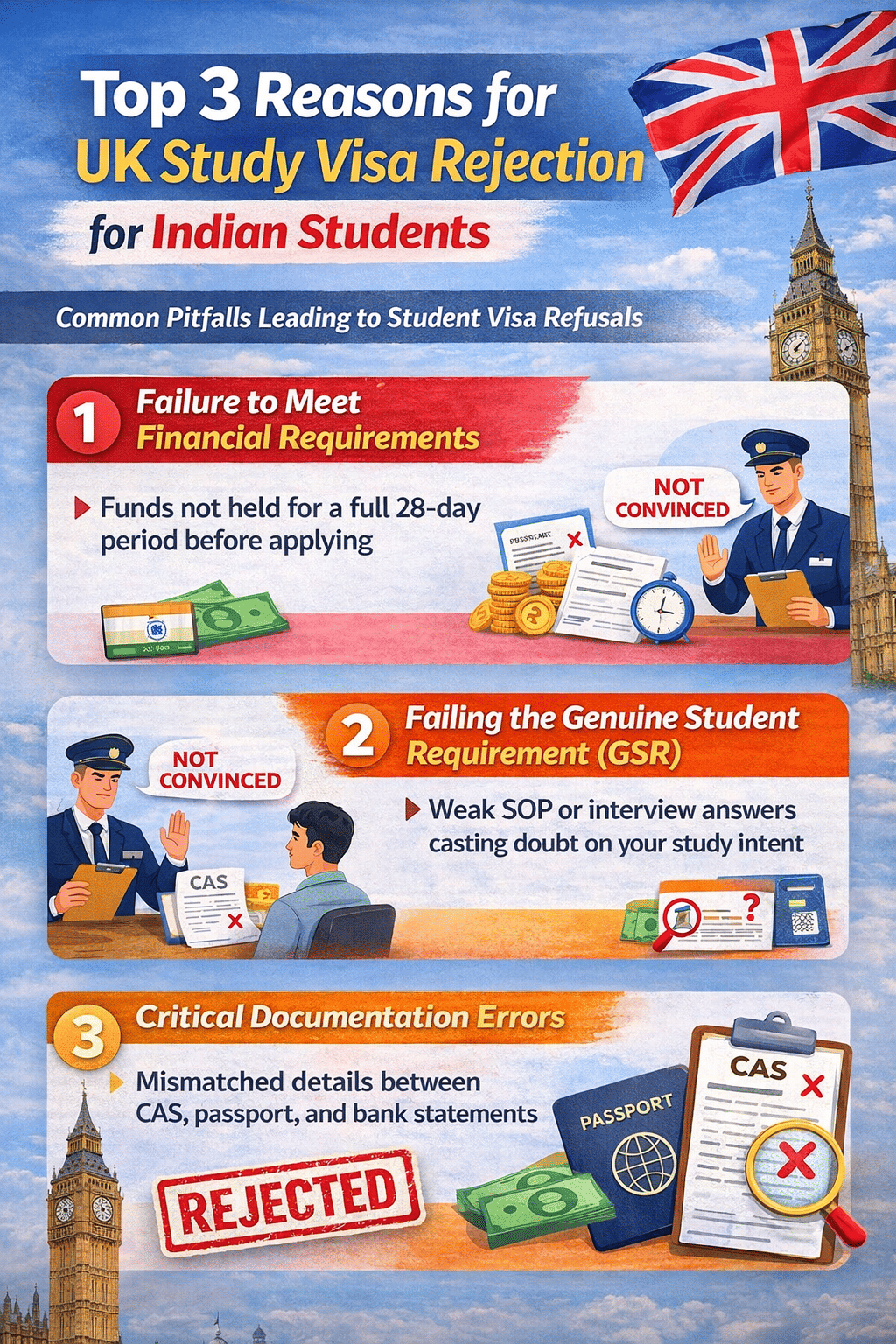
The top 3 UK student visa rejection reasons for Indian students are:
- Failure to Meet Financial Requirements: The non-negotiable '28-Day Rule'. (The required funds were not held in the account for the precise 28-day continuous period)
- Failing the Credibility Test: The Genuine Student Requirement (GSR) Interview. (The caseworker is not convinced of your genuine intent to study and return home).
- Critical Documentation Errors: Inaccuracies on the CAS and supporting evidence. (Simple data mismatches between your passport, CAS, and bank statements).
Check: Requirements for UK Study Visa
Insufficient or Non-Compliant Financial Evidence
The most common reason for UK Student visa rejection is the failure to provide sufficient or compliant financial evidence. UK Visas and Immigration (UKVI) must be certain you can support your studies. UKVI requires applicants to show funds covering their remaining first-year tuition fees (as stated on the CAS) plus mandatory living costs (maintenance).
Required Funds
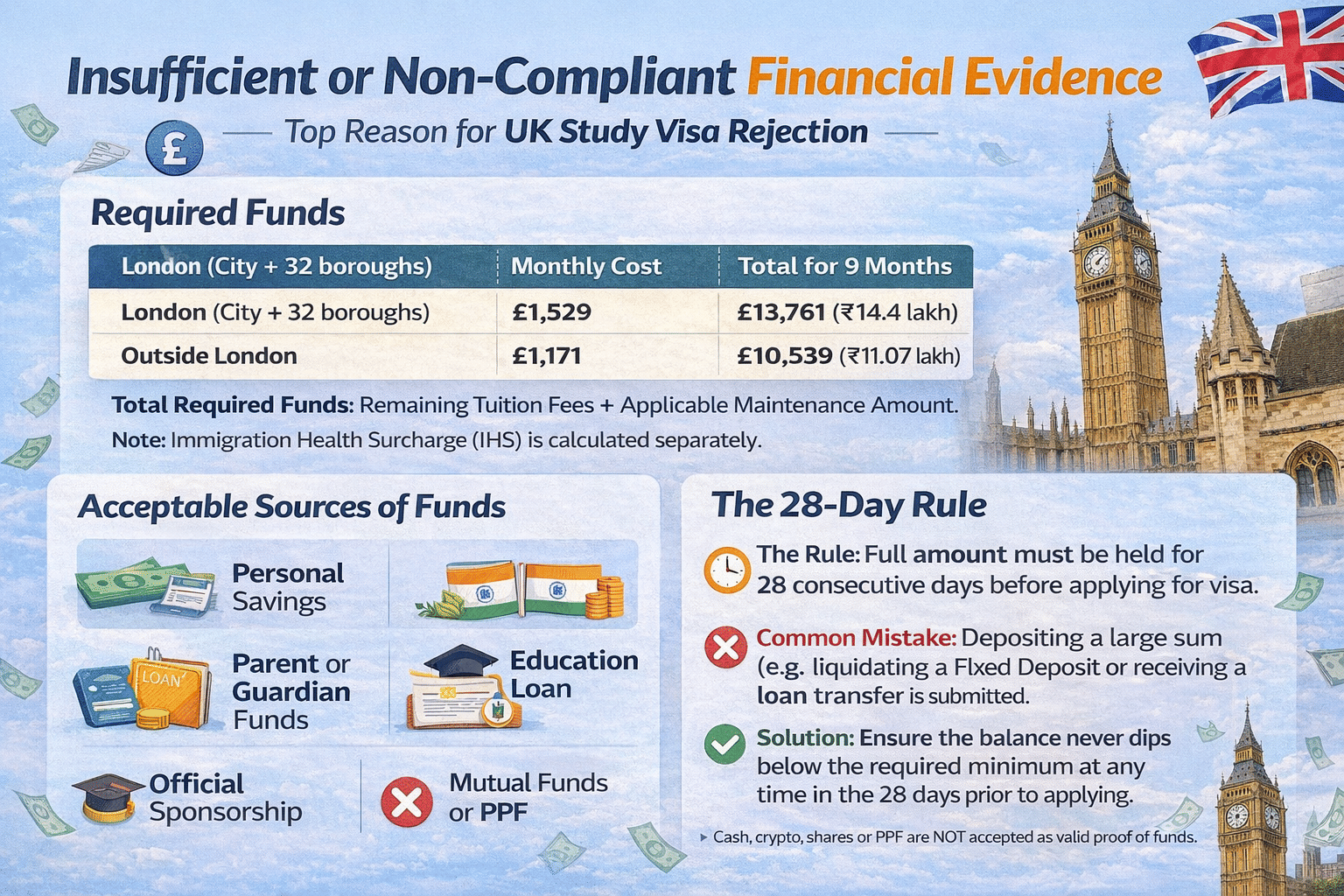
The maintenance amount depends on the location of study:
| Study Location | Monthly Cost | Total for 9 Months |
|---|---|---|
| London (City + 32 boroughs) | £1,529 | £13,761 (₹14.4 lakh) |
| Outside London | £1,171 | £10,539 (₹11.07 lakh) |
Total Required Funds: Remaining Tuition Fees + Applicable Maintenance Amount.
Note: You must also have sufficient funds to pay the Immigration Health Surcharge (IHS), which is calculated separately and paid online before submitting your application.
Acceptable Sources of Funds
The acceptable proof of funds for UK student visa includes:
- Personal savings in the applicant’s current or savings account.
- Parent or guardian funds (with notarised letter of consent + proof of relationship).
- Education loans from recognised financial institutions, supported by a formal sanction letter.
- Official sponsorship (government, university, or recognised scholarships).
Common Pitfalls
UKVI does not accept funds held in non-liquid assets, such as:
- Fixed Deposits (unless liquidated and held in a compliant account for 28 days).
- Public Provident Fund (PPF) or mutual funds.
- Shares, property, or cryptocurrency.
The 28-Day Rule
This is a technicality that results in instant refusal:
- The Rule: The full required amount (Tuition + Maintenance) must be held continuously in the account for 28 consecutive days immediately before the online visa application is submitted.
- Common Mistake: Depositing a large sum (e.g., liquidating a Fixed Deposit or receiving a loan transfer) just before applying, breaking the continuity.
- Solution: Ensure the balance never dips below the required minimum for the entire 28-day period. The final bank statement or official bank letter must be dated no more than 31 days before the application submission date.
Also Check:
Failure to Meet the Genuine Student Requirement (GSR)
The UKVI must be satisfied that you are a genuine student and are not using the Student Route as a primary path to gain work or settlement in the UK. This is heavily assessed through your application and the Credibility Interview. A strong academic record can still be rejected if the visa officer is not convinced of your genuine intent.
Example GSR Questions: "Why this specific module and not one at a university in India?" "Explain the progression from your bachelor's degree to this master's/PhD." "How much is your expected salary when you return to India?
| Red Flag | UKVI Concern | Advice for Indian Students |
|---|---|---|
| Weak course justification | Applicant fails to clearly explain how the course, the university, and the program fit into future career plans. | A clear academic or professional rationale, highlighting how the UK course provides specialised skills or value unavailable in India. |
| Poor academic progression | Applying for a course at the same or lower academic level, such as a second master’s degree, without a strong justification. | Logical continuity or a documented career shift showing how the UK course is essential for your high-level goals back home. |
| Unexplained study or work gap | Significant gaps (typically 12 months or more) raise doubts about academic intent and commitment. | Verifiable documentation (employment records, exam prep proof, certificates) that turns the gap into a period of productive activity, not idleness. |
| Weak ties to home country | An apparent focus on post-study work or settlement in the UK rather than returning after studies. | A credible return-to-India plan, outlining specific job roles, family ties, or financial/property connections in India. |
| Financial inconsistencies | Funds appear disproportionate to the applicant’s background or rely on unexplained third-party sources. | Transparent documentation proving the legitimate source of all funds, especially large deposits or third-party loans. |
Visa officers assess whether the course you’re applying for is relevant to your previous education or career aspirations. If your course seems unrelated or a poor fit, it may raise doubts about your intentions, leading to rejection.
Check Out: UK Student Visa Interview Guide
Missing Documents
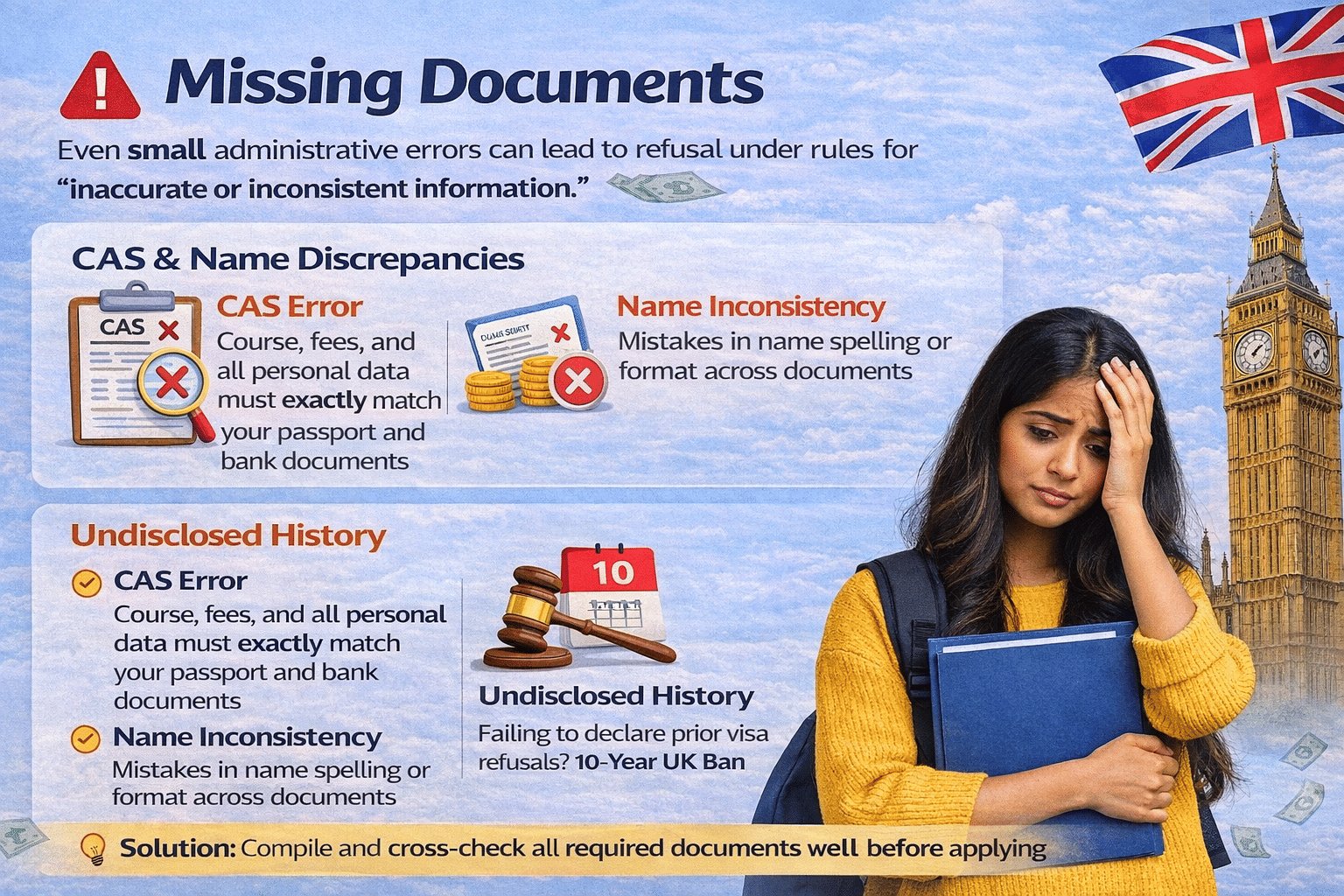
Even small administrative errors can be fatal, leading to refusal under the rules for "inaccurate or inconsistent information.”
CAS and Name Discrepancies
- CAS Error: Your personal data (Name, Date of Birth, Passport Number), the course details, and the fees on your Confirmation of Acceptance for Studies (CAS) must exactly match your passport and financial documents. Any mismatch requires the university to issue a corrected CAS.
- Name Inconsistency: Discrepancies in the spelling or format of your name across documents (e.g., missing a middle name on a bank statement but having it on your passport) are treated as material inconsistencies.
- Undisclosed History: Failing to declare any previous visa refusals (for any country) or immigration violations is considered an act of deception and can result in a mandatory 10-year UK entry ban.
| Document/Component | Description | Key Compliance Point |
|---|---|---|
| Confirmation of Acceptance for Studies (CAS) | Official letter/reference from the university confirming admission and fees. | Must be used within 6 months of being issued. Check all details against your passport. |
| Financial Documents | Proof of funds (bank statements/letters, loan sanction). | MUST meet the 28-Day Rule and be dated no more than 31 days old. |
| Academic Transcripts | Original mark sheets and transcripts from previous education. | Must align with the progression stated on your CAS. |
| English Proficiency Test Scores | Valid results from IELTS, PTE, etc. | Must meet the university's specific requirement (usually higher than the UKVI minimum). |
| IHS Payment Confirmation | Mandatory payment for health coverage. | The paid receipt reference number is mandatory for the application. |
| Parental Consent Letter (If Applicable) | Required if using parental funds. | Must be notarised and accompanied by a Birth/Adoption Certificate. |
Solution: Compile all necessary documents well in advance and cross-check with the visa requirements checklist provided by UKVI.
Unclear Visa Category
Selecting the correct category is essential when applying for a UK student visa. Many students mistakenly apply for visa types unsuited for their intended study duration or purpose. Applying under the wrong category can lead to visa rejection, forcing students to reapply or abandon their plans.
| Visa Type | Age Limit | Program Length | Course Type |
|---|---|---|---|
| Short-term study visa | All ages | Up to 6 months (11 months for English) | Short courses, primarily English language |
| Tier 4 (General) Student Visa | 16 years and older | Full-time studies | Undergraduate, postgraduate, and research degrees |
How to Avoid: Contacting the institution where you intend to study can clarify which visa category aligns with your course and duration of study. They can also issue the required Confirmation of Acceptance for Studies (CAS), which is important for the Student Route application.
Check Out:
English Language Proficiency
English proficiency is non-negotiable for a UK visa, especially for students applying for a Tier 4 Visa. You must meet the minimum score your chosen university and UK visa authorities. The UK Home Office mandates that applicants meet at least Level B1 on the Common European Framework of Reference for Languages (CEFR) scale. Failure to provide adequate proof of English proficiency can lead to visa rejection.
Accepted ELP Scores
| Test | Average Score Range | Minimum Requirement for Visa |
|---|---|---|
| IELTS | 6.0 - 6.5 | 5.5 in each section |
| TOEFL | 90 - 100 | Not specified |
| PTE | 58 - 67 | 59 for degree level; 43 for below degree |
| DET | 100 - 120 | Not specified |
Note: Indian students can be exempt from taking an English language proficiency test if they have completed their previous education (degree-level or higher) in an institution where the medium of instruction was English.
Tip: While UKVI accepts a certain score (e.g., IELTS 5.5 in all sections), your university will often require a higher score (e.g., 6.0–6.5 overall) for your course. Always meet the higher university requirement.
Check Out:
Incomplete UK Visa Application Form
A significant number of UK student visa applications are rejected because applicants fail to complete mandatory sections of the form. The visa form requires detailed information, and missing even a single required field can lead to rejection.
| Step | Description |
|---|---|
| Complete Form | Fill out the online application accurately. |
| Upload Documents | Include passport, CAS, and financial proof. |
| Pay Fee | Pay the visa application fee and keep the receipt. |
| Submit Application | Review and submit the application form. |
| Biometrics Appointment | Schedule and attend for fingerprints and photos. |
| Interview (if needed) | Prepare for potential questions about your study plans. |
How to Avoid: Make sure you review the application multiple times. Ask a mentor or consultant to verify the form before submission if possible.
Lack of Interview Skills
The Credibility Interview is a crucial component of the UK visa process. Applicants who fail to communicate clear academic intentions, financial stability, or proper understanding of their chosen course and university often face rejection.
Key Tips:
- Research your course and the reasons behind your choice of university. Be ready to explain how the course aligns with your career goals.
- Visa officers look for transparency and a genuine desire to study in the UK.
Poor Academic Records
Although UK universities are flexible in accepting a range of academic backgrounds, visa officers assess whether an applicant’s academic performance supports their ability to succeed in their chosen course. Poor grades, especially in subjects related to your desired field, can raise concerns.
How to Improve: Highlight any improvements in recent academic performance and justify any previous gaps or setbacks in your Statement of Purpose (SOP).
Check Out: UK Grading System
What to do if Your UK Student Visa is Denied?
If your application is refused, you generally have two immediate options:
- Administrative Review (AR): This is a formal challenge if you believe the visa caseworker made an error in applying the immigration rules (e.g., they overlooked a document). This is generally not successful if the refusal was due to an error on your part (e.g., not meeting the 28-day rule). Read How to Appeal a UK Visa Rejection?
- New Application (Recommended): In most cases, the best approach is to immediately review the refusal notice, correct the precise reason for rejection, and submit a brand-new application. This might involve re-running the 28-day fund calculation, getting a corrected CAS, or improving your interview preparation.
Check Out:
Securing a UK student visa involves navigating several strict guidelines and requirements. By understanding the most common reasons for visa rejection and following the advice provided here, applicants can significantly increase their chances of approval.
FAQs
Ques. What is the most common reason for UK student visa rejection?
Ans. Providing inaccurate information on the visa application form is a frequent cause of rejection, as discrepancies can lead to doubts about the applicant's credibility
Ques. Why are academic records important for a student visa?
Ans. Poor academic performance can lead to visa denial, as authorities assess whether applicants can handle the academic demands of UK institutions
Ques. How does the intent to study impact visa applications?
Ans. If authorities suspect that an applicant lacks genuine intent to study and may use the visa for other purposes, this can result in rejection















Comments