



Education Journalist | Study Abroad Strategy Lead | Updated On - Apr 6, 2026
Indian design students studying in the UK now have a direct, employer-free visa route to build a long-term career there — without relying solely on the Graduate Route. The UK Home Office's new Design Industry pathway under the Global Talent Visa opens on 1 July 2026, giving graphic, UX, product, and industrial designers a clearly defined immigration track for the first time, with India ranked third among all nationalities using the Global Talent route.
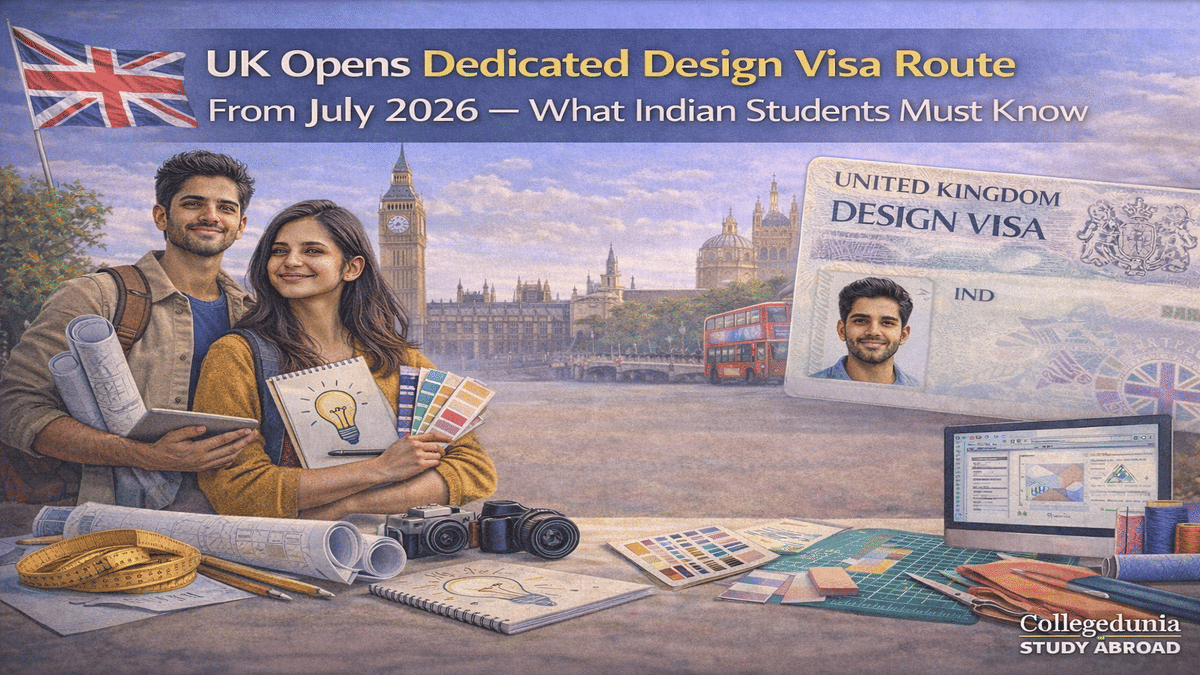
A New Door for UK Design Graduates
Until now, design professionals hoping to stay in the UK after graduation faced a structural problem: the Global Talent Visa existed, but design had no dedicated home within it. Applicants had to squeeze into the broader Arts and Culture pathway, assessed by Arts Council England — a route built for performing artists and cultural practitioners, not UX designers or brand strategists.
The UK Home Office's Statement of Changes HC 1691, laid before Parliament on 5 March 2026, changes that. A standalone Design Industry pathway has been added to Appendix Global Talent, with its own endorsement criteria tailored to how achievement is actually recognised in design fields: awards, published work, exhibitions, media coverage, and international professional engagement.
The pathway takes effect on 1 July 2026.
Who Qualifies: Exceptional Talent vs Exceptional Promise
The design pathway, like all Global Talent routes, operates under two tiers:
Exceptional Talent — for established professionals with a proven track record across at least two countries. Evidence must demonstrate the quality and reach of work, and the applicant's direct contribution to recognised projects.
Exceptional Promise — for early-career professionals still building their profile. Applicants need a developing track record in one or more countries, with regular professional engagement in design over the last five years.
For Indian students completing a design degree in the UK, Exceptional Promise is the more relevant tier. It is designed precisely for those at an earlier career stage — which includes recent graduates with strong portfolios, award nominations, published work, or industry recognition.
Design disciplines now explicitly covered include:
- Graphic and brand design
- Product and industrial design
- UX and experience design
- Service design
- Interior and spatial design
Global Talent Visa vs Graduate Route: The Key Differences
Most Indian students currently use the Graduate Route (Post-Study Work visa) after completing their UK degree — a 2-year open work visa requiring no sponsorship. It is flexible, widely used, and familiar.
But the Graduate Route has limits — and they are tightening. From January 2027, students starting courses now will only receive 18 months on the Graduate Route, down from 2 years.
Here is how the two routes compare for Indian design graduates:
| Feature | Graduate Route (PSW) | Global Talent Visa (Design) |
|---|---|---|
| Job offer required | No | No |
| Employer sponsorship | No | No |
| Duration | 2 years (18 months from Jan 2027) | Up to 5 years, renewable |
| Freelance/self-employed | Limited | Yes — fully permitted |
| ILR pathway | Not directly | Yes — after 3–5 years |
| Eligibility | Any UK degree graduate | Endorsement required |
| Visa fee | ~£822 | £766 (£561 + £205) |
In INR terms (at April 2026 rate of 1 GBP = ₹122.3, source: currency-converter.org.uk):
- Global Talent Visa total fee: £766 ≈ ₹93,700
- NHS surcharge: ~£1,035/year ≈ ₹1,26,600/year
The Global Talent Visa costs more upfront and requires an endorsement — but it offers a direct path to permanent residency that the Graduate Route does not.
What This Means for Indian Design Students Right Now
India is the third-largest nationality on the Global Talent Visa, with 352 visas issued to Indian nationals in the first three quarters of 2025 alone (Home Office Q3 2025 data, via Wonkhe). The new design pathway is expected to expand that number significantly, as it removes the biggest barrier Indian design professionals previously faced: the absence of a route that matched their field.
For students currently enrolled in UK design programmes — or planning to apply for September 2026 intake — this changes the post-graduation calculus. Rather than treating the Graduate Route as the only option, Indian design students can now plan their UK career in two stages:
- Graduate Route first — use the 2-year window to build UK work experience, portfolio, and professional recognition
- Global Talent Visa next — apply under Exceptional Promise once portfolio and professional track record are strong enough
This two-step approach is particularly relevant for students in MA Graphic Design, BA Product Design, MSc UX Design, and MA Communication Design programmes at institutions like the Royal College of Art, UAL, Goldsmiths, and Loughborough University.
How to Plan From the Student Stage
If you are an Indian student currently studying design in the UK, or planning to start in September 2026, here is what to do now:
Build your endorsement evidence from day one:
- Enter and win design awards (D&AD, RSA Student Design Awards, Core77)
- Get your work published, exhibited, or featured in industry media
- Document your contribution to every project — not just the outcome
- Attend and speak at industry events; build an international professional profile
Understand the endorsement body: The design pathway will be assessed by a Home Office-approved endorsing body. Check the UK Global Talent Visa guidance for the confirmed endorser once announced ahead of the July 2026 launch.
Apply before the Graduate Route expires: You can switch from the Graduate Route to the Global Talent Visa while inside the UK — meaning you do not need to leave and reapply from India.
Seek immigration advice: The endorsement stage is where applications succeed or fail. Consult a regulated UK immigration adviser (OISC-registered) before applying.
The Bigger Picture
The design pathway is part of a broader expansion of the Global Talent route announced in the March 2026 Statement of Changes. The same document also simplified the fast-track appointments criteria for academic and research roles, and introduced changes to the Skilled Worker salary compliance framework.
For India, the timing is significant. With the UK Graduate Route shortening and overall immigration scrutiny increasing, the Global Talent Visa offers Indian design professionals a more durable, long-term pathway — one that does not depend on employer sponsorship or salary thresholds, and that leads directly to settlement.
The route opens in less than three months. For Indian design students, the planning starts now.













Comments