



Education Journalist | Study Abroad Strategy Lead | Updated On - Mar 19, 2026
UK Visas and Immigration (UKVI) updated its financial evidence requirements for Student visa applicants on 31 December 2025, revising the living cost thresholds that all international students must demonstrate when applying. For Indian students — who are not on the UK's differential evidence exemption list — this means full financial proof must be submitted upfront with every application, and the amounts required have increased.
Financial documentation is consistently the leading cause of UK student visa rejections for Indian applicants. Getting the numbers wrong, the timing wrong, or the document format wrong results in refusal — even when the money genuinely exists. This guide covers exactly what the updated rules require, what commonly goes wrong, and how to prepare a rejection-proof financial file.
What Changed in the December 2025 Update?
The UKVI guidance page for financial evidence was last updated on 31 December 2025, revising the living cost figures that student visa applicants must demonstrate. The current requirements are:
Living costs (maintenance funds):
| Study Location | Monthly Requirement | Maximum 9-Month Total |
|---|---|---|
| London (City of London + 32 boroughs) | £1,529 per month | £13,761 |
| Outside London | £1,171 per month | £10,539 |
These figures replaced the previous thresholds of £1,483 (London) and £1,136 (outside London) that applied from January 2025.
Course fees: In addition to living costs, you must show you have enough to cover your full first year of course fees as stated on your Confirmation of Acceptance for Studies (CAS). There is no fixed national figure — it is whatever your university has listed on your CAS.
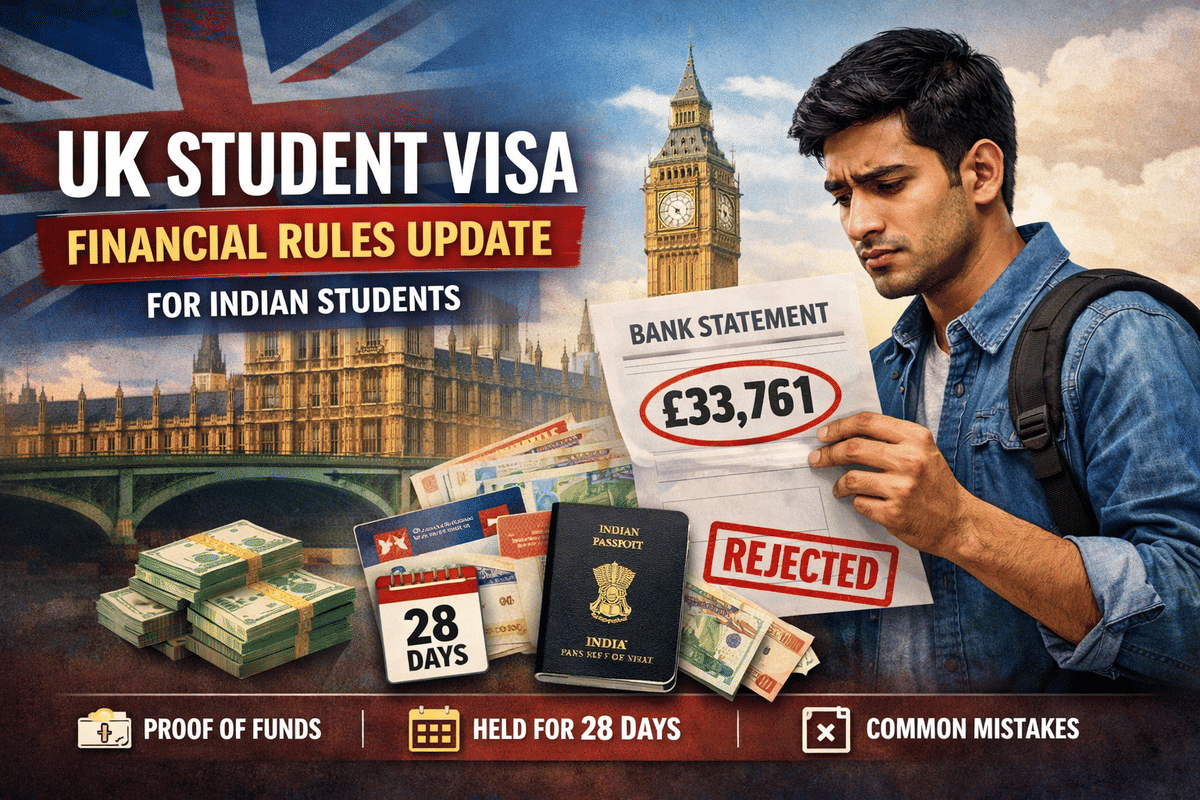
Total funds required (example): An Indian student starting a master's programme in London with first-year fees of £20,000 must demonstrate: £20,000 (fees) + £13,761 (living costs) = £33,761 held continuously for 28 days.
India Is Not Exempt — Full Proof Required Upfront
This is the single most important point for Indian applicants to understand.
The UK operates a differential evidence requirement — a list of nationalities that do not need to submit financial proof upfront at the point of application. They may be asked for it later, but it is not mandatory at submission.
India is not on this list.
Indian students must submit complete financial evidence — bank statements, letters, or other accepted documents — at the time of application, without exception. UKVI can and does verify evidence directly with banks. If they cannot verify it, the application may be refused.
The 28-Day Rule: How It Works and Where It Goes Wrong
The most commonly misunderstood requirement is the 28-day holding rule. Here is exactly how it works:
- The required funds must have been continuously present in the account for 28 consecutive days
- The end date of the 28 days must fall within 31 days of the date you submit your visa application
- The bank statement you submit must show the closing balance from no more than 31 days before your application date
Example (from GOV.UK): If you submit your application on 1 January, the funds must have been in the account for the 28 days ending on 1 December — meaning the money must have been there continuously from 3 November to 1 December.
Check: Financial Requirements for UK Student Visa
Where Indian students most commonly go wrong:
| Mistake | Why It Causes Rejection |
|---|---|
| Depositing the full amount just before printing the statement | The 28-day continuous holding requirement is not met — UKVI checks the full statement history, not just the closing balance |
| Using a statement dated more than 31 days before the application | The evidence is considered out of date and is rejected |
| Showing funds in a joint account without clarifying ownership | UKVI requires the account to be one the applicant (or parent/partner) controls — joint accounts need a letter confirming the funds are available for the applicant's use |
| Large unexplained deposits appearing mid-statement | Raises source-of-funds concerns; UKVI may request additional evidence or refuse if the origin cannot be verified |
| Using overdraft facilities, cryptocurrency, stocks, or pension funds | These are explicitly prohibited as evidence under UKVI rules |
| Parent's funds without a supporting letter | If using a parent's account, a signed letter confirming they agree to the funds being used for the student's study is mandatory |
What Indian Students Must Show: The Complete Financial File
Accepted forms of evidence:
- Bank statements (paper or electronic downloads) — must show your name, bank name, account number, and balance
- Building society passbooks
- Certificates of deposit
- Official letters from your bank or building society
- Student loan letter (if applicable — must confirm loan amount, that it is unconditional, and that funds will be available before the course starts)
- Official financial sponsorship letter (if applicable — must show sponsor name, contact details, duration, and amount)
Not accepted:
- Overdrafts
- Cryptocurrency holdings
- Stocks and shares
- Pension funds
- Accounts not regulated by the financial regulatory body in the country where the bank operates
- Accounts without electronic record keeping
If funds are in a foreign currency (e.g., Indian Rupees): UKVI converts to British pounds using the OANDA spot exchange rate on the date of application. Check the INR/GBP rate when calculating whether your balance meets the threshold — do not assume a fixed conversion rate.
Why This Matters More for Indian Students in 2026?
The financial proof layer sits on top of an already tightened UK visa environment for Indian applicants:
- The UK has raised English language requirements and financial proof thresholds in 2025–26
- Stricter compliance checks are being applied to student visa applications from high-scrutiny nationalities
- The Graduate Route is being reduced from 2 years to 18 months from January 2027, compressing the post-study work window
- From January 2025, master's and undergraduate students can no longer bring dependants — removing a common reason for higher fund requirements, but also removing a pathway many Indian families relied on
For Indian students applying for September/October 2026 intake, the financial file preparation window is now. The 28-day holding period means funds must be in place at least 28 days before you print your statement — and your statement must be dated within 31 days of your application submission.
What Students Should Do Now?
- Calculate your exact requirement — add your first-year course fees (from your CAS) to the living cost figure for your study location (£13,761 for London; £10,539 outside London). This is the minimum balance you must hold continuously for 28 days
- Start the 28-day clock now — if you are applying in the next 4–8 weeks, ensure the full required amount is in your account today and do not withdraw below that threshold for 28 consecutive days
- Do not make large unexplained deposits — if you need to consolidate funds from multiple sources, do it well in advance and keep a clear paper trail of the source of each transfer
- Use only accepted account types — personal current or savings accounts in your name (or parent's/partner's name with a supporting letter). No overdrafts, no crypto, no stocks
- Print your statement at the right time — your bank statement must be dated no more than 31 days before your application submission date. Do not print it too early
- If using parent's funds, get the letter drafted now — a signed letter from your parent confirming they agree to the funds being used for your study is mandatory. Get this notarised if your university or adviser recommends it
- Check the INR/GBP rate on your application date — use the OANDA converter to confirm your INR balance converts to the required GBP amount on the day you apply, not the day you checke














Comments