



Education Journalist | Study Abroad Strategy Lead | Updated On - Mar 31, 2026
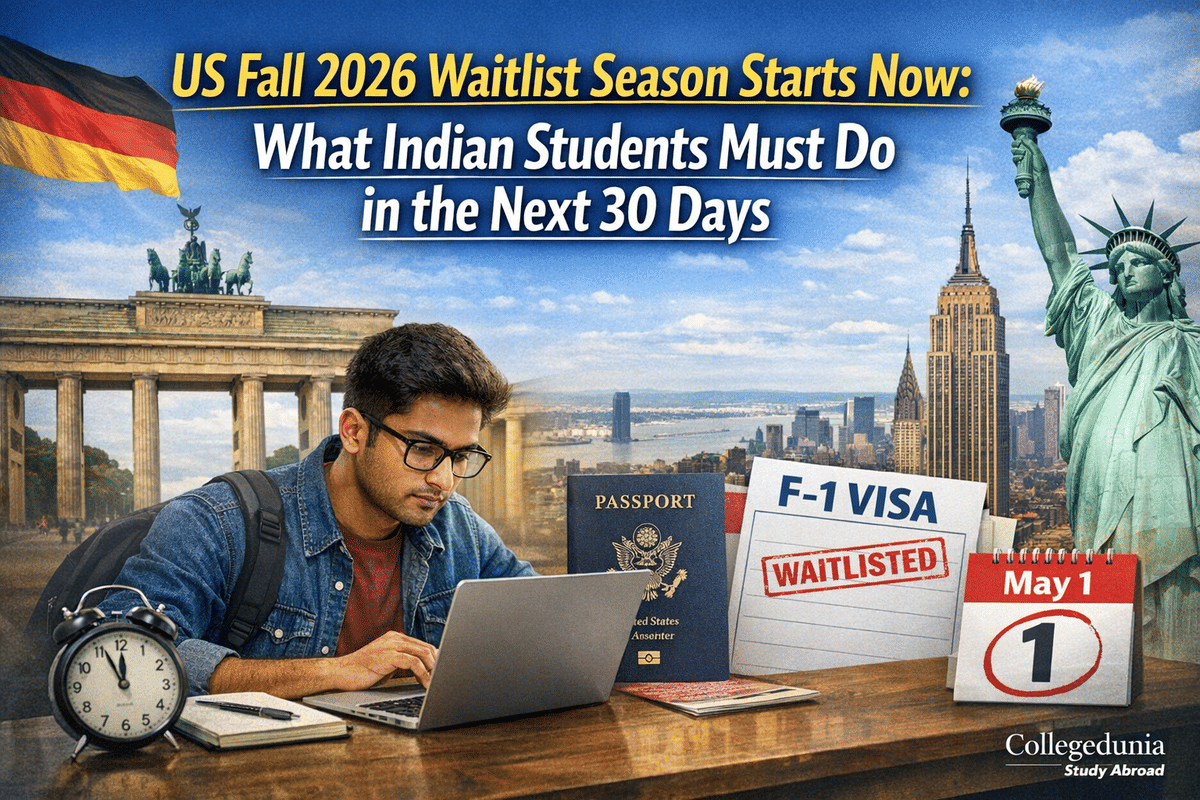
Indian students who received offers from Harvard, Yale, Columbia, MIT, or any of the eight Ivy League schools on Ivy Day — March 26, 2026 — now have exactly 31 days until the May 1 enrollment deposit deadline. But the real deadline for Indian students is today: F-1 visa administrative processing holds for STEM applicants from India run 60–90 days on average, meaning students who wait until May 1 to accept their offer risk not receiving their visa before August classes begin. This year's Ivy Day produced the most selective results in recent memory — Harvard admitted just 3.6% of 54,008 applicants — against a backdrop of record application volumes, Trump administration pressure on elite universities, and a 69% drop in F-1 visa issuances to Indian students in peak season 2025.
Ivy Day 2026: The Full Acceptance Rate Data
All eight Ivy League schools released Regular Decision results simultaneously on March 26, 2026. Here are the verified figures:
| University | Total Applicants | Admitted | Acceptance Rate | Key Note |
| Harvard | 54,008 | ~1,944 | 3.6% | Rate not officially released; estimated from pool |
| Columbia | 61,031 | 2,581 | 4.23% | Largest applicant pool in Columbia history; ED apps fell 6.4% |
| Yale | 54,919 | 2,328 | 4.24% | Second-largest applicant pool in Yale history |
| MIT | 28,349 | 1,299 | 4.6% | Officially released |
| Brown | 47,937 | 1,674 | 5.35% | ED rate was 16.5% — gap of 11+ percentage points |
| Cornell | Not released | 5,776 | Not released | Largest admitted class by number |
| Penn | 61,000+ | Not released | Not released | First cycle with reinstated standardised testing |
| Princeton | Not released | Not released | Not released | Rate not released |
| Dartmouth | Not released | Not released | Not released |
Sources: Forbes (March 27, 2026), Yale News, Columbia Spectator, MIT Admissions — all March 26–27, 2026.
The before/after: In the Class of 2029 cycle (2025), Harvard's acceptance rate was approximately 3.7%, Yale's was 3.7%, and Columbia's was 3.9%. The 2026 rates are marginally tighter across the board — driven by record application volumes, not fewer admitted students.
What Changed This Cycle — and Why It Matters for Indian Students?
1. Columbia's Early Decision applications fell 6.4%
Columbia is the only Ivy League school to report a decline in ED applications for the Class of 2030. The Trump administration's sustained campaign against elite universities — including funding cuts and campus tensions — has visibly affected Columbia's desirability among the most motivated applicants. For Indian students, Columbia remains a top choice for CS, engineering, and finance (NYC location, strong alumni network) — but the reputational shift is worth monitoring for Fall 2027 planning.
2. Financial aid packages are expanding — but not for international students
Notre Dame announced families earning up to USD 150,000 pay zero tuition. Emory introduced tuition-free attendance for families earning under $200,000. Tufts launched its Tuition Pact. None of these apply to international students, including Indians. The financial aid expansion is exclusively for US domestic students. Indian students at these universities continue to pay full international fees — typically 60,000–80,000/year all-in.
3. Public flagships are surging — and becoming relevant for Indian students
University of Michigan received 108,666 applications — a 29% increase over five years. UVA received 82,118 applications — a 27% increase over last year. Georgia Tech saw its largest-ever early applicant pool. These universities are increasingly competitive but remain more accessible than Ivy League schools for Indian students, with strong STEM programmes and OPT eligibility.
4. Standardised testing is back
Penn reinstated its standardised testing policy this cycle — the first Ivy to do so. USC reported its highest-ever incoming class GPA (3.92). The trend toward test-optional is reversing at selective universities. Indian students applying for Fall 2027 should plan for SAT/ACT scores to be required or strongly recommended at most top-50 US universities.
The India-Specific Risk: F-1 Visa Timing After Ivy Day
Indian students holding Ivy League offers face a visa timing risk that is unique to their cohort. Here is the precise problem:
The standard F-1 visa timeline for Indian students (no AP hold):
- Accept offer + pay deposit: April 1
- Request I-20: April 1–15 (5–15 business days processing)
- Pay SEVIS fee ($350): April 15
- Book visa appointment: April 15 (slots available now; fill fast in May–July)
- Visa interview: May–June
- Visa issued: June–July
- Arrives in time for August start
The STEM AP hold scenario (affects CS, engineering, data science, AI, biotech):
- Accept offer + pay deposit: May 1
- Request I-20: May 1–15
- Book visa appointment: May 15 (peak season — slots scarce)
- Visa interview: June–July
- AP hold triggered: 60–90 days
- Visa received: August–October
- Misses August start
The rule: Indian students admitted to STEM programmes at Ivy League or top-50 US universities should treat April 1 as their personal May 1. Accept your offer, request your I-20, and book your visa appointment this week — not next month.
What Indian Students With Ivy League Offers Must Do This Week?
Day 1–2 (Today):
- Log into your application portal and formally accept your offer
- Email the international student office requesting your I-20 immediately
- Begin your DS-160 application at ceac.state.gov
- Check visa appointment availability at your nearest US consulate (Chennai, Mumbai, Delhi, Hyderabad, Kolkata)
Day 3–7:
- Pay your SEVIS fee ($350) at fmjfee.com as soon as your I-20 arrives
- Book your F-1 visa appointment — do not wait for your I-20 to arrive before checking slot availability
- Gather financial documents: bank statements showing sufficient funds for first year (typically 70,000–85,000 for Ivy League), scholarship letters if applicable
Day 8–30 (Before May 1):
- Pay your enrollment deposit (typically 500–1,000) by May 1
- Attend your visa interview with complete documentation
- If AP hold is triggered, notify your university's international student office immediately and ask about deferred start options
The Bigger Picture: What Ivy Day 2026 Tells Indian Students About Fall 2027
For students currently in Class 11 or early Class 12 planning Fall 2027 applications, the Class of 2030 data carries three clear signals:
Apply Early Decision if you have a genuine first choice.
Brown's ED rate (16.5%) vs. overall rate (5.35%) represents an 11-percentage-point advantage. This gap exists at every Ivy League school. For Indian students, ED is binding — but if a school is genuinely your first choice and you can afford it without need-based aid, ED is the single most impactful strategic decision you can make.
Standardised testing is returning.
Penn reinstated testing this cycle. MIT has always required it. USC's record GPA signals that academic metrics are rising. Indian students should plan for SAT 1500+ or ACT 34+ as the competitive floor for Ivy League applications.
Columbia's reputational dip is an opportunity.
Columbia's ED decline and ongoing campus tensions mean it may be marginally more accessible for Fall 2027 than in previous cycles — while still offering a world-class education in New York City. Indian students who have Columbia as a genuine first choice should consider ED seriously.







1691151352.png?tr=w-305,h-145,c-force?h=175&w=350&mode=stretch)



Comments