



Education Journalist | Study Abroad Strategy Lead | Updated On - Apr 6, 2026
Indian students already enrolled and studying in the United States now face a risk that did not exist before 2025: having their legal status terminated without warning, even without a criminal conviction or campus protest involvement. The US government has expanded the grounds under which Immigration and Customs Enforcement (ICE) can terminate a student's SEVIS record — and Indian students account for 50% of the 327 visa revocation cases tracked by the American Immigration Lawyers Association (AILA), despite representing roughly 28% of the total international student population.
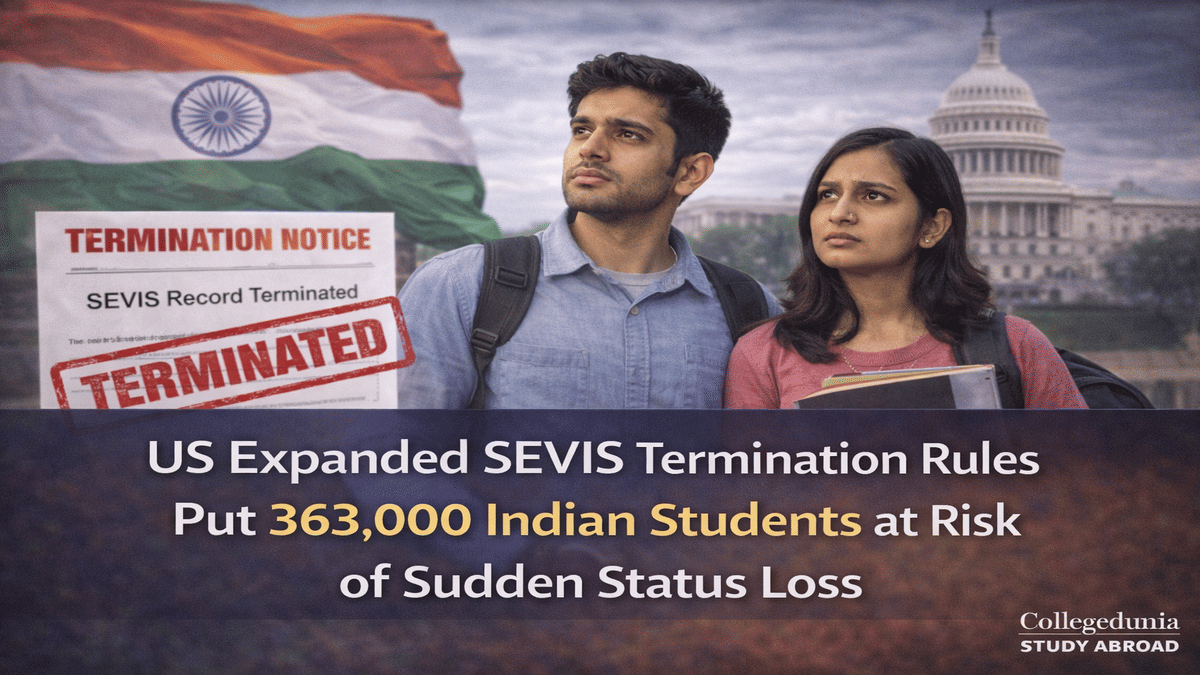
What Is SEVIS and Why Its Termination Is a Crisis?
The Student and Exchange Visitor Information System (SEVIS) is the US Department of Homeland Security's database that tracks every international student on an F-1, M-1, or J-1 visa. A student's SEVIS record is the legal backbone of their status in the United States.
Before 2025, a visa revocation by the State Department only affected a student's ability to re-enter the US — it did not end their permission to remain and study if they were already inside the country.
From 2025 onwards, the US government changed this. ICE now has the authority to terminate a student's SEVIS record — and therefore their legal status — if:
- Their visa is revoked by the State Department
- They are found in non-compliance with the terms of their nonimmigrant status
- Their name appears in a criminal database, even if they were never charged with a crime
- They are flagged by AI-assisted social media screening under the "Catch and Revoke" programme
This change was outlined in an ICE document shared in a court filing on April 28, 2025 (AP), and represents what immigration attorneys described as going against "at least 15 years of SEVP guidance."
"This just gave them carte blanche to have the State Department revoke a visa and then deport those students, even if they've done nothing wrong," said immigration attorney Brad Banias (The PIE News, May 2025).
The Scale: What Happened and What Continues
Between March and May 2025, the US government terminated the SEVIS records of more than 4,736 international students, according to the Student and Exchange Visitor Program (SEVP) data submitted to Congressional committees. Over 1,600 visa revocations were reported to NAFSA by May 7, 2025 — a figure NAFSA described as likely an underrepresentation.
After widespread legal challenges, the Trump administration restored most SEVIS records by April 25, 2025. However:
- Restored SEVIS records did not mean restored visas — revoked visas remained cancelled
- ICE began re-terminating some restored SEVIS records shortly after restoration
- The expanded legal grounds for termination remain in force
- 8,000+ F-1 visas have been revoked since January 2025
The enforcement environment has not normalised. It has become the new baseline.
Why Indian Students Are Disproportionately Affected
According to AILA's brief "The Scope of Immigration Enforcement Actions Against International Students":
| Nationality | Share of Tracked Revocations |
|---|---|
| India | 50% |
| China | 14% |
| South Korea | — |
| Nepal | — |
| Bangladesh | — |
India's outsized share is partly a function of scale — Indian students are the largest international cohort in the US at 363,019 (IIE Open Doors 2024–25, 9.5% YoY increase) — but also reflects the concentration of Indian students on OPT and STEM OPT, which are particularly vulnerable to SEVIS termination.
Of the students affected nationally, 50% were OPT holders (AILA). OPT allows F-1 students to work in the US for up to 12 months (or 36 months for STEM graduates) after completing their degree. A SEVIS termination immediately strips OPT work authorisation — meaning Indian students working at US tech companies, research labs, or startups on OPT can lose their right to work overnight.
What Triggers Visa Revocation and SEVIS Termination in 2026
Based on verified government and legal sources, the following are confirmed triggers:
Definite triggers (confirmed by State Dept / ICE):
- Participation in pro-Palestinian protests or demonstrations deemed to support Hamas (Secretary Rubio, March 2025)
- Criminal conviction — including DUI, misdemeanours, traffic infractions (NPR, Fortune, May 2025)
- Appearance in a criminal database, even without charges filed
- Visa revocation by the State Department (now automatically triggers SEVIS termination under new rules)
"Catch and Revoke" AI programme triggers:
- Social media posts, likes, shares, or follows flagged as supporting Hamas or anti-Semitic content
- Social media accounts set to private (consular officers instructed this "could be construed as an effort to hide activity" — NAFSA, June 2025)
- AI-assisted review of tens of thousands of student visa holders' accounts (Reuters, Axios)
Important: There is no transparency into the exact standards used. NAFSA noted that "the rationale provided by the government ranged from wholly absent, to conflicting, to shifting, to downright baseless." Students have been terminated with no prior notice and no clear explanation.
Consequences of SEVIS Termination: What It Means Practically
| Consequence | Detail |
|---|---|
| Work rights lost immediately | OPT and STEM OPT authorisation ends the moment SEVIS is terminated |
| Cannot re-enter the US | A revoked visa means any student who travels abroad cannot return |
| No grace period | Unlike a standard status violation, "violation of status" terminations carry no grace period (Boston University ISSO) |
| Deportation risk | ICE can initiate removal proceedings; students may be detained |
| Academic status unaffected (temporarily) | Universities are not required to disenroll a student whose SEVIS is terminated — but many do |
| INA 221(g) "Refused" status | Students undergoing administrative processing now see "Refused" in official records, causing confusion even when it is a temporary step |
How Indian Students Can Protect Their Status Right Now
These are verified, actionable steps based on guidance from NAFSA, AILA, immigration attorneys, and university international offices:
Immediate compliance steps:
- Set all social media accounts to public — consular officers and AI screening tools flag private accounts as suspicious under current DOS guidance
- Do not post, like, share, or comment on content related to pro-Palestinian activism, Hamas, or politically sensitive US foreign policy topics
- Check your SEVIS record regularly via your university's international student office (DSO) — do not wait to be notified
- Do not travel outside the US unless your visa stamp is valid and unexpired — a revoked visa means you cannot re-enter
- Maintain full-time enrollment — dropping below full-time without DSO authorisation is a status violation
- Report any police contact immediately to your DSO, even for minor incidents — including traffic stops that did not result in charges
If your SEVIS is terminated:
- Do not leave the US immediately — consult an immigration attorney first; departure may be treated as voluntary departure and affect future visa eligibility
- Download all SEVIS records, I-20 forms, and screenshots of your status immediately (Tarter Krinsky)
- File for reinstatement through your DSO — reinstatement is possible if the termination was in error or based on a correctable violation
- Contact your university's ISSO (International Student Services Office) — they can monitor SEVIS and initiate reinstatement requests
Legal resources:
- NAFSA's Standing for Students and Scholars coalition
- AILA's featured issue tracker on international student enforcement actions
- India's Ministry of External Affairs has confirmed it is monitoring the situation; the Indian Embassy and consulates are in contact with affected students
The Bigger Picture: A Permanently Changed Enforcement Environment
The 2025 SEVIS termination wave was not a one-time event. The legal framework that enabled it — expanded ICE authority, AI-assisted social media screening, and the new link between visa revocation and SEVIS termination — remains in place in 2026.
For Indian students, who represent the largest international cohort in the US and are disproportionately concentrated on OPT and STEM OPT, the risk is structural, not episodic. The Indian government's MEA has acknowledged the issue. Universities across the US have updated their guidance. The courts continue to challenge the legal basis of the expanded termination powers.
Until the legal landscape is resolved, every Indian student on an F-1 visa in the United States should treat SEVIS compliance as an active, ongoing responsibility — not a one-time formality completed at the airport.





1691151352.png?tr=w-305,h-145,c-force?h=175&w=350&mode=stretch)



Comments