



Education Journalist | Study Abroad Strategy Lead | Updated On - Mar 24, 2026
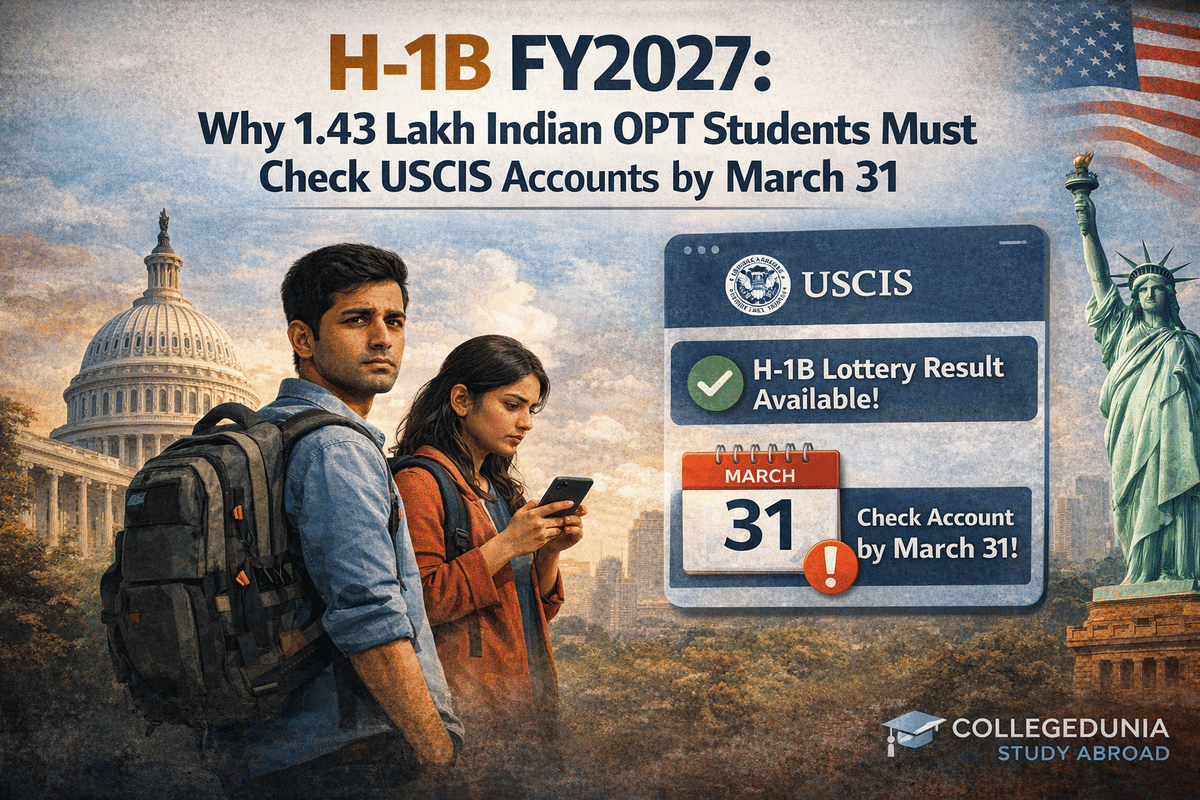
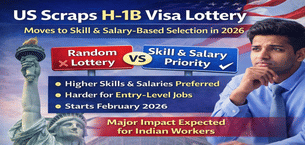
Indian students on OPT in the US now face a lottery where entry-level roles carry just a 15% selection chance — down from the 30% equal odds every candidate held under the old random system. USCIS will notify FY2027 H-1B lottery results by March 31, 2026, giving 1.43 lakh Indian OPT students fewer than seven days to confirm their status and trigger the correct next steps before the April 1 petition filing window opens. The US Department of Homeland Security finalised the new wage-weighted H-1B selection rule on December 29, 2025, replacing the equal-chance random lottery that had governed the process since 2007. Under the new system, a candidate's selection odds are determined entirely by the salary level of their offered role — not by chance.
How the H-1B Lottery Changed for FY2027?
The US Department of Homeland Security finalised the Weighted Selection Process for H-1B Registrations on December 29, 2025. The rule took effect February 27, 2026, and applies for the first time to the FY2027 cap season.
Under the old system, every registered candidate — regardless of salary, role seniority, or employer size — had an equal ~30% chance of selection. Under the new system, each registration is entered into the lottery pool a number of times equal to its OEWS (Occupational Employment and Wage Statistics) wage level:
| OEWS Wage Level | Role Type | Lottery Entries | Selection Odds (DHS estimate) |
|---|---|---|---|
| Level I | Entry-level, supervised | 1x | ~15% |
| Level II | Qualified, mid-level | 2x | ~31% |
| Level III | Experienced, complex | 3x | ~46% |
| Level IV | Fully competent, senior | 4x | ~61% |
The registration window closed March 19, 2026. USCIS intends to notify selected registrants through employer USCIS online accounts by March 31, 2026. Petition filing for selected cases opens April 1, 2026, and closes June 30, 2026.
What the Old System Gave Indian Students — and What's Gone
Before FY2027, the H-1B lottery was a pure random draw. A Master's degree holder on STEM OPT had a 3-year cumulative win rate of approximately 70%, accounting for three annual lottery attempts and the separate 20,000-visa Master's degree pool that runs before the general 65,000-visa cap.
Under the new weighted system, that 3-year win rate drops to approximately 66% for most Indian Master's STEM graduates — a marginal decline. But for Indian students in entry-level (Level I) roles, the shift is sharper: their annual selection odds fall from ~30% to ~15%, effectively halving their chances in any single lottery year.
The before/after gap is widest for:
- Indian undergraduates in non-STEM or lower-paying roles: annual odds cut roughly in half
- Indian Master's STEM graduates in Level III–IV roles: broadly neutral to slight improvement
- Indian graduates promoted to senior roles by their third OPT year: odds could rise to ~73%, above the old system's baseline (MPOWER Financing modelling, March 2026)
How Many Indian Students Are Directly Affected
India is the largest source of international students in the US. According to the Open Doors 2024–25 survey, 3,63,019 Indian students were enrolled in US institutions. Of these, 1,43,740 are currently on OPT — the post-study work authorisation that bridges F-1 student status to H-1B employment.
Indians account for 48% of all STEM OPT participants in the US. The majority are Master's degree holders — over 80% of Indian students in the US pursue postgraduate programmes — which means most are competing in the higher wage tiers where the new system is neutral or favourable.
One critical protection specific to Indian OPT students: the $100,000 employer fee introduced by Presidential Proclamation 10973 (September 2025) applies only to H-1B beneficiaries who are outside the US at the time of filing. Indian students transitioning from F-1/OPT via change of status from within the US are fully exempt from this fee.
What to Do Right Now — Selected or Not
If your registration shows "Selected" by March 31:
- Confirm the notice immediately — Your employer or immigration attorney checks the USCIS organisational account. You will not see this in a personal dashboard. Ask HR or counsel to confirm before March 31.
- Do not travel outside the US — If your petition requests a change of status (COS), travelling abroad while the COS is pending causes USCIS to treat it as abandoned. Book no international travel until your attorney confirms it is safe.
- Verify Form I-129 edition 02/27/26 — From April 1, 2026, USCIS accepts only Form I-129 edition dated 02/27/26. Petitions filed on older form editions are rejected at intake — even if the underlying case is strong. Confirm this with your employer's immigration counsel before filing.
- Maintain OPT status in parallel — Selection does not pause OPT obligations. Continue monitoring your EAD validity, I-20 updates, and employer reporting requirements until October 1, 2026.
- Understand cap-gap — If your OPT expires before October 1, a timely-filed I-129 petition triggers automatic cap-gap work authorisation. Cap-gap activates on filing, not on lottery selection.
If your registration shows "Not Selected" or remains "Submitted":
- "Submitted" is not a final rejection — It means your registration remains eligible if USCIS runs additional selection rounds. Monitor, but do not build your entire plan around it.
- STEM OPT extension — If unused, apply now. This gives up to 24 more months of work authorisation and two more lottery attempts (FY2028, FY2029).
- Cap-exempt employers — Universities, non-profit research organisations, and government research institutions can file H-1B year-round with no lottery. A qualifying role means no cap, no wait.
- O-1A visa — For graduates with demonstrated extraordinary ability (publications, patents, high salary, awards): no cap, no lottery.
- EB-2 NIW — For advanced-degree holders whose work benefits US national interest: bypasses employer sponsorship and the H-1B lottery entirely.
- Canada parallel track — Growing numbers of Indian OPT graduates are building Canadian Express Entry profiles simultaneously, using US work experience as a qualifying factor.
A bipartisan group of US lawmakers introduced the Keep Innovators in America Act on March 23, 2026, seeking to formally codify the OPT programme into law — a signal that Congress recognises OPT's role as the primary bridge between Indian student talent and the US workforce. The bill is being closely watched by Indian students and families for whom OPT availability is often the decisive factor in choosing the US for higher education.
The window between March 31 and April 1 is not administrative — it is the difference between a valid petition and a rejected one. Act on your result the moment it arrives.








1715951259.png?tr=w-305,h-145,c-force?h=175&w=350&mode=stretch)



Comments