



Education Journalist | Study Abroad Strategy Lead | Updated On - Mar 24, 2026
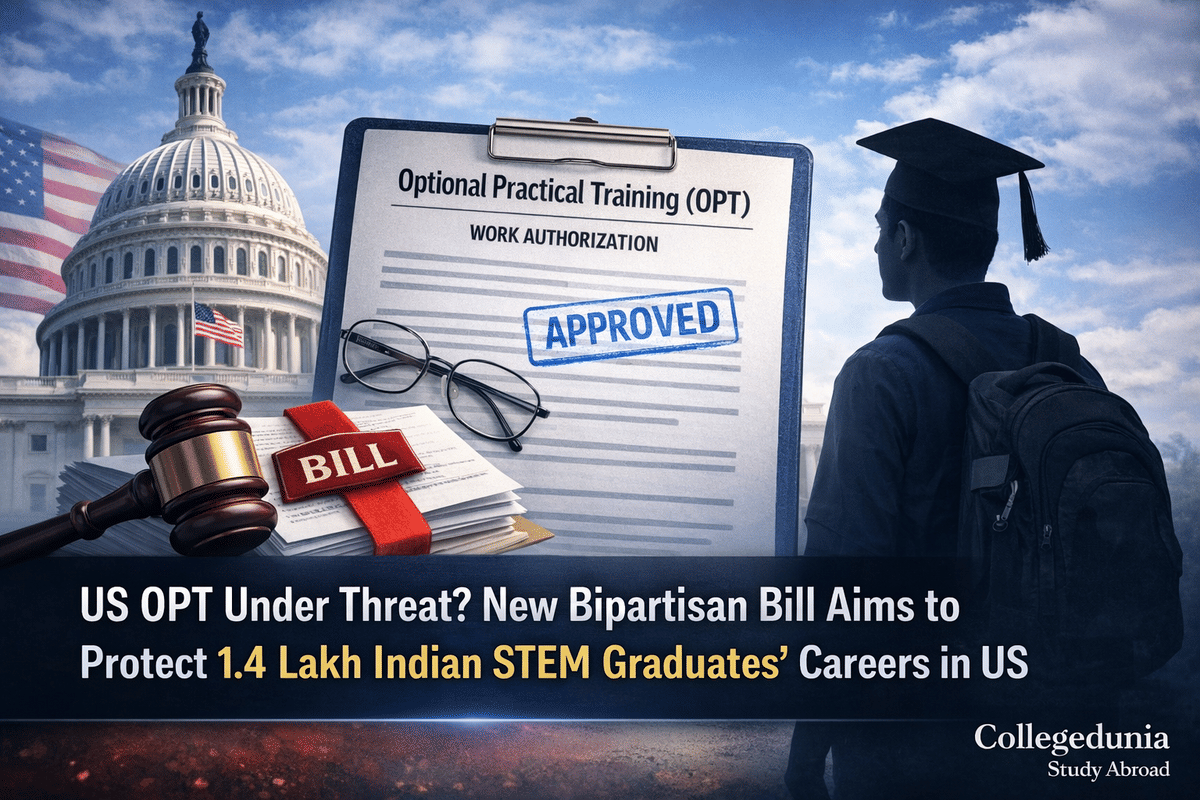
A bipartisan group of US lawmakers introduced the Keep Innovators in America Act on 19 March 2026, seeking to legally protect the Optional Practical Training (OPT) programme for the first time in its 34-year history. The bill, sponsored by Representatives Sam Liccardo, Jay Obernolte, and Raja Krishnamoorthi, comes directly in response to signals from the Trump administration that it may eliminate OPT through executive action — a move that would immediately affect over 1.43 lakh Indian students currently working in the US under the programme.
Optional Practical Training (OPT) is not a visa. It is a work authorisation that allows F-1 international students to work in their field of study for up to 12 months after graduation — extendable to 36 months for STEM graduates. It has existed since 1992 purely as an executive regulation, with no statutory backing. That gap is now the central vulnerability: the Trump administration can eliminate it without Congress.
What Does the Keep Innovators in America Act Propose?
The bill seeks to codify OPT into federal law — moving it from an executive regulation that any administration can revoke, to a statutory programme that requires an act of Congress to change or eliminate.
Key provisions of the bill:
- Formally writes OPT into the Immigration and Nationality Act
- Preserves the 12-month standard OPT period for all F-1 graduates
- Preserves the 24-month STEM OPT extension (total 36 months for STEM graduates)
- Provides legal certainty for students, universities, and employers
- Prevents unilateral executive elimination of the programme
The bill has been endorsed by over 50 organisations, including Compete America, TechNet, the American Immigration Lawyers Association (AILA), FWD.us, NAFSA, the Presidents' Alliance on Higher Education and Immigration, and the Council of Graduate Schools.
Why OPT Is the Most Critical Programme for Indian Students in the US?
For Indian students, OPT is not just a work permit — it is the primary bridge between an F-1 student visa and an H-1B work visa, which is the main long-term employment pathway in the US.
The sequence most Indian STEM graduates follow:
F-1 Student Visa → OPT (12 months) → STEM OPT Extension (24 months) → H-1B Lottery
Without OPT, a student who graduates in May 2026 would need to leave the US or find an employer willing to immediately sponsor an H-1B — a process that takes months and is subject to an annual lottery with no guarantee of selection.
The scale of Indian participation in OPT reflects how central it is to the community's US strategy:
| Metric | Figure |
|---|---|
| Indian students enrolled in US (2024–25) | 3,63,019 |
| Indian students in OPT (2024–25) | 1,43,740 |
| Total international students in OPT (2024–25) | 2,90,000+ |
| STEM OPT participants (2024) | 1,65,524 |
| STEM PhD graduates enrolling in OPT | 76% |
| International student contribution to US economy | $42.9 billion (2024–25) |
For Indian students specifically, OPT is also the period during which most H-1B sponsorships are initiated. Losing OPT does not just mean losing a job — it means losing the runway to convert a US education into a long-term US career.
The Real Threat: Why This Bill Exists Now?
OPT has existed since 1992 under both Republican and Democratic administrations without serious challenge. That changed in 2025.
What has happened:
- May 2025: Joseph Edlow, Trump's nominee for USCIS director, told his Senate confirmation hearing he intended to end OPT, calling it "mishandled"
- September 2025: Trump issued a proclamation unilaterally raising H-1B visa fees to $100,000 — a move that disproportionately affects small employers and startups that hire Indian STEM graduates
- November 2025: The Trump administration signalled it was considering a rule to eliminate or severely restrict OPT, potentially as early as early 2026
- March 2026: A separate bill — H.R.2315 — was introduced in the 119th Congress explicitly to eliminate OPT entirely
No changes to OPT have been made yet. But the combination of a confirmed USCIS director committed to ending the programme, a hostile regulatory environment, and a competing elimination bill means the threat is real and active.
Two Scenarios: What Changes for Indian Students
| Scenario | Impact on Indian Students |
|---|---|
| Bill passes, OPT codified | OPT protected by law; 12-month + 36-month STEM extension secured; H-1B bridge preserved; Fall 2026 applicants can plan with confidence |
| Bill stalls, OPT eliminated by executive action | Students graduating in 2026–27 may have no post-study work authorisation; H-1B sponsorship window collapses; students must leave US or find immediate employer sponsorship; ROI of US education drops sharply |
The bill currently has bipartisan support in the House but has not yet been scheduled for a committee vote. Its passage is not guaranteed.
What Fall 2026 Applicants Should Do Differently Now?
The uncertainty around OPT changes the calculus for students currently applying to US universities for the Fall 2026 intake. Here is what to factor in:
- Do not assume OPT will exist when you graduate — if you are starting a 2-year master's programme in Fall 2026, you will graduate in 2028. The regulatory environment may be different by then. Build a contingency plan.
- Prioritise STEM-designated programmes — STEM OPT (36 months) is more valuable than standard OPT (12 months) and gives more time to secure H-1B sponsorship. Confirm your target programme's STEM designation before applying.
- Research employer sponsorship track records — when evaluating job prospects, look specifically at which employers in your field have historically sponsored H-1B visas. OPT is only useful if it leads to sponsorship.
- Consider the bill's progress as a live signal — if the Keep Innovators in America Act advances to a Senate vote before your application deadline, it is a positive indicator. Monitor updates at liccardo.house.gov.
- Evaluate backup destinations — Canada's PGWP (Post-Graduate Work Permit) offers up to 3 years of open work authorisation with no employer dependency. Germany and the UK also offer post-study work pathways. If OPT is eliminated, these become significantly more competitive alternatives.
- Students currently in OPT: Your existing authorisation is valid until its expiry date. No changes have been made to OPT yet. Continue working, but consult an immigration attorney if your OPT period ends in 2026 and your H-1B status is unresolved.






1715951259.png?tr=w-305,h-145,c-force?h=175&w=350&mode=stretch)



Comments