



Content Curator
Chalcogens are elements belonging to group 16 as per the modern periodic table. The different elements belonging to chalcogens are oxygen, sulphur, selenium, tellurium, and polonium. These are also known as oxygen family elements. Livermorium, which is denoted by Lv is the synthetic element which belongs to the chalcogen group. These are also known as ore-forming elements as they are also found in the earth’s crust in the form of sulphides or oxides. Chalcogens generally have 6 electrons in their valance shells.
| Table of Content |
Key Terms: Chalcogens, Radioactive element, Atomic/Ionic Radii, Ionization Enthalpies, Allotropy, Oxidation States
What are Chalcogens?
[Click Here for Previous Year Questions]
Chalcogens are the elements that belong to group 16 of the modern periodic table (or the oxygen family). These mostly consist of elements such as
- Oxygen
- Sulphur
- Selenium
- Tellurium
- Polonium
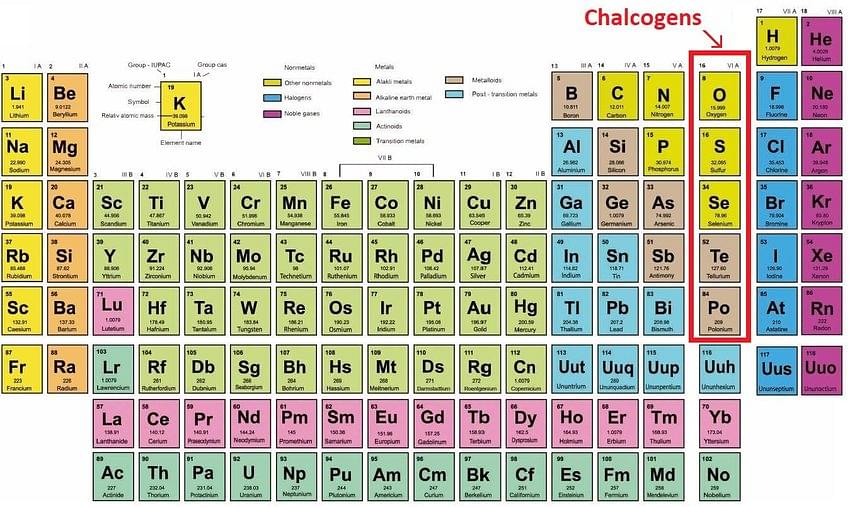
Chalcogens
Chalcogens have 6 electrons in their respective valence shells. Chalcogens are also called ore-forming elements that have a large number of metals which are in the form of sulphides or oxides in the earth’s crust.
Read More:
| Concept Related Topics | ||
|---|---|---|
| Colour Transition Elements | Lanthanum | Chlorine |
| K2Cr2O7 | Transition Metals | Actinium |
Isolation of Chalcogens
[Click Here for Previous Year Questions]
Chalcogens can be isolated by:
- Oxygen can be isolated via the separation of air into oxygen and nitrogen.
- Sulphur is an element which can be extracted from natural gas and oil.
- Yield tellurium and Selenium are the by-products.
- With the help of the particle accelerators Livermorium and polonium can be created.
General Configurations of Chalcogens
The electronic configurations of the elements in these bonds are ns²np4 where in n’ denotes the value of the principal quantum number corresponding to the valence shell of the element.
| Element | Atomic No. | Electronic Configuration |
|---|---|---|
| Oxygen, O | 8 | [He] 2s22p4 |
| Sulphur. S | 16 | [Ne] 3s2 3p4 |
| Selenium, Se | 34 | [Ar] 3d104s24p4 |
| Tellurium, Te | 52 | [Kr] 4d105s25p4 |
| Polonium, Po | 84 | [Xe] 4f145d106s26p4 |
The electronic configuration for the synthetic element Livermorium (believed to be a chalcogen) is [Rn] 5f146d107s27p4.
Also Read: Sodium Hydrogen Phosphate
Physical Properties of Chalcogens
[Click Here for Sample Questions]
There are several Physical properties of Chalcogens, including:
| Type | Physical Properties |
|---|---|
| Inonic or Atomic Radii | Moving down the group in a periodic table, atomic radii or the ionic radii of elements increase. Chalcogen that has lowest atomic radius and ionic radius is oxygen, while the one with largest atomic/ionic radius (excluding livermorium) is polonium. Thus, the atomic radius of oxygen is going to be considerably smaller than lithium. |
| Electron Gain Enthalpies | With the increasing size of an atom, the electron gain enthalpy decreases. Hence, the electron gain enthalpies of chalcogen decrease down the group. |
| Electronegativity of Chalcogens | The electronegativity decreases when moved down a group (factors include: Increase in atomic radius and Increase in electron-electron repulsion. |
| Melting and Boiling Points | Moving down the group of elements, The melting and boiling points increase with the increase in atomic number. |
| Metallic and Non-metallic Character | While oxygen, sulphur, selenium and tellurium are non-metals, the non-metallic character is generally found to be stronger in O and S, while its weaker in Se and Te. |
| Ionisation Enthalpies | The ionisation enthalpy of the oxygen family is relatively less than those of the nitrogen family. Moving down the group from oxygen to polonium, the ionisation enthalpies decrease. |
Chemical Properties of Chalcogens
[Click Here for Sample Questions]
Some of the many chemical properties of Chalcogens are:
| Type | Chemical Properties |
|---|---|
| Allotropy | The most common allotropes of oxygen are Dioxygen and Ozone. Selenium generally has at least 5 different allotropes, while polonium is known to have 2 allotropes. |
| Oxidation States | The general electronic configuration of chalcogens is ns2np4. |
Previous Year Questions
- Oxygen is obtained by heating … [JIPMER 1998]
- Which of the following oxides of chlorine is obtained … [JIPMER 1998]
- Although the details of the structure of monoclinic … [CBSE Class XII]
- What is the structure of thiosulphuric acid? …
- Which of the following does not have S-S bond? …
- Which of the following is the anhydride of sulphuric acid? …
Things to Remember
- The group 16 elements which are known as chalcogens or ore-forming elements are extracted from the sulphur or oxide ores.
- The first four elements namely oxygen, sulphur, selenium and tellurium are non-metals. The non-metallic character is stronger in O and S are weaker in Se and Te.
- The elements belonging to this group have high negative electron gain enthalpies.
- Catenation is the tendency of an atom to form bonds with identical atoms.
- Oxygen is required during combustion where during the combination with some elements, the evolution of heat energy takes place.
Sample Questions
Ques. Does group 16 elements of the periodic table are called Chalcogens? (1 mark)
Ans. Group 16 elements are also generally known as the Oxygen family, i.e., Chalcogens.
Ques. Which element among Selenium and Lead does not belong to group 16 of the periodic table? (1 mark)
Ans. Lead does not belong to group 16 of the periodic table.
Ques. What is the general outer electronic configuration of the Oxygen family? (1 mark)
Ans. The general outer electronic configuration of the oxygen family is ns2np4.
Ques. In chlorous acid, what is the oxidation state of chloride? (1 mark)
Ans. The oxidation state of chloride is +3.
Ques. Which element has very high value of electronegativity and tries to achieve noble gas configuration by gaining electrons? (1 mark)
Ans. Oxygen
Ques. Which oxide does not react as a reducing agent? (1 mark)
Ans. “NO” doesn’t react as a reducing agent.
Ques. Define interhalogen compounds? (1 mark)
Ans. Each halogen combines with other halogens to form a series of compounds called interhalogen compounds.
Ques. Why fluorine is more reactive than other halogens? (1 mark)
Ans. This is because Florine falls among the category of reactive elements and also due to the present of low value F-F bond dissociation.
Ques. What is the use of Phosphorus element present in the group 16 elements periodic table? (2 marks)
Ans. The use of Phosphorus is an essential constituent of animal and plant matter. It is present in bones as well as in living cells. Also, they are present in milk and eggs.
Ques. What are Dinitrogen and its uses? (5 marks)
Ans. Dinitrogen can be expressed as a colourless, tasteless, odourless, and non-toxic gas. Nitrogen atom contains two stable isotopes, 14N and 15N. And, it also has very low solubility in water (23.2 cm3 per litre of water at 273 K and 1 bar pressure), with low freezing and boiling points. Dinitrogen has been found to be inert at room temperature due to high bond enthalpy of N≡N bond. It directly combines with some metals to form ionic nitrides and with non-metals, covalent nitrides, at room temperature. Dinitrogen is generally utilised in the manufacturing of ammonia and other industrial chemicals that contain nitrogen.
Also Read:




Comments