



Education Journalist | Study Abroad Strategy Lead
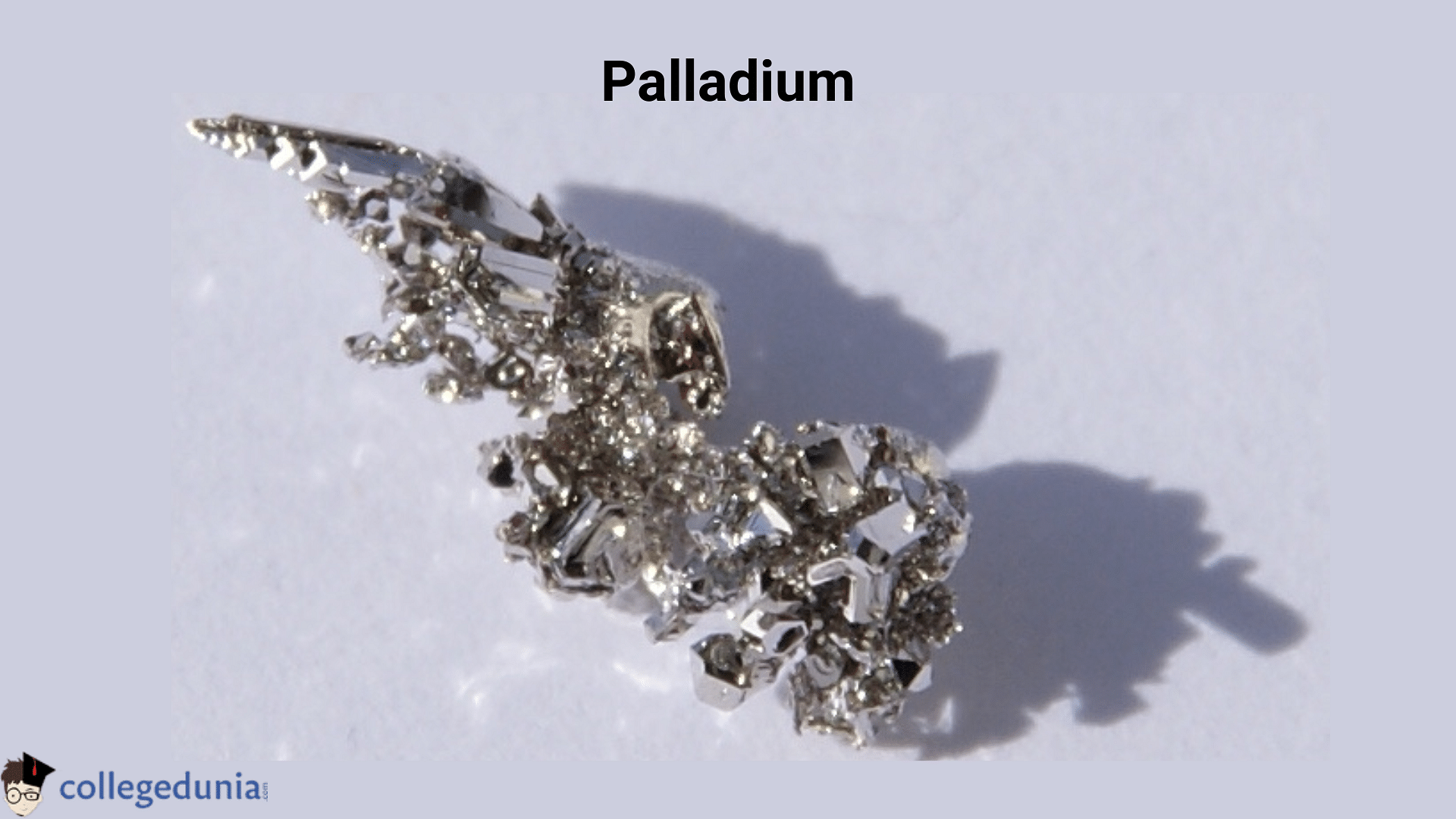
Palladium (Pd) is a chemical element with atomic number 46 in the platinum group. It is often used as a catalyst which is a substance that increases the pace of chemical reactions without changing their products. Pd element is lustrous and silvery white in appearance.
- It is the lowest melting and is the least dense element of the 6 metals of the platinum group.
- Represented by the symbol ‘Pd’, it has a non-toxic biological nature for living organisms.
- Palladium has one of the highest abundances in nature out of the platinum group.
- It also has a ductile nature.
- Palladium is known as white gold as it appears as a white lustrous element.
- It is a transition metal and is extremely unreactive in nature.
Key Terms: Palladium, Pd element, ductility, periodic table, hydrogen, platinum group, transition metal, hydride, catalyst
Pd element
[Click Here for Sample Questions]
Palladium is a grey-white metal that is really ductile. At regular temperatures, it is not oxidized by the atmosphere. Palladium is one of the most abundant metals in the platinum group. It is present in the crust of Earth at 0.015 parts per million. Palladium metal belongs to group 10 and period 5 of the periodic table.
- It is used as a substitute for platinum in electrical contacts and in jewellery.
- The best white gold is produced by small amounts of palladium alloyed with gold.
- The palladium surface acts as an excellent catalyst for chemical reactions having oxygen and hydrogen such as the hydrogenation of unsaturated organic compounds.
- Palladium at 80°C (176°F) and 1 atmosphere is able to absorb more than 900 times its volume of hydrogen.
- In the process, it expands and becomes hard and ductile.
- The magnetic susceptibility and electrical conductivity of the element are also decreased due to absorption.
- A metallic hydride is formed. From it, hydrogen can be removed by increasing the temperature and reducing the pressure.
- As hydrogen rapidly passes through the metal at high temperatures, heated palladium tubes not affected by other gases act as semipermeable membranes.
- They are used for the purification of hydrogen or to pass it in and out of closed gas systems.
Electron Configuration of Palladium
[Click Here for Previous Year Questions]
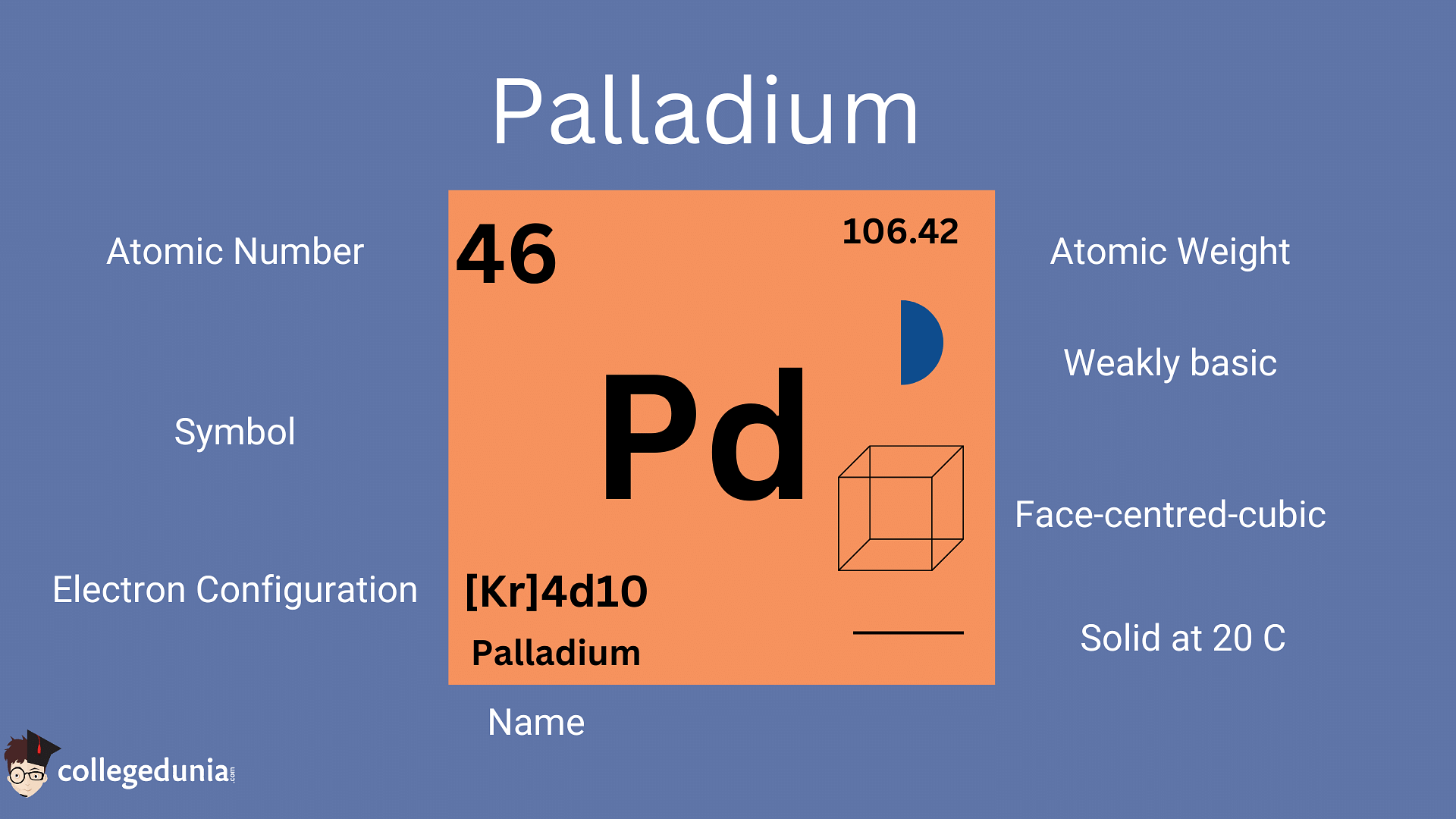
The electron configuration shows the distribution of electrons of any molecule in their molecular orbits. Pd electron configuration is Kr4d10. As the atomic number is equal to the number of protons and neutrons separately, the atomic number of palladium is 46.
By electron configuration, the chemical bonding between atoms is shown. The Pd electron configuration is denoted as-
- 1s2 – 2 electrons
- 2s2, 2p6 – 8 electrons
- 3s2, 3p6, 3d10 – 18 electrons
- 4s2, 4p6, 4d10 – 18 electrons
Read More:
Discovery of Palladium
[Click Here for Sample Questions]
In 1803, English Physicist and Chemist William Hyde Wollaston isolated Palladium from crude Platinum. He named the silvery element in honour of the then-newly discovered Asteroid Pallas.
- Palladium is commercially produced as the by-product of copper and nickel ore refinings.
- In the early 21st century, South Africa, Russia, the United States and Canada were the world’s leading producers of Palladium.
Palladium Properties
[Click Here for Previous Year Questions]
Some of the basic details of Palladium are tabulated below:
| Property | Detail |
|---|---|
| Name of the Element | Palladium |
| Symbol of the Element | Pd |
| Atomic Number | 46 |
| Atomic Weight | 106.42 gm per mole |
| Electronic Configuration | Kr 4d10 |
| Period | 5 |
| Group | 10 |
| Block | D |
| Density | 12 g cm-3 |
| Melting Point | 2830.6°C, 1828K, 1554.8°F |
| Boiling Point | 2963°C, 3236K, 5365°F |
| Common Isotopes | 102Pd, 104Pd, 105Pd, 106Pd,108Pd,110Pd |
| Major isotope | 106Pd |
Physical Properties of Palladium
The physical properties of palladium are –
- Palladium is a silvery-white metal.
- It is ductile and malleable.
- Palladium can trigger allergies in individuals but that also depends on their sensitivity.
- It can be found in the combined and detached states as well.
- Palladium has the lowest density and melting point of all platinum elements.
- It can resist tarnishing.
Chemical Properties of Palladium
The chemical properties of palladium are –
- At Room Temperature, Palladium readily reacts with the solution of Aqua Regia.
- Palladium has two oxidation states of 0 and +2 and with that, it forms compounds.
- It is one of the transition metals and has a high tendency of bonding with carbon elements.
- Palladium is more readily attacked by acids than any other platinum metal, hence it is the most reactive.
- Palladium can be slowly dissolved in Nitric acid and form Palladium (II) nitrate.
Pd +HNO3 → Pb(NO3)2+ NO2+ H2O
- At around 500 °C (932 °F), Palladium is attacked by alkali oxides and peroxides and chlorine.
- Pd reacts with concentrated sulfuric acid H2SO4 to form palladium(II) sulfate.
Pd + conc. H2SO4 → PdSO4∙2H2O
- In the presence of oxygen or chlorine, Pd element in sponge form will even dissolve in HCl.
2 Pd + 4 HCl + O2 → 2 PdCl2 + 2 H2O
- The element combines with many nonmetallic elements on heating, such as arsenic, phosphorus, antimony, sulfur, silicon, and selenium.
- Among the transition metals, Pd element has the strongest tendency to form bonds with carbon.
- All palladium compounds are easily reduced or decomposed to the free metal.
- An aqueous solution of potassium tetrachloropalladate(II), K2PdCl4, is used to detect carbon monoxide or olefin gases.
- A black precipitate of the metal is formed in the presence of extremely small amounts of these gases.
- Natural palladium is a mixture of 6 stable isotopes: palladium-102 (1.02%), palladium-104 (11.14%), palladium-105 (22.33%), palladium-106 (27.33%), palladium-108 (26.46%), and palladium-110 (11.72%).
Palladium Compounds
[Click Here for Sample Questions]
Mostly, compounds of palladium can exist in +2 and 0 states. However, other oxidation states can also be found such as.
Palladium (II)
Palladium (II) chloride is formed by the chemical reaction between palladium and chlorine. It is used to form other heterogeneous Pd compounds with sulphate and carbon.
- In nitric acid, PdCl2 solution with acetic acid reacts to form palladium acetate which is a versatile reagent.
- Palladium (II) chloride reacts with ligands such as NH3, PhCN, PPh3, etc. to form planar complexes of the PdCl2L2 type.
Palladium (0)
Palladium also forms different zerovalent complexes such as PdL2, PdL3, and PdL4.
2 PdCl2(PPh3) + 4 PPh3 + 5 N2H4 → 2 Pd(PPh3)4 + N2 + 4 N2H5 + Cl-
Other than these two oxidation states, Pd (IV) compounds like sodium hexachloropalladate is also formed.
Uses of Palladium
[Click Here for Previous Year Questions]
Palladium is a highly abundant metal in the platinum group. Due to its ductile nature and abundance, the metal has various uses in different industries. Some of the important uses of palladium are-
- Palladium has a major role in cracking petroleum, hydrogenation and dehydrogenations as this metal serves as a catalyst.
- It is used in electrodes and also has a major component in ceramic capacitors.
- It is one of the common metals to form surgical instruments.
- It is used in making jewellery and creates expensive white gold which is equivalent to platinum in appearance. Atmospheric conditions cannot tarnish it.
- It is also used to store hydrogen as the element can absorb the gas in huge amounts.
- It is used as a catalytic converter in automobiles as it can convert the harmful hydrocarbons of nitrogen and sulphur oxides into water and carbon dioxide.
- Palladium is used in dental alloys.
- Chemically plated or electrodeposited palladium coatings are used in printed-circuit components.
- Palladium salts are also used for printing black-and-white photographs.
Other than these applications, the Pd element is found in groundwater treatments, electronics, medicine, etc.
Check out:
| Periodic Table Elements | ||
|---|---|---|
| Strontium | Technetium | Ruthenium |
| Silver | Cadmium | Indium |
| Tin | Tellurium | Iodine |
| Barium | Lanthanum | Neodymium |
| Promethium | Gadolinium | Thulium |
Previous Year Questions
- An element with configuration 1 s2, 2 s2 …….[DUET 2008]
- Which of the following has the highest ionisation energy? [DUET 2008]
- Which one of the following ions has the highest value of ionic radius? [DUET 2008]
- It is believed that atoms combine with each other such that the outermost ……. [DUET 2009]
- Which ion has the largest radius? [DUET 2011]
- Total number of rare earth elements is [BHU UET 2008]
- Diagonal relationship is not shown by [BHU UET 2008]
- Variable oxidation state and degenerated orbital shows: [BCECE 2004]
- The decreasing order of electron affinity is: [UPSEE 2016]
- Atomic radius (pm) of….[TS EAMCET 2017]
- What does the electronic configuration…..[GUJCET 2010]
- As we move from left to right in the 3d-series elements [COMEDK UGET 2011]
- Atomic numbers of vanadium, chromium, nickel and iron are [COMEDK UGET 2014]
- Which one of the following is the least electropositive element? [COMEDK UGET 2007]
- The electronegativity of the following elements is in the order
Things to Remember
- Palladium is a soft metal with an atomic number of 46.
- It has similarities with Platinum in terms of chemical properties and physical properties.
- It is malleable and ductile and hence used in jewellery making.
- It can absorb hydrogen 900 times more than any other metal.
- English Chemist and Physicist William Hyde Wollaston discovered Palladium.
Sample Questions
Ques 1: Why is palladium often used for carrying out electrolysis of aqueous solutions? (3 marks)
Ans: Electrolysis is a process that includes an exchange of ions and atoms caused by the addition or removal of electrons after the application of current. In this process, palladium is used because of the following reasons it:
- It is a chemically inert transition metal.
- It has a high hydrogen absorption capacity and since the adsorbed hydrogen is very active, palladium shows a high catalytic activity in the electrolysis process of aqueous solutions.
Ques 2: Is there any hazardous effect of using Palladium for marine life forms? (2 marks)
Ans: Some of the compounds of Palladium like Palladium Chloride have a toxic and harmful effect on marine life forms. Like the development of Zebrafish, it has a toxic effect. Also, Palladium has no biological effect on nature but it may cause some allergies to some individuals.
Ques 3: With which element does Palladium show similarity? (1 mark)
Ans: Palladium shows similarity with Platinum as both of them are in the same group of metals in the periodic metal of elements. They are also similar in terms of appearance as they are naturally white metals. Jewellery made from these metals requires less maintenance.
Ques 4: How Palladium helps to combat Pollution? (2 marks)
Ans: Palladium is used as a catalytic converter in automobiles and it helps to convert harmful hydrocarbons into Carbon dioxide, water and nitrogen. It is also finely used for hydrogenation and dehydrogenation reactions. Hydrogen can easily diffuse through heated palladium and provides a way of purifying air and gas.
Ques 5: What is Aqua Regia? (2 marks)
Ans: Aqua Regia is a mixture of contracted nitric acid and Hydrochloric acid in the ratio of 1:3 to form a yellow-orange colour fuming liquid. It has the ability to dissolve noble metals like platinum, gold and palladium. It is also called Royal Water or nitro-muriatic acid ( Named by scientist Antoine Lavoisier).
Ques 6: What are the commercial uses of Palladium? (3 marks)
Ans: Palladium has several uses in the commercial industry. Some of the important uses of palladium include:
- It is used in catalytic converters for cars and is helpful in resolving the issue of pollution.
- Also useful in making jewellery and for dental surgeries, dental fillings and crowning.
- Used in the making of White gold by alloying with another metal for decolourization.
Ques 7. Answer the following: (5 marks)
(a) Chemical formula
(b) Melting point
(c) Boiling point
(d) Atomic number
(e) Oxidation state
Ans. (a) Chemical formula - Pd +HNO3---à Pb(NO3)2+ NO2+ H2O
(b) Melting point - 1554.9ºC
(c) Boiling point - 2963ºC
(d) Atomic number - 46
(e) Oxidation state - +2, +4
Do Check Out:



Comments