



Content Writer
Fluorine is a chemical compound with atomic number 9 and the atomic symbol F. It is a highly toxic, pale yellow gas that is reactive with all other elements except inert gases.
- Fluorine is considered to be the lightest halogen.
- The word is derived from the Latin word fluo, which means to flow.
- It is one of the most electronegative elements that can attract electrons.
- Fluorine is a poisonous gas that exists in the gaseous state under normal temperature and pressure.
- It belongs to group 17 of the periodic table.
- The compound is an electron recipient in nature that has a valency equivalent to one.
- It is mostly commonly used in air conditioners and refrigerators in our homes.
Key Terms: Fluorine, Element, P-block elements, Atomic number, Halogens, Isotopes, Melting Point, Boiling Point, Density, Periodic Table, Valency, Electron, Electronegative
What is Fluorine?
[Click Here for Previous Year Questions]
Fluorine is one important element when it comes to chemistry in NCERT Class 12 Chemistry. It is known to be the most reactive element as it is highly electronegative in nature.
- Fluorine was proposed as an element in 1886 by French chemist Henri Moissan, who conducted low-temperature electrolysis.
- At NTP, you can find the element as a diatomic gas (light yellow in colour), which is extremely hazardous in nature.
- Due to its high reactivity, it is never released as a product of a reaction.
According to a Minerals Education Coalition report, fluorine mining is observed in Russia, Mexico, South Africa, China, and Mongolia.
- Gases (volcanic) and warm waters have shown the presence of Fluorine in them.
- It can also be found in teeth, cryolite, seawater, and bones.
- The compound has nine electrons, which is less than one electron in neon.
- They are strong oxidizing agents that accept electrons.
| Category | Data |
|---|---|
| Atomic Number | 9 |
| Symbol | F |
| Discovered by | Henri Moissan |

Fluorine
Read More:
| Chapter Related Concepts | ||
|---|---|---|
| Inner Transition Metals | Actinoids | Ammonium phosphate |
| Argon | Astatine | Gallium |
| Hypochlorite | Electronic Configuration of Iron | Mercuric Chloride |
Properties of Fluorine
[Click Here for Sample Questions]
The properties of fluorine is divided into physical and chemical properties which are as follows:
Physical Properties
The important physical properties of fluorine are as follows:
- The colour of fluorine is usually yellow at room temperature.
- There is only one stable isotope of the compound, which is F-19.
- It also exhibits fluorescence properties sometimes.
- The compound is highly soluble in oxygen (liq.) and ozone (liq).
- Fluorine can be recognised by an extremely pungent odour.
- The element holds a density value of 1.696 g/litre, which adds up to 1.3 times the density of air.
- Fluorine can be seen changing phase (from gas to liquid) at a temperature of -306.5°F (-188.13°C).
- It can be seen changing phase from liquid to solid at a temperature equivalent to -363.30°F (-219.61°C).
- The compound can also be represented as F2.
The physical properties of fluorine are tabulated below:
| Category | Data |
|---|---|
| Atomic number | 9 |
| Atomic Weight | 18.998403163 |
| Melting Point | −219.62 °C (−363.32 °F) |
| Boiling point | −188 °C (−306 °F) |
| Density (1 atm, 0 °C or 32 °F) | 1.696 g/litre (0.226 ounce/gallon) |
| Oxidation States | −1 |
| Electronic Configuration | 1s22s22p5 |
| Number of Isotopes | 18 |
| Most common isotopes | F-19 ( naturally abundant) |
| Block | p-block |
Chemical Properties
Following are some of the chemical properties of Fluorine which are as follows:
Electronegative
Fluorine is extremely electronegative in nature which makes the compounds combined with it highly negatively charged.
Example of ElectronegativeExample: CF3I (trifluoroiodomethane). |
Ionisation Enthalpy
Fluorine exhibits a very high first ionisation enthalpy due to its highly electronegative nature. The value determined is about 402 kilocalories per mole.
Size
Fluorine has a very small size in relation to any other element. This helps pack a large number of Fluorine atoms around any given coordination centre. It implies that it is helpful in formation of various complexes (stable).
Example of SizeExample 1: [SiF6]2- - Hexafluorosilicate  Example 2: [AlF6]3- - Hexafluoroaluminate  |
Oxidising Agents
It is considered one of the most extreme oxidizing agents. This property makes it very difficult for any element to oxidize the element. It also turns out to be the reason for Fluorine not being present in its free state.
Electronic Configuration
Fluorine has an electronic configuration of 1s22s22p5. It consists of two electrons in the innermost shell and seven electrons in the outermost shell. The outermost shell is not able to provide nuclear shielding.
Electrolytic Method
Fluorine has been reported to be extracted by the electrolytic method. You can see the covalent as well as ionic fluorides of the compound with almost every element except helium and neon.
Reaction of Fluorine with Compounds
Some important reaction of the compound are as follows:
F2+Xe→XeF4
5F2+5H2O→10HF+O2+O3
S+3F2→SF6
Uses of Fluorine
[Click Here for Previous Year Questions]
Here are some of the uses of fluorine which are as follows:
- The salts of fluorine and fluorides have been used for welding purposes.
- They also come in handy during the process of frosting glass.
- The process of etching the glass in the light bulbs is done with the help of hydrofluoric acid.
- Fluorine has made its place as a vital component in the nuclear energy industry.
- It is used in the manufacturing of Uranium hexafluoride.
- This compound is helpful in the separation of various isotopes of Uranium.
- A gas named sulphur hexafluoride is used to insulate transformers with high-power electricity.
- It is used in making high-temperature plastics, such as polytetrafluoroethylene (Teflon).
- Teflon exhibits non-stick properties and, therefore, is used to manufacture frying pans.
- Fluorine is added into the water supply to every home about one part per million.
- Various toothpastes contain fluorine as a component, thus helping prevent tooth decay.
Fluorine Effects
[Click Here for Sample Questions]
The harmful effects of fluorine are as follows:
- Due to the consumption of food and water that contain fluorine, an individual might suffer from breathing problems.
- It is found in large quantities in tea and shellfish.
- If fluorine is consumed too frequently, it harms our kidneys, bones, nerves and muscles.
- The compound is released from industries in the form of gas and causes eye and nose irritations.
- The presence of large amounts of the compound in soil will result in retarding the growth of plants and reduces crop yields.
- Animals consuming fluorine can suffer from the problem of bone degradation.
Important Compounds of Fluorine
[Click Here for Previous Year Questions]
Fluorine is involved in the formation of various important compounds, which are as follows:
Calcium Fluoride
The formula of calcium fluoride is as follows: CaF2, which is an ionic compound.

Xenon Difluoride
The formula of xenon difluoride is XeF2 which is represented as follows:

Hydrogen Fluoride
The formula of Hydrogen Fluoride is HF which is represented as follows:

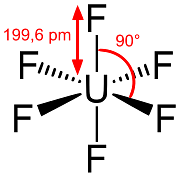
Uranium Hexafluoride
The formula of Uranium Hexafluoride is UF6 which is as follows:
Sodium Monofluorophosphate
The formula of Sodium Monofluorophosphate is Na2PO3F which is as follows:

Sodium Fluoride
The formula of Sodium Fluoride is NaF which is as follows:

Stannous(II) Fluoride
The formula of Stannous(II) fluoride is SnF2 which is as follows:

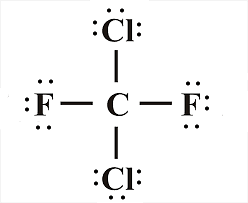
Dichlorodifluoromethane
The formula of Dichlorodifluoromethane is CF2Cl2 which is as follows:
Certain facts about Fluorine
[Click Here for Sample Questions]
There are some very interesting facts related to fluorine, which are as follows:
- Highly reactive fluorine can be seen making compounds with noble gases like radon, xenon, and Krypton.
- Among the most abundant components present in earth's crust, fluorine takes the 13th position.
- Shivling can be easily detected in fluorite, topaz, and feldspar (minerals).
- Its high reactivity makes it tougher to be stored.
- One of its compounds, HF (hydrofluoric acid), has the destructive tendency of breaking through the glass.
- This destructive compound is still considered easier to transport in comparison with fluorine.
Also Read:
Things to Remember
- Fluorine is a highly toxic compound that has an atomic number of 9.
- It is highly reactive and, therefore, needs to be handled with care.
- The compound has only one abundant isotope, which is F19.
- It forms compounds with inert gases.
- Fluorine tends to exhibit fluoride ion F- in the presence of an aqueous solution.
- High exposure to the element will lead to the problem of cancer and may sometimes result in the death of an individual.
Previous Year Questions
- The structure of white phosphorus is….[BHU UET 1994]
- In the following four elements,the ionization potential of which one is the highest ?...[BHU UET 1994]
- The last member of the family of inert gases is...[BHU UET 1994]
- The rate law expression for this process is...[BHU UET 2009]
- Zinc and cold dil. HNO_3 reacts to produce...[BCECE 2007]
- Tincture of iodine is...[BCECE 2007]
- In one of the following reactions HNO3 does not behave as an oxidizing agent. Identify it:...[JCECE 2005]
- Producer gas is a mixture of...[TS EAMCET 2018]
- To dry ammonia gas the drying agent used is….[COMEDK UGET 2009]
- Nitrogen is obtained by heating..[COMEDK UGET 2008]
- Which one of the following forms oleum when dissolved in cone H2SO4 ?...[COMEDK UGET 2008]
- Oleum is...[COMEDK UGET 2006]
Sample Questions
Ques: Fluorine does not exhibit any positive oxidation state. Why? (3 marks)
Ans: The reasons for urine not being able to exhibit any positive oxidation State are,
- Fluorine is highly electronegative. This accounts for it accepting electrons rather than losing them.
- The element also lacks the existence of d - orbitals. Unlike the other halogens, its valence shell is devoid of d orbitals, therefore, refraining it from expanding its octet.
Ques: Fluorine exhibits only -1 oxidation state whereas other halogens exhibit +1, +3, +5, and +7 oxidation states also. Why is it so? (2 marks)
Ans: Fluorine exhibits only -1 oxidation State and the other halogens do not because,
- Fluorine is highly electronegative.
- Fluorine lacks d orbitals in the outermost shell.
Ques: Bond enthalpy of fluorine is lower than that of chlorine. Why? (2 marks)
Ans: Fluorine is considered to be the lightest halogen. It is due to the size of fluorine that it has a lower bond enthalpy than chlorine. The lone pair of electrons repel each other resulting in the easy breaking of bonds.
Ques: HF is a weaker acid than HCL. Why? (2 marks)
Ans: Following are the two reasons for HF being a weaker acid than HCL,
- The high bond dissociation energy.
- The strong H- bonding acting in HF.
Ques: Why is F2 a stronger oxidising agent than Cl2? (3 marks)
Ans: F2 acts as a stronger oxidising agent than Cl2 because of the bond enthalpy between the two fluorine atoms and the tendency of fluorine to be highly electronegative. These two properties of fluorine help an F atom easily accept electrons and form an F- anion.
F + e- →F-
On the other hand, Cl2 has high bond enthalpy and therefore is a low oxidizing agent.
Ques: Draw the structures of the following molecules? (2 marks)
(i) XeF2 (ii) BrF3
Ans: The compound are as follows:
(i)

(ii)

Ques: Complete the following chemical reaction equation? (1 mark)
XeF2 (s) + H2O (l) →
Ans: 2XeF2 (s) + 2H2O (l) → 2Xe (g) + 4HF(aq) + O2(g)
Ques: Explain the importance of fluorine? (3 marks)
Ans:
It is advised to handle fluorine with care because, due to high reactivity, the element is prone to being explosive when coming in contact with other elements. The only elements that do not explode while coming in contact with are Krypton, oxygen, neon, and helium. (A fact given by Chemicool.)- The Royal Society of Chemistry has approved the fact that steel wool turns into flames if brought in contact with fluorine.
- As an electronegative element, fluorine is known to attract electrons much more than any other element.
- The average amount of fluorine content in the human body is approximately 3 mg.
- The Journal of Chemistry has estimated that 25 per cent of various medications and drugs manufactured for treating cancer, the cardiovascular system, and the CNS (Central Nervous System) contain a certain amount of fluorine.
Ques: How can we obtain fluorine? (3 marks)
Ans: Fluorine is found in large quantity in the crust of the earth. It is found in rocks, clay and coal. The compound is released into the air by the wind blowing continuously.
- It is considered to be 13th most abundant element found in the earth crust.
- As per sources it is determined that it contain 950 parts per million of fluorine.
- The compound remain in the atmosphere for longer period of time as it get attach to tiny particles.
Ques: Mention the effects of fluorine on human health? (3 marks)
Ans: The effects of fluorine on human health are as follows:
- Inhalation of a large quantity of compound may lead to eye and nose irritations.
- The compound may affect our kidneys, bones, nerves and muscles.
- Individuals may lead to the problem of tooth decay by consuming fluorine-rich compounds.
- Sometimes, it leads to death, also.
Ques: What are the uses of fluorine? (3 marks)
Ans: The uses of fluorine are as follows:
- This substance aids in the separation of different uranium isotopes.
- Transformers that use high-power energy are insulated using a gas known as sulfur hexafluoride.
- It is employed in the production of polytetrafluoroethylene (Teflon) and other high-temperature polymers.
- Every home's water supply is supplemented with one part per million of fluorine.
- Fluorine is a component in many toothpastes, which helps to prevent tooth decay.
For Latest Updates on Upcoming Board Exams, Click Here: https://t.me/class_10_12_board_updates
Check Out:



Comments