



Content Curator
Neon, indicated by the symbol Ne, is the second lightest of the noble gases. Morris Travers and Sir William Ramsay were the first to discover it. It is a reddish-brown gas that can be found in neon lights, discharge tubes, and vacuum tubes. Neon gas has a wide range of applications. The refrigerating capacity of Neon is three times more than that of liquid hydrogen on a volume-unit basis.
Read Also: What are Noble Gases?
Key Terms: Neon, Element, Noble Gases, Hydrogen, Periodic Table, P-Block Element, Atomic Mass, Electron, Proton
What is Neon?
[Click Here for Sample Questions]
Neon is the second-lightest noble gas, with a reddish-orange colour in neon lamps and vacuum discharge tubes. In many applications, it is a less expensive refrigerant than helium. On a per unit volume basis, it has 40 times the refrigerating capacity of liquid helium and three times that of liquid hydrogen. It's a rare gas with molecules composed of just one Neon atom.
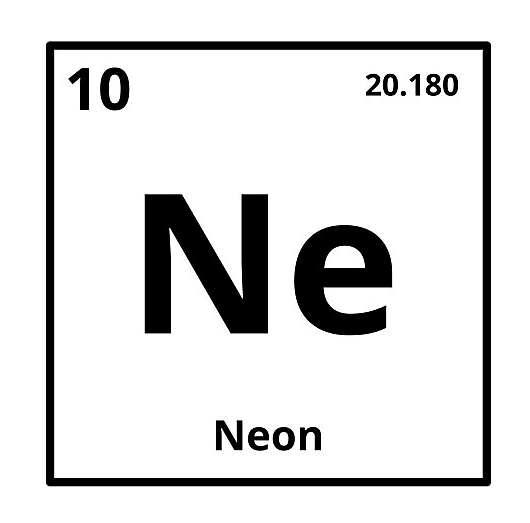
Neon
It's a chemically inert gas that's also non-toxic. Since it is non-reactive and does not form compounds, it poses no hazard to the environment and has no impact. This substance has no negative impact on the environment.
It can create exotic compounds with Fluorine. Fluorine is an inert element that can be used to make different compounds in laboratories. It also produces a hydrate that is unstable.
Chemical Properties of Neon
[Click Here for Sample Questions]
Neon is a noble gas that belongs to Period 2 and Group 18 of the periodic table. It is a p-block element with an atomic number of 10 and an atomic mass of 20. It remains in a gaseous state at a temperature of 20°C. It weighs 0.000825 g/cm3 and has a density of 0.000825 g/cm3. Neon gases have a melting point of -248.59 °C and a boiling point of -246.046 °C.
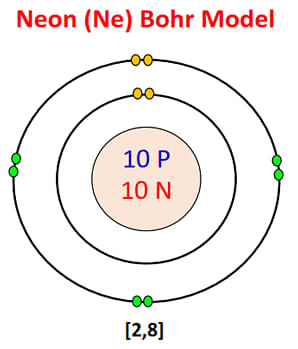
Neon Bohr Model
2s2 2p6 is Neon’s electronic configuration. It is chemically inert and non-toxic.
As neon is a noble gas, it is non-reactive and does not readily form compounds. As a result, neon gas does not pose a significant risk to the environment. However, the neon element has a wide range of applications. In most cases, neon produces an unstable hydrate. It may also perform complex compounds containing halogens, such as fluorine, which is an inert element. Each electron, proton, and neutron in neon possesses ten electrons, protons, and neutrons. It is made up of two electron shells.
Some other specific properties are given below:
- Solid structure: face-centred cubic
- Heat of fusion: 0.3317 kJ/mol
- Specific heat capacity: 0.904 J/gK
- The heat of vaporization: 1.7326 kJ/mol
- Atomic radius: 38 pm
- Thermal conductivity: 0.05 W/mK
- Atomic volume: 16.7 cm3/mol.
Read More:
Uses of Neon
[Click Here for Sample Questions]
Neon has a number of uses/applications in the world:
- Advertising signs are made using neon lights that are reddish-orange in colour. It’s also used in these types of lighting when a lot of other gases are required to generate a variety of colours.
- Other applications for neon include lightning arrestors, high-voltage indicators, television tubes, and metre tubes, as well as gas lasers.
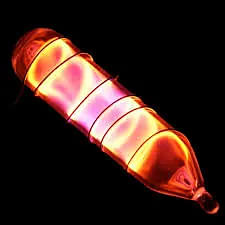
Neon Light
- Neon can be utilised as a good refrigerant in liquid form.
- Neon is used in various types of gas-filled electron tubes in the electronics sector, either alone or in combination with other gases. It has excellent applications in the electronics industry.
- As helium is less soluble in blood than nitrogen at high pressure, marine divers in the sea utilise a mixture of helium and neon for breathing.
Read More: Atoms and Molecules
Health Effects of Neon
[Click Here for Sample Questions]
The human body reacts in different ways when exposed to neon. Some of them are:
- Exposure Routes: The chemical can be inhaled and absorbed into the body.
- Inhalation Risk: When the containment is lost, this liquid evaporates quickly, generating air supersaturation and a substantial risk of suffocation in confined spaces.
- Exposure’s Effects: Simple asphyxiant when inhaled. Frostbite occurs when the skin comes into touch with fluids. Frostbite occurs when the eyes come into contact with liquid.
- Inhalation: This gas is categorised as a simple asphyxiant because it is inert. Excessive concentrations can cause dizziness, nausea, vomiting, loss of consciousness, and death when inhaled. Errors in the decision, confusion, or loss of consciousness can all lead to death if self-rescue is not possible. When oxygen levels are low, unconsciousness and death can happen quickly and without warning.
- Simple asphyxiant gases have an effect proportionate to how much they reduce the amount (partial pressure) of oxygen in the air that is breathed. Before noticeable symptoms appear, oxygen levels in the air may be reduced to 75% of their usual levels. This necessitates the presence of a simple asphyxiant in the mixture of air and gas at a concentration of 33 per cent. When the simple asphyxiant reaches a concentration of 50%, it can cause severe symptoms. In a couple of minutes, a concentration of 75% is lethal.
- Symptoms: Rapid respirations and a lack of oxygen are the first indications of a simple asphyxiant. Mental acuity is lowered, and muscle coordination is hampered. Later on, judgement is skewed, and all sensations are suppressed. Emotional instability is common, and weariness sets in quickly. Nausea and vomiting, prostration and loss of consciousness, and lastly convulsions, deep coma, and death may occur as the asphyxia continues.
Read More:
Environmental Effects of Neon
[Click Here for Sample Questions]
Despite being the fourth most prevalent element in the universe, neon only makes up 0.0018 per cent of the earth’s atmosphere. Neon is most commonly encountered as a gas with molecules made up of a single Neon atom. Neon is a rare gas present in the Earth’s atmosphere with a concentration of 1 part per 65,000.
Neon is a rare atmospheric gas that is chemically inert and non-toxic. Neon is non-toxic and has no effect on the environment because it is chemically inert and does not produce any compounds. There is no evidence that this element can cause any environmental harm.
Things to Remember
- Neon is the noble gas indicated by the symbol Ne.
- It is the second lightest of the noble gases and is present in a reddish-brown colour.
- It is discovered by Morris Travers and Sir William Ramsay
- Neon lights are used as arrestors, high-voltage indicators, television tubes, metre tubes, and botanical gardens.
- The most common is neon-20, which accounts for over 90% of all neon found in nature.
- Neon exposure is harmful, as it can be quickly absorbed into the human body through breathing. It can cause nausea, dizziness, unconsciousness, vomiting, and even death if inhaled in large amounts.
- There are no harmful effects of Neon in Environment.
Sample Questions
Ques. What colour does neon exist in? (2 Marks)
Ans. When neon is exposed to an electric field, it turns an orange-red colour.
Ques. What is the purpose of neon gas? (2 Marks)
Ans. Neon lights are used as arrestors, high-voltage indicators, television tubes, metre tubes, and botanical gardens. Neon lamps are also used to fill sodium vapour lamps.
Ques. Is neon gas a costly substance? (2 Marks)
Ans. As neon is a rare gas, it is expensive to manufacture. It costs around 55 times as much as liquid helium.
Ques. How did neon gas come to be discovered? (2 Marks)
Ans. Sir William Ramsay and Morris W. Travers, two British chemists, developed neon gas in 1898. They cooled a sample of air until it turned into a liquid, then heated it to capture the gases as they boiled away. Following the removal of the gases that had already been discovered. Under spectroscopic discharge, they detected a dazzling red glow. This was a neon colour.
Ques. What are the Neon Health Risks? (3 Marks)
Ans. Neon exposure is harmful, as it can be quickly absorbed into the human body through breathing. Neon liquid evaporates quickly, causing the air to become saturated. In limited zones, supersaturation can raise the risk of suffocation. Liquid neon can induce frostbite if it comes into contact with the skin or eyes.
The gas is classified as an asphyxiant because it is inert. It can cause nausea, dizziness, unconsciousness, vomiting, and even death if inhaled in large amounts. With neon inhalation, muscle activity are reduced, and one does not remain cognitively attentive or alert. Death can happen in seconds when oxygen levels are low. Faulty judgments, weariness, mental anguish, and sadness are common side effects. However, the element poses no danger to the environment.
Ques. When it comes to neon, what is the primary source? (2 Marks)
Ans. The atmosphere, which it is 18 parts per million by volume, is its only commercial source. Neon, together with helium and hydrogen, stays in the small percentage of air that resists liquefaction when cooled to 195.8 °C (320.4 °F, the boiling point of liquid nitrogen), since its boiling point is 246 °C (411 °F).
Ques. What is the reaction of Neon with other gases? (2 Marks)
Ans. Other substances will cause neon to react. The most common application of neon is the creation of advertising 'neon signs.' Neon radiates a reddish-orange colour in a vacuum discharge tube
Ques. What type of neon is the most common? (2 Marks)
Ans. Neon is divided into three stable isotopes: neon-20, neon-21, and neon-22. The most common is neon-20, which accounts for over 90% of all neon found in nature. Some scientists believe that neon can combine with fluorine, the most reactive element in the periodic table, to generate a combination.
Check-Out:



Comments