



Education Journalist | Study Abroad Strategy Lead
Franz Muller Von Reichenstein was the first to discover the element Tellurium. It is in group 16 of the periodic table. It is a silver-white brittle, slightly radioactive uncommon metalloid. Tellurium is a chemical element with the atomic number 52. Tellurium is a chalcogen with the elements Selenium and sulphur. It is sometimes found as elemental crystals in their natural state. Tellurium is significantly more abundant across the universe than it is on Earth. Its exceptional scarcity in the Earth's crust, equivalent to platinum, is attributed in part to the creation of a volatile hydride, which led tellurium to escape into space as a gas during Earth's heated nebular formation.
| Table of Content |
Keyterms: Tellurium, Periodic table, Metalloid, Selenium, Sulphur, Atomic number, Chalcogen, Platinum, Hydrochloric acid, Nitric acid, Polonium,
Introduction of Tellurium
[Click Here for Sample Questions]
Franz Muller Von Reichenstein was the first to discover Tellurium. It belongs to the chalcogen family, which includes selenium and sulphur. It can also be found in indigenous form as elemental crystals. Tellurium is significantly more prevalent across the universe than it is on Earth.
- Tellurium produces a greenish-blue flame when burned in direct sunshine. Water and hydrochloric acid do not dissolve or react with it, but nitric acid does.
- Tellurium serves no biological purpose. Some fungi, on the other hand, utilise it as a sulphur substitute.
- Tellurium is primarily used in copper and steel alloys to improve machinability. Tellurium is also used in CdTe solar panels and cadmium telluride semiconductors, which require a significant amount of metal. Tellurium is a technologically important element.
- Tellurium is one of the rarest stable solid elements, with an abundance in the Earth's crust comparable to platinum. Even the rarest of the stable lanthanides, thulium, has crustal abundances of 500g/kg.
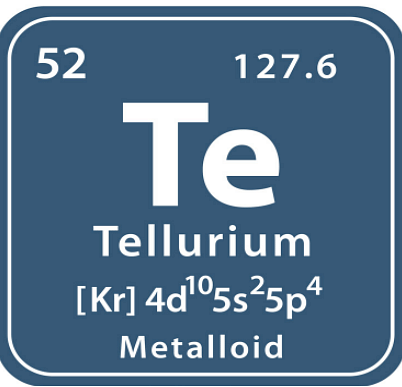
Tellurium
Tellurium's rarity in the Earth's crust does not represent its cosmic abundance. Although rubidium is 10,000 times more prevalent in the Earth's crust, Tellurium is more abundant throughout the universe. The rarity of tellurium on Earth is assumed to be due to conditions in the solar nebula during pre accretional sorting when the stable form of particular elements was regulated by the reductive power of free hydrogen in the absence of oxygen and water. Certain elements that generate volatile hydrides, such as tellurium, were significantly depleted in this scenario due to hydride evaporation. The heavy metals tellurium and selenium are the most depleted as a result of this process.
Tellurium is occasionally found in its elemental form, but it is most commonly found in gold tellurides as calaverite and krennerite, petzite and sylvanite.
The video below explains this:
Tellurium Detailed Video Explanation:
Also Read:
Application of Tellurium
[Click Here for Sample Questions]
- Tellurium is most commonly used in metallurgy. Iron, stainless, steel, lead, and copper alloys are all made with it.
- Solar panels, memory chips and optical modulators are all made with it.
- Tellurium and its constituent are utilised as a ceramic pigment.
- Rubber that is very resistant to heat is made with this ingredient.
- Tellurite agar is used to categorise species of the genus corynebacterium, most notably corynebacterium diphtheria, the pathogen that causes diphtheria.
- In the electric blasting cap delay powder, selenium and tellurium combinations are combined with barium peroxide as an oxidant.
- Tellurium is found in a variety of photocathodes, including those used in solar-blind photo injectors that power today’s particle accelerators. The Cs-Te photocathode, which is predominantly Cs2Te, has a photoemission threshold of 3.5 eV and a unique combination of high quantum efficiency (>10%) and good endurance in low vacuum settings.
Physical Properties of Tellurium
[Click Here for Sample Questions]
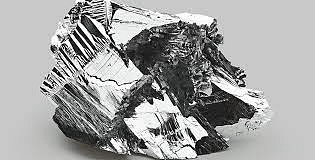
Tellurium exists in two forms: crystalline and amorphous. Tellurium has a metallic sheen and is silvery-white when crystalline. It is a porous metalloid that pulverises quickly. Amorphous tellurium is a black-brown powder made by precipitating telluric acid or telluric acid salts from a solution. Tellurium is a semiconductor with increased electrical conductivity in specific directions depending on atomic orientation; when exposed to light (photoconductivity), the conductivity improves marginally. When melted, tellurium is corrosive to copper, iron and iron when molten.
| Symbol | Te |
| Atomic Number | 52 |
| Atomic mass | 127.6g.mol-1 |
Chemical Properties of Tellurium
[Click Here for Sample Questions]
Given below are the chemical properties of Tellurium:
| Symbol | Te |
| Atomic Number | 52 |
| Atomic mass | 127.6g.mol-1 |
| Discovered by | Franz Muller Von Reichenstein |
| Melting point | 450 °C |
| Electronegativity | 2.1 |
| Density | 6.24?.cm-3 |
| Isotopes | 39 known isotopes |
| Boiling point | 1390°C |
Sources of Tellurium
[Click Here for Sample Questions]
Tellurium is found in coal in concentrations of up to 2 parts per million. This is most likely the primary source of this metal, which plants can absorb from the soil. Although few food plants have more than 0.5 ppm and most have less than 0.05 ppm, tellurium levels in plants can go as high as 6ppm.
Uncombined tellurium samples are occasionally discovered, but they are extremely rare. There are a few tellurium minerals (calaverite, sylvanite and tellurite), but none of them is mined. Global production is estimated to be roughly 220 tonnes per year. The United States, Canada, Peru and Japan are the top producers. This element's reserve has not been assessed.
Things to Remember
- Franz Muller Von Reichenstein was the first to discover Tellurium. To correspond to group 16 of the periodic table. It is a silver-white rare metalloid that is brittle, slightly radioactive, and brittle.
- Tellurium serves no biological purpose. Some fungi, on the other hand, utilize it as a sulphur substitute.
- Tellurium and its derivatives are somewhat hazardous and should be handled with caution, however, acute poisoning is uncommon.
- Tellurium is primarily used in copper and steel alloys to improve machinability. Tellurium is also used in CdTe solar panels and cadmium telluride semiconductors, which require a significant amount of metal. Tellurium is a technologically important element.
- There are two types of tellurium allotropes: crystalline and amorphous. Tellurium is a silvery-white metal having a metallic sheen when crystallised.
- Tellurium's chemical characteristics: Tellurium crystals are made up of three Te atoms per turn in parallel helical chains. This grey substance is non-volatile and resistant to oxidation by air.
Also Read:
Sample Questions
Ques: Tellurium is poisonous. Why? (2 marks)
Ans: Tellurium is poisonous for several reasons. Toxicity differs with different sources of tellurium, such as hydrogen telluride gas exposure. Following the production of ethyl telluride, the garlic breath odour of tellurium has been reported to rise after ingestion of alcohol.
Ques: Is Tellurium a metal or a non-metal? (2 marks)
Ans: Tellurium is a semi-metallic substance that is glossy, crystalline, brittle, silver-white, and lustrous. It comes in the form of a dark grey powder with properties that are similar to both metals and nonmetals. Tellurium produces many compounds that are similar to those of sulphur and selenium.
Ques: What are the health effects of Tellurium? (2 marks)
Ans: Because it is such a rare element, it is extremely unlikely that a regular human will come across it. When inhaled, however, it can cause sleepiness, a metallic taste, a headache, and a dry mouth, among other things.
Ques: What are the uses of Tellurium? (2 marks)
Ans: Tellurium is used in alloys to improve machinability, primarily with copper and stainless steel. When added to lead it increases its acidic resistance while also increasing its strength and hardness. Tellurium is used to vulcanize rubber, colour glass and ceramics, make solar cells, rewritable CDs and DVDs and an oil refining catalyst. In semiconductor applications, it can be doped with silver, gold, copper and tin.
Ques: What is the colour of tellurium when it burns? (2 marks)
Ans: Tellurium produces dioxide when it burns in air or oxygen with a blue-green blaze (TeO2). It is unaffected by hydrochloric acid, but it is oxidised to tellurous acid by nitric acid or aqua regia ( a combination of nitric acid and hydrochloric acid).
Ques: What is the most prevalent tellurium form? (2 marks)
Ans: Tellurium is occasionally found in nature as a free element. It is more typically found in minerals with metals, such as calaverite (gold telluride, AuTe2) and sylvanite (silver-gold telluride). Telluride is obtained commercially as a byproduct of electrolytic copper processing.
For Latest Updates on Upcoming Board Exams, Click Here: https://t.me/class_10_12_board_updates
Check-Out:



Comments