



Education Journalist | Study Abroad Strategy Lead | Updated On - Mar 16, 2026
Munich is Germany's most expensive city, but it's also home to two of Europe's top 50 universities, one of the continent's strongest job markets, and a quality of life that consistently ranks among the world's best. For Indian students, the real question isn't "Is Munich expensive?" — it's "Can I afford it, and is it worth it?"
The average cost of living in Munich for a student in 2026 is €863–€2,939 per month (approximately ₹76,000–₹2,60,000), depending on your accommodation type and lifestyle. That's higher than Berlin or Hamburg — but Munich's part-time job market, with wages starting at €12–15/hour, means most students can offset 30–50% of their monthly expenses.
Budget at least €1,000–€1,300/month as a student in Munich in 2026. With a shared flat (WG), cooking at home, and using the student Deutschlandticket (€43/month), most Indian students manage comfortably on this budget.
Check Out: Top Universities in Munich, Germany for Indian Students
- Average Cost of Living in Munich 2026
- Accommodation Cost in Munich 2026
- Food and Grocery Costs in Munich 2026
- Transportation Costs in Munich 2026
- Health Insurance Cost in Munich 2026
- Utility Costs in Munich 2026
- Other Living Expenses in Munich 2026
- Munich Cost of Living vs Other German Cities (2026)
- How to Save Money in Munich 2026?
- Part-Time Work in Munich for Indian Students 2026
- Frequently Asked Questions
Average Cost of Living in Munich 2026
The average monthly cost of living in Munich for a single person is approximately €1,074 excluding rent, according to Numbeo (March 2026). Add rent, and the total ranges from €1,500 to €2,500+, depending on accommodation choice.
For students specifically, costs are significantly lower, primarily due to access to student dormitories, the discounted Deutschlandticket (€43/month for Bavarian students), and meals at the university canteen (Mensa) at €3–€5.
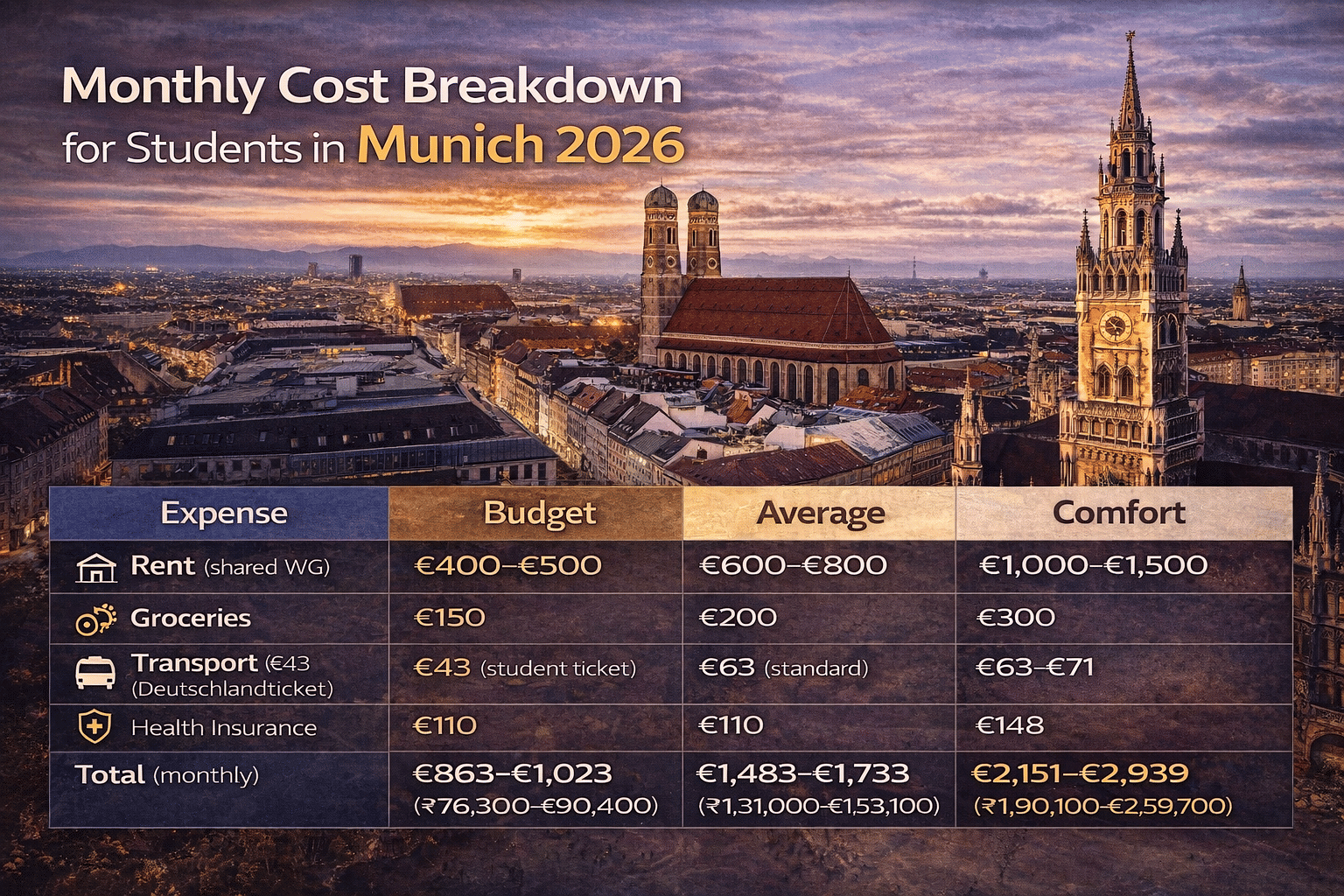
The table below gives a complete overview of monthly living expenses in Munich for 2026:
| Expense Category | Budget Student | Average Student | Comfortable |
|---|---|---|---|
| Rent (shared WG) | €400–€500 | €600–€800 | €1,000–€1,500 |
| Groceries | €150 | €200 | €300 |
| Dining out | €30 | €80 | €150 |
| Transport (Deutschlandticket) | €43 (student rate) | €63 (standard) | €63–€71 |
| Health Insurance | €110 | €110 | €148 |
| Utilities (if not included in rent) | €0–€50 | €150–€200 | €200–€300 |
| Internet & Phone | €30–€40 | €50–€60 | €70 |
| Study materials | €20 | €50 | €100 |
| Entertainment & leisure | €30 | €80 | €150 |
| Miscellaneous | €50 | €100 | €150 |
| Total (Monthly) | €863–€1,023 | €1,483–€1,733 | €2,151–€2,939 |
| Total in INR | ₹76,300–₹90,400 | ₹1,31,000–₹1,53,100 | ₹1,90,100–₹2,59,700 |
Note: 1 EUR = ₹88.36 as of March 2026.
Most Indian students in Munich report spending €1,000–€1,400/month — closer to the budget-to-average range — by sharing a flat, cooking Indian food at home, and using the student Deutschlandticket.
Accommodation Cost in Munich 2026
Rent is the single biggest expense in Munich — and the most variable. Munich has the highest rental prices of any German city, with rents growing 3–5% year-over-year in early 2026. The city's vacancy rate sits at just 0.5–1%, among the lowest in all of Europe, meaning competition for housing is fierce.
The good news for students: there are several affordable options if you plan.
Types of Student Accommodation in Munich
| Accommodation Type | Monthly Cost (EUR) | Monthly Cost (INR) | Notes |
|---|---|---|---|
| Student dormitory (Studierendenwerk) | €280–€400 | ₹24,700–₹35,300 | Cheapest option; very limited — apply 6–12 months early |
| Shared flat / WG (Wohngemeinschaft) | €500–€800 | ₹44,200–₹70,700 | Most popular; average WG room in Munich is €800/month (2026) |
| Studio apartment | €850–€1,100 | ₹75,100–₹97,200 | Private but expensive; average studio is ~€850/month |
| 1-bedroom apartment | €1,125–€1,500 | ₹99,400–₹1,32,500 | Typically for working professionals |
| Suburbs (Garching, Freising, Neuperlach) | €400–€650 | ₹35,300–₹57,400 | 20–40 min commute; significantly cheaper |
Key insight for Indian students: The most practical option is a shared WG (Wohngemeinschaft) — Germany's version of a flatshare. Munich's average WG room reached €800/month in 2026 — the highest in Germany. However, rooms in suburbs like Garching (where TUM's science campus is located) average €660/month, offering meaningful savings.
Use platforms like WG-Gesucht.de, Immoscout24, and Facebook groups (search "WG Munich Indians") to find listings. Properties in Munich typically stay listed for only 20–30 days, so act fast when you find a suitable option.
Pro tip: Apply for Studierendenwerk München dormitories the day you receive your admission letter. At €280–€400/month, they are less than half the market rate — but demand is extremely high and waitlists are long.
For a detailed guide, visit the Student Accommodation in Germany guide.
Food and Grocery Costs in Munich 2026
A student in Munich typically spends €150–€250/month on groceries — manageable if you shop at discount supermarkets and cook at home. Dining out regularly can easily double or triple your food budget.
Grocery Prices in Munich (2026)
| Item | Cost (EUR) | Cost (INR) |
|---|---|---|
| Milk (1 litre) | €1.19 | ₹105 |
| White bread (500g) | €1.96 | ₹173 |
| Rice (1 kg) | €2.73 | ₹241 |
| Eggs (12) | €3.62 | ₹320 |
| Chicken fillet (1 kg) | €10.53 | ₹930 |
| Apples (1 kg) | €2.99 | ₹264 |
| Bananas (1 kg) | €1.95 | ₹172 |
| Tomatoes (1 kg) | €3.44 | ₹304 |
| Potatoes (1 kg) | €1.75 | ₹155 |
| Onions (1 kg) | €1.67 | ₹148 |
Best budget supermarkets in Munich 2026: Aldi, Lidl, and Netto offer the lowest prices — typically 20–30% cheaper than Rewe or Edeka. For Indian groceries (dal, rice, spices, masalas), Indian stores near the Hauptbahnhof and in Schwabing stock essentials at reasonable prices.
Dining Out in Munich 2026
| Meal Type | Cost (EUR) | Cost (INR) |
|---|---|---|
| Mensa (university canteen) meal | €3–€5 | ₹265–₹440 |
| Budget restaurant / döner | €8–€12 | ₹707–₹1,060 |
| Mid-range restaurant (lunch) | €15–€18 | ₹1,325–₹1,590 |
| Dinner for two (mid-range) | €60–€80 | ₹5,300–₹7,070 |
| Cappuccino | €3.86 | ₹341 |
| Domestic beer (0.5L) | €5.00 | ₹442 |
Money-saving tip: The Mensa at LMU and TUM serves hot meals for €3–€5 with your student ID — the single best way to cut food costs in Munich. Many Indian students also use the Too Good To Go app to buy surplus food from bakeries and restaurants at 50–70% discount.
Transportation Costs in Munich 2026
Munich has one of Germany's best public transport networks — the MVV system covers U-Bahn (metro), S-Bahn (suburban rail), trams, and buses. A key 2026 update: the standard Deutschlandticket price increased from €58 to €63/month from January 2026. However, Bavarian students retain access to the discounted Bavarian Discount Ticket at €43/month.
Transport Options and Costs in Munich 2026
| Transport Type | Cost (EUR) | Cost (INR) | Notes |
|---|---|---|---|
| Bavarian Discount Ticket (students) | €43/month | ₹3,800 | Unlimited travel across all of Germany; for students enrolled at Bavarian universities |
| Deutschlandticket (standard) | €63/month | ₹5,566 | Increased from €58 in January 2026; valid on all local/regional transport in Germany |
| MVV monthly pass (M zone only) | €71.40/month | ₹6,310 | Munich city only; no Germany-wide coverage |
| Single ticket (1 zone) | €4.10 | ₹362 | - |
| Day ticket | €10.10 | ₹893 | - |
| Weekly ticket | €23.80 | ₹2,103 | - |
| Bicycle (second-hand) | €80–€150 (one-time) | ₹7,000–₹13,250 | Best long-term investment for students |
| Gasoline (1 litre) | €1.72 | ₹152 | For car owners |
The Bavarian Discount Ticket at €43/month is the best transport deal for students in Munich in 2026. It covers unlimited travel on all local and regional public transport across Germany — not just Munich — and is available to all students enrolled at Bavarian universities including TUM, LMU, and HM. Purchase via MVG (M-Login) or DB Navigator.
Important 2026 update: The standard Deutschlandticket rose to €63/month from January 2026 (up from €58 in 2025). If you are not enrolled at a Bavarian university, you will pay the standard €63 rate.
Cycling is also highly practical in Munich. The city has extensive bike lanes, and a second-hand bike from eBay Kleinanzeigen or a campus flea market costs €80–€150 — often cheaper than two months of transport passes.
Health Insurance Cost in Munich 2026
Health insurance is mandatory for all students in Germany — you cannot enrol at a university without proof of coverage. This is a non-negotiable expense that many Indian students underestimate when budgeting.
| Insurance Type | Monthly Cost (EUR) | Monthly Cost (INR) | Who It's For |
|---|---|---|---|
| Public health insurance (under 30) | ~€110 | ₹9,720 | Most international students; mandatory for university enrolment |
| Public health insurance (30+) | €148–€200+ | ₹13,080–₹17,670 | Students over 30 pay higher rates |
| Private health insurance | Varies (€50–€200+) | ₹4,400–₹17,670 | Some students opt for this; check university acceptance |
Recommended providers for Indian students: TK (Techniker Krankenkasse), AOK Bayern, and Barmer are the most popular public health insurers among international students in Munich. All are accepted by German universities for enrolment purposes.
Important: If you are over 30 years old, you are not eligible for the standard student rate and will pay significantly more. Factor this into your budget planning before applying.
Utility Costs in Munich 2026
In Munich, utilities are often partially or fully included in rent — especially in shared WGs (listed as Warmmiete — warm rent). However, if you rent a private apartment, expect to pay separately for electricity, heating, water, and internet.
| Utility | Monthly Cost (EUR) | Monthly Cost (INR) |
|---|---|---|
| Electricity, heating, water, garbage (85m² apartment) | €200–€340 | ₹17,670–₹30,040 |
| Internet (60 Mbps+) | €30–€38 | ₹2,650–₹3,360 |
| Mobile phone plan (10GB+) | €10–€20 | ₹883–₹1,767 |
| TV licence (Rundfunkbeitrag) | €18.36/month | ₹1,622 |
Note on the Rundfunkbeitrag: The German public broadcasting fee of €18.36/month is mandatory for every household — not per person. In a shared WG, this is split among flatmates, reducing the cost to approximately €4–€6/person/month.
Other Living Expenses in Munich 2026
Beyond the essentials, students in Munich typically budget for the following:
| Expense | Monthly Cost (EUR) | Monthly Cost (INR) |
|---|---|---|
| Gym membership (university ZHS) | €30–€50 | ₹2,650–₹4,418 |
| Cinema ticket | €13 | ₹1,149 |
| Clothing (monthly average) | €50–€100 | ₹4,418–₹8,836 |
| Study materials (books, stationery) | €20–€50 | ₹1,767–₹4,418 |
| Entertainment & social activities | €50–€150 | ₹4,418–₹13,254 |
| Miscellaneous | €50–€100 | ₹4,418–₹8,836 |
Student discount tip: Always carry your student ID in Munich. You'll get discounts at the Deutsches Museum, Pinakotheken art galleries, theatres, cinemas, and many restaurants near university campuses. The ZHS (Zentraler Hochschulsport) offers affordable sports and gym facilities for TUM and LMU students at €30–€50/semester.
Check out Affordable Cities in Germany for International Students
Munich Cost of Living vs Other German Cities (2026)
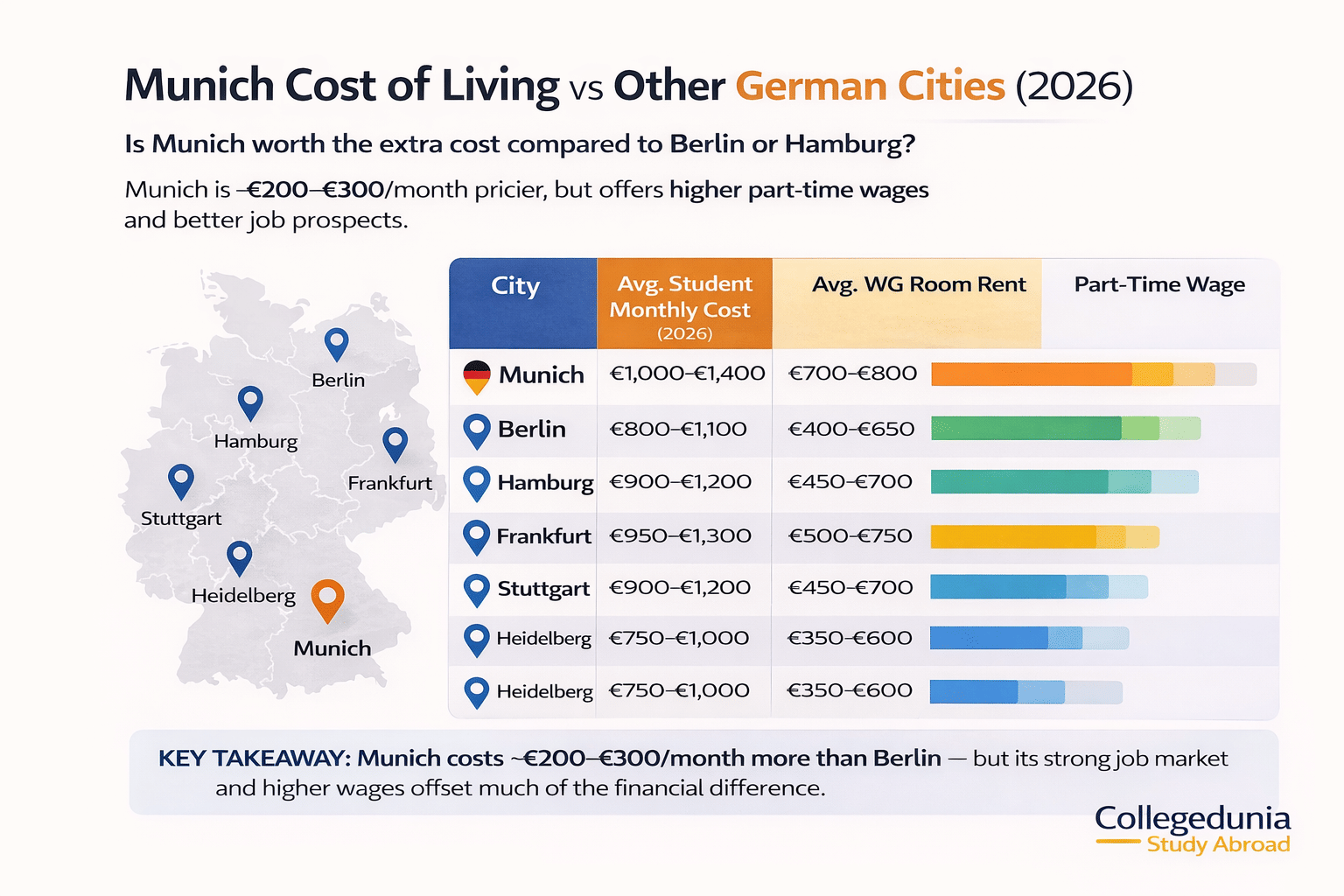
One of the most common questions from Indian students: "Is Munich worth the extra cost compared to Berlin or Hamburg?"
The honest answer: Munich is significantly more expensive — but it also offers higher part-time wages, stronger industry connections (BMW, Siemens, MAN, Allianz are all headquartered here), and arguably the best quality of life of any German city.
| City | Avg. Student Monthly Cost (2026) | Avg. WG Room Rent | Part-Time Wage |
|---|---|---|---|
| Munich | €1,000–€1,400 | €700–€800 | €12–€15/hr |
| Berlin | €800–€1,100 | €400–€650 | €12–€14/hr |
| Hamburg | €900–€1,200 | €450–€700 | €12–€14/hr |
| Frankfurt | €950–€1,300 | €500–€750 | €12–€15/hr |
| Stuttgart | €900–€1,200 | €450–€700 | €12–€14/hr |
| Heidelberg | €750–€1,000 | €350–€600 | €12–€13/hr |
Key takeaway: Munich costs approximately €200–€300/month more than Berlin — but the stronger job market and higher wages mean the net financial difference is smaller than it appears. For students at TUM or LMU specifically, Munich's industry connections translate into better internship and job placement outcomes.
For a complete comparison visit the Best Cities in Germany guide.
How to Save Money in Munich 2026?
Munich is expensive — but manageable with the right strategies. Here's what Indian students actually do to keep costs down:
- Apply for student dormitory housing immediately after admission. Studierendenwerk München dormitories cost €280–€400/month — less than half the market rate. Demand is extremely high; apply the day you receive your admission letter.
- Get the Bavarian Discount Ticket (€43/month). This covers unlimited travel across all of Germany — not just Munich. It's €20/month cheaper than the standard Deutschlandticket (€63 from January 2026) and one of the best deals in Europe for students enrolled at Bavarian universities.
- Shop at Aldi, Lidl, and Netto. These discount supermarkets are 20–30% cheaper than Rewe or Edeka. For Indian groceries, the Indian stores near Hauptbahnhof and in Schwabing are your best bet.
- Eat at the Mensa. A hot meal at LMU or TUM's student canteen costs €3–€5 with your student ID. Eating there 5 days a week saves €100–€200/month compared to restaurants.
- Use Too Good To Go. This app lets you buy surplus food from bakeries, supermarkets, and restaurants at 50–70% off. Many Indian students in Munich swear by it.
- Work part-time as a student assistant (HiWi). HiWi positions at TUM and LMU pay €12–€15/hour and are directly relevant to your field of study. They're also excellent for your CV and networking.
- Consider suburbs like Garching or Neuperlach. Rent is €100–€200/month cheaper than central Munich, and both are well-connected by U-Bahn. TUM's main science campus is actually in Garching, where average WG rooms cost ~€660/month vs €800 in central Munich.
- Buy second-hand everything. eBay Kleinanzeigen, Vinted, and campus flea markets at the start of each semester are goldmines for affordable furniture, textbooks, and clothing.
Part-Time Work in Munich for Indian Students 2026
Indian students on a German student visa can work up to 120 full days or 240 half days per year without needing additional work permits. Munich's strong economy means part-time jobs are relatively easy to find.
| Job Type | Hourly Wage (EUR) | Monthly Earnings (20 hrs/week) | Monthly Earnings (INR) |
|---|---|---|---|
| Student assistant (HiWi) at TUM/LMU | €12–€15 | €960–€1,200 | ₹84,800–₹1,06,000 |
| Café / restaurant / retail | €12–€14 | €960–€1,120 | ₹84,800–₹98,900 |
| Tutoring (private) | €15–€25 | €1,200–€2,000 | ₹1,06,000–₹1,76,700 |
| Internship (paid) | €800–€1,200/month | Fixed monthly | ₹70,700–₹1,06,000 |
| Delivery / logistics | €12–€13 | €960–€1,040 | ₹84,800–₹91,900 |
Key platforms for finding part-time jobs in Munich in 2026: Jobmensa, Zenjob, Stepstone, Indeed Germany, and your university's career portal (TUM CareerCenter, LMU Career Service).
Important: Earnings above €538/month may affect your public health insurance status. Consult your health insurer (TK, AOK, Barmer) before taking on significant paid work.
Read more about Part-Time Jobs in Germany for International Students
Frequently Asked Questions
Ques. What is the average cost of living in Munich in 2026 for a student?
Ans. The average cost of living in Munich for a student in 2026 is approximately €863–€2,939 per month (₹76,300–₹2,60,000), depending on accommodation type and lifestyle. Most Indian students manage on €1,000–€1,400/month (₹88,000–₹1,24,000) by sharing a flat, cooking at home, and using the Bavarian Discount Ticket (€43/month).
Ques. How much is the Deutschlandticket for students in Munich in 2026?
Ans. Students enrolled at Bavarian universities (TUM, LMU, HM, etc.) can get the Bavarian Discount Ticket for €43/month in 2026 — covering unlimited travel on all local and regional public transport across Germany. The standard Deutschlandticket increased to €63/month from January 2026 (up from €58 in 2025). Purchase via MVG (M-Login) or DB Navigator.
Ques. Is health insurance mandatory for students in Munich?
Ans. Yes. Health insurance is mandatory for all students in Germany and is required for university enrolment. Public health insurance costs approximately €110/month (₹9,720) for students under 30 in 2026. Popular providers for international students include TK (Techniker Krankenkasse), AOK Bayern, and Barmer.
Ques. What is a good monthly budget for an Indian student in Munich in 2026?
Ans. A realistic monthly budget for an Indian student in Munich in 2026 is €1,000–€1,300 (₹88,000–₹1,15,000). This assumes a shared WG room at €500–€700, cooking at home, using the Bavarian Discount Ticket (€43/month), and eating at the Mensa on weekdays. With part-time work of 15–20 hours/week, most students can cover 30–50% of their monthly expenses.
Ques. What are the cheapest areas to live in Munich for students in 2026?
Ans. The most affordable areas for students in Munich in 2026 include Garching (home to TUM's science campus, average WG ~€660/month), Neuperlach, Freising, and Pasing — all well-connected to central Munich by U-Bahn or S-Bahn. Rent in these suburbs is typically €100–€200/month cheaper than central Munich neighbourhoods like Maxvorstadt or Schwabing.
Ques. How much does a student visa blocked account require for Munich in 2026?
Ans. The German student visa requires a blocked account (Sperrkonto) with a minimum of €11,904 per year (€992/month) as of 2026, as set by the German Foreign Office. However, given Munich's higher costs, most advisors recommend having €13,000–€15,000 in your blocked account to comfortably cover Munich's living expenses.













Comments