



Education Journalist | Study Abroad Strategy Lead | Updated On - Apr 18, 2026
Studying in Germany costs Rs. 10L to Rs. 16L per year at a public university. That figure covers tuition (zero at most public universities), accommodation, food, health insurance, transport and personal expenses. For a 2-year Master's degree, the total investment is typically Rs. 20L to Rs. 32L — making Germany one of the most affordable study destinations in the world for Indian students.
The number that confuses most students is the blocked account requirement of €11,904 (Rs. 13.0L). This is not an additional cost. It is your own money deposited upfront and returned to you at €992 per month after you arrive in Germany. It is a visa requirement, not a fee.
This guide breaks down every cost Indian students face when studying in Germany in 2026: tuition fees by university type, monthly living expenses by city, one-time pre-departure costs, health insurance, part-time work earnings and the total budget you need to plan for.
All conversions use the the rate of 1 EUR = Rs. 109.25
Read More: MS in Germany: Top Universities, Eligibility and Job Outcomes 2026

- Tuition Fees in Germany 2026: Public vs Private Universities
- Monthly Living Expenses in Germany for Indian Students
- City-Wise Cost of Living: Cheapest to Most Expensive
- One-Time Pre-Departure Costs for Indian Students
- Health Insurance Cost in Germany 2026
- Blocked Account: What It Is and How Much You Need
- Total Budget: How Much Does It Cost to Study in Germany
- Part-Time Work: How Much Can You Earn as a Student
- Scholarships That Reduce Your Cost
- FAQs
Tuition Fees in Germany 2026: Public vs Private Universities
Most public universities in Germany charge zero tuition for international students. You pay only a semester administrative fee of €100 to €400 per semester. This is the single biggest financial advantage Germany offers over the US, UK and Australia.
The exception is the state of Baden-Wurttemberg, which introduced tuition fees of €1,500 per semester for non-EU international students. Universities in this state include Heidelberg University, University of Stuttgart, KIT and University of Freiburg. If you are applying to a university in Baden-Wurttemberg, factor in an additional €3,000 per year (Rs. 3.3L) in tuition.
| University Type | Annual Tuition (EUR) | Annual Tuition (INR) | Examples |
|---|---|---|---|
| Public university (most states) | €0 (semester fee €200 to €800 per year) | Rs. 0 (semester fee Rs. 21,900 to Rs. 87,400) | TU Berlin, RWTH Aachen, TU Dresden, LMU Munich |
| Public university (Baden-Wurttemberg) | €3,000 per year (€1,500 per semester) | Rs. 3.3L per year | Heidelberg, KIT, University of Stuttgart, University of Freiburg |
| TU Munich (non-EU Master's) | €8,000 to €12,000 per year | Rs. 8.7L to Rs. 13.1L per year | TU Munich selected Master's programs only |
| Private university | €10,000 to €20,000 per year | Rs. 10.9L to Rs. 21.9L per year | IU International University, EU Business School, Jacobs University |
The practical advice for Indian students: target public universities outside Baden-Wurttemberg to keep tuition at zero. RWTH Aachen, TU Berlin, TU Dresden, University of Bonn and Freie Universitat Berlin are all free for international students and rank among Germany's best universities.
Also Check: Tuition Free Universities in Germany for Indian Students
Monthly Living Expenses in Germany for Indian Students
The average monthly living cost for an international student in Germany is €850 to €1,200 (Rs. 92,900 to Rs. 1.31L). This covers accommodation, food, health insurance, transport and personal expenses. The biggest variable is rent, which differs significantly by city.
The German government sets the blocked account at €992 per month as the official minimum living cost estimate. In practice, students in expensive cities like Munich spend €1,200 to €1,500 per month while students in smaller cities like Leipzig or Magdeburg manage on €700 to €900 per month.
| Expense Category | Monthly Cost (EUR) | Monthly Cost (INR) | Notes |
|---|---|---|---|
| Accommodation (shared flat) | €300 to €700 | Rs. 32,800 to Rs. 76,500 | Student dormitory is cheaper at €200 to €350. Private flat is €600 to €900 |
| Food and groceries | €180 to €250 | Rs. 19,700 to Rs. 27,300 | Cooking at home. Eating out adds €100 to €150 per month |
| Health insurance | €125 to €148 | Rs. 13,700 to Rs. 16,200 | Public insurance (TK, AOK, Barmer). Mandatory for all students |
| Semester ticket (transport) | €63 to €100 | Rs. 6,900 to Rs. 10,900 | Covers all public transport in the city. Paid per semester |
| Mobile and internet | €20 to €40 | Rs. 2,200 to Rs. 4,400 | SIM-only plans. Home internet included in many shared flats |
| Books and study materials | €20 to €50 | Rs. 2,200 to Rs. 5,500 | Most materials available free at university library |
| Personal and miscellaneous | €80 to €150 | Rs. 8,700 to Rs. 16,400 | Clothing, toiletries, entertainment, gym |
| Total Monthly Cost | €788 to €1,438 | Rs. 86,100 to Rs. 1.57L | Lower end: small city, dormitory. Upper end: Munich, private flat |
One important saving: the semester ticket included in your semester fee covers unlimited public transport within your city and often the surrounding region. Most students in Germany do not need a car or pay for individual transport tickets throughout their studies.
City-Wise Cost of Living: Cheapest to Most Expensive
Where you study in Germany matters as much as what you study when it comes to your monthly budget. Munich is the most expensive city. Leipzig, Magdeburg and Halle are among the cheapest. The difference between the two extremes is €400 to €600 per month.
| City | Monthly Cost (EUR) | Monthly Cost (INR) | Average Rent (Shared Flat) | Top Universities |
|---|---|---|---|---|
| Leipzig | €700 to €900 | Rs. 76,500 to Rs. 98,300 | €250 to €400 | University of Leipzig |
| Magdeburg | €700 to €950 | Rs. 76,500 to Rs. 1.04L | €250 to €380 | Otto von Guericke University |
| Dresden | €800 to €1,000 | Rs. 87,400 to Rs. 1.09L | €300 to €450 | TU Dresden |
| Dortmund | €800 to €1,050 | Rs. 87,400 to Rs. 1.15L | €300 to €480 | TU Dortmund |
| Berlin | €950 to €1,300 | Rs. 1.04L to Rs. 1.42L | €450 to €700 | TU Berlin, Freie Universitat, Humboldt |
| Hamburg | €1,000 to €1,350 | Rs. 1.09L to Rs. 1.48L | €500 to €750 | University of Hamburg, TUHH |
| Frankfurt | €1,050 to €1,400 | Rs. 1.15L to Rs. 1.53L | €550 to €800 | Goethe University Frankfurt |
| Munich | €1,200 to €1,600 | Rs. 1.31L to Rs. 1.75L | €700 to €900 | TU Munich, LMU Munich |
For Indian students on a tight budget, Dresden, Dortmund and Leipzig offer the best combination of affordable living and strong university rankings. TU Dresden and TU Dortmund are both well-regarded for engineering and CS programs and cost Rs. 30,000 to Rs. 40,000 less per month than Munich or Frankfurt.
Read More: Most Affordable Cities in Germany for International Students 2026
One-Time Pre-Departure Costs for Indian Students
Before you even board the flight, Indian students face a set of one-time costs that most budget guides ignore. These include the APS certificate, student visa fee, blocked account setup fee and flight. Together they add Rs. 1.5L to Rs. 2.5L to your total cost.
| Cost Item | Amount (EUR/INR) | Notes |
|---|---|---|
| APS Certificate | Rs. 18,000 (approx. €165) | Mandatory for all Indian students. Processing: 3 to 6 weeks. Apply early |
| German student visa fee | €75 (Rs. 8,200) | Paid at German consulate in India. Non-refundable |
| Blocked account setup fee | €49 to €89 (Rs. 5,400 to Rs. 9,700) | One-time fee charged by Fintiba or Expatrio. The €11,904 deposit itself is your own money |
| Uni-Assist application fee | €75 first university + €30 each additional (Rs. 8,200 onwards) | Only if applying through Uni-Assist. Not all universities require it |
| IELTS or TOEFL exam fee | Rs. 17,000 to Rs. 22,000 | Required for English-taught programs. One attempt. Retake adds cost |
| Flight to Germany | Rs. 35,000 to Rs. 65,000 | One-way economy. Varies by season and booking time |
| Initial settlement costs | €200 to €400 (Rs. 21,900 to Rs. 43,700) | Bedding, kitchen items, SIM card, local transport card on arrival |
| Total One-Time Pre-Departure | Rs. 1.15L to Rs. 2.0L | Excluding the blocked account deposit which is returned monthly |
The APS certificate is the most time-sensitive item on this list. It takes 3 to 6 weeks to process and must be obtained before you can complete your student visa application. Apply for it as soon as you receive your university admission letter. Do not wait until after you have confirmed your enrollment.
Read More: German Student Visa 2026: Requirements, Fee and Application Process
Health Insurance Cost in Germany 2026
Health insurance is mandatory for all students in Germany. You cannot enroll at a German university or obtain a student visa without proof of valid health insurance. The standard monthly cost for public health insurance in 2026 is €125 to €148 per month (Rs. 13,700 to Rs. 16,200).
Students under 30 are eligible for the discounted student rate at public insurers. The main public insurers used by international students are TK (Techniker Krankenkasse), AOK, Barmer and DAK. All offer comparable coverage. TK is the most popular among international students due to its English-language support.
| Insurance Type | Monthly Cost (EUR) | Monthly Cost (INR) | Who It Is For |
|---|---|---|---|
| Public insurance (student rate, under 30) | €125 to €148 | Rs. 13,700 to Rs. 16,200 | All students under 30. Recommended for most Indian students |
| Public insurance (standard rate, 30 to 34) | €148 to €180 | Rs. 16,200 to Rs. 19,700 | Students aged 30 to 34. Higher rate applies |
| Private travel insurance (short-term) | €33 to €55 | Rs. 3,600 to Rs. 6,000 | Only valid for visa application. Not accepted for university enrollment |
A critical point: private travel insurance is not accepted for university enrollment. You must have public statutory health insurance (gesetzliche Krankenversicherung) or an approved private insurance plan. Many Indian students make the mistake of purchasing cheap travel insurance for the visa and then discovering it is not accepted at the university registration office (Immatrikulationsamt).
Blocked Account: What It Is and How Much You Need
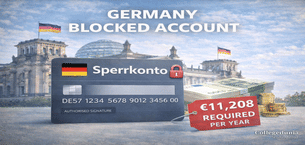
The blocked account (Sperrkonto) is a German bank account that holds a fixed deposit of €11,904 as proof of financial resources for your student visa. It is not a fee. The money is yours and is released to you at €992 per month after you arrive in Germany.
The €11,904 figure is set by the German Federal Foreign Office and has been in effect since Winter Semester 2024/25. It continues through 2026 and is expected to remain at this level through 2027 according to BAMF (Federal Office for Migration and Refugees).
| Blocked Account Detail | Amount | INR Equivalent |
|---|---|---|
| Total deposit required | €11,904 | Rs. 13.0L |
| Monthly release after arrival | €992 per month | Rs. 1.08L per month |
| One-time setup fee (Fintiba) | €89 | Rs. 9,700 |
| One-time setup fee (Expatrio) | €49 to €69 | Rs. 5,400 to Rs. 7,500 |
| Processing time | 1 to 3 business days | Apply at least 4 weeks before visa appointment |
The two most widely used blocked account providers for Indian students are Fintiba and Expatrio. Both are recognised by German authorities worldwide. The only cost you pay is the one-time setup fee. The €11,904 deposit earns minimal interest and is fully returned to you over 12 months after arrival.
Total Budget: How Much Does It Cost to Study in Germany
The total cost of studying in Germany for Indian students depends on three variables: the type of university (public or private), the city and your lifestyle. Here is the complete annual and 2-year budget across three realistic scenarios.
| Cost Component | Budget Scenario (Small City, Public Uni) | Mid-Range Scenario (Berlin/Hamburg, Public Uni) | Premium Scenario (Munich, TUM) |
|---|---|---|---|
| Annual tuition | €0 | €0 | €8,000 to €12,000 |
| Semester fee (annual) | €300 to €500 | €400 to €700 | €300 to €500 |
| Accommodation (annual) | €3,000 to €4,800 | €5,400 to €8,400 | €8,400 to €10,800 |
| Food (annual) | €2,160 to €2,640 | €2,400 to €3,000 | €2,640 to €3,600 |
| Health insurance (annual) | €1,500 to €1,776 | €1,500 to €1,776 | €1,500 to €1,776 |
| Miscellaneous (annual) | €1,200 to €1,800 | €1,500 to €2,400 | €2,000 to €3,000 |
| Total Annual Cost (EUR) | €8,160 to €11,516 | €11,200 to €16,276 | €22,840 to €31,676 |
| Total Annual Cost (INR) | Rs. 8.9L to Rs. 12.6L | Rs. 12.2L to Rs. 17.8L | Rs. 25.0L to Rs. 34.6L |
| Total 2-Year Cost (INR) | Rs. 17.8L to Rs. 25.2L | Rs. 24.4L to Rs. 35.6L | Rs. 50.0L to Rs. 69.2L |
The pre-departure one-time costs of Rs. 1.15L to Rs. 2.0L should be added to the above figures. The blocked account deposit of Rs. 13.0L is excluded as it is returned to you monthly and is not a net cost.
Also Check: Cost of MS in Germany in Indian Rupees: Full Breakdown 2026
Part-Time Work: How Much Can You Earn as a Student
International students in Germany can work up to 140 full days (or 280 half-days) per year as of 2026, increased from the previous limit of 120 days. At the minimum wage of €13.90 per hour, a student working 20 hours per week can earn approximately €1,112 per month before tax.
Germany raised its statutory minimum wage to €13.90 per hour on January 1, 2026. This is one of the highest minimum wages in Europe and significantly higher than what Indian students can earn part-time in India. Working student (Werkstudent) roles in tech, engineering and business typically pay €14 to €18 per hour.
| Work Scenario | Hours Per Week | Monthly Earnings (EUR) | Monthly Earnings (INR) | Annual Earnings (EUR) |
|---|---|---|---|---|
| Minimum wage, 10 hours/week | 10 | €556 | Rs. 60,800 | €6,672 |
| Minimum wage, 20 hours/week | 20 | €1,112 | Rs. 1.22L | €13,344 |
| Werkstudent role, €16/hour, 15 hours/week | 15 | €960 | Rs. 1.05L | €11,520 |
| Werkstudent role, €18/hour, 20 hours/week | 20 | €1,440 | Rs. 1.57L | €17,280 |
A student working 20 hours per week at minimum wage earns approximately €1,112 per month (Rs. 1.22L). This covers most or all of the monthly living expenses in a smaller city. In practice, many Indian students in Germany cover 50% to 80% of their living costs through part-time work, significantly reducing the financial burden on their families.
The first €603 per month is tax-free under the minijob exemption. Earnings above this threshold are subject to income tax and social security contributions.
Scholarships That Reduce Your Cost
Several scholarships are available specifically for Indian students studying in Germany. The most significant is the DAAD scholarship which covers living expenses, health insurance and travel costs. Applying for scholarships before arrival can reduce your annual cost by €6,000 to €15,000.
| Scholarship | Amount | Who Can Apply | Deadline |
|---|---|---|---|
| DAAD Scholarship (Masters) | €934/month + travel allowance + health insurance | Indian students applying for Master's or research programs in Germany | October to November for following year intake |
| Deutschlandstipendium | €300/month (€3,600/year) | Students enrolled at a German university. Merit-based. Apply after admission | Varies by university. Usually April to June |
| Erasmus+ Scholarship | €800 to €1,200/month | Students from partner universities with an Erasmus agreement with a German university | Varies by home university |
| Heinrich Boll Foundation | €934/month + €300 book allowance | Students with strong academic record and social or political engagement | March 1 and September 1 each year |
| Friedrich Ebert Foundation | €934/month + additional allowances | Students with academic excellence and commitment to social democracy values | Rolling applications |
| Konrad Adenauer Foundation | €934/month + book and travel allowances | Students with strong academic record and civic engagement | January 15 and July 15 each year |
The DAAD scholarship is the most valuable for Indian students. It covers your monthly living expenses at €934, health insurance and a travel allowance to and from Germany. If you receive a DAAD scholarship, your net out-of-pocket cost for a 2-year Master's in Germany drops to Rs. 5L to Rs. 10L in pre-departure and incidental costs only.
Apply for DAAD at least 12 to 14 months before your intended start date. The application requires a detailed research or study proposal, two academic references and proof of language proficiency.
Read More: Scholarships in Germany for Indian Students: DAAD, Erasmus and More
FAQs
Ques. How much does it cost to study in Germany for Indian students in 2026?
Ans. The total annual cost of studying in Germany at a public university ranges from Rs. 8.9L to Rs. 17.8L depending on the city. This includes zero tuition (at most public universities), accommodation, food, health insurance and transport. For a 2-year Master's degree, the total investment is Rs. 17.8L to Rs. 35.6L. Students at TU Munich or universities in Baden-Wurttemberg pay additional tuition of €3,000 to €12,000 per year, bringing the total higher.
Ques. Is studying in Germany really free for Indian students?
Ans. Tuition is free at most public universities in Germany. You pay only a semester administrative fee of €100 to €400 per semester (Rs. 10,900 to Rs. 43,700 per year). The exceptions are universities in Baden-Wurttemberg (€1,500 per semester for non-EU students) and TU Munich (€4,000 to €6,000 per semester for non-EU Master's students). Living expenses of €850 to €1,200 per month are your primary cost.
Ques. What is the blocked account requirement for Germany in 2026?
Ans. The blocked account requirement for a German student visa in 2026 is €11,904 (Rs. 13.0L). This amount is deposited upfront with a provider like Fintiba or Expatrio and released to you at €992 per month after you arrive in Germany. It is your own money and is not a fee. The one-time setup fee charged by the provider is €49 to €89 (Rs. 5,400 to Rs. 9,700).
Ques. How much is health insurance for students in Germany in 2026?
Ans. Public health insurance for students under 30 costs €125 to €148 per month (Rs. 13,700 to Rs. 16,200) in 2026. The main providers are TK, AOK, Barmer and DAK. Health insurance is mandatory for all students in Germany. You cannot enroll at a university or obtain a student visa without proof of valid health insurance. Private travel insurance is not accepted for university enrollment.
Ques. Which is the cheapest city to study in Germany for Indian students?
Ans. Leipzig, Magdeburg and Dresden are among the cheapest cities for Indian students in Germany. Monthly living costs in these cities range from €700 to €1,000 (Rs. 76,500 to Rs. 1.09L) compared to €1,200 to €1,600 (Rs. 1.31L to Rs. 1.75L) in Munich. TU Dresden and University of Leipzig are well-ranked universities in these affordable cities. Berlin offers a middle ground at €950 to €1,300 per month with access to three major universities.
Ques. Can Indian students work part-time in Germany to cover living costs?
Ans. Yes. International students in Germany can work up to 140 full days (or 280 half-days) per year as of 2026. At the minimum wage of €13.90 per hour, a student working 20 hours per week earns approximately €1,112 per month (Rs. 1.22L). This covers most or all monthly living expenses in smaller cities. Working student (Werkstudent) roles in tech and engineering pay €14 to €18 per hour. The first €603 per month is tax-free under the minijob exemption.
Ques. What are the one-time costs Indian students must pay before going to Germany?
Ans. The main one-time pre-departure costs are: APS certificate (Rs. 18,000), German student visa fee (€75 or Rs. 8,200), blocked account setup fee (€49 to €89 or Rs. 5,400 to Rs. 9,700), Uni-Assist application fee if applicable (€75 onwards), IELTS or TOEFL exam fee (Rs. 17,000 to Rs. 22,000) and flight to Germany (Rs. 35,000 to Rs. 65,000). Total one-time pre-departure costs are approximately Rs. 1.15L to Rs. 2.0L excluding the blocked account deposit.
Ques. Does the DAAD scholarship cover all costs of studying in Germany?
Ans. The DAAD scholarship covers monthly living expenses at €934, health insurance and a travel allowance to and from Germany. It does not cover tuition (which is already free at most public universities). If you receive a DAAD scholarship, your net out-of-pocket cost for a 2-year Master's drops to approximately Rs. 5L to Rs. 10L in pre-departure and incidental costs. Applications must be submitted 12 to 14 months before your intended start date.

















Comments