



Education Journalist | Study Abroad Strategy Lead | Updated On - Mar 26, 2026
Indian students planning to study in Germany from Winter Semester 2026/27 must now score a minimum of 70% overall in their Class XII certificate to qualify for an APS evaluation — the mandatory credential check required before applying to any German university. The rule, announced by APS India on February 23, 2026 and implemented in the anabin database from March 15, 2026, applies to all Indian school boards — CBSE, ICSE, and all state boards — with no exceptions. Students who scored below 70% in Class 12 are no longer eligible for either of the two undergraduate admission pathways to Germany, effectively closing the door on their Germany plans unless they pursue an alternative route.
With approximately 50,000 Indian students currently enrolled in German universities — a figure that more than doubled from 20,000 in 2019 — and tens of thousands more in the application pipeline for Winter 2026/27, the impact of this change is immediate and wide-reaching.

What APS Changed — and What It Means?
The APS (Akademische Prüfstelle), operated by the German Embassy in New Delhi, is the mandatory academic evaluation body for Indian students applying to German universities. Every Indian student — regardless of which German university they are applying to — must obtain an APS certificate before their application can be processed. Without it, no German university will consider an Indian applicant.
Until March 15, 2026, there was no universal minimum Class XII percentage required to apply for APS evaluation. Students with lower scores could still qualify for the Studienkolleg pathway (a one-year preparatory course before university entry) or the direct subject-restricted admission pathway (for students who had already completed one year of a Bachelor's degree in India).
From Winter Semester 2026/27 onwards, both pathways now require a minimum of 70% in Class XII:
| Pathway | Previous Requirement | New Requirement (from Winter 2026/27) |
|---|---|---|
| Studienkolleg (Class XII + APS) | No minimum % specified | Minimum 70% in Class XII |
| Direct subject-restricted admission (Class XII + APS + 1 year Bachelor's) | No minimum % specified | Minimum 70% in Class XII + 1 successful academic year |
APS India confirmed in its February 23 announcement: "The minimum threshold refers to 70% of the maximum achievable overall marks in the Class XII certificate, regardless of the examining board."
Who Is Affected — and Who Is Not?
Directly affected:
- Indian students currently in Class 12 (2025–26 batch) who score below 70% in their board exams — they will not be eligible for APS evaluation for Winter 2026/27 or any subsequent semester
- Students who have already completed Class 12 with below 70% and had not yet submitted their APS application before March 15, 2026
- Students planning to apply for Winter 2026/27 who are waiting for their Class 12 results — APS has clarified it cannot hold applications open while applicants wait for future exam results (March 16, 2026 update)
Not affected:
- Students who submitted their APS application before March 15, 2026 — their applications are assessed under the old criteria
- Students who already hold a valid APS certificate — existing certificates remain valid regardless of Class 12 percentage
- Students already enrolled at a Studienkolleg or German university — the rule does not affect ongoing studies or admission decisions already made
- Students applying for Master's programmes — the 70% rule applies to undergraduate admission pathways only; Master's eligibility criteria are set by individual universities
Important: APS has also clarified that completing one academic year of a Bachelor's degree does not automatically guarantee direct admission — all conditions must be met, including the 70% Class 12 threshold.
Why does this affect more Indian Students Than It Appears?
The 70% threshold sounds straightforward — but the scale of students it excludes is significant.
In CBSE Class 12 (2025), the overall pass percentage was 88.39% — but the average marks among students who passed was approximately 57.87%. Only around 1.15 lakh students out of 16.3 lakh who appeared scored 90% or above. The 70% bar sits well above the average CBSE score.
The impact is sharper for state board students. Over 92% of Indian higher secondary students appear for state and regional board exams — not CBSE or ICSE — and average scores on many state boards are lower than CBSE. A student from a state board who scored 65% — a respectable result in many states — is now ineligible for APS evaluation entirely.
This is a structural shift: Germany, which had positioned itself as an accessible, affordable alternative to the US and UK for Indian students across score ranges, has now introduced a hard eligibility floor that mirrors the entry standards of more selective destinations.
The Winter 2026/27 Timeline — What Students Must Do Now
For students who do meet the 70% threshold, the Winter 2026/27 application window is open and moving fast:
Step 1 — Verify your eligibility. Use the APS Eligibility Quiz at aps-india.de to confirm which pathway applies to your academic profile. The 70% threshold is calculated as overall marks across all subjects in Class XII — not subject-specific scores.
Step 2 — Apply for APS evaluation immediately. APS processing currently takes 3–4 weeks. Applications require hard-copy documents sent by courier to APS India's New Delhi office. Do not wait for Class 12 results if you are a current student — APS cannot hold applications open for pending results.
Step 3 — Open a blocked account. The German student visa requires a blocked account showing €11,904 (approximately ₹12.97 lakh at current rates of €1 = ₹108.90 as of March 25, 2026, per the European Central Bank). This takes 2–3 days to set up but requires the funds to be available upfront.
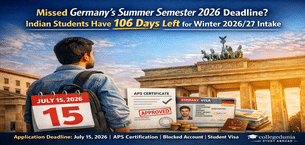
Step 4 — Apply to universities via Uni-Assist. The general Uni-Assist deadline for Winter Semester 2026/27 is July 15, 2026. Some universities have earlier deadlines — check individual university portals.
Step 5 — Apply for German student visa. German consulates in India are currently processing student visas in as little as 6 days — a significant improvement from the 6–10 week timelines of previous years.
If You Score Below 70% — What Are Your Options?
The APS rule closes the direct undergraduate pathway to Germany for students below 70%. But it does not close Germany entirely:
Option 1 — Pursue a Bachelor's degree in India first, then apply for a Master's in Germany. Master's eligibility is set by individual German universities, not APS, and many accept Indian Bachelor's graduates with strong academic records regardless of Class 12 scores. This remains the most common pathway for Indian students in Germany — the majority of the ~50,000 Indian students currently enrolled are postgraduate students.
Option 2 — Consider other European destinations with lower entry barriers. The Netherlands, France, and Ireland all offer English-taught undergraduate programmes with different eligibility criteria. Spain's EduBridge programme also offers a fast-track pathway for students in the US pipeline.
Option 3 — Improve your academic record. Students currently in a Bachelor's programme in India who score below 70% in Class 12 but complete one strong academic year may still qualify for the direct subject-restricted pathway — provided they also meet the 70% Class 12 threshold. The Class 12 score cannot be improved, but the combination of a strong Bachelor's year alongside a borderline Class 12 score does not help if the 70% floor is not met.
The Bigger Picture
Germany's APS rule change is part of a broader tightening of eligibility standards for Indian students at a destination that had, until recently, been one of the most accessible in Europe. The blocked account requirement (€11,904/year), the mandatory APS certificate, the November 2022 UGC accreditation requirement for private university graduates, and now the 70% Class 12 floor represent a cumulative raising of the bar. Germany remains one of the most affordable and post-study-work-friendly destinations for Indian students — with 140 working days per year permitted and a minimum wage of €13.90/hour — but it is no longer the open-access alternative it once appeared to be for students across the academic spectrum.
For the Class of 2026 sitting their board exams right now, the message is clear: 70% is the new minimum for Germany.

















Comments